











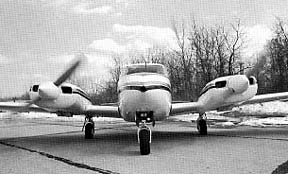
If youre in the market for a light twin, the Twin Comanche has two appealing traits: A top speed of 170 knots or more and two fans that operate almost as cheaply as one. But the real charmer is its price-$88,000 to $122,000 average equipped price, according to the Aircraft Bluebook.
you’ll pay that much for many good, used singles-ones with less impressive performance and lacking the security (at least in cruise) of an extra engine. And, while the oldest Comanche is 35 years old, you’ll have the benefit of a fairly decent parts supply, reliable IO-320 engines and an owners association filled with satisfied members.
History
Between 1963 and 1972, Piper produced some 2,150 Twin Comanches in Lock Haven, Pa. The sporty aircraft (collectively known as the PA-30 and PA-39 series) was intended to fill the gap created by the demise of the slower, bulbous-nosed PA-23 Apache. That, in turn, evolved into the PA-23-250 Aztec.
The first Twin Comanche shared two things with its slower predecessor: It had four seats and the same basic 160-HP Lycoming O-320 powerplant (though the PA-30s engine was designated the IO-320-B1A, due to the introduction of fuel injection). Also, cabin room was virtually identical in the two birds. There, the similarities ended. The Twin Comanche had a rakish appearance. Poised slightly aft on its tricycle landing gear, it had tiger shark engine nacelles and optional tip tanks. So, with 170-knot top speeds and miserly fuel requirements, the Twin Comanche was popular among private owners, flight schools and charter operations.
In 1966, Piper introduced a new Twin Comanche-the PA-30B. Although it has two extra seats, it really isn’t a six-place airplane for anything but the shortest flights. The extra seats eat up the baggage space, and the useful load of 1,390 pounds allows just a half load of fuel if all six seats are filled and a reasonably equipped instrument panel is installed.
Comfort
For the benefit of the back seat passengers, incidentally, the PA-30B provided extra windows on each side. One owner, who has flown the earlier model PA-30 for 15 years, said he didnt care for the lack of rearmost windows: The cabin is relatively small, but not cramped for average builds. Visibility outside, especially for the rear-seat passengers, is really less than desirable. On the plus side, he added: Even with the original windscreen and side glass, the aircraft is so very quiet. Similarly, the owner of a 1967 Comanche says passenger comfort is either cozy or claustrophobic, depending on your point of view.
Turbocharging
To gain better performance at higher altitudes, the PA-30B came with optional factory-installed Rajay turbochargers. Speeds of up to 190 knots can be attained at altitude by turbocharging. Two ADs worth noting were issued on the Rajays. Making the Rajay turbocharger kick in is straightforward: Each turbo wastegate is controlled directly by a mechanical cockpit knob. Although such a system is cheap and reliable, it imposes yet another cockpit duty on the pilot thanks to the lack of an automatic wastegate.
In 1969 Piper brought out the PA-30C, which provided minor improvements. Among these was a new instrument panel with an offset radio rack and flight instrumentation in the classic pattern, rather than Pipers traditional hodgepodge arrangement. The last of the Twin Comanche breed was the PA-39 series. Distinguished by its counter-rotating engines, this series was regarded by many as the finest of the Twin Comanche line.
Performance
Twin Comanche owners report cruise speeds of 160 to 210 knots on 13 to 16 gallons per hour. Generally, those with higher cruise speeds have installed various speed-boosting mods. Granted, many singles turn in similar performance figures. But they do this without the benefits of multiengine flight, though these benefits may seem remote when it comes time to overhaul both engines. Still, in terms of cruise speeds and fuel burns, one owner gloated that with a 120-gallon capacity (thanks to tip tanks) trips nearly half way across the country are no problem. Who could ask for more on a nickel budget? he said. The first Twin Comanche, incidentally, carried 90 gallons in four wing tanks. Like the single-engine Comanche, it had four seats, with baggage space behind the rear seats.
Handling
Overall, handling of the Twin Comanche is good, with one exception: takeoffs and landings. Here, the aircraft has an impish nature. Its difficult to obtain consistent, graceful landings (the airplane often prefers to pay off with a jolt). And on takeoff, the Twin Comanche wants to fly before Vmc.
Developing techniques to deal with these peccadilloes is a frequent topic among pilots. For takeoff, avoiding the potential hazards of getting off the ground when still below Vmc is accomplished in two ways. Keep the aircraft in ground effect until it attains Vmc, or try to keep it on the runway, though in gusty winds this can lead to some nervous skittering and wheelbarrowing. (One solution for this problem is a surprisingly simple mod: a smaller nose tire.) As for landings, the Twin Comanche likes to float. Then, when the wing sheds its lift-all at once-the gear goes kerplunk! Generally, these rude arrivals are laid on the tapered, laminar-flow wing and stubby rear main gear. To make matters even worse, the stabilator seems to have limited authority during a flare.
Hangar talk
Among Twin Comanche pilots, advice abounds on how to make consistently soft landings. There are numerous suggestions as to approach and threshold speeds and flare height. One favorite technique is raising the flaps during the flare to dump the lift and pin the airplane to the runway.
Most agree the Comanches landings are safe, despite an occasional thumper. Ive operated in high crosswinds and gusts to 50 with as much confidence as any aircraft Ive flown, relates one owner, who says greasers in a Twin Comanche are for him as elusive as getting a Cleared as filed from New York ARTCC. (For some owners, though, the Twin Comanches tricky landing and takeoff characteristics have been cured with various mods and their own, special techniques.)
Safety
Thanks to its popularity as a multiengine trainer, the Twin Comanches stylish image was dragged into a tailspin-literally. On a number of training flights, Vmc demonstrations got out of hand (thanks, in part, to Vmc speeds being optimistically marked 10 knots lower than today). So, Vmc and stall speed could be nearly the same. This proved to be an unnerving and fatal experience for a number of unsuspecting students and their instructors. (Many of those instructors probably were on the green side themselves.)
The stall/spin syndrome was exacerbated by the FAAs recommendation that Vmc maneuvers be performed at as low an altitude as possible-to get full asymmetric power. This, coupled with a wing that tended to lose lift all at once in a stall, helps explain the series of training accidents. One lucky Twin Comanche owner who did his ME training in the bird recalls one interesting Vmc demonstration in Hawaii at 7,000 feet. Before reaching Vmc, the Comanche stalled. Next, it flipped into a spin, turning through one-and-a-half turns about as fast as a Citabria snap-rolls. Recalls the then-novice ME pilot: I vividly remember looking at the horizon rolling, and then seeing sugarcane fields directly below. Fortunately, recovery was normal.
That Twin Comanche, incidentally, lacked stall strips, which Piper soon offered to customers at no charge. The strips afforded more predictable stall performance by ensuring initial flow separations over the inboard wing sections. On the PA-39-the Twin Comanche variant with counter-rotating props-the stall strips became standard equipment. Counter-rotating props provided an additional safety benefit by eliminating the critical engine. The FAA also issued an AD requiring that Vmc be increased to a more realistic 72 knots. Another feature on late-model Twin Comanches is interconnected aileron and rudder controls. Owners say it keeps the ball almost dead center without rudder coordination, during reasonable rates of turn and bank angles.
Despite these improvements, the Twin Comanches fatal accident rate still wasnt the greatest. With a 2.1 fatal accident rate per 100,000 hours and 10.7 total rate, it ranked near the bottom among 17 popular twins, according to an NTSB comparison of light-twin accident rates several years ago. Since then, the Twin Comanche appears to have largely redeemed itself. We examined fatal Twin Comanche accidents over a six-year period and didnt find a single instance of a training-induced fatal stall/spin. There was just one fatal crash that might be considered stall/spin related. The pilot lost power on an engine during a descent with the fuel selector on an empty tank. And he lost control when the airspeed went below Vmc, and he failed to feather the prop.
Overall, there were just eight fatal accidents, mostly related to what seemed pilot error-hitting rising terrain, breaking up in a storm, fuel exhaustion, stalling when overloaded. Not a single fatal accident was caused by an engine sputtering from mechanical causes, a testament to the reliability of the IO-320 engines. Incidentally, a malfunctioning autopilot was blamed for one other fatal accident.
Fuel AD
A fatal stall/spin accident of particular note occurred in 1980, over which Piper settled a lawsuit to the tune of $925,000. While the aircraft was on final approach, another airplane pulled onto the runway, and the Twin Comanche pilot tried to go around. The aircraft, seen climbing with gear and flaps extended, lost power in the left engine, and rolled over and spun to the ground. Investigators found that the left wing fuel drain had stuck open, allowing all of the fuel to drain out in flight.
Pipers General Counsel Jan K. VonFlatern told The Aviation Consumer that investigators also discovered that there was contamination in the fuel drain and filters, and that the aircraft operator had complied neither with an AD requiring a check of the drains every 50 hours, nor with Piper instructions to clean the filter every 90 days.
The AD (83-10-01) requires this repetitive action to prevent water accumulation and corrosion of the fuel strainer filter. Critics say the fuel strainer bowl design is flawed in that it allows contaminants to collect at the bottom and ultimately corrode the screen and the spring that returns the valve to a closed condition. Also, they say that when the draining tubes discolor with age, it can be difficult for the pilot to tell if fluid is moving through them and has, indeed stopped. With the Twin Comanche, the fuel draining ritual is conducted from inside the cockpit so there is no need to crawl under the aircraft in the conventional manner. But of course then there is no exact way to tell if any water or sediment have been drained, thus warning the pilot of a possible water accumulation problem.
Nevertheless, our inspection of Service Difficulty Reports showed only two instances related to this situation. In one the filter retaining washers were found badly corroded and broken, which allowed the filter to unseat and trash to bypass and contaminate the screen in the fuel control, causing erratic engine operation. Water was found in the sump, even though the stainless housing had been installed in accordance with Piper Service Letter 589. The retainer washers, according to the report, had corroded from water trapped in the sump. The report filer recommended the washers be made of stainless to prevent corrosion.
Another issue that raised Pipers hackles in connection with the aforementioned legal settlement was The Aviation Consumers observation that during discovery proceedings, it was revealed that Piper certification test flights had shown the Twin Comanche had dangerous stall/spin characteristics and that much unflattering documentation for the testing was destroyed by Piper. Among the destroyed material were reports critical of the aircrafts stall characteristics, single-engine stall, spin characteristics, spin recovery technique and determination of minimum control speed.
Later, of course, the Vmc was raised, stall strips added and counter-rotating propellers incorporated. These, presumably, have contributed to the decline in Vmc-related accidents.
Embarrassing
Though the Twin Comanche isn’t eating pilots for breakfast anymore, based on our survey of the FAAs accident database, it is embarrassing a lot of them-as victims of various types of gear-up landings or gear collapse incidents. We counted 42 inadvertent gear-ups, gear collapses or gear retractions. Thirty-eight percent were purely the fault of the pilot-he just forgot to lower the gear. The rest involved mechanical or electrical problems, most of which the pilots could have remedied in the cockpit, had they only noticed the gear down light wasnt on and then followed proper emergency extension procedures.
Indeed, Twin Comanche gurus insist the twins gear system is virtually foolproof-provided its properly maintained and operated. One classic scenario for a gear-up landing starts with a popped circuit breaker: It pops when the gear fails to completely retract, due to worn out bungee cords (which aid in gear retraction) and, to a lesser extent, a poorly lubricated gear mechanism. This is the scenario offered by Twin Comanche guru Bill Turley, of Aircraft Engineering, Bartow, Fla.
Unfortunately, some pilots don’t take note of the gear unsafe or gear down light: Theyve been tolerating an intermittent light and assume the wheels are down just because the landing gear handle is down. (Periodically, a Twin Comanches gear lights can become intermittent, because the gear light wires are located in the wheel wells. Theyre folded every time the gear is cycled, so they eventually short out.) Turley relates that basic ignorance of the gear system is another problem he often encounters. Seventy-five percent of the owners cant tell you how the gear works. Ill ask them, Is it hydraulic or mechanical, and they say, Hell, I don’t know! Sometimes, Turley says, an owner who landed a Twin Comanche gear-up tells him that he pumped the gear handle for dear life-but couldnt get the gear down. Its no wonder: The Twin Comanches emergency gear extension system isn’t hydraulic.
Gear AD
There’s one repetitive gear Airworthiness Directive worth noting. The landing gear bungee cords are supposed to be replaced every 500 hours in service, or every three years, whichever comes first. (Turley, though, recommends that this be done every year.) The bungee cord AD was promulgated in 1977 to prevent the landing gear from collapsing after a manual extension. It also helps in retracting the landing gear, and when its too worn out to do this, the gear circuit breaker is likely to pop.
Service difficulties
There are a number of matters Twin Comanche owners need to watch. Since it was first produced, the airplane has been dogged by structural ADs. And, while there was only one accident since 1984 caused by a structural failure (an upset in bad weather) this situation bears watching, now that the fleet is aging. Reports from some owners indicate that aileron spars are especially fragile components, with cracks developing under the hinge brackets.
An AD was supposed to have solved this problem. It required the installation of new hinge brackets, after which 100-hour inspections can be discontinued. However, reports from the field indicate that it would be prudent to continue examining this area. In our check of SDRs, drooping ailerons discovered during a pre-flight provided evidence of broken hinge brackets.
Along these lines, one A&P who owns a Twin Comanche relates: My greatest frustration is the maintenance requirement (AD) that mandates the removal and inspection of the ailerons every 100 hours, unless heat-treated double-thick counterweight nose ribs are installed. The heat-treated version came out only weeks after I had completely disassembled the ailerons, installed the new spars and had put on the then-new, non-heat-treated double-thick nose ribs. Installation of these nose ribs requires complete disassembly of the aileron. So far, Ive gone with the removal and inspection options rather than the rebuilt option.
The Twin Comanches engines have a fine record, which is reflected in the fatal and non-fatal accident statistics. Also, the reliability record is underscored by the small number of ADs covering the engines, including the turbocharged version.
Although our check of SDRs didnt reveal any problems with fuel pumps, there have been problems in past years. In some airplanes in the past fuel pumps suffered repeated failures. Most occurred within a few hours of overhaul. One aircraft fire we know about was blamed on a leaking fuel pump.
Along similar lines, weve heard some complaints about fuel pumps in general. Often, the problem has been blamed on pumps that have been sitting on the shelves of parts shops for extensive periods. Because shelf life depends to a large extent on storage techniques, wed strongly advise buyers to check the dates on new and rebuilt parts.
In turbo twins in particular, corrosion in engine mounts has caused problems in years past. Trouble spots are the areas where exhaust heat tends to weaken the metal. On the normally aspirated models, heat fatigue problems on the engine mounts also have been reported. Other problems to watch: Magneto coils can develop resin leaks due to overheating; heat exchangers can become burned or cracked (this was the subject of an AD requiring an expensive 500-hour overhaul); and the spinners on the Twin Comanches Hartzell props can develop problems.
Price comparison
How does the Twin Comanche stack up against five comparable light twins in terms of price? According to the Aircraft Blue Book Price Digest, the PA-39 CR on average is selling for just a hair less than the newer Seminole and Duchess. Despite its comparative antiquity, the old Twin Comanche has the edge in speed and efficiency. Naturally, the ancient Apache is the dog of the group (or maybe bargain?-but not in our book). The nice-flying, great-looking Cougar is the real bargain of the bunch, if you can find one.
Should you decide to buy a used Twin Comanche, you can probably consider the purchase a decent investment. In todays hot used airplane market, the Twin Comanche has been appreciating in price since 1988.
Comanche society
Twin Comanche owners agree that the International Comanche Society is an extremely worthwhile organization. Members receive a monthly magazine, Comanche Flyer, and technical help from the society. Currently, the society has more than 3,900 members. For prospective Twin Comanche buyers, the society offers a book describing what to look for in a used Twin Comanche. They can be reached at (308) 352-4275.
Owner Comments
The single most annoying characteristic-a byproduct of its low form drag-is its reluctance to slow down. Neither the gear nor the flaps have high enough extension speeds to be of much help for descents. Braving the wrath of ATC and asking for descents while still 40 miles out is the only option that has worked for me. Speed builds quickly in a descent, and getting properly configured for an ILS approach-without shock cooling the engines-requires patience. Once set up, however, the airplane is stable. With the gear down, you have just the right descent profile when flying inbound for the final approach fix.
The cost of ownership is as reasonable as for any twin. The Lycoming IO-320s have proven to be close to bulletproof. The gear system, fuel select, gyros and the Janitrol heater require TLC. The secret to owning a Twin Comanche is to find a good mechanic and to court him shamelessly. Anyone contemplating a Twin Comanche would be we’ll served to join the International Comanche Society. Besides arranging social gatherings, they provide a monthly newsletter, a digest of maintenance and operational tips, group insurance possibilities and leads on parts and maintenance facilities. I believe the Twin Comanche is probably one of the best airplanes ever built by Piper. It offers fast, economical transportation, without major vices. It may steal your heart, but not your pocketbook.
-M.C. Maxwell
Potomac, Md.
I have owned my 1966 PA-30B for exactly two years and two months. Since then, I have looked for a better, and more practical replacement. I have never found one. Its part of the tragedy of general aviation that state-of-the-art stopped dead a quarter century ago. I decided to work out the negatives of the airplane, and invest money in modifications from Robertson/STOL whose mods were acquired by Sierra Industries, Uvalde, Texas, (512) 278-4381, and Knots 2U.-Ed. Today, my airplane flies at 8,000 feet, trues out at 193 mph and burns 14.5 GPH on a four hour trip. I know of no airplane built since the Twin Comanche with which to draw a comparison. If the price of gas goes up again, these little twins will rise in value-you can bet your license!
-Eric Moser
Naples. Fla.
I have no problems with the Twin Comanches landing characteristics, provided the speed is correct. Have it five mph either way and it will let you know. My technique is to slowly run the elevator trim back (I have electric trim) on final as I bleed the speed back to 90 mph at the threshold. Then, I apply a steady back pressure, which gives me a smooth arrival.
The Comanche Society is a great support organization and its technical director, Maurice Taylor, would do credit to any manufacturers product support organization. They are better than some of the major aircraft manufacturers I know. Bob Weber of Webco, Newton, Kans., is a good source for parts at sensible prices.
Sam Price of Lock Haven, Pa. Air Parts also is a good guy to deal with. He has a big supply of new and used parts. Also, he has an STC for a nosewheel shimmy damper that I have fitted to my airplane.
-Brian A. Dunlop
Waynesboro, Pa.
My 1964 PA-30 Twin Comanche is marvelous for a 26-year-old aircraft. The numbers are simple-160 knots at 10,000 feet and 16 GPH (which equals 10 nautical miles per gallon on two engines).
Loading is flexible and rather remarkable. It can carry pilot, full fuel (120 gallons) and oil plus 416 pounds, for a thousand nautical miles. Or it will carry 776 pounds plus pilot, oil and 60 gallons of fuel for 500 miles. Most amazing of all, its impossible to load it out of CG when nominal passenger, fuel, baggage area and gross weight values are observed.
In the last 1,400 hours, the major aircraft repair items have been the replacement of the aileron spars, removal of the fin for AD modification and bracket inspection, replacement of both electronic fuel pumps, landing gear motors, gear retracting bungees, and both vacuum pumps.
There has also been minor maintenance to the DG and horizon bearing, and some Southwind heater problems. The nacelle nose cowls began to crack about 10 years ago and required some fiberglass repair.
Engine repairs have amounted to replacement of one magneto impulse coupling spring, resealing of one prop governor, reworking of alternate door hinges, replacement of some spark plugs, generator bearings, brushes and re-wrapping of both starter field coils. The most serious basic engine problem has been a cracked compression ring in one cylinder. My airplane is hangared at all times, except when on trips. I have no doubt that this decreases maintenance problems tremendously.
-Harold Berk
Blissfield, Mich.
Also With This Article
Click here to view charts for Resale Values, Payload Compared and Prices Compared.
Click here to view the Piper Twin Comanche features guide.