











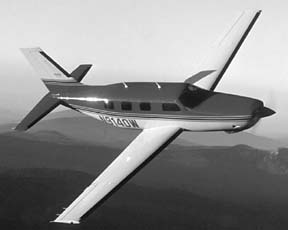
The Malibu and its near-clone, the Mirage, are airplanes that fall into a class all their own. The PA-46 is pressurized and has an air-stair door, so in terms of accommodation it ranks up with cabin-class twins. In terms of performance, too, it rivals many airplanes having the benefit of an extra engine. However, its single engine offers (at least theoretically) lower operating and maintenance costs.
There are some airplanes configured similarly to the PA-46, but theyre in a different league, with turboprop engines; specifically, the SOCATA TBM 700. The closest piston-powered counterpart is the Cessna P210, which is of similar size but which has a more conventional cabin layout. In fact, its nearest competitor may be the Piper Meridian, a look-alike turboprop introduced in 2000.
Designed to provide comfortable, efficient high-altitude transport, the PA-46 has come quite close to its design goals. However, there have been numerous system problems, and there are certain operational limitations that must be followed.
History
The PA-46 is the last all-new airframe design to have come out of Piper. Previously, the company proved itself a master at grandfathering its type certificates, producing seemingly endless variants of the same airframe (take, for example, the PA-28).
The prototype was rolled out at Vero Beach in late 1982, amidst much fanfare. It was certainly different: six-place, pressurized, with a high-aspect-ratio wing having a span of 43 feet, an air-stair door and a twin-turbo, twin-intercooler Continental TSIO-520BE rated at 310 HP. Clearly, it was an airplane built with a specific mission in mind, and it appeared that the designers had hit the nail on the head. Initial base price was $275,000, which typically swelled to more than $330,000 for average equipment.
Public acceptance was immediate, and orders started flowing in even before the airplane was certificated. This was no small accomplishment, given that the general aviation slump had already begun and sales overall were plummeting.
In order to attract buyers (the Cessna P210 cost significantly less), Piper worked hard to keep costs down. Also, in order to live up to ambitious performance goals, the airplane was kept as light as possible. Both of these drives caused problems later on.
The first Malibus were delivered in 1984. The production airplane was significantly heavier than intended, but that was offset by a boost in takeoff weight. Still, the useful load turned out to be about 80 pounds less than forecast.
From the outset, buyers asked Piper to hang a Lycoming on the airplane instead of the Continental. Initially, this was due in part to field experience with Continentals: the Lycomings had more of a reputation for reliability. Ultimately, the owners proved correct: the Continental package turned into such a nightmare (piston pins and crankshaft bearings in particular) that in 1987 the company asked the owners to ground their airplanes voluntarily until the problems could be worked out.
Despite fixes to the Continental, in 1989 Piper punted and introduced the Mirage (actually Malibu Mirage). It was essentially the same airplane with a Lycoming TIO-540-AE2A of 350 HP instead of the Continental. The new engine weighed more (113 pounds), but the maximum takeoff weight also was boosted by 200 pounds. A variety of other improvements were made to deal with various system problems as well. The Mirage is the same airplane still in production today.
Prices started at the aforementioned $275,000. With the introduction of the Mirage, base had climbed to $349,000, with an average-equipped airplane going for over $400,000.
Early problems
The Malibus powerplant got a lot of attention early on when it came to difficulties, but there were many other systems that werent holding up well. The complex nose gear, which rotates 90 degrees to fit into its bay, proved delicate. The hydraulic system (which ran the gear) kept failing and was sensitive to dirt and maintenance. The door was so lightweight that extended use could distort it. Interior materials were flimsy and prone to wear.
With regard to the engine, the installation and operational procedures were a bit different than pilots were used to. For one thing, the oil sump was very small compared to other comparable installations: only eight quarts, and the oil pump seemed to have a tendency to cavitate. Also, Continental required pilots to lean the engine to 50 degrees lean of peak for all operations below 80 percent power, which is the maximum recommended cruise setting. That goes against what most pilots have been taught, and a fair number ignore the instructions and run rich of peak. Many engine problems have been traced to improper leaning, and pilots often cruise at 65 percent, which evidently reduces the potential for failure. As one owner noted, You can blow through cylinders in under 500 hours without absolute vigilant operation.
The battles between the owners, Piper and Teledyne Continental got very ugly, very quickly, and led to the aforementioned voluntary grounding. Piper tried to sweeten the deal for owners by offering first-class air fare for any trips they needed to make while their airplanes were laid up.
The irony is that the fixes applied to the Continental made it as good as the Lycoming installation. Both are sensitive to proper operating technique (the pilot we quoted above said the same thing about Lycomings).
With the introduction of the Mirage, some of the systems were addressed. The hydraulic system was improved, the engine cooling system was redesigned, the cabin door was beefed up, the seats were strengthened and the flaps were changed from hydraulic to electric operation. The Mirage also sprouted some goodies: a dual-bus electrical system, internal windshield deice, standard dual alternators and vacuum pumps, and an auxiliary heater for the cabin.
Ongoing trouble
Unfortunately, substituting one engine for another didnt solve all the problems. Maintenance continues to be a big headache for PA-46 owners. Alternators, vacuum pumps and in particular the exhaust system are all items mentioned by our survey respondents. One owner shared the maintenance expenses for the first two years of ownership for his Mirage, which came to we’ll over $46,000; that figure included substantial amounts for neglected maintenance from an earlier owner, but also included three replacements of the same alternator.
The exhaust system is a weak point, writes one owner. About once a year I have an exhaust leak from failure of a coupling or connection. Only once was this serious – when the exhaust cross-over parted and fried the mixture control, heater control, and GEM wires. Because the mixture control was frozen (rather welded), I could not start the engine for the next flight! I suppose that could be called a failsafe design.
Cylinder problems and valve train events have been fairly even between the two engines. Turbocharger problems on the Malibu Mirage seem more frequent while the notorious main bearing shift has been the most frequent cause of grief to 310P operators.
Lycoming operators also have experienced higher-than-normal oil consumption that has proven difficult to remedy. One theory labels valve guides as the probable culprit.
Magneto problems are common to both. Moisture contamination of the pressurized mags is fairly common. Preventive inspection and maintenance is strongly recommended.
The nose gear is tender, and the hydraulic system continues to pose problems. These respond we’ll to preventive action (as we’ll as proper pilot technique).
The alternate air door has been the subject of an AD calling for reinforcement, and weve heard some tales of woe; failure of the door can cause damage to the turbos.
Both Malibus have had problems with loose rivets in the wing and tail as we’ll as cracked ribs (and, on some Mirages, missing rivets in the fuselage). A number of problems with primary flight control cables have occurred, as well. The latter reinforces the value of knowledgeable technicians. Many of the problems were not apparent using normal inspection methods.
One Malibu owner says that although his -350P and -310P had different problems, the frequency of discrepancies and maintenance costs are very close, and quite high as well.
Accommodations
On the ramp, the PA-46 looks large and impressive, but inside it can be a tight fit. Those who are taller and/or wider than average may find themselves cramped; up front, pilots with long legs may even find the control yoke movement restricted somewhat.
Overall, the arrangement is superb, with the Mirage somewhat better than the original Malibu. Rear-seat passengers complain about too little heat (which prompted Piper to add an auxiliary heater to the Mirage), but the air conditioning/pressurization system is very good.
As far as noise and vibration are concerned, the Continental is a bit tamer than the Lycoming.
Handling and performance
A delight to fly, high or low, says one owner. The handling characteristics of the PA-46 are indeed excellent, though they lack the rocklike (or trucklike, depending on your point of view) stability that many instrument pilots prefer. Light and responsive is the word of the day, with pitch the lightest and roll the heaviest.
The PA-46s long, high-aspect-ratio wing is good for climb and high altitude performance, but along with it comes a very low maneuvering speed – in the mid 130s KIAS at gross, reducing as the airplane gets lighter. Normal cruise indicated airspeed at altitude is not much higher, but during descents its quite easy to get far above maneuvering speed. This, along with the autopilot and weather factors, was looked at in a string of in-flight breakups that led to a great deal of consternation (and an AD-mandated restriction on operations) some years ago, but no positive link was uncovered and the airplane was given a clean bill of health. Still, as with any aircraft flown as the PA-46 is meant to be, large amounts of recurrent training are recommended (and practiced by owners).
To slow the airplane down, the gear has a very high extension speed – 170 KIAS on the Malibu, 165 on the Mirage – and can be left out almost to Vne. The first notch of flaps can be extended at the same time as the gear. Pilots report that the gear makes a very effective speed brake. Retraction speed is much lower, at 130 (Malibu) and 126 (Mirage) KIAS.
Many PA-46 incidents occur during landing. There isn’t anything particularly difficult about it, but the long wing encourages floating, and when lightly loaded the CG is forward. These two characteristics sometimes lead to abuse of the relatively delicate nose gear.
The wingspan of the PA-46 is a very long 43 feet. Compare this to the Cessna P210, an airplane with a gross weight nearly identical to the original Malibu: 36 feet, 9 inches. That means special challenges when taxiing.
Malibu performance puts it in a category with a lot of twin-engine airplanes. Initial acceleration is sluggish, but it can get in and out of 3,000-foot strips at sea level with ease. With full fuel, both versions are three-person-plus-some-odds-and-ends airplanes. This is competitive with many similarly equipped twins.
Malibu pilots tell of getting cruise speeds of 208 knots TAS at FL220 at 67 percent power and 212 knots true at FL250 at 75 percent. One said he climbed at 900 fpm to FL180. Mirage pilots talk about getting 220 knots true at FL230-250 at 75percent burning 18.8 GPH. Pilots of both models talk about making 1,100-NM trips with IFR reserves.
The -350Ps Lycoming engine is larger, and the accessory layout is different, so the forward baggage bay in the Mirage is a bit smaller than that of the Malibu. The inclusion of an access panel in the firewall is a good tradeoff, since it makes it much easier to get at the backside of the powerplant.
The -310P, with its lower fuel consumption – as much as four to five GPH when flown by the book – has nearly 25 percent better range and is only (roughly) five percent slower. One owner cited this as the reason he chose the Malibu over the Mirage. Going fast and high makes no sense if you need to land after two and a half hours to get fuel, he wrote. The fuel efficiency can be traded for endurance (as much as five and a half hours plus IFR reserves) or payload, which is a bit short on the Malibu.
For those who cant imagine staying aloft for five-plus hours, it bears noting that there is a relief tube; however, failure to clean the underside of the airplane after use can lead to corrosion of the belly skins.
Rate of climb for both models is good enough to make regular operation at or above 20,000 feet practical, ATC willing. The range of speed-from landing configuration stall to maximum-is very wide.
Baggage space is generous as most high-performance singles go. Two baggage bays, one just aft of the engine compartment and the other behind the rear seats, makes loading within limits easier. Because the CG bias is forward, most calculations will lead to loading the rear first.
Mods, organization
The PA-46 benefits from a type-specific owners organization, the Malibu/Mirage Owners and Pilots Association, which comes highly recommended. They can be reached at (402) 753-0765, email mmopa@uswest.net. The club also has a Website, at http://www.mmopa.org.
An STC is available for retrofit of the 350 HP Continental Voyager 550 engine onto the original Malibu. This popular mod has been performed on about 70 aircraft. Malibu owners can also upgrade to an interior like that of a Mirage.
One modification of note is the Van Kesterin fuel tank mod, which essentially places new filler ports farther outboard on the wing for additional capacity, raising usable fuel from 120 to 140 gallons.
Also available are spoilers from Spoilers, Inc. of Gig Harbor, Washington. However, the gear makes such an effective brake that most owners use it instead. The spoilers do have a wider operating envelope, however.
Owner Comments
I flew a Malibu for about two years, and for the past nine years a Mirage I purchased new. I hope the following notes will help any prospective owner.
The cockpit is tight. I am six feet tall, and there is just enough room with the seat fully aft and bottomed when I wear my David Clarks. However, my friend who is 6 feet 4 inches tall cannot safely fit in the cockpit. We tried, but he could not keep his knees out of the travel of the control yoke. If you are tall, try out the cockpit for size before you purchase.
Closing the cabin door with the locking bolts extended chips paint and cuts the pressure gasket. It is hard to prevent mechanics or well-meaning passengers from helping by closing the doors with the bolts extended. This is a poor design, as the door mechanisms do not have detents in the open position. Partially rotating the handle, or folding the steps before closing the lower door guarantees unsightly gashes, and possibly an expensive replacement of a door gasket.
Accessory redundancy is relative in the aircraft. There are two vacuum pumps, but two are needed to power the boots. With one out, the plane is not certified for icing conditions. As the vacuum pump only runs the attitude indicator (and possible the optional copilot attitude indicator and DG) it is more likely there will be loss of the attitude indicator than the vacuum power source. I have lost the attitude indicator twice since 1990, and a vacuum pump once. The vacuum pump sheared its axle, which is common, at about 1,000 hours. Besides the cost of a new pump, $1200, it was a non-event.
The Achilles heel is the pilots attitude indicator which is the primary attitude source for the autopilot (as we’ll as the pilot). So the loss of this instrument can be very insidious, especially if the autopilot is on. As the attitude indicator gradually tilts, the autopilot follows the instrument, and the pilot many not sense the problem. Because the autopilot is still satisfying the attitude indicator, all looks normal. This proceeds until an extreme attitude is reached, the gyro completely tumbles, and the autopilot disconnects. The plane is then significantly out of trim, because the autopilot attempted to correct to the false attitude indications. Partial panel in a grossly mistrimmed aircraft is no fun at best, and fatal at worst.
There are twin alternators. However, my experience is one or the other will fail about every few hundred hours. I have replaced nine alternators in the past nine years. The plane can be flown we’ll on one, unless (as has happened twice) the alternator shorts out the entire electrical system. If an alternator fails, it is important to entirely isolate it from the remainder of the electric system. This means pulling two circuit breakers. Turning off the alternator switch is not enough!
On one alternator has insufficient current to run all of the deicing equipment – prop heat, windshield heat, pitot heat, and stall warning heat. Load shedding may also be required even without anti-icing equipment on in EFIS equipped planes. The two alternators are often needed to supply a typical load of more than 60 amps in we’ll equipped planes.
Writers continue to consider the twin turbochargers redundant. However, failure of either results in loss of cabin pressure and engine manifold pressure will fall to ambient. There are no safety valves to isolate a failed turbo, and all boost is lost.
Commonly associated with turbocharger failure is the loss of oil, and then engine seizure. There is a large flow of oil through the turbochargers for lubrication and cooling. A restriction of oil flow (the oil lines can collapse) will inevitably lead to turbocharger failure. And a turbocharger failure will typically allow oil to be pumped overboard. The results are not good for the engine, and it is time to land.
The pressurization system is excellent. The 5.5 psi differential is more than many turbine twin aircraft, and allows a physiologically comfortable 8,000 foot cabin at Flight Level 250, the operational ceiling. The plane will climb higher, as this is not a true ceiling, but it is not legal.
There are few aircraft of its size and cost that will complete the 900 nm IFR mission from New Jersey to Florida (Vero Beach) on 100+ gallons of fuel in at up to Flight level 250 in a comfortable pressurized cabin. Average times are 5:15 southbound and 4:20 northbound, with good fuel reserves. The Van Kesterin extra fuel, and the willingness to reduce power on the trip south make most trips non-stop. Even in headwinds the plane does better at a lower power setting. The slower speed is more than offset by not having to make a fuel stop.
Most of Mirages are very we’ll equipped, and are a pleasure to fly with EFIS, moving maps, Stormscopes, radar, and a capable though sometimes unpredictable autopilot.
The Van Kesterin fuel filler mod should be considered by any Malibu or Mirage owner. There is almost no down side to having the additional fillers added to the wings. They allow – because of the dihedral – another 20 gallons of fuel to be legally added. Thus, full fuel increases from 120 to 140 gallons. The wings can be overfilled with another eight or so gallons. However, if the NACA vents are old, fuel will leak from them. Their replacement Ive been told is $1,800 each, as there is no provision to replace the rubber valve only. So don’t stick pencils up the vents.
The beauty of the Van Kesterin mod is if you don’t want extra fuel, you don’t fill the tanks. The weight of the two additional fillers is negligible.
Unfortunately you cannot expect the range in the Pilots Handbook, unless you lean to peak. However, most operators agree this is not wise, as in the flight levels will result in turbine inlet temperatures of 1650-1750 degrees F. I run the engine about a TIT of 1550. At 29 inches manifold and 2500 RPM, the engine consumes about 22 GPH. This compares with the book value of 19 GPH. when leaned to peak, and results in 66% or normal cruise power.
The mixture control is very sensitive, and due to some slack in the cable leaning is difficult. Piper should have opted for a vernier control.
A typical useful load is less than 1400 pounds. Subtract 760 pounds for full fuel (120 gallons), and there is about 640 pounds for passengers and luggage. When I subtract my weight and 40 pounds for Jeppesens and other equipment, I can only carry another 400 pounds. Like most six place aircraft it is usually impractical to fill all seats, unless for local sightseeing.
The plane is a delight to fly high or low. The controls remain crisp in the flight levels. The only control problem is on high speed roll out after landing. The plane can be difficult to keep straight with the nose gear. It wants to dart right or left.
Many owners have installed speed brakes. However, as the landing gear can be extended at 165 knots indicated and can remain extended to 195 knots which is we’ll into the yellow arc and just short of Vne at 198 knots. It is a most effective speed brake. The plane must be slowed to 126 knots to retract the gear, but I have not found this a problem, and do not miss having the brakes.
Ice is seen earliest on leading edges of wings, but you need to lean forward to see it.
In precipitation or visible moisture near or below freeing, the alternate air door must be open. If it is not ahead of icing, it my freeze in the closed position, and the engine may be choked by icing of the air intake filter. However, if you leave the alternate air open, FOD can enter the engine. Therefore, it should be closed for takeoffs and landings. When the ceiling is low, and the air very cold, this results in a compromise.
The Mirage Lycoming engine uses about a quart of oil per hour, and I have been unable to improve upon that.
The static ports are not heated. While it is rare, they can ice up on takeoff, as water from a wet runway is thrown up against a fuselage that is colder than freezing. The solution is to go to alternate air.
The plane needs a new battery about every year.
The oxygen canisters are Mickey-mouse. The tubes and activation strings are always tangled. Luckily, the pressurization works so well, chances are you will never need to use this system. When you see an oxygen warning light, it probably means a little micro switches at one of the three canisters has been become misaligned. Of course it could mean one of the canisters has been activated.
Fuel boost pumps are activated by the right and left fuel selector. However, at altitude as the cabin expands enough so the pump may be shut off. The red light is annoying, but the pump usually decides to start again after a while, and I have never had vapor locks or other problems when this has happened. Its just annoying, and is always okay when tested on the ground.
Attending professional training school for this aircraft is a must, and not just because you will be required to do so by your insurance company. There is a lot to know about the aircraft and its systems. While most flights are fun, there are just enough things that can go wrong so you cannot afford to be complacent.
The Mirage is the only plane in its class. It appears expensive, but Piper has little competition. If you want something better than a pressurized aircraft that does 200 knots and is certified for known icing, the next step up costs more than two million dollars. That is why many owners like me have purchased more than one PA-46.
-Ian Blair Fries, M.D.
Mantoloking, N.J.
I have owned a 1984 Malibu since 1987. It has been a pleasure to own and fly this wonderful airplane. Im able to fly long distances above most weather with the confidence to make approaches in low IFR. It is not unusual to fly from Denver (parents home) to Raleigh-Durham non-stop direct in 4-6 hours landing with 2 hours of fuel reserve. I am presently on my second engine since 1989 and have had few mechanical problems.
I rarely have had to take the airplane in between annuals, with one major exception. I had an autopilot malfunction that was intermittent and took 2 years to troubleshoot. The problem was uncommanded pitch up and pitch down even on an ILS coupled approach near DH. After a very scary episode near the ground, I grounded the airplane and refused to fly it. SkyTech Inc. of Baltimore pitched in and immensely helped solve the problem. Eventually we found there were two different problems including one in the computer and an intermittent altimeter-encoding problem. After six weeks of very extensive work, the plane has flown flawlessly since.
I have been servicing my plane at SkyTech since 1989 and even though they seem more expensive up front, I think they know potential problems and know how to solve these problems more efficiently than taking it to a less knowledgeable service center. When I had a problem, they pitched in and helped me out by dedicating their service people and involving their King radio consultant. In the end, they gave me a break on the invoice.
The major disadvantage to this airplane involves the maintenance cost, but we need to compare this to other cabin class pressurized airplanes (probably twins). In comparison, the Malibu isn’t as expensive as most equivalent aircraft. My annuals run between $4,000-$10,000 per year, and this usual includes some upgrades.
I usually run my engine at 65 percent power and burn 14.3 GPH with a true airspeed of 208 knots. The engine (continental TSIO -520BE) runs smooth and cool since the gear door louvers have been installed. Maintenance includes careful evaluation of the intake manifold for any leaks since this will cause the engine to run rough in the lean configuration. Also, the magnetos need meticulous care. I have the original Gar-Kenyon hydraulic system and this has never required maintenance.
In conclusion, the Piper Malibu is a wonderful aircraft with great capability that requires a knowledgeable service center for maintenance. Also, the recurrency training programs have significantly improved the safety of this aircraft. I have thought about upgrading, but I cant find any aircraft that gives the utility, speed, comfort, and great looks of the Malibu.
-Douglas Leet
via e-mail
I have never seen any discussion of the real reason I selected the Continental over the Lycoming, and the Malibu in particular. After looking at the practical range for many singles and twins for the 400- to 1100-NM trips that are important to me, I found that nothing even comes close to the Malibu. Going fast and high makes no sense if you need to land after 2-1/2 hours to get fuel.
The beauty of the Continental engine is the tuned induction, which balances the fuel-air mixture so we’ll that it allows lean-of-peak operation. I have discussed this issue with Continental technicians, many pilots and expert Malibu mechanics and I am convinced that lean-of-peak operation with a smooth engine and cool CHTs, monitored on an engine analyzer, is healthy for your engine. Lycomings cant do this, and peak EGT operation. Based on a MMOPA survey, about 75 percent of the Continentals are being operated lean of peak, with the other 25 percent following the old wives tale of rich-of-peak operation. What they may not understand is that peak CHTs occur about 50 degrees rich of peak EGT.
The lean-of-peak operation results in fuel flows that are about 4 to 5 GPH more efficient. That means at 65 percent power, 16 vs. 21 GPH which, with IFR reserves, equates to a 50 percent increase in range from 830 NM to 1200 NM. For a four-hour flight there is a major impact on payload, with 20 gallons less fuel needed.
-Jon McMurtrie
Appleton, Wisc.
Also With This Article
Click here to view charts for Resale Values, Payload Compared and Prices Compared.
Click here to view the Piper Malibu features guide.