











Not long ago, owners of TIS-traffic equipped GTX330 Mode S transponders wondered why they willingly dropped six grand for now-orphaned technology. Once billed it as a grand-slam modern investment in both safety and airborne data products, the FAA is pulling the plug on some of the remote terminal radar sites that transmit TIS-linked traffic data, in favor of the new digital ARS-11 radar.
Despite the pending doom of an orphaned TIS technology, the automated GTX330
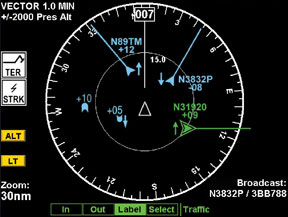
Mode S transponder remains a lively seller and arguably the top choice for an entry-level traffic minder. We hoped for an easy mod to existing GTX330s that would allow them to play in the force-fed world of ADS-B. The GTX330ES (and remote GTX33ES), with 1090 Extended Squitter isn’t exactly that, but is a step in that direction. While its not full-fledged ADS-B, it seems capable enough for starters.
1090ES for Dummies
In the avionics technical world, the transponder squitter is the transmission or reply format that sends data to ATC facilities over the 1090 MHz frequency. Its the backbone of airborne transponder pulse theory. In the ADS-B world, the technical thread revolves around 1090-ES- for 1090 MHz Extended Squitter.
Thats not to be confused with the UAT, or Universal Access Transceiver. With ADS-B comes a handful of abbreviations that substantiate the layers of ADS-B-VDL 4, TIS-B, FIS-B-the list goes on. Its no surprise that many pilots are confused and misinformed on ADS-B.
The 1090-ES and UAT handle the communication with ground stations and/or other aircraft in different ways. The 1090-ES interface is common in commercial aircraft that routinely fly in the flight levels, while the UAT link was designed for lower-altitude, smaller-craft applications.
Extended squitter streams data including aircraft address information, GPS-based position, velocity, and projected heading data to the ADS-B ground stations and other ADS-B equipped aircraft via the 1090 MHz pulse. The key here is automatic broadcast, resulting in better surveillance, rather than old-school interrogation theory (a.k.a. request and reply, which suffers from a slow refresh rate).
The other piece of the ADS-B puzzle is TIS-B (not to be confused with TIS traffic as we know it now). TIS-B means Traffic Information Service Broadcast, and is integral to a so called “free flight” ATC system of NexGen. Garmins GTX330ES model will do TIS-B, but understand that it doesnt receive any ADS-B (including TIS-B) data. It strictly broadcasts aircraft data. It must be interconnected with approved Garmin panel-mounted GPS systems, such as the GNS400W- and 500W-series, GNS480/CNX80, and G1000s with GDU software 9.11 and higher.