











If there’s an airplane that still makes even the slightest economic sense to own and fly, its probably the Cessna 172 Skyhawk. While its a dated airframe that wont turn heads on any ramp, the Skyhawk delivers enough for the money to earn its keep. On the used market, there are oodles of models from many vintages to pick from. Thierry Deutsch Even if you bottom feed and end up with a project airplane that begs for mechanical and cosmetic attention, chances are it will take only a modest sum to bring it to airworthy status. It might not be the fastest, the most aerodynamic or poshest ride around, but one thing is certain: The Skyhawk delivers enormous practical value for its highly affordable purchase price. For this reason, you wont need to look far on any ramp or used airplane ad to find a Skyhawk. During its original 31-year production run, a total of 35,773 Skyhawks were built and we’ll over 20,000 of those are still flying in the U. S. The fact that Cessna could reintroduce and continue to build and sell such a stale design compared to flashy composite speedsters that dominate the market says that buyers resonate with the Skyhawks many strong points. The performance and economics are compelling. The airplane chugs along at an honest 115 knots, burning under 10 gallons per hour while carrying a reasonable load. Just don’t be in too much of a hurry to get where youre going in a Skyhawk -its no speed demon. On the other hand, you’ll need to work at getting hurt in a 172-its an easy airplane to fly by most standards. It has a low fatal accident incidence. Most owners are enthusiastic about their rides. Nearly all boast of an easy-to-afford set of wings that can easily haul family, friends and gear. Many fly hard IFR and brag of a stable instrument platform. As one owner put it, “Its tempting to step up to something with more speed and creature comforts, but my Hawk is predictable in every aspect of ownership.”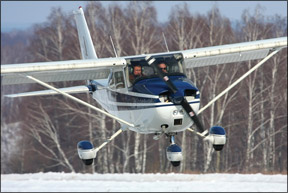
MODEL HISTORY
The 172 legacy started in 1956. Actually, it was the tail-dragging model 170A that planted the 172 seed back in 1949. The 170A was a fabric-wing machine that suffered from poor roll response since its ailerons were carried over from the
smaller Cessna 140.
The 172, of course, is a true tricycle gear airplane, but one that almost didnt come to pass. Met-Co-Aire of Fullerton, California, had already developed a tri-gear modification for the Cessna 170. Pipers Tri-Pacer, the first trike to sell in serious volume, was a hit because it was so much easier to land and taxi, which is what budding pilots wanted. Then as now, mastering a conventional gear airplane without an excursion into runway edge ditches was a difficult challenge.
The tricycle gear promised to simplify training and it was thought to be the design of the future. But not everyone saw it that way, least of all the established movers and shakers at Cessna. Nonetheless, some at Cessna saw that there was a place for a tri-gear airplane and they began to develop one, albeit without the official blessing of the companys management. In fact, if the behind-closed-doors tri-design wasnt stashed away for future use, the 172 as we know it today may never have come to market.
The R&D effort that became the 172 was conducted at an isolated farm strip we’ll away from Cessnas main operations in Wichita. The prototypes first flight occurred in June of 1955 and although it was successful, a list of concerns surfaced:
There were worries about controllability versus stability, ground handling concerns plus fear of propeller strikes, yaw or directional stability and the need to ensure enough elevator power to overcome the high thrust line, which tended to press down the nose gear, aggravating the prop strike problem. Further, the firewall had to carry both the engines weight and the nosegear attach point, which Cessna engineers knew would take a terrific beating at the hands of ham-fisted pilots. Other questions related to centering the nosewheel in flight and figuring out how
to keep the wheel from shimmying like crazy on landing and takeoff. This was uncharted territory for Cessna and non-issues for familiar tail-dragging designs.
MODERN GEAR
The 172 main and nosegear that emerged from these deliberations formed the foundation for what became Cessnas standard fixed-gear design. The gear was made fairly short to lower the center of gravity and minimize porpoising and ground upset. A total of 2318 landings were made during the test program by a number of pilots with widely varied experience.
This resulted in what Cessna marketing mavens called the “Land-O-Matic” gear and Cessnas promotion soon reflected its new devotion to tricycle gear design. The ads touted that you “drive it into the sky and drive it into the ground.” Unfortunately, the latter part of that phrase came to have a double meaning. In truth, getting the landing gear right was not quite so simple and it took some effort to improve the 172s crosswind and ground handling habits.
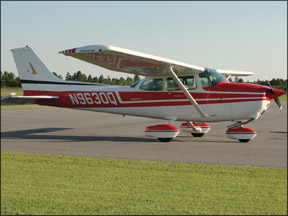
The 172 as introduced in 1956 was powered by a Continental O-300-D six-cylinder engine rated at 145 HP turning a fixed-pitch propeller. Gross weight was 2200 pounds. The original 172s had an upright vertical stabilizer and a straight-backed fuselage which, to the modern eye, looks dated. But that wasnt so in 1956 and Cessna moved 1100 172s that year.
Then began what would become a proliferation of model changes and improvements, including the long hibernation between the mid-1980s and 1997 which brought the technically advanced Skyhawk still in production today. More on that in a bit.
The 172A, with the vertical tail swept, was introduced in 1960. The new empennage was heavier; rudder power was reduced, and directional stability was degraded somewhat all in favor of marketing. The fastback fuselage blended with the swept tail looked cool.
The 172B was developed for the 1961 model year. The landing gear was shortened by three inches to improve crosswind and taxi handling, while the motor mounts were raised by the same amount to retain propeller ground clearance.
A baggage door was incorporated for the first time and the “Skyhawk” name was introduced. Most pilots use 172 and Skyhawk interchangeably and in later models the two did become one. But early on, just like in the car market, there was a
distinct difference in trim and equipment levels.
In 1963, the “Omni-Vision” rear-window 172D version was introduced. To help overcome the squirrelly handling, the span of the horizontal tail was increased by eight inches. The center strip in the windshield was eliminated and along came the one-piece windshield, which improved the view out the front. An optional childs seat for the baggage bay was introduced and gross weight was increased another 50 pounds to 2300 pounds.
Skyhawk models 172 E through H (1964 -1967) featured improvements such as a shorter nose gear stroke lessened by three inches and the F-model came with electrically operated flaps. Many lamented the passing of the manually operated versions because these were more precise, less distracting and easier to maintain. The competition from the other side -the Piper Cherokee-maintained the simplistic manual flaps.
POWERPLANTS
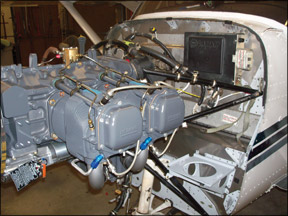
A significant change occurred with the 172I in 1968: The Continental six-cylinder engine was dropped in favor of the Lycoming 150-HP O-320-E2D, one of the most prolific engines ever made. In addition to a new cowling and motor mounts, the new engine package got an oil cooler.
Of course many-including the folks at Cessna-believed that the 172 had seen its day and would soon be displaced by the newly emerging 177 Cardinal. So Cessna ordered 4000 engines from Lycoming for the Cardinal. But the 150-HP Cardinal proved a dog so the Skyhawk inherited the engine. It included the troublesome dual Bendix magneto which still draws the ire of owners and mechanics alike.
The 172K of 1971 dropped the famed-and successful-Wittman spring steel main gear in favor of tapered steel tubes that provided more fore and aft flexing to supposedly improve ground handling on rough surfaces.
The landing light was moved from the leading edge of the left wing to the nosebowl of the cowl, which improved airflow over the wing at the expense of more complicated cowl removal and sharply reduced bulb life, probably due to engine vibration.
In 1972, the 172L emerged with an extended dorsal fin to improve longitudinal stability, making it more difficult to enter a spin. But closer to the ground, 172 pilots typically approached and landed too fast and the accident record bears out that observation to this day; runway prangs due to off-speed landings are a common accident scenario.
In 1974, cruise performance was improved through an effort to reduce drag and improve airflow through the cowling. This turned out to be a greater improvement than many of the other changes. At 8000 feet, 75 percent cruise increased from 113 to 120 knots, although owners say the lower number is more realistic and most plan for even less, around 100 to 105 knots. This suggests that if Cessna had paid more attention to aerodynamics than to perceived market movements, the 172 would have performed better than it does, at least with regard to cruise. Environmental awareness soon caught up with GA as the Skyhawk continued to evolve.
With the mandated change to low-lead fuel, engines designed to operate with 80-octane fuel showed various signs of distress. Lead fouling of plugs and valves rose to epidemic proportions. Deposits caused hot spots that led to premature failure of engine components. Fuel system elements deteriorated because of new and incompatible aromatics and other additives.
ENGINE DISASTER
The Cessna and Lycoming solution turned out to be ill-starred at best, a disaster at worst. In 1977, the 172N was fitted with the now-infamous O-320-H2AD. It had 10 additional horsepower which yielded a higher service ceiling and a knot or two of added cruise speed, but these improvements came at horrendous cost. The engine was a maintenance nightmare. Because of poor lubrication in the valve train, cold starts in cold weather caused tremendous damage to cams and tappets. The spalled metal tended to quickly trash bearings, oil pumps and other critical components.
Cessna and Lycoming supported owners to a generous degree, as aviation goes, but it took a long time to understand the nature and cause of the problem and to devise ways to alleviate it. More than 5000 of these engine/airframe combinations were built.
There are three major ADs on the H2AD engine and resale value of the airplane is dependent on compliance. AD 77-20-7 calls for replacement of the tappets, AD 78-12-8 calls for replacement of the oil pump impeller and AD 78-12-9 (the big one) mandates replacement of the crankshaft.
Its critical that these ADs be checked. We think its unlikely that any 172s are still out there sporting unmodified H2ADs, but the logs ought to be reviewed, nonetheless.In 1981, the troubled H engine was replaced in the 172P with another model, the O-320-D2J engine that yielded relatively good service. This is the last of the original Skyhawks and the line was history in 1986.
THE MODERN SKYHAWK
Cessna Chairman Russ Meyer stood by his promise to restart piston single-engine production if Congress passed liability reform. Turns out hes a man of his word. The Skyhawk was reintroduced in 1997 as the 172R and sold for about $135,000 with average equipment including the new Silver-Crown Plus line of avionics-a launch product for Bendix/King that proved to be doggy. While modern for its time, this gear was plagued with problems and its not uncommon to find an airplane that has a radio stack replaced multiple times.
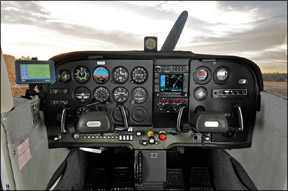
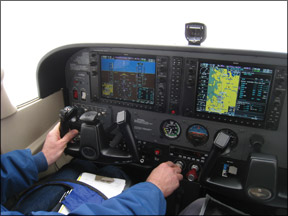
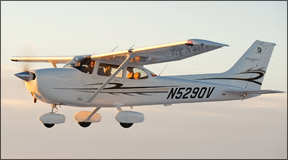
Although produced under the same type certificate, the airplane has a long list of improvements, including a metal panel, refined seats, better seatbelts, better ventilation and improved anti-corrosion treatment. The mid-2000s model line brought the 172S with Garmins G1000 integrated avionics suite and eventually the hugely capable GFC700 autopilot. While it had its growing pains, the G1000 was a vast improvement over the Bendix/King gear and brought the 172 into the world of glass.
The biggest change was the fuel-injected Lycoming IO-360-L2A in place of the carbureted variant used in the last production Hawks. This change reduces the likelihood of carb ice, but some owners complain that these engines can be bitchy to start.
Cessna shot itself in the foot on quality control. Owners of these newer aircraft were peppered with ADs and service bulletins totaling no fewer than nine for the 172, ranging from exhaust system problems, firewall problems due to shoddy assembly work, engine oil pressure switches, missing rivets and bad bolts in control yokes. Cessna has stood behind these fixes, but all things considered, owners would prefer better quality in a new airplane.
Performance
Folks who buy Cessna 172s tend to be honest about the airplanes attributes and limitations. Most consider the 172 a two- to three-place airplane with room for baggage and with acceptable although not exceptional performance and range. Most owners say 8 GPH is about right for fuel burn, with a little more for the newer 172s, especially the SP. One hundred knots is about right for IFR planning speeds.Loading a 172 requires some attention from the pilot, but its relatively generous in CG range and regardless of loading, there are few complaints about the handling qualities. Pitch forces are the highest of the three axes, but good speed control minimizes this. Properly flown, the 172 can handle stiff crosswinds. Improperly handled, it suffers a high level of landing accidents.
Despite NTSB reports littered with loss of directional control, prop strike, and nose gear failures, the 172 has few vices. It has proven itself as a forgiving airplane that has enabled many people to be pilots who otherwise wouldnt have made the cut.
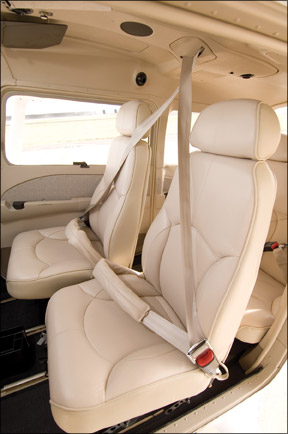
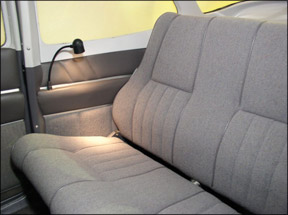
One of the great strengths of the 172 is its comfort. While its dimensions arent generous, for all but the longest or widest of pilots and passengers, its comfortable. For sightseers, the backseat of a Skyhawk is one of the best places to be. Seats in earlier (and unmodified) models are somewhat skimpy and uncomfortable after a couple of hours. In later models, both the comfort and adjustability of the seats are quite good.
Most owners, particularly those whove had their Skyhawks for a few years, report low annual costs. Compared to other brands, Cessna parts are reasonably inexpensive and used parts are normally available in abundance, if needed.
For a design as old and with so many airplanes operating, the number of SDRs and airworthiness directives is surprisingly small, even considering Cessnas problems with late-90s production quality. Skyhawks are notorious leakers of rain, especially around the windshield. Rigging and condition of control cables, pulleys, fairleads and fittings should also be carefully checked.
Many 172s have been poorly or improperly rigged over the years. Corrosion has been found between cable strands and this isn’t always visible. Things like this tend to be disguised by a new paint job rather than fixed. The design is notorious for poor nosegear shimmy damping.
MODS, OWNER SUPPORT
Fifty years ago, the general aviation industry was busy putting the tailwheel in front. Now, there are modifiers to put the nosewheel in the tail. Things have come full circle so you can now undo Cessnas work and turn the 172 into a 170. There are countless other mods, too.
Some owners feel flap and aileron gap seals pay off both in low-speed handling and improved cruise. Others say there isn’t any difference. Others swear by 180-HP engine upgrades to up the ante in climb performance.
Some of the more popular mods included STOL kits (www.springaviation.com), (www.hortonstackdoor.com), (www.sijet.com), engine upgrades from Penn Yan Aero (www.pennyanaero.com), Air Plains Services(www.airplains.com), and Isham Aircraft (www.ishams.com). Auxiliary fuel tanks are available from O&N (www.onaircraft.com) and Flint Aero (www.flintaero.com). PowerFlow exhaust modifications are also available (www.powerflowsystems.com).
Cessna Pilots Association (www.cessna.org) which has an insurance program, monthly magazine and fly-ins is an excellent tool for all kinds of support. The association runs a variety of type-specific maintenance and operational clinics, including sessions on owner-performed maintenance.
Which Model?
Mods or not, if youre not considering a newer 172, which of the many model variants is best? For basic day VFR flying, we think an earlier 172 is a good buy. The original Skyhawk with the straight tail and “fastback” fuselage is the best handling, say those who know the breed. The O-300D is unquestionably one of the most successful and comparatively trouble-free engines ever to come from Continental.
Self-proclaimed Cessna experts might say its easy to pick the worst 172: the notorious O-320-H2AD-engined 172N. However, thanks to mods, overhauls and information about the engine, this models horrors have receded into the past.
If price isn’t the major concern, a used S-model G1000 ride is desirable. For less, the 172P could be the ultimate model to pick, in our view. It has a proven and reliable powerplant and represents good value for the money. But check the logs for an airplane thats been beat up in flight school operations. Understand, too, that you’ll likely need to upgrade the avionics-a big expense that can make an already excellent aircraft even better.
Reader Feedback
I have a 47-year-old 1963 Cessna 172D. With respect to the Skyhawk, whats not to like? I think this is the perfect airplane for me. I have put nearly 320 hours on mine since purchasing N2618U in 1997. Mine is powered by the Continental O-300, which is mated to a climb prop. While I don’t go forward very fast, I can climb like a bat out of hell (when compared to other Skyhawks). I am a VFR pilot and the Skyhawk is perfect for flying VFR.
I am relatively short and the 1963 172 is we’ll suited to a short pilot. I don’t have vortex generators, yet my stall speed is a very sedate 41 MPH, with the airplane very controllable even at the slow speed. When I am at the top of my game, I can come in quite slow and be stopped just past the numbers. Most Skyhawks I have flown climb at 500 to 700 FPM. On a cold day, I can climb out for the first 1000 feet at 1500 FPM. My airplane is stone simple to operate, with a bulletproof engine, Johnson bar flaps and, in some cases, the typical World War II surplus instruments common in Cessnas of this vintage.
I budget $1500 per year for annuals and rarely go past that amount, though I am quite anal on my maintenance and always replace with brand new when my mechanic recommends replacing parts. Insurance is quite inexpensive at approximately $760 per year. I hangar my plane in an expensive hangar, but consider that money we’ll spent due to the wear and tear my airplane has not suffered to the elements. Bottom line: Everything in the airplane is simple and reliable.
I like how the older airplanes fly, and I think they fly better than the newer ones. My seats are cloth-covered originals, so on a long cross country, the ergonomics leave a lot to be desired compared to newer Cessnas. My airplane averages 7.1 gallons per hour, so shes a cheap date. I don’t fly as often as I want, so the Skyhawk is a wonderful companion that tends to make me look better than I am. I have noticed that a Skyhawk seems to be as big a plane that people fly just for fun. Ninety five percent of my flying is for fun, with the remaining 5 percent takes me somewhere. My favorite flights have been long cross-country flights that have spanned half the continent. I flight plan for 90 knots, which is quite accurate. I carry 39 gallons of fuel, with 36 useable, giving me a solid 5:30 theoretical, although I usually plan for approximately three-hour legs. Most people consider my airplane too slow to be a good cross-country aircraft, but I disagree and have the experience of several voyages over 1000 miles to back that up
I like having the extra room in a four-seater, although in 13 years I have only filled the seats once. With a max of two people, I know I can safely carry pretty much anything we need. The Skyhawk wont awe anyone with blistering performance, but it is a great airplane to own. It wont send you to the poor house, has no bad habits and when one hasnt flown much of late, it doesnt bite as you get back in the groove.
Only thing to learn with a generator-equipped plane like mine is that you cant activate all the electronics and lights at the same time and idle the engine. I, like others, have wanted to get into glass, but when push comes to shove, the old airplanes fly just as we’ll or better than the newer ones, without one having to trade the house on an airplane. I cant think of a better all-around airplane to own and fly. Someday, I will probably get glass, but it is very likely to be carried aloft in a Skyhawk. Cessnas 43,000-plus airplanes sold proves that a lot of people agree with me!
Hesham D. Oubari
Suffolk, Virginia
My Cessna 172 is not your usual Skyhawk. I purchased my 1975 172M in 1984, equipped with factory long-range 52-gallon tanks and it had already been modified with a 180-HP AVCON conversion. Cruise is 144 MPH at 10 GPH at 8000 feet. I have flown the airplane a total of 2300 hours, including four trips to Alaska and many trips to the Midwest and East Coast. The airplane will fly anything off the ground you can sensibly, though not necessarily legally, load into it.
Worthwhile modifications I have added: Horton STOL , Powerflow exhaust system , Paul David STC wheel fairings, gap seals, Mountain High oxygen system, Aero-Trim aileron trim and a Hoskins fuel computer. The engine was field overhauled at 2400 hours, and was the final engine to be done by Sacramento Sky Ranch before they discontinued their machine shop. Assembly and installation was done by IA Dave Hillerman at Turlock, California, and it just could not have turned out any nicer. All propeller work has been excellent, accomplished by Johnson & Sons, now at Shafter Airport in California.
The AVCON conversion makes the airplane what it is, basically a less-roomy 182 at 172 expense. Fully loaded sea-level rate of climb is greater than 1000 FPM and it will still be climbing at 200 FPM at 18,000 feet. The weak point is that the legal gross weight remains at 2300 pounds, since AVCON never increased it as some other 180 HP kits have done…at the loss of 10 degrees of usable flaps. The constant speed prop more than makes up for this with better climb, higher service ceiling and is at least as fast as the fixed-pitch kits. High terrain and density altitudes here in the intermountain west really demand the extra 30 HP.
Maintenance over 2300 hours of use has included one major overhaul, two prop overhauls (because of ADs), one prop governor overhaul, replacing the junk ARC radio and transponder, one repainting, one interior replacement, replacement of all glass with upgraded thicker Plexiglas, replacing one Slick mag that failed in flight, replacing the worn-out original Prestolite starter with a lightweight Sky-Tec unit, and twice having the alternator wiring chafe through in flight, plus a new battery about every three years. Not too bad for 26 years of loyal, dependable service. This has been a good all-around work and family airplane. It is at home on pavement or rough dirt strips, has an 860-pound useful load and is fast enough for long cross-country flying.
Handling is typical 172, namely, solid and unchallenging (perfect for less-than-stellar pilots, like me). It is noisy, so good headsets are a must. The long range fuel is necessary for the larger engine, allowing for regular 600-plus-mile trips with generous reserves.
Insurance through AVEMCO runs about $1200/year, hangar rent runs $540/year, and owner-assisted annuals help keep expenses down. I change oil (Aeroshell 15W50 plus AvBlend) and a spin-on filter every 30 hours, adding one quart during the interval.
This is the best airplane available and affordable for my needs and is likely the only one I will ever own. Or need.
Stewart Vaughn
Via-email