











As pilots, we all want to decrease risks. In some cases, that can be done by buying sophisticated equipment, such as a sferics device, radar or improved seatbelts.
Until very recently, gadgets to reduce the risk of a midair collision have been out of reach for most aircraft owners, primarily due to cost. The typical airline TCAS (Traffic Collision Avoidance System) costs from $50,000 up to more than three times that, making it a top-heavy investment for light aircraft owners.
The low-cost alternative-the Ryan TCAD-helps. But until recently, it lacked one very critical bit of information: azimuth. With a TCAD, you can tell when traffic is out there and how high it is relative to your own altitude, but you cant see where it is, electronically speaking.
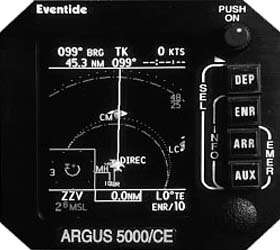
Recently, Ryan has teamed up with Eventide, maker of the popular Argus moving map products, to build a collision avoidance device that graphically displays traffic threats.
The new Ryan 9900B/Argus competes directly with BFGoodrichs Sky Watch system, which projects traffic threats on a WX-1000 Stormscope display. Lets examine how the systems compare. But first, lets put the bottom line at the top. Goodrichs Skywatch system will cost about $19,800 for just the hardware, assuming you already have a WX-1000+ Stormscope. (Prices vary; depending on the shops discount, that total could also include installation or figure on about $2000 for installation.)
If you don’t have the Stormscope, installing both the weather mapping and Skywatch functions of this system will total about $32,000. If you want just the traffic function, not weather mapping, the cost will be about $24,000. By comparison, the basic Ryan 9900B-which alerts to traffic and displays a simple arrow on the panel-mounted box to show azimuth-costs about $15,000 for the hardware, plus installation.
If you already own an Argus moving map (5000 or 7000 series, color or late-generation monochrome), you can couple the display to the 9900B to graphically display traffic for the cost of a $500 software package, plus minor wiring costs.
If youre starting from scratch and considering the Argus route, there are quite a few options. Start with $15,000 for the 9900B, to include the antennas. From there, you’ll have to decide on color or mono. For a mono Argus, the 5000 monochrome model, the price is $4995; the larger 7000 mono model is $6995. If you opt for color, the Argus 5000/CE is $7000, the larger 7000 C/E is $9000.
don’t put away your checkbook yet. The Argus maps now interface with BFGoodrichs remote Stormscope sensor, the WX-500, which sells for $5995. Adding it all up, if you don’t have the Argus map already, the cheapest Ryan/Argus system will cost about $20,000, to display navigation info and traffic only, no weather.
Go for color and you’ll pay $22,000 to $24,000. Add in the weather option and the total for the Ryan/Argus system comes to $28,000 to $30,000, putting this equipment in the general range of the Goodrich gear.
The Argus color maps will do two things the Goodrich systems wont: Theyll display detailed navigation information and show it all in color symbology.
Where Is It?
I have flown about four years with an earlier panel-mounted Ryan TCAD 8000. Ive been generally pleased with its capability to see and alert to nearby airplanes equipped with transponders and to provide pilot-based separation from Mode-C equipped aircraft based upon altitude and from Mode-A traffic based on distance.
The glaring weakness is lack of azimuth information. If a threat aircraft remains above or below by 500 feet or stays several miles away, this isn’t such a big deal. However, when altitudes are converging and distance is diminishing, the search for traffic can become frantic.