











There was a time when almost all light airplanes were taildraggers. Tricycle-gear airplanes were rare, mainly because taildraggers-or conventional-gear airplanes, if you prefer-generally were better at dealing with the unpaved runways at most airports. This common kinship among light airplanes continued into the early 1950s, broken only by such types as the Ercoupe, Navion and Beech Bonanza, to pick
three.
Up at Lock Haven, Pennsylvania, in the late 1940s, the Piper Aircraft Corporation was making a wide range of airplanes, including the venerable Cub, mostly of fabric stretched over a wood or metal frame. Out in Wichita, Cessna and Beech were only beginning their transition to all-metal airplanes with tricycle gear, which must have made for some sleepless nights at Piper. While the company apparently couldnt develop an all-metal airplane overnight, it could convert its four-seat, conventional-gear Pacer to the tricycle-gear configuration ahead of many others.
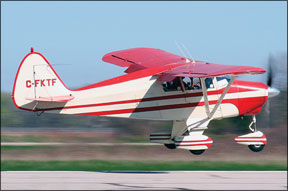
The result, which the company unimaginatively dubbed the Tri-Pacer, is not what one would call a modern-looking airplane, even for the early 1950s. Short-coupled, with stubby, strut-braced, high-mounted wings and thick-looking tricycle landing gear, the tube-and-fabric four-seater seems more than a bit dowdy today. Nicknames bestowed upon it-like Flying Milk Stool, Slow-Pacer, Flying Brick and Three-Legged Hog-reflect its silhouette. But the airplanes looks gave way to owners delight at the airplanes pleasing mix of reasonable performance and load-carrying capability combined with low purchase prices and rock-bottom operating costs.
And theyve got a point. The Tri- Pacer can cruise faster than a vintage Cessna 172 on only seven to nine GPH. It has good short-field perfor mance, a wide CG range and good parts availability to boot. The price for this ranges from about $15,000 up to around $20,000 or so, though a “fixer-upper” can be had for less. Thats a pretty good value, if the prospect of being snickered at doesnt bother you. Its a steal if youre into vintage machines and prefer watching your wallet instead of making sure you have the latest and greatest.
History
In a way, the Tri-Pacer defined a whole new market niche, one eventually dominated by Cessnas Skyhawk. Introduced for the 1951 model year, Pipers PA-22-125 Tri-Pacer was based on the PA-20 Pacer, itself only a year old and an upgrade of earlier models. Because of those roots, its possible and popular to convert a Tri-Pacer back to taildragger configuration with an STC. Interestingly, the PA-20 is, to our eye, more aesthetically pleasing than the Tri-Pacer. Amazing what that nose gear can do.
The Tri-Pacer was a great success back in the heady 1950s. During the airplanes nine-year production run, more than 7600 were built. But in 1956, Cessna introduced the world-beating 172, which outsold the Tri-Pacer so badly that production was stopped in 1960.
The first Tri-Pacers had 125-HP Lycoming O-290-D engines, which were changed halfway through the second year of production to 135-HP -D2 models (PA-22-135). In 1955, that engine was swapped out for a 150-HP Lycoming O-320-A1A (PA-22-150) . In 1958, the 160-HP O-320-B2A was offered as an option, giving a boost in useful load and changing the model designation to PA-22-160. The latter engine can be retrofitted with an STC; a worthwhile mod at overhaul. From 1958 through 1960, the PA-22-150 Caribbean-a less well-equipped Tri-Pacer-also was offered. Aside from this, there were no significant changes during the Tri-Pacers production run. Floats were offered as an option for the PA-22S seaplane version, as were 44-gallon tanks after 1955.
Despite ending Tri-Pacer production in 1960, Piper kept the marque alive with the Colt, which competed against Cessnas 150. Powered by a 108 HP Lycoming O-235-C1B, the Colt only saw three years of production, which ended in 1963. Some 1800 PA-22-108 Colts were produced.
Accommodations