











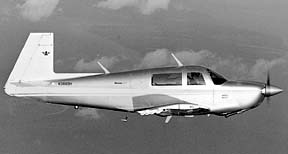
The Mooney M20J, introduced in 1977, marked a turning point for Mooney. It was the beginning of a new era, simultaneously retaining the traditional Mooney strong points while delivering significant improvements in performance, appearance and utility over its predecessors. So good was the initial product that it has continued in production to this day largely unchanged, despite several name alterations along the way.
History
The basic airframe of nearly all Mooneys (the ill-received Porsche PFM being a notable exception) is essentially the same, and has been since the M20A of the mid-1950s. It consists of a semi-monocoque rear fuselage, metal-skinned steel tube cabin, a long and slender tapered wing, and distinctive backwards tail (which, though it appears to sweep forward, does not – the leading edge is vertical). Major systems, too, have remained unchanged as the decades go by: trim is accomplished via a screwjack that moves the entire empennage, controls are all pushrod driven and the landing gear still uses a stone-simple trailing link design with shock absorption handled by stacks of rubber donuts.
The original M20 had serious problems. Several in-flight breakups resulted in the abandoning of wooden components. The resulting all-metal four-place retractable was notable for its efficiency, delivering impressive speed on relatively little horsepower. For the next 20-odd years the line evolved and branched, with short- and long-cabin versions and a choice of power.
The company, too, went through some changes, and not all good. It changed hands more than once, and faced mismanagement and quality control problems. By the mid-1970s, the line was looking a bit dated and the company was in trouble yet again. Some new blood was badly needed to get things moving again.
Fortunately for Mooney, the right man for the job was in place at the right time. LeRoy LoPresti, now a near legend for his ability to get the utmost from an airplane through aerodynamic cleanups and already famous at the time for his work at Grumman-American, applied his talents to the M20. The result was the M20J, which filled the spot previously taken up by the M20F. There were a number of changes made, the most visible being a new cowling and new, more aerodynamic windshield. The interior was redone as well, with a new panel.
The old Mooney naming conventions (names like Executive and Statesman) were chucked in favor of the moniker 201, which stood for the new M20 variants top speed in MPH. Mooney, in a marketing ploy, even went so far as to reserve as many 201 registration numbers as possible for the new airplanes. It was a success: More than 1000 201s were sold in the first four years. Not world-beating numbers, but not bad for its market niche.
The 201 effectively marked the end of the old M20s, and became the model for all new Mooneys to come. First out was the 231 (M20K), a turbocharged machine, then the TLS (M20M). There was also the aforementioned PFM (M20L). Mooney dropped the M20J in 1999 in favor of the Eagle, built on the longer Ovation fuselage. Today, the line consists of the TLS Bravo, the popular M20R Ovation and the Eagle.
But back to the 201. By 1985, the general aviation slump was taking its toll on everybody, so to boost sales Mooney came out with the 201 LM (for Lean Machine), a stripped-down version with basic IFR avionics for a relative bargain price. Two years later, the M20J got some more tweaks (gear doors) and was renamed the 205. Inexplicably, the 201 was still being produced, as was the 201 LM. Mooney was selling three airplanes that were more or less the same: All M20Js, but with different equipment. In 1988 the 201 was dropped, and the 205 became the 205SE.
By 1989, Mooney realized that it was simply confusing the customers, and returned to the 201 name. That same year, a trainer version was introduced, called the AT. It was intended only for flight schools, and is notable for the inclusion of speed brakes. In 1991, Mooney abandoned numerical names and redubbed the 201, calling it the MSE. There was a version with special equipment in 1992 called the MSE Limited. In 1993 all special variants were dropped, and the airplane is now named the MSE… though pilots still call them 201s.
Total production of the M20J – regardless of name – totaled in the vicinity of 2100, and the airplane retains a loyal following.
The 201s base price more than doubled in the first six years, from $46,725 (1979 base) to $97,500 (1985).
Evolution
Here is a rundown on the more significant changes to the series:
The biggest operational shortcoming of the original M20J was its low gear-operating speed (Vlo) of 107 KIAS for both retraction and extension. This together with the low flap extension speed (Vfe of 114 KIAS) created a lot of headaches in high-density areas and led to the airplanes reputation as a hot-handling, hard-to-land performance machine. It also led to a lot of engine shock cooling that reduced reliability, shortening TBOs and increasing operating cost.
Vle (gear extended speed) and Vlo/e (maximum gear operating/extend/speed) were increased to 132 KIAS for the 1978 model year. The 107 KIAS maximum retraction speed remains. Even these speeds are low, given the slickness of the airframe. We highly recommend getting speed brakes (they were offered as a factory option starting in 1986).
Where the first 201s have throttle quadrants, in 1978 this was changed to conventional push-pull engine controls. The panel and central console/pedestal were redesigned twice. In 1980 (1981 model year), the panel and glareshield were changed to the same configuration as that in the 231, with the extended section over the radio stack to provide more room. This change also is credited with solving a lot of the vibration and rattling that had been an annoying problem in earlier 201s. The ventilation system also was improved, and the shaped wing tips with faired navigation and strobe lights that were first introduced on the 231 were added.
Further aerodynamic and several serviceability changes were made for the 1984 model year. The nose gear doors were redesigned to make them close fully on retraction, a fairing was added to the tail cone, and a one-piece belly fairing was installed. The eight-foot-long belly skin can be removed in little more than a minute to permit easier inspection of and access to several systems. (The single fairing, which is fastened with 38 Dzus fasteners, replaces eight access panels with 175 screws.) Engine access was improved, too.
Over the years, empty weight increased by roughly 80 pounds; basic empty weight was 1,640 in 1981, 1,671 in 1984 and 1,726 in 1992, for example. Some versions have more than 200 pounds in optional equipment, and end up with full-fuel payloads down around 460 to 470 pounds.
The big changes in the 205 were in the electrical system and landing gear. The 205 electrical system is 28 volts compared to the 14-volt system in earlier M20Js. The higher-capacity system is an improvement even though the 70-amp maximum output of the alternator is unchanged, because it can produce 70 amps whereas the earlier system is capped out at roughly 60 amps. Battery rating also is increased. Along with that, Mooney added a much improved electric load monitoring system to supplement the high- and low-voltage annunciators-idiot lights that don’t help manage demand to any great extent.
The 205 gear system incorporates the M20K doors that fully enclose the gear when retracted and is the major contributor to the modest claimed speed increase of four mph The mechanical, three-position cowl flaps were replaced by an electrically-operated, infinitely adjustable system. Gear speeds were raised to a Vlo/extend of 140 KIAS and Vle of 165. A flap preselect system was offered for the first time, and Vfe/approach (15 degrees) was raised to 132 KIAS. The higher speeds were lost when the 201 returned in 1989.
With the 1991 introduction of the MSE, the maximum takeoff weight was increased by 160 pounds, from 2,740 to 2,900. The increase can be retrofitted (primarily a paperwork change and airspeed indicator exchange) back to some 1989 models, from serial number 24-1686 on, according to Mooneys long time customer service director, Edwin G. Penney. However, one owner wrote that Mooney charges …a mere $2,000… for the change. I would have it done if Mooney ever returns to the planet earth with a more realistic charge… Also, the instrument panel was redesigned again and a larger brake master cylinder was installed.
The competition
Despite its reputation for being small and cramped, the M20J is quite competitive in interior space and arrangement to its closest competitors, the Cessna Cardinal RG, Skylane RG and Piper Arrow. It is faster and more fuel efficient than either of those, and in terms of both still-air range and payload, it is competitive. In performance it also is competitive with more muscular singles, such as the Beech 33 and 35 Bonanzas, Cessna 210 and Piper Saratoga except in terms of payload. With the 2,000-hour recommended TBO on its IO-360-A3B6D and four cylinders to deal with at overhaul time, opposed to six on some other powerplants in its performance category, the life cycle costs of the 201 definitely are comparatively outstanding (with the usual caveat: for the properly operated and maintained airplane).
Performance
Performance is, of course, the bottom line for most Mooney owners. At 60 to 65 percent, true airspeeds average 155 knots and endurance with reserves at 4.5 hours or better. Like most general aviation airplanes, the M20J is not a fill-the-tanks-and-seats airplane. But most can haul three 170-pounders plus about 40 pounds of charts, baggage and in-flight snacks. With partial fuel loads, the Mooney still offers good range with seats filled.
The 201 has outstanding altitude performance for a low-power, normally aspirated single, thanks to its comparatively high aspect ratio and efficient wing. Its performance is good enough to make cruising at 14,000 to 15,000 feet a practical matter (don’t forget the oxygen). Service ceiling is 18,600 to 18,800 feet, depending on the version.
It is not a short-or rough-field airplane. The gear doors almost brush the ground, and the prop has less than 10 inches of clearance.
Comfort
Mooneys in general have a reputation for being cramped, but owners say there’s plenty of room. The small frontal area of the airplane means that the seating position is rather sports-car-like, with feet stretched out in front. This is in contrast to, say, a typical Cessna, which is more like sitting in a kitchen chair. There is definitely lots of legroom: pilots shorter than 5 feet 9 or so may have to use a booster cushion to reach the pedals.
The adjustable seat backs and other features available in later versions provide enough options to make just about anyone comfortable in the front or back of the airplane The M20J is a noisy, vibrating airplane. Good headsets and an intercom system are the most effective ways to deal with the noise. And both noise and vibration can be mitigated to some extent by periodic dynamic propeller balancing.
The baggage bay is of adequate size and is approved for up to 120 pounds. Most owners don’t mind the location of the hatch, which requires you to lift baggage over the sill rather than place it in. The baggage door doubles as an emergency exit for rear seat passengers (although some owners say its too small or too hard to reach). The earlier models have fixed rear seat backs, which occasionally causes loading problems for really bulky items: the baggage door isn’t all that large.
Handling
Most owners appreciate the handling characteristics of the M20J, especially as an instrument platform. Control pressures are higher than in other airplanes of similar size and power, thanks to the push-pull tubes rather than cables to actuate primary flight controls. The result is direct, fast and linear response.
Rudder is the lightest control in the three axes, but it also is the least powerful. In stiff crosswinds, there isn’t enough rudder authority to keep the nose straight down the runway, although many owners say a 15-knot crosswind component is no problem for them. Pitch changes with configuration and power changes are significant. A go-around or missed approach with full flaps requires anticipation and generous use of trim. In landing configuration, application of power results in a strong pitch up.
One trick of note is that the flap and trim motors run at the same speed, which means that the pitch change with flap extension can be nicely balanced by running the trim in the opposite direction at the same time.
Stalls in a we’ll rigged 201 with the stall strips properly located on the leading edge are brisk but not all that tricky. There can be a pronounced wing drop, and you don’t want to put the airplane in a spin: it will drop 1000 feet immediately.
Mooneys have long had a reputation as floaters on landing. This is not true, provided the pilot keeps the speed nailed down. With proper speed, approaches and landings are easy.
The biggest handling problem occurs on the ground. Turning radius is fairly large. This, coupled with the long wingspan and low seating position creates taxiing and ground maneuvering problems for transitioning pilots. The limited nose wheel turning radius also creates maintenance problems. Untrained or careless ramp people towing Mooneys frequently exceed the limits and damage steering horns, trusses and other nose gear elements.
Its good to note that the word on 201 characteristics is getting around. Almost every owner mentioned the importance of speed control during approach to proper landing technique (and reduced prop strikes and nose gear failures). Some operators still refer to wheelbarrowing or skidding main gear during the takeoff run, too.
The trick during takeoff is to set the trim properly, use flaps as recommended and apply a little back pressure. It may skate a bit before reaching flying speed. When the plane wants to fly, don’t try to hold it on the ground.
Maintenance
Despite an AD dealing with the situation, 201s are plagued with fuel tank leaks. Repairs are expensive, and some owners have yet to cure the problem satisfactorily on their airplane. Owners mention two- and three-thousand-dollar bills per wing. One shop said proper treatment can cost $12,000 or more.
This is because all old sealant must be hand scraped. And, the fuel tank access bays are very small. According to one source, typical solvents tried on Mooney tanks leave a residue that can eat through new sealant. Cleaning out the old stuff is a slow, hard job.
Another recurring fuel system problem is water contamination caused by faulty fuel cap seals and/or corroded fillers. Leaking water also is responsible for another expensive problem. Poorly sealed (or deteriorated sealant in) windows or leaking ice windows allows water to seep into insulation, which leads to rust and corrosion of the tubular cabin structure. One shop said 50 percent of all 201s have the problem to some degree; another one said early (through 1982) Mooneys are the most affected.
Inspection and repair is expensive: the interior and insulation have to be removed. Even if an airplane has been repaired (replacing tubes frequently is required), the problem can recur if an improved type of insulation was not installed or if window leaks recur. One repair operation recommends detailed inspection of all flight control elements, especially if an airplane has been repainted. Paint stripper can penetrate and corrode torque tubes, bell cranks and other elements of the system.
Exhaust system elements, especially flame tubes and mufflers, also are repeat maintenance items, in part due to poor quality, according to some maintenance technicians.
Despite a variety of fixes, the cowl-mounted landing lights continue to fail at an annoying rate, largely due to our old acquaintance, vibration. One owner says he went through 27 landing lights in nine years.
The ram air system also is prone to failure and regular inspection for deteriorating gaskets and proper operation is suggested. Some owners recommend sealing it and forgetting it. Finally, the next best things to a warm, bird-free hangar are cockpit covers and cowl plugs.
Speaking of birds, they like to nest in the tail cone. Make sure its checked for corrosion, and inspection should be part of the preflight.
Mods, club
The Mooney Aircraft Pilots Association (MAPA, 10715 Gulfdale Number 285, San Antonio, Texas 78216; phone 210-525-8008, or on the Web at http://www.311wc.com/mapa/) is a must. They have a good magazine, proficiency and insurance programs, and fly-ins.
There are a number of shops that specialize in Mooneys, though most mods are intended to make older Mooneys more like the 201. Of particular note are Mod Works, Lake Aero Styling, and Southwest Texas Aviation.
Speed brakes are a very worthwhile addition. Theyre available in manual, vacuum or electric varieties from Precise Flight.
Owner Comments
Three of the six aircraft I have owned in the twenty nine years that I have been flying have been Mooneys. My bias towards Mooneys is therefore obvious. I currently own a 1982 M20J that I have flown for over 3300 hours and it has been a great airplane.
The original engine was trouble free and I had it overhauled by Clydesdale Aircraft Corporation in Columbus, Ohio at the previously recommended TBO of 1800 hours using Cermichrome cylinders. It is still running strong as it once again approaches TBO.
Although Lycoming has increased the TBO to 2000 hours on the IO-360-A3B6D engines, I have been told the cam shafts usually show a lot of wear at 1800 hours and one should view the 2000 hour number with some skepticism. I used Phillips X-C oil to break in the overhauled engine and this oil seems to work we’ll with the Cermichrome cylinders. Other than alternators which seem to last 600 hours and vacuum pumps which seem to last 700 hours, there have been no problems with the aircraft.
I have kept the receipts for everything done to my Mooney since I bought it and I looked at the past 10 years to generate the following information: Average cost of an annual inspection = $1418.00 (High: $1752.00, Low: $1022.00); Average cost per hour to operate, excluding a reserve for overhaul but including hanger costs of $140 per month = $48 per hour; Average cost of insurance (I am an ATP with almost 6000 hours in Mooneys)= $1738.00 per year. I have found the insurance provided by the Mooney Aircraft Pilots Association to be the most competitive in terms of cost.
I lean the mixture conservatively and plan for 11 GPH with a true airspeed of 155 knots. The performance numbers published by the factory are reliable.
Living in Ohio, I frequently encounter icing conditions in the winter due in significant part to the moisture from nearby Lake Erie. In 1993 I had a TKS de-icing system installed by Shoreline Aviation located in Marshfield, Mass. They are experts on the installation of the TKS system on Mooneys and I recommend them without reservation. The TKS system has been maintenance free for the past four years and it performs as advertised. While only the Mooney factory can certify the TKS system for known icing, they limit this certification to the Ovation and the TLS/Bravo. The weight penalty is 96 pounds for the system but when ice starts to form, the loss of useful load seems a great trade-off.
For maintenance I use John Fogle of J&S Flying Service located at the Monroe Co. Airport in Woodsfield, Ohio. He works on Mooneys exclusively and he is extremely knowledgeable on all Mooney models. I strongly recommend using only A&Ps who have been trained on the idiosyncrasies of Mooneys. This can save you serious time and money. J&S is one of perhaps half a dozen or so Mooney gurus located around the country and one would be we’ll advised to seek these men out for the care and feeding of their Mooneys. Those seeking a pre-purchase inspection are especially advised to use shops familiar with Mooneys. Other than the usual pre-purchase protocols , older Mooneys should be examined for corrosion in the airframe around windows ( there is an important service bulletin on this), leaking fuel tanks and nose truss damage caused by overzealous ground crew towing the aircraft.
The Mooney Aircraft Pilots Association is a must belong to organization if you own a Mooney. MAPA has a monthly publication with useful information in it and they host an event called Homecoming each year at the factory with great seminars and factory tours. The MAPA Safety Foundation holds weekend ground/flight schools tailored to Mooneys that are of great value to both new and experienced Mooney pilots. The Mooney factory itself is very responsive to owners needs and this is yet another reason to own a Mooney.
Although I have frequent bouts of Ovation/TLS fever and on some dark and stormy nights I even get twin fever, my home remedy is to look at the cost numbers I mentioned above and the reliability of the 201. Ive flown to Europe, South America, Russia and just last month I flew my Mooney to the North Pole. I cant think of another aircraft that could do all of the things I ask of my Mooney as we’ll as it does them.
In conclusion, I have observed that pilots keep trading airplanes until they finally get one they cant afford. The 201 is a great combination of value and performance that admirably addresses this problem.
-John G. Sayle
East Liverpool, Ohio
I purchased my 1979 Mooney 201 in July 1996. After some discussion and the usual FedEx package of photos and specs, the broker agreed to fly it up for a pre-purchase by my mechanic for the cost of gas. If I bought it, I would have to pay his way home.
This was to be my fourth airplane. I started in gliders in 1983 at the age of 41, and the Mooney was to be an upgrade from a 1966 Piper Cherokee 180 that I used to get my instrument rating. After a few long trips in that airplane, I knew I wanted something that would go higher and faster, in addition to being reliable and serviceable for my business. A lot of hangar flying and reading led me to the Mooney. The specs were just unbeatable. No other airplane provides the performance for the price, both in terms of original purchase price and ongoing fuel consumption and maintenance. Bonanzas are a bit faster, but thirsty and reputedly very expensive to maintain. And the twins just couldnt compete for the mission I had in mind.
My Mooney has smoothed wings, gap seals, overlapping gear doors and thicker glass. The engine had 1200 hours on a Firewall Forward STCed overhaul, which includes the high-compression pistons from the helicopter version of the IO-360. I have a full IFR panel, plus a Garmin 100, Stormscope and Century II autopilot with altitude hold.
The 201, with those long wings, is a bit like my glider. In fact, by throttling back, I have thermaled it, making steep turns at 80 knots to stay in the thermal. Six hundred FPM is nice when its free! Landing a Mooney is just like the books say. You must have your speed under control. Eighty knots on final with full flaps, 70 over the numbers and a good flare will kiss it on the runway every time. But you have to let it land; forcing it on will always get you a bounce or two. Recovery is simple; a little throttle and let it settle back down.
Getting the plane down from altitude without shock-cooling the engine or exceeding redline takes planning and the cooperation of ATC. I plan on a 500 FPM descent and add a couple of minutes to get into the pattern. By using the ETE from the GPS, I start requesting a cruise descent based on that plan. Sometimes, when I have to overfly Washington National or Dulles, they wont let be down as fast as I want, but ATC usually accommodates me if I ask in advance.
Sometimes, I just slow to 130 KIAS at altitude and extend the gear. Thats good for about 750 to 1000 FPM, with some power to help the cylinders stay warm. Full slips work we’ll for losing altitude too. But I am budgeting for those speed brakes.
What does all this cost? Since I bought it a year ago, with 1200 SMOH, we have replaced the fuel pump and done a top overhaul to get oil consumption in line. The gear kept acting up. After much fiddling, we sent the motor and related off to Eaton to get rebuilt. It took four months, about 25 phone calls and a final call to the plant manager to get it done. After that call, it came back in two days. Seems they were waiting for enough old units to come in for repair to justify an order for some of the old parts. Took the plant manager to point out to them that the new parts work just as well! Anyway, it works great now. The magneto went shortly after the overhaul, and there have been numerous electrical problems to troubleshoot.
I paid about $80,000 for the plane, and have put in $1,600 in avionics plus about $13,000 in engine and airframe repairs. We have flown the plane over 200 hours, so the repairs have cost about $70 per hour for the first year. A lot of people have told me to budget about 15 to 20 percent of the purchase price for the first year to get the plane into shape. This has proven to be true. Of course, I am a stickler and want everything fixed properly, so I probably pay more. But my peace of mind is we’ll worth the cost.
The 201 regularly cruises at 155-160 KTAS between 7000 and 9000 feet. Above 10000 it will slow to 145 KTAS with the ground speed still around 150-155. Fuel burn averages 10 GPH, though it will go to 9 GPH when I take it to 11-13000.
We regularly fly from Birmingham to Gaithersburg, MD, our home base, nonstop in about four hours, and Gaithersburg to St. Louis in under six hours. An oxygen bottle in the luggage compartment lets us go high and not get headaches. Our usual load is full tanks, two 200-pound men, and about 150 pounds of computers and luggage.
Normal days give initial climb rates of 1000 FPM at 90 knots up to about 3000, tapering off to 700 up to 6000, and holding 500 FPM up to about 11000, loaded. After burning some fuel, we can keep 500 FPM up to 13000.
Contrary to the myths about Mooneys being tight, we have plenty of room to stretch out on long trips. Once airborne, I kick my seat back and cant touch the pedals. I am 6 feet, 195, as is my partner. We are both comfortable, with plenty of room.
The back seat and luggage area hold all we need, which is more than the airlines allow. We travel a great deal, and given our load carrying needs the Mooney has more than paid its way.
So far, we have gotten icing only once, causing a lot of prop vibration. Now, were looking into a heated prop and TKS. Also, the idea of a turbocharger and radar is appealing as we start working our way west. For now, we’ll fly this one a lot, making house calls on our customers and prospects. Its paying for itself, and you cant ask for more than that.
If you want to go fast in reasonable comfort and be able to justify the cost, a Mooney is the way to go.
-John Stalick
Rockville, Md.
Ive been flying my current Mooney J-model since purchasing it new in 1989, the fifth Mooney I have owned. Ive covered 49 states in one or another 201 in all seasons, mountain and flatland flying. Its a great plane. Just wrap it around you and go.
For anyone doing a lot of long-distance endurance flying I highly recommend the Monroy long range wing tank modification, which raises the total usable fuel capacity to 98 gallons. The resulting efficiency is hard to beat: several times each year I must travel to the East Coast from south-central Texas, a trip of over 1400 NM. Normally I make the trip non-stop, with ample fuel reserves – even without much help from the wind.
At 6000 to 7000 feet, 60% power, and leaned to 8.5 GPH on the fuel flow meter, I cruise at 150-55 KTAS (depending on OAT) and go, and go, and go… averaging about 18 NMPG, not much less than my Jeep.
The main drawback to the Mooney of course is its carrying capacity. Going solo, weight is no problem, but on occasions when my husband accompanies me, filling the aux. tanks would put us over max. gross. (On the other hand, a 9+hour nonstop trip is an acquired taste.) Even leaving the aux. tanks empty but main tanks filled, three FAA standard weight souls can exceed the weight limit – with no baggage.
My only other gripe is that the Mooney seems designed for a very long-legged male with short torso. On occasion my 6’+ passengers bump the ceiling in turbulence. Short pilots have a different problem: without installing special pedal extenders, you cant reach the rudder pedals. Dugosh Aircraft Service in Kerrville does all of my maintenance. I know none better.
-Susan Crawford Tracy
Medina, Texas
Also With This Article
Click here to view charts for Resale Values, Payload Compared and Prices Compared.
Click here to view the Mooney M20J 201 features guide.