











Emer
We felt the same until we found ourselves roaming around a dense cornfield one night while our airplane lay smashed on its back after suffering an engine failure. As rescue aircraft homed in on our activated ELT signal, we had a change of heart, realizing that ELTs serve a valuable purpose.
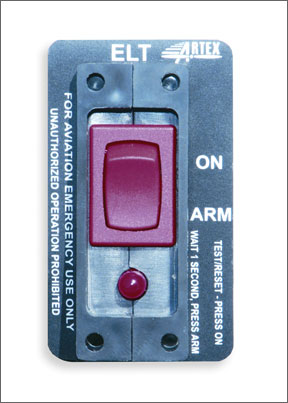
If youve ignored the ELT market lately, you’ll be surprised to find that ELTs have become pricey with the planned 2009 termination of the 121.5 MHz beacon satellite support. Moreover, if, by February 1, 2009, your aircraft still has a 121.5 MHz ELT and you crash in the sticks, don’t expect help in a hurry unless your crash site is within range of a listening control tower. The follow-on technology is the 406 MHz system, with ELTs now becoming available.
How It Works
When a 121.5 MHz beacon activates, it transmits a continuous swept tone until the battery is spent. Neglected batteries might shave that time in half. The more sophisticated 406 MHz digital pulse transmits at 50-second intervals for 24 hours and transmits pre-programmed, digitally encoded data such as aircraft tail number and beacon serial number, plus country of origin and aircraft serial number. Think of it as a personalized dispatch for low-earth orbit and geosynchronous orbit COSPAS-SARSAT satellite processing. A 406 MHz hit has an alert time of under five minutes with a single detection by a geosynchronous satellite. The waiting time for a LEO-satellite-based 121.5 MHz detection hit could be 45 minutes or more.
Limited Market
Improved 406 MHz beacons have been available for a while, but the market is hardly hot. Despite advances, 406 MHz technology hasnt caught fire in light aircraft GA because of the higher cost. This is hardly a shocker. But the industry is buzzing about new low-cost 406 MHz models that are about to hit the market.