











Automotive technology trickles into aviation in fits and starts and with spotty success. HID lighting, for example, was practically standard equipment on some cars before it finally gained a foothold in the light aircraft GA market. Now LEDs-light emitting diodes-are undergoing a similar evolution.
Weve seen them in cars and on motorcycles for years and lately, theyve found their way onto wingtip and nav/position lights. Next step: landing lights. In this article, were examining a new product recently sent to us by a company called AeroLEDs. AeroLEDs is by no means the only supplier of this technology. Whelen,
for example, makes a line of LED landing lights and we know of some other similar products in development. we’ll do a detailed comparison of all the LED products in a future issue, but in this article, were interested in testing the concept itself.
Landing and taxi lights are big draws on the airplane electrical system for a reason: You need a bunch of light to reach through the murk to find night details necessary to establish depth perception and hazard detection. Although theyre inefficient in terms of converting electricity to light, conventional incandescent bulbs are still more than bright enough to do the job, which explains why theyve endured so long. At $20 a pop, theyre also relatively cheap, if not always reliable. Can LEDs hope to compare? We aimed to find out.
Why LEDs?
LEDs are one of those alluring technologies that seem too good to be true. They deliver bright, cool light with a fraction of the power required for an incandescent lamp. This, more than anything, explains why LEDs are turning up in everything from flashlights to automotive tail lights.
LEDs themselves have more to do with transistors than with traditional filament-type bulbs. LEDs have p-n or positive-negative semiconductor junctions, just like transistors do. When power is applied to the junction, electrons flow and drop into so-called electron holes-they actually revert to different orbits in the junction material. When that happens, energy in the form of photons is released. Physically, the p-n junction is small and so are LEDs. An individual LED is bright, but its overall light output is small, so to approach the requirements for something like a landing light or even a navigation light, multiple LEDs are ganged together. The SUNSpot product that AeroLEDs sent to us has 16 LEDs arranged in a circular lens assembly.
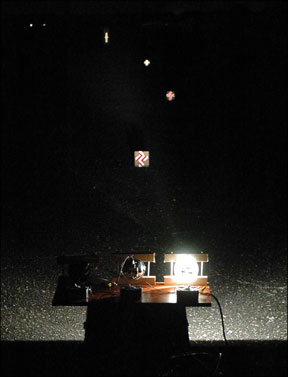
Unlike traditional filament bulbs, which concentrate their light energy from a single, bright filament and can thus use a single reflector, each individual LED has to have its own reflector assembly. This represents a challenge for the lamp designer and the largest problem is producing a coherent beam that will illuminate objects in the distance. In short, LEDs don’t do this very we’ll compared to single reflector lamps, in our view. In a gang design, they produce a locally bright beam thats wider and more diffuse than a traditional filament bulb, but they don’t reach out into the dark corners as well. This has pros and cons. The softer, wider beam is fine for taxiing or where you want to see the edges of a surface youre moving along. Its arguable whether this is better in the landing flare. To properly gauge height, you should be looking down the runway, not out the side windows at close-in objects. In reality, most of us probably use some combination of distant and close-in observation. But