











At a Wall Street analysts forum in 2007, the CEO of Ballistic Recovery Systems, Larry Williams, told the audience why he thought the all-plane parachute made sense: “In 2005, there were just over 1600 [accidents] involving general aviation airplanes in this country that resulted in 556 deaths. Now, if you offset that with the fact that were saving 199 people, all of the sudden, parachutes start to make sense.” Except that its not that simple. As of this writing, BRS has claimed to having saved 233 lives, but thats counting every occupant on every successful parachute deployment as a saved life. A quick look at the record shows that death was far from a certainty in many of the parachute deployments. A subtler knot in the logic that BRS has saved 233 people is that having a parachute installed affects the delicate balance of risk versus utility in aircraft. We know from experience and interviews that there are pilots who will take on conditions such as rough weather with the chute that they wouldnt take on otherwise. We can only guess that some of the CFIT accidents in the Cirrus were influenced by the faulty assumption that the pilot will always have enough time to pop the bddn chute before auguring in. But the risk equation is more complex than that. Situations such as single-engine at night over mountains or low-visibility takeoffs are risky only because the consequences of an emergency are high, even though the likelihood of failure is extremely low. Having an ace-in-the-hole to cover that unlikely event will shift the go/no-go call for some pilots. We believe those pilots will get more out of their airplane with a negligible increase in real risk. So BRS may be overstating its positive impact on lifesaving, but also understating its positive impact on aircraft utility. 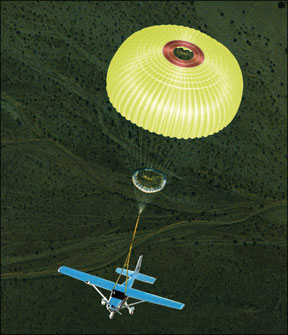
To Die or Not To Die
Lets state this in no uncertain terms: BRS has unquestionably saved human lives. And we think anyone would be hard-pressed to argue any product that can make a lifesaving claim isn’t worthwhile. Take the example of a pilot of a Tukan trike whose control-bar downtubes collapsed at 1500 feet, resulting in an immediate spin. Quoting the pilot: “I was in a tight spiral when my downtubes buckled. The wing folded back like a butterfly landing on a window ledge. When I pulled, witnesses said I was no more than 150 feet from the ground.” While its possible to survive spinning in from low altitude, its not likely. BRS can rightly claim a save.
But some chute pops are more ambiguous. A recent save was in a Challenger II LSA. BRS reported that the event occurred, “at 2000 feet altitude when the pilot suddenly lost elevator control. Not willing to risk landing under such conditions, he elected to deploy his onboard BRS parachute system while descending through 1800 feet.” A similar deployment was on a locked elevator on a Dragonfly ultralight that had been towing a glider where the pilot reported, “Since I wasnt in immediate trouble I waited till I was in a better area and fired the BRS.”
While we cant say with authority that these aircraft were landable, loss of elevator control in a normal flight attitude certainly has options. Adjusting power and, if available, trim, can do quite a bit on their own.
We asked Gary Moore, VP of Marketing for BRS, whether claiming 233 lives saved was overstating the case. “I don’t know what went through the pilots mind. Could a more experienced pilot have landed? I guess its possible … but the pilot elected to deploy the system. So were not consciously overstating it.”
Second-guessing the pilot is, of course, the tough part of this analysis. We couldnt get to all the records of BRS deployments, but we were able to examine several. There are many that we see as discretionary deployments. That is, the chute was deemed by the pilot to be the best option rather than being the only option. But that includes situations where perhaps the pilot might not agree. In his written report the pilot of that Challenger II LSA felt, “If the parachute wasnt on there, I absolutely would not be here. There was no way to ultimately get the aircraft down. I just didnt have the flight controls to do it.”
Similar thoughts probably motivated the pilot of the very first Cirrus parachute deployment. But even he had control to “[fly] the airplane toward an unpopulated area, shutdown the engine, and deployed the aircrafts ballistic parachute system.” Again, death seems far from a certainty.
There are a couple of interesting instances where the deployment itself was not enough to save the day, but it factored into the save. In these cases, the pilot deployed the chute and then flew under power to guide the aircraft descending under the canopy to a safer landing site. None of these sites were airports, so its anyones guess how a landing would have gone with serious forward momentum.
And then there is that unknown of where the parachute option might have factored into the accident cause. Would a Cirrus pilot who deployed his chute off the coast of Nantucket after getting disoriented on the approach have lied to the controller about being instrument rated if he didnt have the chute as a back door?