










Oil leads a tough life. Its supposed to lubricate, seal, clean and cool the running engine. After shutdown, its supposed to protect metal surfaces so the next start doesnt scrape off corroded material thats ultimately replaced from your wallet via a premature overhaul. Oil companies will improve the oil as best they can, but their choices to market a case of oil at the right price might not match your preference for long-term investment in your engine. The bottom line is this: Is it worth up to an extra dollar an hour-maybe $2000 over the life of an engine-to beef up your oil? We think it is if the supplement in question can back up its claims. Two rise to the top of the pack with approval for certified engines, and enough lab and field data for us to review: ASL CamGuard and AvBlend. We asked both companies for all the data they could supply, and posted a request for comments on our sister publication AVweb.com to see what the experiences of owners and shops have been. The 609 responses we got don’t constitute a large sample, but we feel some broad conclusions can be drawn from these opinions.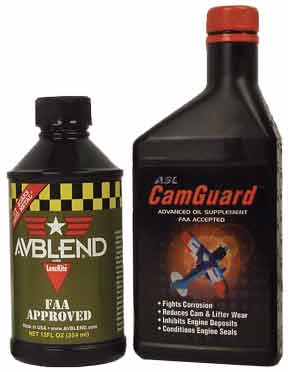
CamGuard
ASL CamGuards creator, Ed Kollin, did the initial research that lead to Exxon Elite. (Full disclosure: Ed Kollin has frequently served as a source on oil articles for Aviation Consumer.) That research included looking at red-tagged parts to try and see why parts failed. “Corrosion was 95-plus percent the reason.” Even the scuffing problem in Lycoming cams and lifters, Kollin felt, was actually due to pitting on the hard metal that lead to spalling. “Of our top 10 list, corrosion was one through five.”
Kollin proposed a mix of several ingredients for a protection formula, but it proved too expensive for Exxon. Kollin struck out on his own with a modified version that mated corrosion protection with additives for anti-scuff, deposit control and conditioning of seals. Kollin added the latter because the anti-scuff protection in some oils breaks down thermally into a seal-eating compound.
CamGuard has been vetted through a battery of industry-standard tests, as we’ll as modified versions that Kollin claims are closer to the operating environment of an aircraft engine. The results are impressive, in our view. For example, wear protection was increased 10 fold over some base aviation oils and some corrosion tests stopped when an oil-plus-CamGuard mix had prevented corrosion 40 days longer than the nearest competitor. In our short corrosion test (page 11) CamGuard didnt outstrip oils with additives by this much, but in previous (longer-duration) tests, it performed better.
Kollin says that most of CamGuards anti-wear capabilities are from corrosion protection. He claims a 30-percent reduction in wear metals is typical when using CamGuard. Savvy Aviator principal Mike Busch has been testing CamGuard in his Cessna 310 and reports 10- to 20-percent reductions. In our owner opinion poll, 165 out of 292 CamGuard users reported a reduction in wear metals in their oil analysis.
But this claim is a bit tricky in that total metal must be corrected for the hours flown (since metals accumulate in the oil with time). Maintenance or a change in flying habits can throw off the numbers. We didnt get enough reports from our poll respondents to independently verify these claims, and results can be subtle, as you can see on page 10. Blackstone Labs took a look for us across the board for wear metals in Lycoming O-360-A4Ms using CamGuard versus those that don’t (they can see CamGuard in the oil). The results were inconclusive.
Kollin stops short of claiming CamGuard will free sticky rings, but he says it interacts with fuel residues that cause many deposits to form. Engine motion over time may free parts, which may lead to lowered oil consumption. One poll respondent told us, “I own the largest piston overhaul shop in Australia … when we tear down the time-expired engines that have been running Camguard they all have less deposits, less carbon and less corrosion than engines not using Camguard.”
Reports of lowered oil consumption and cleaner engines also speckled the results, but not with a frequency that made our pulse quicken. CamGuard did its FAA approval testing (which only needs to show the additive does no harm) using a Lycoming IO-540 doing aerobatic flight for 500 hours. Photos of the torn-down engine looked shockingly clean, in our opinion. Even so, were with many of the aircraft owners who say they wont really know until overhaul.
We didnt ask specifically about weeping seals on our questionnaire, but several respondents volunteered that CamGuard helped with this problem. This isn’t conclusive but it did catch our attention.
AvBlend
AvBlends pedigree dates back to the late ’40s (with roots even earlier) to deal with cold-start scuffing issues in auto racers. The product, called Lenckite, found aviation through Ed Rachanski Sr., a funny car racer and builder who went on to found an FAA Repair station, Blueprint Engines, at Chicagos Midway Airport.
AvBlend was field tested for FAA approval at Executive Helicopter in Chicago using a Lycoming HIO-360-C1A in an Enstrom helicopter used for traffic work. The testing ended five overhauls later when the cylinders had 7787 hours on them (one finally developed a head crack). They were just then reaching their service limits. On each of the overhauls, parts turned up exceptionally clean, particularly around problematic valve guides.
Whats called AvBlend in the aviation world is also sold for over-the-road use as ZMax. This product got wound up in an FTC lawsuit over claims made by the company about specific performance gains a consumer would see. The silver lining to that suit, as AvBlends Ed Rachanski Jr. will point out, is that the company did $2 million in lab testing, which verified its claims for decreased wear, increased performance, deposit control, corrosion protection and more.
AvBlends test documents show that much of this testing was done with automotive oils in automotive engines, and we cant say how applicable those findings are to aircraft engines. Looking only at the single-cylinder lab engine (CLR) tests using aircraft oil and ZMax (AvBlend), however, still shows 17-percent reduction in blowby, a six-percent reduction in piston-skirt wear, a two-percent reduction in exhaust-valve wear, and about an 8.5-percent gain in power and efficiency. All were shown to be statistically significant. Lab data also supports wear reduction and corrosion resistance, albeit using automotive oils. In our own corrosion tests, AvBlend did as we’ll as any of the other supplements.
In our field interviews, the first thing that popped up was deposit control. “An AvBlend engine sticks out like a sore thumb,” said Dave Allen of Poplar Grove (one of our top-rated engine shops). “I can tell because theyre so clean.” We asked