











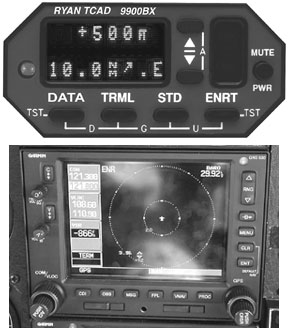
In the world of little airplanes, its all but a given that technology has stood frozen in time since the mid-1960s. The shining exception is avionics. Thanks to GPS and (relatively) cheap color displays, the modern high-dollar IFR panel makes the host airframe seem positively Jurassic.
But even within the rosy world of airplane electronics, there’s an exception: Collision avoidance equipment. While GPS-even color GPS-is we’ll within the budget of the common hangar dweller, electronic collision avoidance is not. Consider this: Even a basic electronic traffic avoidance system-say the Ryan 8800 TCAD-could easily double the cost of a mid-range avionics upgrade, without providing all-important azimuth data about nearby traffic.
As a result, electronic traffic avoidance still isn’t an everyday item. More panels have it than five years ago, but its still a relative rarity. For the time being, we don’t see this changing much. (We suspect a price breakthrough is on the horizon, but nothing reportable yet.)
Ryan International, whose founder, Paul Ryan, pioneered the Stormscope, can claim credit for making electronic collision avoidance at least approachable for the light aircraft GA cockpit. At nearly $8000, its first offering, the ATS 8000 TCAD (for traffic collision alerting device), found takers, although it could hardly be called a mass-market box.
Since the mid-1990s, Ryan has been busy, dramatically expanding its product line across a range of prices and capabilities, offering six models or variations, including a soon-to-be introduced active interrogation design that rivals BFGoodrichs top-of-the-line Skywatch and expensive airline-type TCAS systems. Goodrich has reportedly done we’ll with the Skywatch, but with an installed cost between $20,000 and $31,000, many owners have understandably balked.
isn’t there something cheaper? Yes, as a matter of fact there is. A tiny upstart called Monroy Aerospace has developed the handheld GPS-equivalent of traffic avoidance, a portable device called the ATD-200. For $789, its basically a transponder listening device, sans fancy software. But it delivers surprisingly good-if limited-performance for the dollar.
But the biggest development since we last examined this equipment in the July 1997 issue of Aviation Consumer, is display technology. Continuing the trend of new multifunction displays showing everything but Star Trek re-runs, displays from Garmin, Avidyne, Argus and soon UPSAT/Apollo and Bendix/King will display traffic information.
Although this doesnt necessarily help much with the cost-in some cases, it may double the installation invoice-having the choice of an MFD offers considerable flexibility over a dedicated weather or traffic display. We therefore think any owner contemplating an expensive traffic avoidance system should at least shop the MFD market at the same time. The bottom line versus value delivered may tilt in favor of the MFDs. It seems clear that MFDs of the Garmin 530/Apollo MX-20/Avidyne ilk are the wave of the future. What they cant do now, theyll surely be able to do in a year or two.
Passive, Active
In the current market, electronic traffic avoidance sorts into two broad types: Passive and active. Passive systems-the Monroy and all of the Ryan systems except the 9900BX-are transponder receivers.
When a nearby transponder-anywhere from 1/2 to 6 miles-is interrogated by ground beacon radar, the anti-collision device hears the reply, calculates its range based on receiver signal strength and filters this through its alerting thresholds.
The lower-priced passive units cant determine bearing or azimuth but since virtually all transponders emit a Mode-C pressure altitude pulse, passive systems can compute relative altitude by comparing the received transponder signal to the host aircrafts Mode-C output.
Last year, responding to competition from BFGoodrichs Skywatch, Ryan introduced the higher-priced 9900B, a passive system capable of resolving azimuth. Active systems-the Skywatch and Ryans 9900BX-do their own interrogation of nearby transponders and thus address the passive systems primary weakness, which is an inability to see transponders that arent being probed by ground radar. Neither system, of course, will see airplanes with inoperative or no transponders.
A third system is worth mentioning, although its far too immature to be ready for market. Automatic Dependent Surveillance or ADS, uses GPS-derived position information transmitted via datalink and ground processing to report-and display-the location of nearby aircraft. Potentially, this system-which is being tested in the FAAs Capstone project in Alaska, offers more capability than active or passive airborne systems. But it may be many years before its fielded commercially, if ever. (See sidebar.)
Ryan Passive
At the low end of the panel mount market is Ryans 8800 Gold and Silver series. These are essentially derivations of Ryans initial passive product, albeit improved. The primary difference between the two is that the Gold model includes altitude alerting while the Silver model doesnt. Price for the Gold version is $7000, while the Silver sells for $6000.
Given discounts, these are close to the installed prices. (Add another $200 for the antennas.)
Both are essentially identical installations, requiring antennas on both the top and bottom of the fuselage, so transponder signals from other aircraft can be readily received. (Weight is about 4 pounds, plus antennas and transponder coupler, which reports your Mode-C output to the TCAD. All of the processing and display is contained in a single, standard-rack panel-mounted box.)
Although both models have an onboard display for target distance, relative altitude, target altitudes and so on, this information cant be displayed on a remote multi-function display. (Only the 9900B and BX have that capability.) All of the Ryan products work with what the company calls an ATSA or air traffic shield area. Think of this as a sensitivity threshold settable by the pilot. For example, in enroute mode, the distance alert can be set to 3 nautical miles, allowing more look time at higher speeds.
In a terminal area, alerting can be reduced to 1.5 miles to eliminate no-factor nuisance alerts. Maximum vertical sensitivity is 5000 feet, based on received Mode-C output as compared to the host transponder. Alerting is by chime-which can be set by the user or temporarily muted. (In the Gold model, the altitude alert function also chimes.)
Because they lack any azimuth information, using the 8800 TCADs is a practiced art. When the unit chimes, the natural instinct is to look outside. But experienced TCAD pilots also glance at the units distance display, which is important not so much for the actual value but for the trend. If distance is trending rapidly downward on a target near your altitude, you may have a significant collision risk, say faster traffic closing from the rear or front quarter.
On the other hand, if the altitude shows 1000 feet above or below or the distance is constant or increasing, there probably is no threat, even if you cant lay eyes on the suspect airplane. Even though the absolute range may not be precise, the trend tells the story. (Claimed range accuracy is .3 mile at 1 mile, increasing with distance.) Operability is relatively simple and close to set-and-forget. You do have to enter the current altimeter setting and target altitudes, mainly for the altitude alerting feature. The shield thresholds can be set to automatically transition from one scale to the next, based on altitude, with the enroute transition occurring at 2000 feet.
In short, the 8800-series TCAD is about as basic as it gets, although hardly what we would call cheap. The absence of azimuth information, while not a deal killer, does make for higher scanning workload. This can be mitigated by the trend and altitude information but its a definite limitation.
Ryan 9900 Series
Higher on the price and the sophistication scale are Ryans 9900 series TCADs, of which there are four models, the 9900, the 9900A, the 9900B and BX models. These are second-generation boxes with a small console/control head in the panel and a processor box that lives remotely in an avionics bay. Like the 8800 series, they each require a pair of shark-fin transponder antennas, one topside and one on the belly. The BX, an active design, uses a new patented antenna array from Ryan.
But unlike the 8800s, these boxes are specifically designed to be upgradeable, thus you can buy in at the basic level and add features from the higher level units later on, a laudable approach in the avionics biz.
The 9900 ($8200, including antennas) has essentially the same features as the 8800 Gold model, except that it can be upgraded to receive ADS-B data, if it ever becomes available. The 9900 has altitude alerting and density altitude computation as standard features.
For $10,900, the 9900A adds two features: Range sensitivity out to 6 nautical miles and software that automatically mutes tones from aircraft on the ground when near an airport. (This is no small advantage, since one of the things we don’t like about the TCAD is its incessant chiming.)
The next step up is significant and, in our view, desirable. For an installed cost of about $15,000, the Ryan 9900B TCAD includes target azimuth; an arrow that points in the general direction of the target, thus eliminating a large sector of sky that has to be scanned to see the traffic.
At $4000 over the next cheapest option, thats an expensive little arrow but it does add additional capability, significantly reducing the amount of effort devoted to scanning the sky where the threat airplane isn’t. Better yet, at least for the well-funded pilot, is the 9900Bs ability to display what it sees on an external display, in which case the cost is $14,000, plus the display of your choice.
As currently configured, the 9900B can show traffic on Argus 5000 and 7000 models, Garmin GNC 420, 430, 530 and GPS 400 navigators and the Avidyne FlightMax series. (As of press time, plans are in the works to develop software for UPSAT/Apollos MX-20 display by early next year, with Bendix/King, ARNAV, Becker, Archangel and others to follow.)
Displayed on an MFD or the Garmin color units, targets appear as small triangles on the screen, with relative altitude given in feet. (Relative in the sense that the targets actual altitude isn’t shown, only its height above or below your altitude, which the TCAD calculates from your transponder output.)
On a demo flight with a Garmin 530 display, we noted that targets appear more or less where the display says they are. However, there’s a degree of disconnect. If a target appears on the display to be right off the wing, it may in fact be a little ahead or a little behind. Users report-and we noted-a degree of target jump, both in range and azimuth, something that appears to be a limitation of the 9900Bs passive design. We don’t see this a no-buy limitation, but at this price, you cant expect TCAS.
Ryan predicts you can expect that sort of performance from its newest product, the 9900BX, which has been undergoing certification trials for the past couple of years.
Like TCAS and BFGoodrichs Skywatch, the 9900BX is a fully active system, interrogating transponders on its own and filling in the gaps where the passive systems are rendered blind by lack of ground radar coverage. The 9900BX, at $20,200, including Ryans display or $1000 less if you output to an MFD or Argus, adds yet more features to the 9900 series. These include greater range-out to 10 miles-greater programmable altitude flexibility and what Ryan calls audible position alerting, which calls traffic by clock azimuth and height-traffic, 9 oclock high.
Not having tried this unit yet, we’ll reserve judgment on that feature. It sounds like a good idea but we can only hope there’s some means to suppress the TCADs tendency to over alert. At some point, chimes and Bitchin Betty voice aids cross the line of diminishing returns; youd just like the thing to shut up so you can look out the window.
The 9900BX is expected to be available no later than the end of this year. As noted, buyers of any 9900-series TCAD will be able to upgrade to the active model. If you use the Argus map products for a display, you’ll still need the Ryan display/control head.
Skywatch
Occupying the top of the heap in both price and capability is the BFGoodrich Skywatch system, which was rolled out as an affordable anti-collision device in 1997. But affordable is relative, in our view. Costing between $20,000 and $30,000, depending on installed displays and capability, the Skywatch is hardly an impulse purchase. On the other hand, owners who have installed this system swear by it. Basically, Goodrich scaled down the expensive airline TCAS 1 system-about $60,000 installed-and married it to the companys popular WX-1000+ Stormscope. (If you have a WX-950, sorry, Skywatch isn’t compatible.)
In an aircraft with no Stormscope at all, the combination of weather and traffic avoidance will cost a cool $31,000 or so, variable by shop. In an airplane with radar where Stormscope might not be a worthwhile addition, plan on spending $24,000 or so for Skywatch. If you already have a WX-1000+, you can add Skywatch for $19,980, give or take.