











Most airplane seats are poor places to park your keister for a few hours. After a decade or so of the temperature extremes found on the typical airport ramp, their foam deteriorates, eliminating any resilience in the cushions and creating a permanent sag. The vinyl and fabric-or, if youre lucky, leather-has long since started to rip apart at the seams, snagging shirts and trousers as you shift and squirm. A good interior shop can fix this for a grand per seat, but there are less-expensive options, including ready-made upholstery you install yourself. One often-overlooked option is to do nothing at all with the seat itself but simply hide the ugliness and discomfort with a custom-fit cover. A wide variety of materials are available-especially if you don’t mind installing something from the automotive market. One of the more popular options is the made-to-fit sheepskin seat cover. Installing one automagically resolves several issues, among them eliminating the hot/cold seat, sticky vinyl and unsightly, worn and torn upholstery. They trap air between you and the seat itself, so theyre cooler in the summer and warmer in the winter, plus they wick away moisture, like the sweat from your next flight review. To find out if theyre a viable option for personal aircraft, we obtained samples from three of the popular vendors-Aerosheep, Aircraft Spruce and Sportys-and installed them in our Debonair. All were high-quality products, with similar finishing details and many similarities, along with a few differences.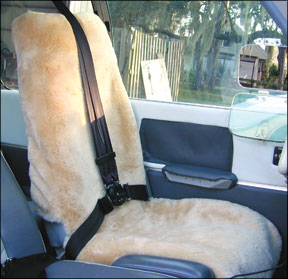
Overview
A sheepskin seat cover isn’t without its drawbacks. For one, the added thickness can further crowd an already too-tight cockpit. If youre close to bumping your head against the cockpit ceiling already, the extra thickness they add to the seat may eliminate any remaining room. For another, they also add thickness to the seat at the sides. Put a sheepskin cover on a seat already close to the cabin sidewalls-whether by design or deformed by years of use-and it may fit so snugly that adjusting the seats fore-and-aft position becomes difficult. The same is true for retractable arm rests between the seats, for example, or consoles.
Installing anything in a low-wing airplane cabin with only one door can be a chore and these seat covers were no exception. Each sample we examined came with sturdy fabric straps and either heavy-duty metal clasps or hooks to secure them. The straps are designed to secure the cover to the seat back, under the seat bottom and through the gap between the two. Covers we obtained from Aircraft Spruce and Sportys were one-piece designs, encompassing the headrest; the Aerosheep cover came in two pieces, including a separate one for the headrest.
To do this right, at least in our airplane, wed want to remove the seats from the airplane entirely, install the covers and then reinstall the finished product. On some airplanes-double-door Cessnas, for example-thats probably not a big deal. On ours, it is, as it might be on other single-door airplanes.
But the effort would be worth it. The covers we examined were all we’ll made, with thick fleece and heavy-duty stitching. Each was nicely finished, with piping sewn to the edges and each product left uncovered the seatback, allowing ready access to map pockets for rear-seat passengers. While it will require a few years of use to tell the tale, all the straps appeared up to the task and used a minimum of elastic, which loses strength