











Its more or less a given that carrying a handheld VHF transceiver in the airplane is a good idea, for ground frequency monitoring, pre-start clearance getting and as a back-up comm. The market hardly lacks for choice and now it has one more to pick from. At Sun n Fun, Dynon Avionics announced the DX15 VHF air band transceiver to compete with Icom, Vertex and Sportys at a price point of $156 that we think is competitive with other radios. The DX15 itself is a compact and credible product, in our view. Its the smallest, lightest VHF portable weve tried, but that size comes with compromise. It doesnt have some of the higher end features that the Sportys SP-400 or Icom products do, such as built-in VOR or localizer/CDI capability. On the other hand, who cares? Most of us use portable radios as comm radios and depend on portable GPS for backup nav, so no dings from us against the DX15 for lack of ancillary features. You get what you pay for. Another limitation of the DX15s compact size is its battery pack. The only option is a dedicated lithium ion battery pack, the rechargeable chemistry of choice these days. While Li-Ion chemistry delivers good power with a graceful discharge rate, its also slower to charge than other types of batteries and has self-discharge at an unknown rate. For this reason, Dynon recommends that for storage, the battery be removed and stored separately. This complicates its use as a back-up comm a bit-just more parts and pieces to keep track of. Also, the battery needs to be in a plastic bag or a container that otherwise protects its exposed terminals against 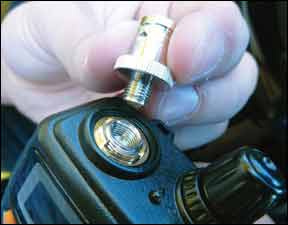
Dynon DX15: Compact, Capable
Its more or less a given that carrying a handheld VHF transceiver in the airplane is a good idea, for ground frequency monitoring, pre-start clearance getting and as a back-up comm. The market hardly lacks for choice and now it has one more to pick from. At Sun n Fun, Dynon Avionics announced the DX15 VHF air band transceiver to compete with Icom, Vertex and Sportys at a price point of $156 that we think is competitive with other radios. The DX15 itself is a compact and credible product, in our view. Its the smallest, lightest VHF portable weve tried, but that size comes with compromise. It doesnt have some of the higher end features that the Sportys SP-400 or Icom products do, such as built-in VOR or localizer/CDI capability.