











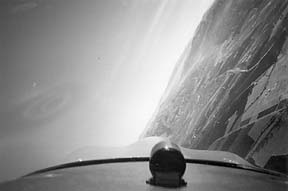
Remember that pilot personality self-survey, with the half dozen psycho babble attitudes guaranteed to make a smoking hole? There was resigned, anti-authority, impulsive, macho and invulnerable.
We think a more accurate way to assess whether a pilot falls into one of these groups is to connect him to an EEG and see which button lights up following the words, Caution wake turbulence, departing 757.
Would your button be Resigned? Impulsive? Invulnerable? If you don’t spend your spare time tearing up gyros for fun, the prospect of an uncommanded flight upset might make your blood run cold.
A better-than-average grasp of airmanship may cause you to understand that the instinct to pull away from trouble can get you killed. But the absence of practical training may we’ll relegate that understanding to the cognitive waste bin when you really do wind up inverted. Toward that end, we set out to find some solid courses of instruction in the sorts of emergencies and upsets the average GA Joe might encounter in the real world. We werent interested in aerobatic courses masquerading as emergency training but courses aimed sharply at surviving upsets and loss of control.
West Coast Visit
The most comprehensive offering of the sort we wanted was Rich Stowells Emergency Maneuver Training Program, operating from CP Aviation at Santa Paula, California.
Not only has Stowell authored a comprehensive book and a video on the subject, but this was also the only course we found that included specific training on dealing with control surface failures and off-airport landings, just the sorts of things GA pilots are likely to encounter.
Stowell graduated from Rensselaer in 1980 with a B.S. in mechanical engineering. Dutiful entry into the real world followed but the lure of flight beckoned. He has taught aerobatics and emergency procedures for more than a decade.
Nevertheless, its apparent that he still feels enthusiasm for both the subject and the students. He has authored a comprehensive book on Emergency Procedures ($29.95) as we’ll as a video ($69.95, $15 less with the book). We found these very useful, both as an advance introduction to the flight training and an after-the-fact means of review that wasnt dependent on adrenaline-impaired recollection.
Down time around Santa Paula really isn’t, by the way, so you shouldnt hesitate to team up with a friend for the EMT course. Youll enjoy waiting for the other student, as the Santa Paula Airport is Hangar Rat Heaven, boasting a wealth of exotic aircraft in daily operation as we’ll as an on-field restaurant we’ll equipped with outside tables facing the runway.
Two Modules
The EMT program has two distinct modules of interest for our purposes. The first consists of four lessons on stall/spin awareness, which is a prerequisite for the second module on general in-flight emergencies. (There’s also a third module on basic aerobatics.)
Each module is composed of roughly three hours ground and three hours flight time, broken up over two days. In other words, it takes four days to complete both modules in the same visit. Combined cost for both is $1065 per person, using both the Citabria and Decathlon. If you attend with a friend, ground school can be combined and the cost adjusted accordingly.