











There may not be widespread midairs out there, but we wiggle in our seats in busy airspace and non-controlled fields. If you fly a glider, rental or don’t have 10 grand in your budget for a traffic alerting system (TAS) install, a portable traffic system can fill the gap. But these arent active systems like TAS. Portable systems are passive, simply listening for 1090 MHz transponder transmissions of other aircraft. Some designs suffer from pulse suppression issues. The result is nuisance alerts that might have you reaching for the power switch in busy airspace. In a traffic-rich environment position accuracy is also a concern. Interpreting the data on a small screen-especially when its on top of the glareshield in a sun-splashed cockpit-is tough. Tying it to a portable GPS map screen solves this issue, but with added wiring clutter. Given that rules vary for LSAs and certified aircraft, we tested several configurations: Some connected to external L-Band antennas, some installed in the panel and some plopped on the glareshield (which became a projectile in turbulence). We tested in high-wing, low-wing and a helicopter. We also tested on the ground, evaluating effectiveness for spotting targets in the pattern before takeoff. We compared the units to on-board TIS and TAS systems for yet more drama. Our testing grounds was a slice of central Connecticut Class D airspace sandwiched between New Yorks Class B and Hartfords busy Class C. Finding threat targets to paint in any direction was not a problem. We admit to some tension.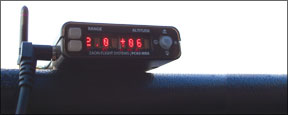
Zaon PCAS models
PCAS stands for Portable Collision Alert System, and the PCAS XRX Onyx (used to be SureCheck) is the flagship offering with a street price just south of $1500. It did the best at spotting traffic of any in the test group and has the most features.
The XRX can play its traffic on everything from the Honeywell AV8OR or later-generation Garmin portables to Anywhere Map software. It also interfaces with LSA/experimental cockpit displays from Grand Rapids, Advanced Flight and others. The XRX is unique with display of target bearing and two configurable screen options, including a top-down, 3-D quadrant view. It has a serial port and an audio interface on the rear of the case (rugged power/data cable optional). Speaking of audio, the XRX offers tone or voice alerts that can be routed through headsets with a plug-in adapter which Zaon calls Headset Direct. It worked we’ll with our Bose headsets when the extra wires werent getting in the way.
We think the XRX traffic presentation and azimuth function is the most detailed of any of the portables. The unit detects and paints up to three target aircraft and bearing data is depicted with on-screen arrows. It also has intuitive menus for setting range-either one, three or six nautical miles as we’ll as relative altitude window of 500, 1500 or 2500 feet. You can even configure whether the host aircraft is a high- or low-wing. An optional ground mode wont show traffic less than 200 feet above. For traffic resolution, the system uses integral altimeter, compass and turn and bank, and thermal sensors. As a result, there’s display of local squawk code, altitude, bank angle, bearing
and temperature offering some critical and useful flight data. It even works in a pressurized cabin.
If you are looking for a low-profile and inconspicuous model, the XRX has a small footprint but there’s an awkward signal amplitude/phase cancellation antenna protruding from the top of the case. In fact, we struggled to find a good way to keep the XRX in place and forward facing when jumping from aircraft to aircraft. Proper placement on the glareshield is critical to bearing resolution and you need to be careful mounting the unit too close to the structure. Zaon warns of potential aft-shadowing in metal airplanes-up to 60 percent in some cases. In the XRXs defense, we didnt use the included Velcro mounting dots or silicon feet during our testing.