











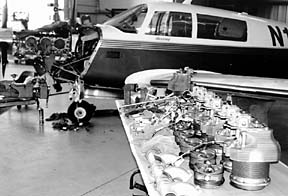
During that week your airplane is in for its annual, you have to dread the phone ringing. Or worse, the message that starts out, Yeah, this is Joe at AeroMech, we found three soft cylinders on your engine and need to know what you want us to do.
At that point, you have two options, neither pretty. Return the call and get the details behind the headlines or drive out to the airport, allowing a few quiet moments for 600 milligrams of denial to kick back the pain of a $6000 maintenance invoice. Yet most owners will face the cylinder replacement dilemma, either at a mid-time top or an overhaul. And then the recriminations start. Where did I go wrong? Should I have picked another cylinder type? What should I do now? Should I nurse the engine along or do a mid-time top overhaul?
Boiling down the choices, it sorts like this:
Do limited or spot repairs to specific problem cylinders.
A local complete top using your own reconditioned cylinders or remans.
Install new OEM or PMA manufactured cylinders.
The Road to a Top
Often, one answer lies in your logbook. Inactivity continues to be the bane of engine longevity, something we see everyday as airplanes flown 20 hours since the last annual come into the shop with corroded jugs. A frequently flown airplane may break now and again, but rusted cylinders wont be a problem.
Yet in many cases, an airplane flown regularly will still encounter unexpected cylinder problems or premature failure. By the term premature failure, we don’t necessarily mean a jug that tanks in the first few hundred hours or within the warranty period.
For the scope of this article, we refer to a total-time-in-service failure to occur somewhere about mid-time, or within about three-quarters of the way to recommended TBO. By failure, what do we mean?
Some definitions of terms, first: Outside of clear-cut mechanical failures such as cracked cylinder heads or stuck valves, the most common cause of having to do premature top-end work is low compression or high oil consumption, sometimes resulting in fouled lower plugs.
Both Continental and Lycoming have specifications for their engines on both counts and you should check the specs for your engine, not rely on airport folklore. TCM even goes one step further and calls for a special orifice/restrictor assembly to be used when measuring compression differentials with compression bleed-down gauges. don’t let an A&P talk you out of doing the manufacturer-specified compression check before you resort to drastic action. And get a second opinion, even if it means calling the factory direct.
Also, prior to putting wrench to metal and if the situation warrants it, run your engine around the patch a time or two and check compression again. Often, rings can be lined up with the gaps all in a row or there can be carbon stuck under a valve, skewing the compression readings. High oil consumption is another matter. Sometimes cylinder barrel glazing-lack of proper ring seating-can be the culprit and a hard run at full power with mineral oil might cure it without having to disassemble the cylinders. In desperation, it may be worth a try before topping.
Stop at a Top?
If you have to top, at what point does it make more sense to major it instead? This is a tricky decision to make when the numbers reach some point near or beyond mid-time for your engine. Obviously, at 600 hours into the run with soft cylinders and a solid bottom end, a top makes sense. At 1400 hours, it might not.
If your engine is near its recommended TBO, say beyond the two-thirds or three-quarters benchmark or 12 to 15 years since its innards have seen daylight, its nearly always economic to major it and often uneconomic to top it. The top-only strategy at high-time often leads to a sad why-did-I-do-that? sentiment later on.
A halfway measure-economically speaking-is to do a power-section- only overhaul on the engine core, sans the accessories, mounts, hoses and such, rather than the typical complete overhaul. Remember, major overhauls add measurably to Bluebook value while tops rarely do.
One or All?
If you have to top, the next decision is to do it surgically on one jug or the whole lot, or something in between. Logic suggests that since all the cylinders have been living and breathing off the same block, subject to the same air/fuel mixture, when one goes kaput, the others arent far behind. Sometimes thats true, often its not. It depends on why the suspect cylinder failed. The problem in doing low-compression/high oil consumption patch jobs is that youre buying the labor to remove nearly all of one bank of cylinders but you end up replacing or repairing only one jug per side.
Most of the baffling and the exhaust and intake manifolds have to be removed and so on. For another hour or two of labor, you can yank and inspect the other cylinders.
Failure to grasp this concept sometimes results in what we call progressive tops or eventual complete top overhauls done one or two cylinders at a time over a period of several years, with the owner paying for overlapping labor to R&R the basics and eventually doubling his costs.
Exchange, Fix or Buy?
Years ago, most shops had both the talent and equipment to do basic top overhauls in-house. No more. Now its the rare general airframe A&P who can even measure or inspect cylinders properly, grind or re-seat valves and perform quality top overhauls in-house. Most local repair shops send cylinder assemblies to specialty overhaul shops for repair.
So the choice is to send your cylinder assemblies out for spot repairs, rebuild or remanufacture them or opt for an exchange or new cylinder. Time generally rules this choice, as anxious owners opt to have exchange (or new) cylinders bolted on in order to get them back into the air within a day or two. This compares to weeks or longer to have your own cylinders re-worked by a specialty shop and re-installed by your local guys.
Exchange Types
If you know for a fact that you have first-run or low-time cylinders, our advice is to not give them up for un-known used/reman cylinders of dubious total time which may be floating around in the exchange pool. Smart owners know these facts prior to making this decision as there’s a probability that a high-time cylinder will have problems down the road.