











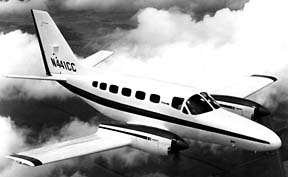
Despite an extremely rocky start in the late 70s, Cessnas top-of-the-line turboprop has recovered nicely and now commands a premium in the marketplace. The 441 Conquest/Conquest II stacks up very we’ll against the competition in an area of great interest to turboprop buyers: Performance.
History
In the aviation heyday of the 1970s, Cessna made a bold move by completely ignoring the fast-growing turboprop market (then populated by Beech, Mitsubishi and Rockwell, with Piper soon to arrive) by introducing the Citation fanjet. The idea was to leapfrog the competition and give the potential turboprop buyer the option of flying a real jet without having to jump up to a Lear.
At the time, it seemed a reasonable idea. The Citation could fly higher and somewhat faster than a turboprop, albeit at the cost of greater fuel burn and shorter range. It also had the cachet of being a real jet.
World events caught up with Cessna, however. The first of two gas crises hit, and the cost of jet fuel quadrupled virtually overnight. Suddenly the Citation looked a lot less attractive than a (relatively) fuel-efficient turboprop.
(A Conquest brochure of the time talks about fuel efficiency and range compared to a jet. There’s a graphic showing the Conquest flying a typical mission non-stop, compared to-surprise-a Citation, which has to make a fuel stop.)
Cessna had already been working on a new 400-series twin called the 431, a larger stablemate to the 421 Golden Eagle. The company changed course, and replaced the 431s enormous Continentals with a pair of Garrett TPE-331-8 turboshaft engines producing 636 HP apiece. The result was the 441 Conquest. (The piston version of the airplane became the 404 Titan.)
It came on the market late in 1977 as a 78 model, about ten years after turboprop business twins were first introduced. By this time, buyers had a wide range of airplanes to choose from. Beech had the widest variety, with several models of the 90, 100 and 200 series King Airs, Piper had the Cheyenne I and II, Mitsubishi had the long-and short-bodied MU-2s, and Rockwell had the Turbine Commander 690.
While much more expensive than some of these aircraft, the 441 boasted a more recent design and better performance. It cost a bit under $900,000 equipped.
Almost as soon as the Conquest started flying, however, disaster struck. Only two months after the introduction, an early production Conquest (serial no. 0006) broke up in flight, killing all seven aboard.
Only weeks after the crash, Cessna said it had found the problem: The elevator trim tab actuator had failed, causing elevator flutter. The crash resulted in an immediate suspension of the airworthiness certificates for the few dozen Conquests then flying.
The events that followed showed serious problems with FAAs certification process as it was then practiced. Then, as now, certification was an extremely complex and expensive process. In order to cut down on red tape and cost, FAA had granted special rights to major airframe manufacturers like Piper and Cessna that allowed them to independently perform tests, certify that a given aircraft design passed, and report to the FAA via a system of designees employed by the company. The administration would then routinely approve the tests without becoming directly involved.
The problem, of course, was that the process resulted in a clear conflict of interest. FAA designees, employed by an airframe manufacturer, don’t have a lot of incentive to make expensive waves or to dig too deeply into a design.
The reason that Cessna was so quick to find the problem with the Conquests tail was that the company had already known about it: The elevator and trim tab had been giving trouble for years.
The tail had been a point of contention during the design process. Engineers said it shouldnt be placed low in the propwash where it would be buffeted, while management disagreed. (The FAA later noted that The horizontal tail was configured as it is only because Cessna [1] was aware of problems encountered with the T-tail configuration utilized by other manufacturers; [2] they had no experience with the T-tail; but [3] they had extensive experience with the existing design.)
Very soon into the test flight program, there were problems with the trim tab actuator loosening. Multiple redesigns and beefups didnt solve the problem. It even got to the point that the flight test department started asking management to redesign the tail. The response was another beefup.
Under pressure to bring the airplane to market, Cessna used its FAA-granted Delegated Option Authority and certified the airplane as it was. The FAA, having no direct involvement in and therefore no knowledge of the ongoing actuator problems, gave its approval.
It should be noted that even without the DOA, the airplane would probably have been certificated. From a 1978 FAA statement: In view of the very general language of the regulation…there is nothing in the record to indicate that Cessna did not fulfill its responsibilities under Parts 21 and 23.
During the demonstration tour that followed certification, problems continued to occur. The pilot of the airplane used on the tour (the prototype-serial no. 0001) gave a statement to the NTSB during the investigation of the fatal crash of 0006 noting: While demonstrating [s/n 0001] I experienced elevator trim tab vibration…. Inspection…showed that the left trim tab actuator mounting bracket was cracking and that the left elevator hinge bearings had worn through.
He also provided a 10-item list of tail components which had to be changed during the tour. Four were retrofits of regular production parts to the prototype; the remaining six included the tab actuator and bracket, the elevator hinge bearings (replaced twice) and pushrods, the horizontal stabilizer bolts and a panel doubler.
Despite the ongoing evidence of tail problems, Cessna started selling airplanes. Even no. 0006, the accident airplane, was squawked for a trim problem only a month before the accident.
After the fleet was grounded and Cessna made its statement about the cause of the breakup, the company beefed up the actuator yet again. This fix was claimed to be fifty times stronger than it needed to be. The fleet was modified, and everyone was satisfied.
Then, six months after the first accident and three months after the design was cleared by FAA, another incident occurred. A Conquest encountered a severe tail vibration and pitch-up, but was able to land safely. Inspection revealed a broken trim tab actuator. Clearly, the latest fix wasnt working.Cessna finally decided to punt. While the fleet (now numbering 106) was again grounded, Cessna went back to the drawing board and completely redesigned the horizontal stabilizer.
Engineers decided that the tab actuator wasnt the problem, but a symptom of vibration. The new stabilizer had thicker skins, more ribs, and a second spar. There were also new elevators, a redesigned leading edge, dual trim tab actuators, and new aft fairings.
The company swallowed the entire cost, providing painted, balanced and ready-to-install tail assemblies to owners in the field, and picking up the cost of customer transportation while the airplanes were retrofitted. The company even elected to bring all existing airplanes up to 1980 model standards, effectively making even the oldest Conquest like a 1980 model.
After that rough and rocky start, the history of the Conquest was relatively quiet.
Early Conquest buyers actually benefited from the whole unfortunate affair. To protect the reputation of the Conquest, Cessna went to great lengths to support the plane. The company provided loaner airplanes to Conquest customers during the second grounding, and refurbished the airplanes to the latest configuration before returning them to service. One Conquest owner reported to us at the time that the company paid for a new paint job, all new windows, five changes of the HSI and dozens of other minor changes. Virtually every service bulletin we checked provided for full parts and labor credit. A used Conquest buyer can count himself lucky for missing the 1979 nightmare, yet reaping the benefits of Cessnas efforts to rebuild the airplanes reputation.
Production
There are very few differences between Conquests in the field. As we noted above, all aircraft below serial number 110 (78 and 79 models) are essentially identical, having been updated during the great tail retrofit. Serial numbers 153 and above had new engine combustion chambers to combat power-robbing carbon buildup. (This is called the 402 engine mod, more of which later.) Serial 173 and later (1981 models and up) were approved to fly up to 35,000 feet-5,000 feet above the original certificated max altitude. Both mods are retrofittable and should be part of any used Conquest under consideration.
Other changes included the usual evolutionary avionics upgrades. In all, 362 Conquests were produced: the last models were sold in 1986.
Performance
There have been several turboprops introduced since the Conquest came out, notably aircraft like the Beech Starship and Piaggio Avanti. Among its contemporaries, however, the 441 boasted a newer design: at the time of its introduction, it was the only aircraft in its class with a design less than a decade old.
The Conquest has excellent speed, range and climb performance, and its fuel efficiency is better than any of its contemporaries. Max cruise speed is 293 knots, second only to the MU-2 and 20-30 knots faster than comparable King Airs. But fuel consumption is far less than the MU-2s. At normal cruise power, the Conquest turns in 278 knots at 33,000 feet while burning about 375 PPH of fuel-a sparkling 5.0 MPG. This efficiency is reflected in an extraordinary 2,000-mile plus IFR range, among the best of turboprops, and considerably better than its stablemate, the Citation.
Thanks to the high-aspect-ratio wing, time to climb is also good. The Conquest will reach 30,000 feet in about 22 minutes, and its 35,000-foot ceiling in just over 30 minutes. The 35,000-foot limit is higher than most turboprops, and is a major reason for the airplanes high efficiency…not to mention desirability.
Operators report that the Conquest is routinely able to operate in the 30,000-foot range without the long, struggling climbs that limit most turboprop operators to the mid-20s in everyday use. Part of the Conquests efficiency stems from its ability to climb quickly and fly high, where turboprop efficiency is dramatically better.
The Conquests single-engine performance is about average for the turboprops. Vmc is 92 knots, right in the middle of the pack, and single-engine climb rate is 715 FPM. Climb gradient is also very good. Runway performance is about average; accelerate-go distance is about 4,000 feet at gross weight and standard conditions.
Loading
Useful load generally runs around 3,800 pounds in normal configuration. With a full load of fuel (475 gallons, or about 3,180 pounds), this allows a cabin payload of just over 600 pounds, or three people (including crew) and a bit of luggage. A full cabin of eight people and bags leaves room for 2,800 pounds of fuel, enough to fly about 1,500 miles with IFR reserves. Thats pretty good.
As with all long-cabin variable-seating airplanes, care must be taken when loading the last few tail-end Charlie passengers aboard. Aft CG limits can easily be exceeded unless counterbalancing baggage is loaded into the nose cargo bay. But generally, the Conquest has decent loading and balance characteristics, in contrast to aircraft such as the Piper Cheyenne II, which is extremely sensitive to aft loading.
Comfort
The Conquest has a big cabin. Its nearly 13 feet long, longer than any comparable turboprop except for the cavernous 100 and 200 series King Airs. Cabin width and height are about average, or perhaps a tad less. Seating arrangements range from eight to a rather crowded eleven. The Garrett engines make the Conquest a bit noisier than comparable PT-6-powered aircraft, particularly on the ground.
Handling
The 400 series Cessnas in general have a reputation for pleasant, we’ll harmonized controls, and weve heard some pilots say the Conquest is the best of the lot. It also has a trailing-beam type main landing gear for soft touchdowns and a wide stance for good runway handling.
We received no owner reports about single-engine handling qualities. However, the NTS (Negative Torque Sensor) system on the Garrett engines, a type of auto-feather device that quickly sets the propeller to a near-feather position in case of power loss, should help the pilot out in the critical task of quick identification and feathering of the failed engine. And were pleased to note that the Conquest flight manual drives home the fact that a slight bank into the good engine (which results in a skid) is necessary to achieve the listed single-engine performance.
Maintenance
The Conquest, as one might expect from such a complex aircraft, has had its share of service problems. However, Cessna has been generous with warranty repairs, and many Conquest service bulletins have been company paid. So its likely that any used Conquest will have had most service bulletins complied with.
Nevertheless, a potential buyer should be aware of several potential trouble spots, and carefully examine the maintenance history of the aircraft to determine compliance. Among the Conquests maintenance checkpoints:
Environmental system problems. Serial numbers 1-74 had lots of problems with vent fans, air cycle machines and other parts of the heating/air conditioning system.
Starter/generator failures. Improved brushes were fitted to serial numbers 106 and later.
Nose wheel. The first 62 airplanes had defective nose wheels, but even the improved model on later aircraft should be modified.
All of the above improvements were almost certainly made to the first 109 aircraft during the four-month grounding for the tail retrofit. Since the Conquests return to service, however, the following problems have cropped up:
Window delamination. Make sure the aircraft has the improved PPG windows. Several Conquests had to have a complete set of new windows.
Pressurization outflow valve. Older models were subject to cracked retaining rings, while serial numbers 120-176 were pinpointed for possible cracked poppet valves. The cracked retaining ring problem may have been related to the famous wandering Conquest crash that killed LSU football coach Bo Hein.
Wheel-well modifications. Problems with tire clearance led to a redesign of the wheel well. Older aircraft should have been modified.
Potentially the most serious Conquest problem (now that the tail has been fixed) is power loss in the Garrett TPE-331-8 engines. During 1979 and 80 there were reports of unexplained power loss as aircraft time passed 500 hours or so. One Aviation Consumer reader reports his airspeed fell off from the normal 290 knots to 260.
The cause was found to be carbon buildup in the combustion chambers, which caused erosion of the hot-section parts and consequent loss of power. In August 1980, Cessna and Garrett announced the 402 mod, essentially a new combustion chamber designed to reduce carbon buildup. We would not advise buying a Conquest without this mod, unless the price is correspondingly low to account for premature hot-section overhaul and combustion-chamber replacement. By this time, most if not all 441s should have the mod installed.
Other sources of power loss in the Garretts have proven to be due to inadequate compressor clearance, leaking anti-ice valves, flow divider problems, bad secondary fuel nozzles and leaking igniters. (Only the Champions leak: look for AC igniters.)
ADs, SDRs
Given the complex nature of an airplane such as this, its surprising that there arent more Airworthiness Directives to contend with.
The last Cessna-specific AD was 92-16-18, which had to do with replacement of Cessnas pedestal commuter passenger seats. More recent ADs include restrictions for flight into known icing (a blanket AD affecting most ice-equipped aircraft) and changes to the POH requiring changes to operating procedures at flight idle.
The airframe still has a few bugs, though. AD 92-16-7 calls for repetitive inspection of the horizontal stabilizer attach bulkhead for cracks. It seems the airflow around the tail is still capable of causing problems.
AD 93-2-1 calls for replacement of certain fuel manifold assemblies. 93-15-11 and 92-26-7 concern various gaskets.
A scan of the SDRs on file for the Conquest reflect most of the problems mentioned above. We noticed an extremely large number mentioning control cable problems (either frayed, worn or misrouted). There were also some reports that reflect poorly on Cessnas quality control, such as multiple rivet holes for the aft attachment of the horizontal stabilizer, oxygen regulators installed backwards and four-ply tires installed at the factory instead of the required six-ply.
Mods, organizations
Unlike smaller airplanes like Mooneys and Bonanzas, once you get up into the turboprop class there arent many mods available. Two which are significant are the conversion from the stock -8 engines to the more-powerful -10 variant.
Another is the conversion from the stock three-bladed props to new Hartzell four-bladed propellers. The new props reduce noise, improve acceleration and climb.
There are two shops that do mods on the Conquest II. Executive Wings does the engine conversion, prop conversion, plus soundproofing packages and winglets. West Star Aviation also does engine and prop conversions, along with soundproofing. West Star can also install a custom interior to convert a 441 to an air ambulance.
There is an owner/operator organization for the Conquest II. The Conquest Aircraft Operators Group, ((912) 244-1568).
Owner Comments
I bought serial 79 new at the beginning of 1979 and thus unwillingly became a member of Cessnas experimental department. When the airplane was flying again with a new tail in December of 79 (and a number of other updates and improvements), I was a fairly disgruntled customer. Cessna provided me with a 340 to use during the downtime, which was better than nothing, but not very satisfying after having laid out a million dollars for a turboprop.
I got reasonable service from that time forward. There have been many irritating problems; i.e., new paint job, new windows, five changes of the pilots HSI (and finally installing a Collins PD-108), dozens and dozens of minor changes, all paid for by Cessna, I might add, to their everlasting credit. The airplane was down for weeks at a time with these miseries. I run the 441 on Part 135, so the downtime has been lethal. The latest major catastrophe appears to be the engines. After 200 hours, we started getting a dropping off in true airspeed. At 750 hours we were getting 260 knots instead of the original 290. Once again, we had expense and downtime fooling around with recompensation and Lebow tests. Eventually we were approved for the 402 mod. Another month of being grounded. The cabin windows were replaced, too.
The airplane is a delight to fly. It literally has no bad habits. Our customers also find it comfortable and reasonably quiet. The range is sensational. I have flown all of the current turboprops and am typed in the Lear and Citation. I have 5,000 hours (ATP). The airplane is flown on 135 operations about 200 hours/year by another professional ATP, who spends most of his time looking after the maintenance and concomitant record keeping.
One flight problem does exist, however. When the airplane is flown at high altitude and then descends to ground level when the humidity is high, all of the windows fog up tight. This can happen during the approach (and has) or immediately after landing. The defrost blower is completely inadequate for the job. We have obtained a quote to fix this and you guessed it! Instead of installing a $50 blower, a $2,300 mod is required.
I believe the 441 is the easiest to fly and probably among the safest of the currently available turboprops.
-G.W. Balz
Kalamazoo. Mich.
I operated a Cessna 425 for five years and was very happy with the performance, and with the exception of an expensive hot section, pleased with the operating cost.
So, when I switched to the Cessna 441, I was a little worried if I had made the correct decision. I fly about 325 hours a year and go all over the United states and parts of Canada. I flew the Cessna 441 a little over a year and then at 3,000 hours did the Dash 10 [engine] conversion including four-blade McCauley props at West Star Aviation in Grand Junction, Colorado. The Dash 10 conversion is the single best performance conversion I have ever put on an airplane. I flight plan the airplane for 300 knots compared to 280 knots previously, and it consistently makes or beats that speed. I operate at 29,000 to 33,000 feet and the fuel burn is the same as the 425s was at 24,000 feet and 250 knots.
The Cessna 441 with Dash 10 engines is in a class by itself. What other prop jet can go to 35,000 feet, fly at 300-plus knots, burn 65 gallons per hour and fly 2,000 mile legs? The airplane is also very comfortable for up to eight people.
-Charlie Hillard
Fort Worth, Texas
I have been operating Conquest serial no. 0295 since January, 1983. I have approximately 4,700 hours in it. The airplane has 5,400.
The airplane should have had three batteries. This ought to result in quicker, cooler starts, and therefore lower hot-section inspection and overhaul costs.
It would be good if the empty weight CG could have been an inch or two farther forward. We operate with 100 to 150 lbs. of lead ballast in the nose bay for most passenger carrying operations.
The cabin auto-temperature control is virtually useless. It should be eliminated or redesigned to operate properly. The cabin temperature must be controlled with a manual toggle-switch system.
The cabin comfort is good to excellent. Occasionally the heat distribution during high altitude operations gets a bit tricky, but overall very good.
The autopilot pitch servos should be inside the heated pressure vessel. They become cold-soaked and troublesome during prolonged high-altitude or winter operations.
Converting to Cleveland brakes is a virtual must for cold latitude operations. They all but eliminated our landing with frozen brakes, blown tires and ruined wheels.
Crew station comfort and outside visibility are very good. The panel layout was the best in the business in 1983 and very good even now. I do think the fire/firewall shutoff buttons should have been located outboard of their respective annunciator panels; might have reduced the risk of pressing the wrong one at a critical moment.
The handling characteristics are a pleasure. Control harmony and response to inputs is simply superb; the airplane is wonderful to fly. The trailing beam landing gear makes nice arrivals the rule rather than the exception.
I believe the 441 to be one of the finest combinations of power, performance, range and economy in its class. It had few serious competitors in the 70s and 80s, and may have even fewer now. It is in a class by itself.
-Lyle W. Hilden
Bismarck, N.D.
Also With This Article
Click here to view charts for Resale Values, Payload Compared and Prices Compared.
Click here to view the Cessna 441 Conquest features guide.