











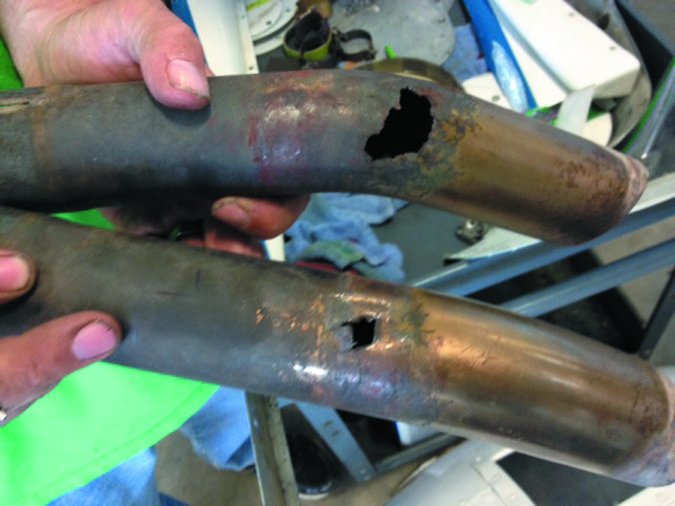
As aircraft owners and pilots, we seem to pay far more attention to the middle portion of our powerplants-where reciprocation takes place-than to the area where the products of that reciprocation exit. It seems to be worthy of only a passing glance on preflight with, at best, a tug on the exhaust pipe to see if it’s still more or less attached.
The discharge portion of a powerplant has a pretty nasty job and lives in an environment that may we’ll be the definition of harsh. I think the FAA’s description in its Airframe and Powerplant Mechanics Powerplant Handbook understates things: “. . . a scavenging system that collects and disposes of the high-temperature, noxious gasses as they are discharged by the engine.” The reality is that those pipes bolted onto the engine eat flame, endure corrosive gasses that attack their very structure amidst intense vibration and are charged with safely channeling all of that heat and excitement to a point outside of the aircraft where they can do no harm to the trusting occupants of the cabin.