










Register

Cheap Flight Timers: No Frills Functionality

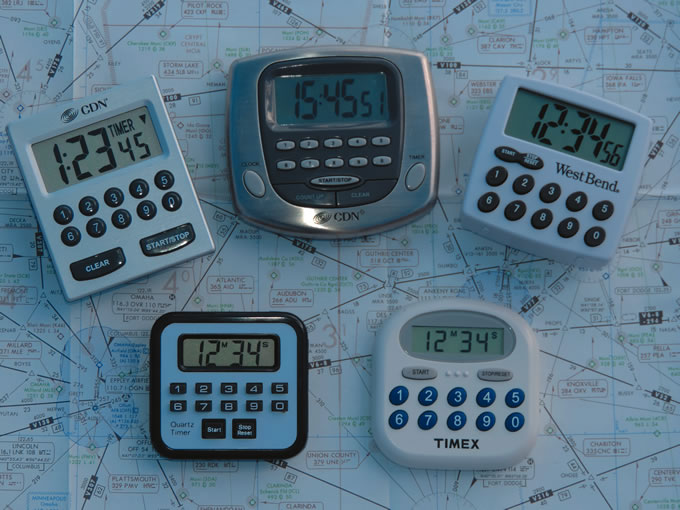
Given today’s avionics and RNAV approaches, do you really need a timer? Truth is, many of the devices in our panels and on our portable gadgets already have a timer built in. Using that timer, however, can be a challenge as the sequence of commands to access it in the Garmin G1000, for instance, might not be something you’re going to always remember or find sufficiently convenient. So, we think a dedicated, standalone timer is still useful. Sure, you could use the timer function in your smartphone, on the Pebble Smart watch or the one in Garmin’s D2 pilot watch, but we think timers are best placed within the instrument scan.

Given today’s avionics and RNAV approaches, do you really need a timer? Truth is, many of the devices in our panels and on our portable gadgets already have a timer built in. Using that timer, however, can be a challenge as the sequence of commands to access it in the Garmin G1000, for instance, might not be something you’re going to always remember or find sufficiently convenient. So, we think a dedicated, standalone timer is still useful. Sure, you could use the timer function in your smartphone, on the Pebble Smart watch or the one in Garmin’s D2 pilot watch, but we think timers are best placed within the instrument scan.

Still, would you actually use the thing? Yes. You’d still use it to time fuel tanks, power reductions on descent when concerned about shock cooling, maybe for timing a turbo cool-down after landing and, yes, on the occasional non-RNAV approach.

Frank Bowlin

Frank Bowlin, CFI/CFII/MEI, ATP is the editor of IFR Magazine and has contributed to Aviation Consumer and Aviation Safety. Active since VORs were new, he's flown more than 40 types, ranging from B-something airliners down to J-something taildraggers. Today, he mostly flies his Cessna 340A over 100 hours a year for both business and pleasure.