











Whats the use of takng a Chevy Impala, throwing on some extras and pretending its a Jaguar?
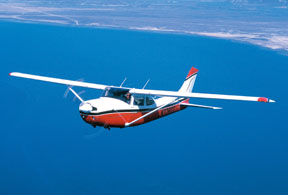
Some pilots wondered the same thing when Cessna took that sedan of airplanes, the roomy, drafty but handy straight-legged 182 and gave it folding gear and the option of a turbo for that big Lycoming O-540.
Those who love the 182s all-around utility and mostly good manners had no problem understanding what Cessna had done. The airplanes decent but less-than-stellar cruise speed had been its big drawback but, in one bold stroke, Cessna had made the airplane go 15 knots faster at the same 12 to 14 GPH fuel burn.
No wonder the model sold we’ll initially, until the industry hit a brick wall within a few years of the retractable Skylanes introduction.
Model historyCessna introduced the R182 Skylane RG in 1978, making almost 600 of them that year. The total run, including the turbocharged version, would reach 2032 through 1986, when a mere nine were built before Cessna took a powder from the single-engine market. Thats not many airplanes compared to all the M20 Mooneys or Bonanzas out there.
To create the model, Cessna took the popular 182 and gave it a variation of the folding electro-hydraulic gear used on the 200-HP Cardinal RG, which had been introduced two years before. The R182 (thats the correct type designation, not 182RG) got a bigger Lycoming than the 182s 230-HP Continental O-470; the retractable came with the Lycoming O-540-J3C5D, which required adding four inches to the length of the cowling. The turbo option was offered on the 1979 model, when Cessna first began building the line with integral fuel tanks instead of those troublesome bladders, which leaked and trapped water in wrinkles. The integral tank never needs resealing or repair. Some 727 R182s and TR182s were built that year. Fewer than half that number were built during the 1980 model year and the total fell off each year thereafter.
Aside from the switch from bladders after 1978, Cessna made only minor changes in the airplane through its eight-year run. The alternator and over-voltage sensor were swapped for an alternator control unit and the high-voltage warning light was switched to a low-voltage light in 1979. The next year a new latch and pin system was introduced to reduce the notoriously drafty fit of the doors-there are two on the Skylane, which is as celebrated for its ease of entry and loading as it is reviled (or patiently accepted) for its so-called “gappy” Cessna construction and fit.
In 1980, an avionics cooling fan became standard and the oil cooler was relocated from the left forward baffle to the firewall. Also, the battery was moved from the firewall to the less hostile environment of the tail cone and for easier access. A new muffler for better cabin heating, especially in the rear seats, addressed another Skylane complaint.
In 1983, Cessna replaced the amber “gear up” light, which stayed on if the gear did not lock down, with a red “gear in transit” light, which stayed on whenever the gear motor was running.
With the gear tucked up, the Skylane will build up speed when the nose drops. It helps that the first 10 degrees of flaps can extend at 140 knots. In 1983, Cessna beefed up the flaps further so they can be lowered to 20 degrees at up to 120 knots.
The wing root ventilators were redesigned in 1980, but they are known for getting loose with age, spraying water into the cockpit in rain and popping open all by themselves. Duct tape over the wing inlets is the standard field solution. Skylane windshields also tend to leak and the R/TR182 is no exception. The only solution that works is removing the windshield and resealing it. Watch for shops that use silicone sealant instead of the proper felt stripping. Windshields expand and contract; hardened silicone does not.
The R/TR182 has no main gear doors. But it does have nosegear doors and early on they occasionally caught the cowling skin and got stuck. A 1983 redesign addressed the problem. In 1984, the airplane got new composite fuel caps and rear-seat shoulder harnesses as standard equipment. Dual controls became standard instead of optional that year, but whos seen any single-control Skylane RGs around?
PerformanceThe Skylane retractable is a solid cross-country airplane with a 150-knot cruise commonly reported at a fuel burn of 12 to 14 GPH. With its 88-gallon usable standard tanks (on 1979 and later models), it can go far. Its range and its 1200- to 1300-pound useful load give it lots of flexibility as a good hauler.
Those big tanks, which provide better range than early Mooneys and Bonanzas, leave less of a useful load than a 250-HP Piper Comanche with full tanks-but that comparison doesnt do justice to the airplanes flexibility.
With full fuel, four “standard” FAA grownups can go on a long trip-close to 1000 miles, depending -and share a single overnight bag. Fly with less fuel and you can carry just about anything you can fit into the airplane and still fly for hours. Weve said it before and cant resist saying it again: Your bladder cant last as long as the fuel supply when you cruise an R182 at lower power settings, say 55 to 60 percent.
Another big attraction is that the R182, with its big, fat wing, big flaps, high flap extension speeds and good prop clearance, is just as handy getting into and out of smaller airports and rougher fields as it is keeping up the speed on the ILS into a Class Bravo airport even as it drops full flaps at the last minute and gets out of the way at the first turnoff.
Try that in a Mooney. A few owners do complain, however, that because the tires on the RG are smaller and inflated to higher pressures than those on the fixed-gear Skylane, it can be a little squirrelly in crosswinds and harder to control on the runway.
Its 235 horses also take some pilots by surprise when they pour on the coal: A Mooney or Arrow pilot used to 200 HP might be surprised by the left-turning tendency of the Skylane RG at full power and high pitch. These traits, and the heaviness of the elevator, may explain a number of runway and go-around crack-ups over the years.
Comparisons are not made between the R182 and the Bonanza, which pilots do not consider a lower-priced choice in the used market. So Aviation Consumer a few years ago conducted a side-by-side flyoff between the R182 and a 201. It found the R182 had the better climb rate and more dexterity getting into and out of a variety of airports. The Cessna hauled more, both in weight and volume, and was a little faster than the sleek 201, but of course at 20 to 40 percent more gallons per hour.
The turbocharged version is significantly faster after its easy climb into the low teens, where it can achieve 165 knots TAS and more at higher altitudes. The normally aspirated R182 climbs well, too, with 1000 FPM typical at lower altitudes at gross weight and standard temperature. The turbo, its adoring pilots have told us, will lope up to FL 200 at 1000 FPM the whole way up.
Handling, CabinIn the air, the 182RG is a gentle, forgiving bear with a solid ride and feel. An Avcon writer used it to practice airwork for his CFI certificate and found it gentler than a 172, unwilling to bite even in a fully cross-controlled stall. Still, it requires some skill to fly well. It is not a feet-on-the-floor airplane like the Cherokee and its derivatives.
Pilots who don’t use as much rudder to help roll out of a turn as they used rolling in will wallow all over the sky. (They never seem to notice how far the ball slid outside the cage.) The RG likewise needs nimble and firm rudder work on and near the runway to keep the nose straight on takeoff and in crosswinds.
Most notorious is the heavy elevator feel, something youd expect pulling back on a DC-3 yoke. The heavy pitch and the Skylanes brick-like descent rate with full flaps and gear out-something youd expect of the Space Shuttle-have led to a fair number of hard landings and runway loss-of-control accidents. don’t try to land power-off with full flaps; the timing of the roundout and flare will be so critical as to invite a hit or a drop. Keep some power in. Watch out especially for forward-CG landings, with full fuel and only two aboard in the front seats. And before buying a used Skylane RG, check the logs, gear and the firewall carefully for evidence of damage.
The Skylane cabin is famously roomy and easy to access with a wide door on each side and windows that open on both, in most models. The baggage door is low to the ground and convenient. That big box of a cabin, however, flexes and the door and windshield fit can get sloppy over the years. That makes for drafts and water leaks. The original seats are okay except for their cheesy plastic and fabric. They are adjustable in height and seatback angle with lots of parts and pieces. Watch out for broken adjusters as we’ll as worn seat tracks, the subject of a well-known AD affecting many Cessna singles.
MaintenanceA look at the past 10 years of Service Difficulty Reports (1996 to 2006) confirms that landing gear malfunctions and problems continue to top the list of R/RT182 maintenance woes. Out of 85 SDRs during that period, 17 or 20 percent had to do with sheared bolts, failed downlock pins, cracked pivot assemblies, stuck doors and the like.
Thats an improvement over the rate seen in earlier SDR reviews. Owners who wrote us recently had no complaints about the gear. One said its better for grass strips than the fixed-gear Skylane because its sturdy and there are no wheel pants. Pilots who know how to avoid hard landings, we suspect, probably have landing gear systems that work just fine (as long as a previous owners mistakes have been properly repaired).
The next most common issues found in the SDRs were internal engine problems, including worn or stuck valves (six out of 85); cracked spinner back plates, six cases; magneto woes, such as missing teeth on the distributor gear, six cases; and carburetor trouble, including a failed inlet nipple that allowed fuel to spray inside the cowling and ignite, burning a hole in the belly aft of the firewall.
Shimmy damper problems have plagued the RG but do not stand out in the most recent SDRs. A Cessna service bulletin (80-67) was aimed at correcting the problem with a mod kit and it appears to have been successful. Also in the past, service bulletins dealt with balky throttles. Any RG should have the recommended mods installed.
Other complaints over the years have included instrument lights that flicker out, leaks around the windshield and wing root, turbos leaking oil, shearing vacuum pump drive shafts, poorly aligned aileron hinge cotter key holes, failing Bendix starters, cracked exhaust stacks and worn alternator mount bolts.
Be aware that in the past, the R/RT182 had more than its share of bugaboos. Recent history and owner comments suggest, however, that at least some of the old RG problems have been ironed out. There have been no ADs specific to the RG series in recent years. Notable old ones involve leaky flush-type fuel caps and wrinkles in the 1978 fuel bladders that trapped water. More recently, AD 2000-06-01 requires inspection of the fuel strainer assembly and, of course, AD 2005-19-11 is the infamous Lycoming crankshaft replacement directive.
Mods, Owner Group
The Cessna Pilots Association is a great source of information for all Cessna owners. A membership is $45. Visit www.cessna.org/ to sign up. AOPAs member section (www.aopa.org/) has a great summary of the hundreds of mods available for the Skylane, some of which can be applied to the RG series, including kits for drag reduction, STOL performance, replacement tanks and caps for the 1978 bladders and caps and backup vacuum and electrical systems. we’ll respected speed mods come from Horton STOLcraft in Wellington, Kansas (620-326-2241) and Knots 2U, Ltd. of Burlington, Wisconsin (262-763-5100, www.knots2u.com/). If there are still RGs out there with the old bladders, Monarch Air and Development Inc. in Oakland, Oregon has the fix (541-459-2056, www.airsport.com/).
Owner Feedback
I bought N79MR, a 1979 TR182, in 1998 with 4500 hours. It now has 5300 hours and 450 SMOH, which included new Millennium cylinders and new three-blade prop. I owned an Archer for 10 years and was looking for speed.