











If youre absolutely determined to kill yourself in an airplane, you’ll have to find a better way to do it than gassing yourself with carbon monoxide. The world is so awash with CO detectors across a range of prices and capabilities that we cant imagine many owners havent at least considered these gadgets. And the good news is that all of them work quite well, even, you might be surprised to know, the $4 cheapie stick-on detectors that all your friends tell you are a joke. (They arent.) How real is the risk of your exhaust or a perforated heater doing you in? Its real enough, although not the level of risk that should keep you awake at night. On the other hand, given the choices in detector technology, there’s no reason you cant eliminate the risk entirely or at least tamp it down. We were surprised to learn that the market has shifted quite a bit since we last examined detectors five years ago. There are many more small portable units and even a couple of panel mounts. We didnt attempt to try them all, but in this review, were examining some of the more prominent offerings, which offer more than enough choices.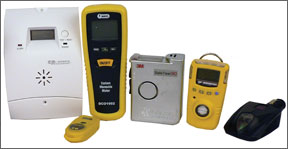
Three Categories
The gadgets sort into three basic categories: The familiar stick-on patch detectors that have been around since dirt was invented, sophisticated and sensitive portables and a line of panel mount devices dominated by a company called CO Guardian.
We obtained samples of each type and tried them in a shop-built gas chamber which we charged with low levels of CO from a laboratory-grade cylinder. We were able to expose the detectors to various levels of CO from under 100 PPM to several hundred PPM.
The important performance expectation is low-level sensing. Although the EPA says that acceptable levels of exposure in the workplace can be up to 50 PPM over an eight-hour period, as a certification requirement, the FAA requires that the cockpit have levels no higher than 50 PPM.
Yet at levels as low as 10 to 40 PPM, its possible to suffer symptoms of CO poisoning such as headache, blurred vision and impaired judgment. That last item is the main worry. Ten PPM isn’t much CO, but, like hypoxia, a mild case of CO exposure could lull you into a critical misjudgment or result in poor decision making