











A significant fraction of the aviation community is made up of pilots who are less interested in getting rapidly from Point A to Point B than they are in just going aloft to enjoy a fine day and perhaps being able to top off the flight with a loop and a roll or three. Rather than fantasize about bigger engines, retractable gear, turbocharging and glass panels, they dream of an airplane that will let them enjoy

Willis Damasio
the sky by doing more than flying straight and level while still being able to go somewhere at a reasonable pace. The explosion of the homebuilt, ultralight and the budding Light Sport industry in recent decades is testament to the demand for simple, inexpensive airplanes suited to the pure joy of flight. Unfortunately, for those who prefer factory-built airplanes, the choices are limited, especially if one has the desire to enhance that joy with the sensuous pleasure of aerobatics. The American Champion Citabria is right up at the top of the list for those looking for a simple, fun flying machine capable of most inside positive G aerobatics. (Citabria is “airbatic” spelled backwards. Apparently Citaborea just didnt sound right.) Available in several versions, with varying powerplants and equipment, the Citabria and its stablemate, the Decathlon, have a great deal to recommend it to the recreational flyer: Simplicity, economy, few vices and-not insignificantly-support by a viable manufacturer.
History
The Citabria, which remains in production, is based on the American Champion 7-series airframe. The similar, although more rugged, 8 series is used for the Scout bushplane and more fully aerobatic Decathlon, which arent covered in detail here. There are a few things to watch for when looking for a Citabria, most notably the wooden wing spars found in pre-1990s models. There’s also the possibility of strut corrosion, similar to what Piper owners have been finding for some years. The good news is that American Champion can retrofit new, all-metal wings onto older airplanes for owners who prefer them, and many Citabrias have undergone the upgrade. In addition, a gross weight boost for the metal-spar versions adds utility to the fleet.
The Citabria traces its roots back to the Aeronca Champion (which everyone called the Champ), one of the crowd of postwar tailwheel trainers that included the Piper Cub, Cessna 120 and Luscombe. The postwar production boom resulted in tens of thousands of these airplanes, but by 1951 the market was saturated and production ended. The 7EC Champ was returned to production periodically and is now being manufactured for the Light Sport market by American Champion as the Champ, with a 100-HP Continental O-200 engine.
In 1959, the first airplanes that would eventually become Citabrias appeared, dubbed 7GC. In the years that followed, a fistful of airplanes debuted, each called
Citabria. Eventually there were six variants. In some cases, the differences between models are minor, in others more significant:
7GC-
Produced only in the 1959 model year, it had flaps and a 140-HP Lycoming O-290.7GCB-
Essentially the same as the 7GC, but with a 150-HP Lycoming O-320; produced from 1960 to 1964.7GCA-
Aerobatic, with the same Lycoming as the 7GCB. No flaps. Introduced in 1967 and in production today as the 7GCAA Citabria Adventure.7GCBC-
Aerobatic, same as the 7GCAA, but with slightly longer wings and flaps. Also introduced in 1967 and in production as the 7GCBC Citabria Explorer.7KCAB-
Introduced in 1967 as a more capable aerobatic ship, with a fuel-injected 150-HP Lycoming and inverted fuel and oil systems. It was produced through the 1977 model year.7ECA-
Introduced in 1964 as an aerobatic follow-on to the Champ. Originally, it had a 100-HP Continental O-200, soon replaced by the 115-HP Lycoming O-235. It is in production as the 7ECA Citabria Aurora.The 8-KCAB-150 and -180 appeared in 1971 and 1977, respectively and sported both more power and constant speed props, which are nice for combination aerobat/cruisers.
Most of these airplanes were built by Bellanca, which went under in 1980 at the beginning of the GA slump and American Champion acquired the taildragger line. It made a brief attempt to revive the line in 1984, but the timing wasnt right and
production stopped again. In 1992, American Champion started delivering Decathlons, followed a year later by the Scout. 1994 saw the reintroduction of the 7GCBC Citabria, followed by the 7ECA in 1996 and most recently the 7GCAA.
The GCBC model has proven the most popular, followed by the KCAB. The latter, built as a low-end aerobatic airplane capable of inverted flight, did not last largely due to competition from the Decathlon. The Decathlon, with its shorter wings and semi-symmetrical airfoil, was a better buy for aerobatics, though the KCAB is still a fine airplane.
Todays Citabrias are essentially the same airplanes introduced decades ago (although American Champion offers engines with up to 180 HP), with one significant difference: the wing structure. The Bellanca airplanes had wooden wing spars, which sometimes suffered cracks and were the subject of ADs. American Champion came up with an all-metal structure and incorporated it into all new aircraft. Owners of earlier models can also have the new wings retrofitted. The cost is steep at (depending on model) $15,000 to $18,000 per set plus $800 to $950 installation and $900 for paint, but the new wings boost the gross weight, are free of repetitive inspection requirements and certainly increase the resale value of the airplane.
Even though the number of aviation lawsuits has dropped, its clearly in American Champions interest to get as many of the old wings out of circulation as possible. This is reflected by a core charge of $4000 per wing, refunded on return of the original wings-even those that are badly damaged.
The factory can also supply new, improved front struts for $990 a set and aileron spades for $550. All of these are worthwhile improvements to older aircraft. When shopping for a Citabria, extra consideration should be given to upgraded airplanes.
Offering the upgrades has proven a shrewd business move, affording the factory a source of cash flow that isn’t dependent on the sale of new airplanes while simultaneously reducing its liability exposure.
Handling
As tailwheel airplanes go, the Citabrias have benign ground handling characteristics, making them excellent transition training vehicles. Nevertheless, pilots with little or no tailwheel experience must remember the fundamental differences between conventional and trigear airplanes. On the ground, tailwheel machines are more prone to swapping ends due to the location of the center of gravity aft of the main landing gear.
This means the pilot absolutely must stay alert to side loading of the landing gear. “Tracking the centerline is everything,” one pilot told us. It also means that the ailerons must be properly positioned for the wind when on the ground. Learning that skill matters. In the last five years, there were 65 reported Citabria accidents, 37 of them were mishaps tied to landing rollout, almost all due to pilot error.
Once aloft, the Citabria is forgiving in virtually all flight modes, although it is definitely a “rudder” airplane requiring work to keep the ball centered due to adverse yaw. The elevators and rudder are nicely harmonized while the ailerons are comparatively heavy and less effective. Adding spades corrects this characteristic and are, in our opinion, worth the price.
Stalls are mild, giving aerodynamic warning whether flaps are up or down and stall speeds are as low as about 40 knots for the flap-equipped 7GCBC. Citabrias will spin nicely if the ball is not near the center at the stall. Spin recovery is positive,
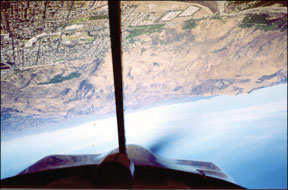
but requires several hundred feet, even if initiated immediately. Although stressed and certificated for loops and rolls, the Citabria is not a serious competition-level machine. Its ideal for initial acro training and unadulterated fun, but only the 7KCAB has an inverted fuel and oil system. The other variants are generally limited to positive-G or G-neutral maneuvers such as inside loops, barrel rolls and the like. One potential handling trouble spot is PIO (pilot-induced oscillation) during landings. Although not unique to Champions, the spring-steel main gear can bounce the airplane if the pilot dumps it too hard or if he or she fails to go around. More bounces, a groundloop and/or nose-over and/or prop strike can result.
PerformanceThe cruising speed of the Citabria is sedate: 100 to 110 knots or so, depending on model, so a number of owners use them for travel. The extra power afforded by the larger Lycoming shows up mostly in greater climb rates. The longer wings of the 7GCBC help; according to Champion, the 7ECA climbs at 740 FPM, while the 7GCAA moves up at 1167 FPM and the 7GCBC climbs at 1130 FPM.
Takeoff and landing performance are impressive, particularly for the wood spar 7GCBC. According to the
Aircraft Bluebook, takeoff ground roll is only 296 feet, and a 50-foot obstacle can be cleared in 457 feet, although in our opinion, those numbers are a tad optimistic. Landing distance over a 50-foot obstacle is also in the 900-foot range, with about a 500-foot ground roll. (Older airplanes with lower gross weights will do somewhat better.)Loading, Ergonomics
An important thing to note about the new metal wing structure is that it gives the 7GCBC Citabria a gross weight of 1800 pounds, compared to 1650 for the older models. Gross for the 7GCAA and 7ECA was upped in early 2001 to 1750 pounds for metal-spar versions. The Citabrias, especially early versions, are not known for their load carrying capacity. While the lifting ability varies according to model and
205
equipment, in general its not possible to fill the seats and tanks at the same time. When two large people wearing parachutes consider aerobatics, they may be approaching gross weight even before fuel is added. Owners report that staying within the CG envelope is generally not a problem.
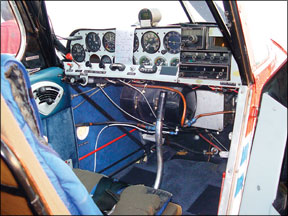
The cockpit of the Citabrias is laid out so that everything falls easily to hand. Solo is from the front seat and visibility is fair in flight. In the three-point attitude, the nose doesnt block forward visibility. The front stick length gives just the right leverage for the control gearing, especially with aileron spades. The rear stick is short and instructors report that it often takes both hands to get full aileron deflection in a roll in a non-spade aircraft. Each throttle (one for each seat) is where one reaches almost unconsciously with the left hand; the carb heat knob is immediately below.
Most Citabrias have toe brakes, although some of the earliest have that bane of many pilots existence–heel brakes. Front seat travel is limited and short pilots may have difficulty getting full rudder throw without using an extra back cushion. Citabrias are some of the better airplanes for tall pilots, especially as the high roofline means not having to bend over to look out the side windows. The seats are surprisingly comfortable and the cushions snap out quickly when it is parachute time. The panel is low and slender, making installation of more than basic VFR instruments and radios challenging. Headsets or ear plugs are a must as the cockpit noise level is about on par with the proverbial boiler factory.
The fuel system is utter simplicity, with three sump drains, one direct-reading mechanical gauge in each wing root and a simple fuel selector. Fuel supply is by gravity feed, of course, but there’s also a boost pump.
MaintenanceAlthough maintenance is simple, it pays to seek out a mechanic whos familiar with tube-and-fabric airplanes and, if looking at an airplane with the older wing, who has experience with wood. The covering is Dacron, which is durable, although not good for a lifetime. Owners suggest keeping the airplane out of the sun, since a re-cover job can be costly and time consuming.
Owners and mechanics tell us that aside from making certain the ADs are complied with, especially AD2000-25-02 R1 on wooden spar airplanes, a serious look at all of the fuselage tubes, especially those aft and low, for corrosion and proper inspection of the wooden spars, there are no particular trouble spots to watch for when shopping for a used Citabria. Early model wing struts had thinner, .035 wall
239
thickness as compared to the more recent .049 wall thickness. AD 77-22-5 called for replacement of the old struts, and most if not all airframes should have the heavier struts installed; the presence of a placard limiting speed to 153 MPH is proof of the thinner struts. Also watch for cracked seat backs. There have been accidents in which the pilots seat back failed, planting his torso on the aft stick with disastrous results. The landing gear U-bolts can develop cracks, especially in airplanes subjected to rough fields or training.
Its difficult to find a Citabria that has not been groundlooped at some time in its life, simply because they are tailwheel airplanes. A groundloop by itself is not cause for alarm; the trouble arises when the loss of control results in a wingtip and/or prop blade hitting the ground or the landing gear being damaged. Wing damage repair is not always recorded in the logbooks, so inspect any Citabria for wing repairs, especially, as the experts tell us, that most wood spar compression cracks can be traced to an impact event, usually from a groundloop. A full set of service bulletins should be a part of any owners library, since they can point out areas of weakness.
The new wing structure was developed as the result of cracks in Decathlon wing spars, not those of the Citabrias, so the presence of wood is not necessarily a deal-killer. Nevertheless, years of movement of aluminum ribs against a wood spar means wed look carefully before buying a wood spar Citabria. Weve taught aerobatics in Citabrias and we know that students can err and blast right through redline airspeed, so a buyer should assume that an airplane capable of aerobatics has been doing them and that pilots have made mistakes in the process, so inspect the wing and tail carefully.
Fortunately, the Citabrias systems are simple and inexpensive to maintain, so previous owners are more likely to have kept things up to snuff than owners of more complex, expensive and labor intensive hangar queens.
SupportUnlike many airplanes, there’s a variety of sources for parts. First and foremost, of course, is American Champion. Theyre located in Rochester, Wisconsin (262-534-6315) or on the Web at www.amerchampionaircraft.com. We like the fact that the factory puts a number of its service bulletins and technical information on its Website as a free service.
Another source is Santa Paula, California, home of Air Repair (805-525-8616) and Screaming Eagles (805-525-7121), a pair of shops that specialize in the line. Air Repair can sell you copies of all the factory service bulletins, a worthwhile investment.
For owner support, it appears the Citabria Owners Group has disappeared but there’s a Bellanca-Champion Club based in Coxackie, New York, with a Website at www.bellanca-championclub.com. This site doesnt seem to have a great deal of technical information available.
Owner FeedbackIve owned my 1976 Bellanca Citabria 7ECA for 27 years. I bought it in 1980 with 225 hours for $12,500. It sold new for $13,700. It now has 1450 hours. It came from the factory with the aerobatic group, which includes wheel pants, greenhouse roof and scalloped paint scheme. I have added a seat heater, intercom and transponder with Mode C.
My Citabria has always been hangared. The fabric is original with some cracks in the paint. Maintenance costs approximately $500 per year, including the annual inspection. It has no oil filter so I change oil every 20 hours. The engine has not been overhauled in 245 hours, but did have work on one cylinder. I had to replace many nails holding the ribs to the spar on the right wing, caused by rolling the airplane to the left.
My 7ECA is STCd for autogas which I have used for 20 years, burning 6.5 to 7 gallons per hour. Most of my flying is for fun: loops rolls, spin, lazy eights, steep turns. My cross country trips are 200 miles or less. I have owned and flown many other airplanes in the last 27 years, but obviously I have a soft spot in my heart for my Citabria 7ECA. It has been a sound, economical, fun and dependable aircraft to own.
Dick Rodencal
Wisconsin Rapids, Wisconsin
I have owned, either alone or in a partnership, three Model 7 Champion/Citabrias: A 1946 7DC (in this case 90 HP), a 7GCAA (150 HP) and presently a 1974 7ECA (115 HP Lycoming O-235-C1). Obviously, I find these to be fun flying knockabouts. They are pleasant flying, with safe and predictable characteristics. I also find them to be ideal flight trainers.
As far as maintenance issues are concerned, there is nothing too exotic here, just robust tube-and-rag construction and well-known, reliable engines. For those contemplating purchasing one, condition is everything, as is the case on most of our aging GA fleet. Give more for a good one, you’ll never be ahead buying a fixer-upper. Sadly, logbooks don’t mean that much these days as they depend on honest people to keep the records and I have not found that to be that common. This seems to be especially so on the lower end of the aircraft scale this type occupies.
For example, when the AD came out for the inspection of the wooden spars for compression cracks, we owned the 7GCAA. Turns out, it had a compression crack in the classic area-just outboard of the strut attach doubler. Using the bend-a-light and mirror method, it appeared something wasnt quite right, although it was quite hard to see. When we opened the fabric above the area, it became clear that someone had sanded the surface imperfection on the top of the spar to make the crack less obvious. A little ink dabbed on the grain revealed a serious compression failure in the grain. Amazing.
Again, on the 7DC, a garden variety span-wise delamination of a glue joint led to spar replacement. When the fabric came off the rest of the story became apparent. The aircraft had suffered spar tip damage and instead of a proper repair, the spar was trimmed about 7 inches, the tip bow was reformed and the damage covered over. The span was 7 inches shorter on one side than the other!
An extensive pre-purchase inspection by someone who truly knows the type, or at least knows ragwing aircraft, is essential. The fuselage truss that the landing gear attaches to is particularly vulnerable to damage in the event of groundloops. Lets face it, at this point in time virtually all of these have suffered runway incidents of one sort or another.
Currently, the 7ECA we own has been almost completely rebuilt since 2001. New wood in wings and fuselage, new cover, engine overhaul. While it hasnt been perfect (one of the overhauled cylinders was poorly done and needed more work at 250 hours SMOH), it is a pretty good aircraft. Id advise searching for one like this.
Bill McClure
Falmouth, Massachusetts
Fun and versatility, plus delightful flying qualities, go hand in hand with Citabrias and Decathlons. I have been fortunate to own both-a 2000 7GCBC Citabria and, currently, a 2002 Super Decathlon. The two airplanes look very similar, notwithstanding differences in the airfoils, load factors, engines and propellers.
Both have been manufactured by the good folks at American Champion since 1990, with the Citabrias, originally designed by Champion Aircraft, designated CH-7s by the FAA and the Bellanca-designed Decathlons identified as BL-8s.
If you want a reasonably-priced airplane, certified for both aerobatics and IFR, offering excellent visibility both from the air and on the ground, capable of operating into back country airstrips and with comfort and range for one or two persons cross country, thats a Citabria-especially the 160-hp 7GCBC Explorer. I know of no other airplane combining all those qualities. Of course, the Citabrias cousin, the Super Decathlon, provides more speed and better aerobatic performance at a somewhat higher price.
Are there shortcomings? Sure. They don’t carry much of a load. There was an AD on the 8KCABs cables last year. The baggage compartment isn’t easy to get things into or out of and its virtually impossible to access the valve stem on the main gear tires without taking the wheel pants off. But thats about it.
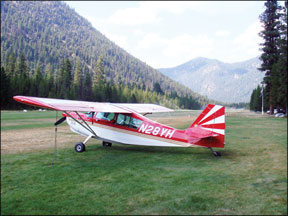
I took delivery of my Super Decathlon in 2002 at Oshkosh, where it was American Champions show plane at AirVenture. Since then, it has provided several hundred hours of pure pleasure, from basic aerobatics to low-and-slow tours of the Pacific coast and San Francisco Bay to visits into unpaved mountain airstrips such as Johnson Creek, Idaho and McKenzie Bridge, Oregon. (Im attaching a recent photo of my Decathlon at the beautiful McKenzie Bridge State Airport, which is officially classified as a “hazardous” airport by the State of Oregon, due to its rough surface, 130-foot trees and nearby ridges.)
For family transportation, Im glad that my partner and I also share an A36 Bonanza; but, when its just me, the Decathlon is my first choice. I don’t want to trade places with the pilots who approach me on the ramp and say wistfully, “I wish I had never sold mine.”
Robert P. Parker
Sun River, Oregon
I owned a Citabria 7KCAB for 35 years and loved it. (I recently sold it and bought an American Legend Cub-and love it, too!)
I had but two real problems with my 7KCAB. One was the original inverted oil systems baffle plate, which cracked. That was solved in the last major overhaul by installing a Christen inverted oil system.
The other problem was more insidious. Although I was getting older and perhaps less agile, I noticed that I was having some annoying ground control problems. Finally, after an excursion across an infield during takeoff, I did some serious looking at Scott 3200 tailwheels on other airplanes.
I discovered that after 30-plus years of my rudder yoke pulling on the Scott side ears that steer the tailwheel, the 3200s ears had bent upward more than 40 or so degrees from their normal horizontal plane. That reduced the effective lever arm by 30 percent.
A call to Scott showed that they had just introduced a much stronger set of ears and the new ones had bent-up tips so that the rudder springs would transfer more force to actual steering and less to lifting up on the ears. After installing the new kit I felt like a teenager-what a difference. I had no problems with ground control for the next seven years.
Tom Osborne
via e-mail