








When Diamond was hard into its certification of the DA42 Twin Star in 2005, it knew it was taking a big chance on the untried Thielert 1.7 diesel engines. But it also hedged its bets by running a near parallel certification effort of the same airplane fitted with Lycomings angle-valve IO-360, a we’ll proven powerplant. It back-burnered the Lycoming project once it appeared that the diesel engines were both preferred and were gaining ground in the market. It now appears as though the Lycoming hedge is paying off, by necessity. As is we’ll known by now, the Thielert diesels turned out to have a spotty service record at best, a disastrous one at worst. The engine required numerous periodic replacement parts-mainly gearboxes and clutches-but also lots of unscheduled (and expensive) maintenance that all but tanked the 1.7 diesels as serious contenders. As we go to press this month, Diamond is finishing certification details on the resurrected Lycoming project under its new version of the airplane, the DA42-L360. (The trade name Twin Star has been dropped because of a trademark dispute with a helicopter manufacturer.) The Lycomings will be offered as an option in place of the newly certified Austro AE300, which Diamond also brought to fruition by launching a company just for that purpose. The new engines will be available for both new aircraft and owners of existing Thielert diesel models who may wish to convert. (We suspect many will.)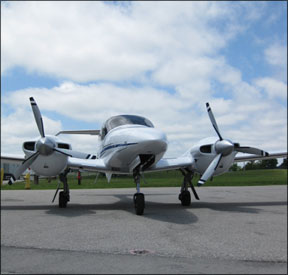
Fish or Fowl?
Diamond would prefer that the L360 be compared with other twins in the training market, namely Pipers Seminole, the only real competition. We see the point, but we also maintain that this comparison simply wont fly, at least for our purposes. Thats because the original DA42 was born as a Thielert diesel-powered airplane. Just as the airplane was developed for the diesel, its also true that if the Thielert engines hadnt done so poorly in the field, the Lycoming version of the airplane wouldnt exist.
Response to the diesel was so strong in 2005 that Diamond saw no need to continue with the Lycoming version. There was no interest in it in Europe and even in the U.S., where you can hardly find, much less buy, an automotive diesel, interest was also flat. Still, Diamond knew that the 180-HP Lycs were a good match for the DA42.
Fully dressed, the gasoline engines are about 50 pounds lighter than the Thielert diesels and the installation is accordingly simpler. There’s no plumbing for a cooling system, no FADEC and its associated wiring, no gearbox and no backup battery. Lycoming four-bangers are what theyve always been: Gray lumps of rotating parts that turn out torque.
With the original DA42 as the starting point, the Lycomings are attached to the same firewall, albeit through a Dynafocal mount rather than the four-point mount