











The general publics cry for security at general aviation airports has caused most of us in the aviation industry to roll our eyes. However, its also spurred some government agencies to look at tightening security or even requiring beefed up security for small airplanes.
There may be a hidden benefit in this hysteria. From an airplane owners standpoint, the real risk from theft is that you’ll discover a gaping hole where your avionics stack used to be. So maybe it makes sense to think about security. And given public paranoia, several aviation authorities have been deliberating what kinds of measures to put into place to make sure light aircraft don’t become terrorist weapons. don’t be surprised if your airport requires you to secure your aircraft in some way.
In 2000 and 2001, a total of 26 airplanes were stolen. For decades, thefts of general aviation airplanes have hovered at an average of between one and two a month-hardly an epidemic. Most of the thefts have been in California or the Southwest, presumably to be used in drug smuggling.
There are a number of approaches to securing an airplane, and we remain convinced the best way is with a locked hangar door. However, most owners don’t have that luxury, especially when traveling.
Whats Out There
There are basically three categories of locks available for light aircraft, so you can choose your poison. For the sake of this analysis, we left out expensive, intrusive actions such as alarm systems, modifications to the electrical system, custom-made metal panels that cover the instruments and beefy cabin door locks. we’ll look at those later.
So youre left asking whether you want to lock your wheels, your props or your controls. you’ll have your own ideas about the potential of each method with respect to theft deterrence, ease of use and potential for damaging the airplane.
Wheel locks have the advantage of being obvious to a would-be thief, possibly deterring the theft. If the airplane cant be taxied, takeoff is impossible. Wheel locks have been used on automobiles, boat trailers and construction equipment for years. Fans of wheel locks point out that a thief trying to steal a booted airplane would have to defeat the device in full view of any passers-by. Cutting tools, lock-freezing spray and removing the wheel would be conspicuous. But wheel locks only work on some airplanes. Forget about locking anything with wheel pants, because the wheel locks need to pinch onto the hub.
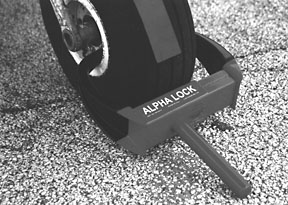
They work great on the nosewheel of a twin because you can get to the wheel without crawling underneath the wing and youre out of any propeller arc. However, theyre also the bulkiest devices we tested. We tried two, the Alpha Lock and the Pit Bull Tire Lock.
The Alpha Lock is available from a wide range of hardware stores, auto parts stores and other general retailers, mainly as a device to protect cars, trailers and construction equipment. Construction quality is top-notch, and the vinyl-coated jaws wont mar the rims.
It fits around tires up to 11 inches wide. The unit is made of hardened steel and the lock is said to be impervious to freezing with Freon and resistant to drilling. We found it easy to put the unit on and lock it in place. Although its a two-handed affair, the handle on the Alpha Lock made it easier than its competition.
Best of all, the Alpha Lock is priced like an automotive product rather than an aircraft product. At $90, the Alpha Lock is a clear winner if you decide a landing gear lock is the right option for you.
We also tested the Pit Bull Tire Lock and came away less than impressed. The construction quality was nearly comparable to the Alpha Lock, with heavy-duty aluminum alloy and a quality lock, but the design of the Pit Bull was, well, clunky, in our view.
It takes two hands to position the two calipers and then with your third hand you slide the lock into place. After a few tries, we managed to get it locked, but we cant see this becoming a simple affair.
In addition, to install the cylindrical lock, you need to slide it into the appropriate set of holes, which are drilled into each piece of the lock. Deciding which one lines up best takes some fumbling in the daylight; we cant imagine doing it at night in the rain.
Speaking of rain, the holes are machined into the cast aluminum and do not have drains on the bottom. Anyone else spot a potential for gunk buildup and corrosion? A weather cover is available for another $8, but it seems like it should be standard equipment.
The heavy-duty polyolefin-coated tips on the calipers, there to prevent marring the wheel, had a made in the back yard appearance, although they worked fine. The Pit Bull is adjustable over a wide range and would fit a much larger tire than the Alpha Lock, but we don’t see that as being much of an issue among light airplanes, except perhaps those with really big tundra tires.
Finally, the most off-putting thing about the Pit Bull is its price-$350. While the Pit Bull works as advertised, wed pick the Alpha Lock even if price were irrelevant.
Prop Locks
Hanging a chain on the prop is a time-honored security device. For this, you don’t really need an aircraft part. Shopping locally at a motorcycle shop or even a high-end bike store will yield several options for high-quality chains and locks.
Prop locks have the advantage of being simple, portable and conspicuous. However, because theyre not specialized parts, some owners decide to save a few bucks and buy a lightweight bicycle chain and a drug store padlock.
We hesitate to be too critical because, as we said at the beginning, airplane theft isn’t the dire threat some people believe it is. Even so, if youre going to do something, do it right. A flimsy cable or chain offers little obstruction to a bolt cutter and would allow a thief to cut through it in the blink of an eye.
We tried a prop lock offered by Sportys Pilot Shop for $170. At six feet long and 12 pounds, this vinyl-sleeved chain/lock is a serious security device. The chain was long enough to allow it to be slung around each blade and crossed over the spinner without any of the unprotected parts banging on the airplane. Although we didnt subject it to destructive testing, we came away convinced this is not your kids bike lock. Its of high quality. There are a few things wed like to see changed, however. The black vinyl sleeve would be better in red or orange, given the proclivity pilots have for sketchy preflight inspections. Start the engine with this baby attached and youd better be pre-approved for a second mortgage.
In addition, the key is required to lock the chain, rather than just to unlock. While we can appreciate the lock design that makes this an advantage, we also found that locking this chain could be a handful if not placed just so on the prop. But we think a little practice would make this a non-issue.
In addition to the chain locks, we tried the Pit Bull Puppy Prop Lock and the Prop Club. Design and construction of the Pit Bull Puppy were similar to the Pit Bull Tire Lock, although the unit was about half the size.
The design seemed a little more elegant as a prop lock than as a tire lock, but again, we found problems that make this lock unsuitable for most general aviation airplanes.
The biggest problem we ran into is that the Puppy doesnt stay secure on the blades. The unit apparently was designed with turboprops in mind. We tried it on a variety of singles and light twins, two bladed and three bladed, fixed and constant speed, and found that in every case, you could slide the lock off the end of the prop without unlocking it.
But thats not all. The painted metal device had almost no provision for protecting the propeller blade. The inside of each caliper had a thin strip of rubber-like tape that felt like it would peel off with little persuasion. Even with the strip in place, the caliper was free to scrape along the blade unless the lock was carefully handled. In addition, the ends of the calipers can clunk into the cowling.
We would call the Pit Bull Puppy a non-contender for most light airplanes under almost any circumstances. Tack on the $350 price tag, and our enthusiasm withers further. While it may make sense for a King Air or other airplane with fat prop blades, buyers will still need to concoct some kind of protective coating for the calipers. For the price, we don’t think buyers shouldnt have to resort to such measures.
The Prop Club, on the other hand, is a marvelously designed product that encircles one prop blade without posing a risk to the cowling. Its also unique among the products tested in that it has a combination lock and comes with a remove before flight banner. The plastic-coated lock is made of tempered steel with a patented locking system. Plus, when unlocked, it stays in one piece.
The Prop Club is advertised by Winner Aviation as adaptable to a variety of constant speed propellers and of the aircraft we tried it on, it fit them all. Priced at $250, the Prop Club is a pricey but smartly designed (and compact) propeller lock.
Control Locks
Control locks have some real advantages. Theyre out of the weather, so corrosion and ramp debris arent issues in fouling the locks. They typically prevent the airplane from being operated rather than ruining something if a thoughtless pilot forgets to take the lock off. On the other hand, they have some disadvantages as well. A thief might bust into the airplane without noticing its protected, which means fixing a jimmied door or broken door lock.