











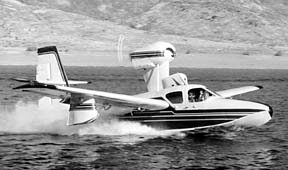
Boats or floats? Thats the first question many pilots wishing to operate off the water ask. Boats, of course, are airplanes with displacement hulls while float planes are conventional designs fitted with heavy and draggy pontoons.
For those who opt for boats, the practical choice narrows to one airplane: The venerable Lake Amphibian, an airplane that has become an icon for off-the-water flying.
Homebuilts aside, the Lake is the only displacement-hull amphibian being built today and, frankly, not many are rolling off the line. About a dozen new Lakesare built for civil use each year, plus an unknown number of the Seawolf, a military/utility variant. But there are plenty of used examples and the used-airplane shoppers job is simplified. Lake Aircraft still manufactures and services its amphibians. A family-owned company since 1979, it has won extraordinary praise for its energetic, customer-oriented service and has recently gotten into the used aircraft business as well, offering a full broker services to would-be buyers and sellers. Essentially, the Lake buyer program snatches up the best airframes, refurbs them as necessary at the companys Laconia, New Hampshire facility, and sells them on the open market.
Warts and All
Owners insist there’s nothing quite like a Lake. It can operate equally we’ll off a runway or into a remote lake or river in a way that one pilot described as instant vacation.
But this flexibility comes at a price. A big tradeoff is in cruise efficiency for the size of engine. Lakes are draggy and slow and they wont win any efficiency contests for fuel burn. Generally, a landplane with the same size engine will be considerably faster and will carry more payload. Then there’s maintenance. While airplanes and water do mix, the marriage is not without its rough spots. Corrosion and moisture-related maintenance glitches are a constant worry. These are all addressable but an owner has to pay attention to this, especially if operating off saltwater.
The Lake extends all the way back to 1948, with the Colonial C-1 Skimmer. A 150-HP three-seater, the Skimmer was designed by two ex-Grumman engineers, Dave Thrust and Herb Lindblad.
In 1958, the Skimmer got a 180-HP engine and a four-seat configuration and a new name, the C-2. Two years later, there were more changes: A longer bow, stretched wing and another name change-Lake LA-4. Before production was shut down in 1962, about 250 Skimmers and LA-4s had been built.
In 1963, a new marketing arrangement emerged which remains in place today. The Lake is built by one company, Aerofab, and sold and serviced by Lake Aircraft, owned since 1979 by Armand Rivard. Production continues but at a very slow pace. Parts availability appears to be no problem.
In 1970, the 180-HP Lycoming was replaced with a 200-HP fuel-injected Lycoming and the four-seat Buccaneer was born. Over the years, a small number of turbocharged models were built, and there even was one straight seaplane version.
When the marketing company changed hands in 1979, two new models-the EP and Renegade-were introduced. The EP was a Buccaneer with an extended propeller shaft and other modifications.
To reduce cooling drag, it got a new nacelle and prop noise in the cabin was lowered by extending the propeller shaft and placing the prop five inches farther aft. To improve the Buccaneers low-speed stability, the EP version featured bat wing fillets at the wing root/fuselage junction.
Renegade
The Renegade, which has a 250-HP Lycoming IO-540 engine, is an enlarged six-seat version of the Buccaneer. It easily outperforms its predecessors, which are anemic performers by landplane standards in any case. The Renegade cruises at about 132 knots (compared to about 129 knots for the EP), with a climb rate of 1200 FPM, according to owners.
The Renegade is also better in the water, especially in challenging conditions. An 18- to 20-inch chop would be a handful for even an experienced Buccaneer pilot. But a competent Renegade driver wont even break a sweat in such conditions. Still, training and the proper technique are a must. Taking green water over the bow of an amphib is no fun, nor is bashing the dock with wing-mounted floats, an inherent shortcoming of an airplane that squats low in the water.
Standard fuel in the Renegade is 54 gallons, with an aux option that boosts the total to a generous 90 gallons. Lake pilots don’t often use the 1000-mile range that this much gas provides but they do hop around lakes and rivers in the bush, where avgas isn’t likely to be available. Being able to tanker it in is a must.
To accommodate the extra 360 pounds of weight the Renegade could haul, its hull, wings and landing gear struts were strengthened and the tail was enlarged and redesigned. The gull-wing canopy eliminates the need for any gymnastics during entry or egress.
Turbocharging, Too
In 1988, Lake Aircraft introduced the Turbo Renegade, a 270-HP amphibian that immediately set two world records. One for attaining an altitude of 24,000 feet in an amphib, the other for sustained flight at that altitude. In 1991, two new models came along, the Seafury and Turbo Seafury. These are enhanced Renegades, with a few extra options-lift rings, a survival equipment package, a custom tool kit, aux power receptacle, and stainless steel brake discs-plus extra corrosion-proofing. The latter consists of an extra coat of chromate primer inside and out and a ceramic coating on the steel parts, both excellent additions in our view.
The 1997 lineup consisted of the two Renegades and the Seafurys. Another model not available to the public is the Seawolf, which is essentially a Seafury modified to make it attractive to the military. Its marketed as a patrol and special operations aircraft, and according to Bruce Rivard at Lake, is being used by the U.S. military and other governments.
Buy Carefully
New Lake buyers are advised to enter the market very carefully. The used market is not flush with prime examples and prices can vary widely. Watch out for beaters and corroded hulks.
For several years, the Lake company has been buying back used Lakes whose history it knows. The airframes are reconditioned, including addition of the companys hydro-booster hull mod. This adds four external strakes to reinforce the hull, reduce water drag and help stabilize the Lake in turns. There’s a 90-day warranty on refurbished airframes, something youre not likely to get from a broker or on the open market. The company also converts older LA-4s to the EP model. Although every buyer should take to heart the standard warnings about pre-purchase inspections, this is doubly true for a Lake purchaser. don’t even think about having the pre-buy done by other than a mechanic who knows the airplane inside and out, even if this requires ferry expenses that may turn up a dog you’ll have to walk away from.
An experienced Lake mechanic, for example, would immediately check the hull bulkhead at station 97 for hard-landing damage-an area your Cessna mechanic might overlook. Lake does pre-purchase inspections for the same fixed price as annuals, advising the owner of what must be fixed and also recommending elective repairs not strictly related to airworthiness.
Performance
A 200-HP Buccaneer performs about on par with a typical 150-HP landplane-the 130-knot speeds Lake used to claim were optimistic. Most Buccaneer owners report cruise speeds in the 105 to 115-knot range, with fuel consumption of about 10 GPH, similar to other 200-HP airplanes. A Renegade owner told us he burns 13.5 to 14 gallons of fuel per hour. The EP pulls about 125 knots and offers improvements over the Buccaneer. It has hull strakes, which improve water handling and make it easier to get on step. The EP can climb off the water at about 45 knots.
In contrast, a Buccaneer will take off at 53 knots; 50 knots with a bat wing mod. One Renegade pilot who has owned almost every Lake model offered this advice: The EP is the best of the lot, in my opinion. Its almost as fast as the Renegade, it has better short-field performance, and its more economical. An 88-gallon EP has a 9 to 10 hour range.
Compared to most Lakes, a Mooney flies 40 or 50 knots faster on the same amount of fuel, raising the legitimate question of how this airplane will be used. If it wont really be flown off the water that much, you may be setting yourself up for frustratingly slow cross country flying. Said one owner: The Lake is a delight for trips up to 350 miles. But if your goal is beyond 350 miles, Id use a Bonanza and put a canoe at your destination.
Owners complain that a heavily loaded Buccaneer-its useful load is about 1135 pounds-is sluggish during climb, prompting some to regard it as a two-place airplane with baggage or a four-place airplane with reduced fuel. Lakes 180-HP models are somewhat underpowered and shouldnt be considered four-place airplanes. At gross weight, climb will be around 500 to 600 FPM. Cruise is about 105 knots, max.
Loading, Comfort
Useful load averages about 800 pounds for a 180-HP Lake without an IFR panel while its about 950 pounds for the 200-HP model and 1200 pounds for the Renegade. In any case, a Lake pilot is advised not to ignore weight and balance. The airplanes tend toward nose heaviness, a characteristic aggravated by the fact that the Lakes CG moves forward as passengers are added, not rearward, as in landplanes. In terms of creature comfort, there’s adequate elbow room in the front and while there’s less space in the rear seats, its not uncomfortable for two adults. For life in the bush, you can remove the rear seats and sleep in the Lake, an option thats possible because the rear seats extend into the baggage compartment. The Buccaneer has about seven feet of floor space, the Renegade some eight or nine feet, so youre not going to be cramped, exactly.
That said, however, the rear baggage compartment in all but the Renegade is small. Its accessible only through the cabin with its two front clamshell doors and if youre loading fishing and camping gear off a dock, you’ll be muttering about the limitations of this arrangement. The Renegade has an extra rear cabin door, which can be retrofitted on older Lakes. As for cosmetics, some liken the Lake interior to the inside of a 1950s Nash Rambler. The seats are small, hard and without any adjustment other than forward and backward, wrote one owner of a 1978 LA4-200. Four hours of flying can be an ordeal. The EP, however, has an interior with customized features and more foam. The Renegade has the nicest interior of all, in our view. But then the cost reflects that.
Consider buying noise canceling headsets if youre contemplating Lake ownership. Even though the engine is mounted high on that pylon above the wing, Lakes are described as noisy by their owners.
One cockpit feature that Lake owners will have to adjust to is the overhead engine controls. Another oddity is the Lakes heater. Because of the engines location, exhaust heat cant be used to warm the cabin. Bothersome gasoline heaters are the only practical alternative.
Through 1973, Lakes used the Janitrols, for which an AD was issued that required complete overhauls every two years. Lake switched to Southwind heaters in 1974. While more reliable, they had only two switches: on or off. Obviously, Lake pilots didnt enjoy the choice between cooking or freezing, so Lake Aircraft started using improved Janitrols in 1983.
Obviously, an airplane shaped like a boat will necessarily have some limitations and ground handling is one of them. The Lake doesnt have a steerable nosewheel; conning down the taxiway is done with differential braking. Its not exactly cumbersome but not a sports car, either.
On smooth water, it takes precise pilot technique to get a heavily loaded Lake on the step on a hot day. Owners repeatedly warn that getting dual with an experienced Lake instructor is a must, both to learn proper takeoff and landing technique and to keep from having submarine experiences with the airplane.
Once in the air, the Lake is agile by seaplane standards. The ailerons require a light touch while the rudder requires some heavy footwork. To fly the Lake well, rudder work is essential. Stalls occur at about 42 knots indicated, and recovery is gentle and predictable. With all that drag, descending is easy enough. Drop the gear and flaps, cut the power and push over the nose.
One we’ll known handling quirk pilots note is the unusual pitch response to power. The nose drops when the throttle is advanced; it rises when power is reduced. On takeoff, a definite rotation is required to overcome the Lakes high-power, low-speed nose-over tendency.
This, of course, is caused by the high engine position, which induces pitching moments with power changes. Owners universally report that quirk is easy to adapt to, but it requires a few hours and some demos from an experienced instructor.
Maintenance
For a complex aircraft operated in the demanding world of off-water ops, the Lake is generally free of serious ADs. But there is one that requires careful attention: AD 98-10-2 requires inspection of the horizontal and vertical stabilizer fitting gap in accordance with a factory service bulletin. Separation of the tail is a possibility so this one needs to be taken seriously.
The Lake is a complicated airplane. Hydraulics control the gear, flaps and trim. When corrosion is present-a major concern for old or poorly maintained Lakes or those used extensively in salt water-watch for escalating maintenance bills.
During the 1960s, the 180-HP Lakes had no zinc chromate treatment, and some didnt have alodine, either. Apparently, there’s a way to determine which Lakes received alodining and which didnt. Alodine treatment lends the aluminum a faint gold tint, and if it was done, it will be found on the interior structure of any pre-1970 airplane.
The absence of green zinc chromate primer makes an amphibian susceptible to corrosion-particularly one exposed to salt water. And a bad case of corrosion can make an airplane virtually worthless. Starting in the 1970s, all Buccaneers were alodined and zinc chromated and an additional polychromate primer was used starting with 1983 models. And the new Seafurys have still more corrosion-proofing.
And corrosion isn’t the only water-related worry. Amphibs and seaplanes take a terrific beating during even routine water operations in moderate conditions. Waves and minor junk in the water slam into the hull and create inevitable dimples and dents. Sliding up on sandy beaches or grinding over gravel strips the paint and gouges the hull. Watch for it. Check the fuselage/hull structure for internal damage-the bulkhead at station 97, in particular. Starting with 1982 models, this bulkhead was strengthened.
Turbo 270 Beefs
Although owners of Turbo 270s seem satisfied with their airplanes, theyve reported some problems. These include oil dripping from the crankcase breather tube and spraying the tail. Neither Lake nor Lycoming has yet to figure out why this is so nor have they developed a fix. Not a safety issue, but one owner says it makes the tail look like hell. Another problem is premature mag failures, which one owner suspects are caused when the mags overheat because of their proximity to the turbo. Reports also were received of cracked exhaust pipes, malfunctioning electric boost pumps, cracked cowl hinges, and a broken accumulator in the hydraulic system.
In several instances, Turbo 270s experienced failed fuel check valves. One owner said that when he topped off his 270, a faulty valve caused the fuel to flow from the main tank into the right wing and out the vent onto the ground. A new valve was installed, but the problem reappeared one day: Fuel ran out onto the ground until the right wing gas cap was opened-evidently relieving a buildup of pressure.
Hydraulics
Regarding the Lakes hydraulic system, a Buccaneer owner had this to say: The hydraulic system has been a nuisance. The pump motor on my model was controlled by a Ford horn relay, which I replaced with a higher capacity Beech part. This offered an extra contact which can be connected in the field if required.
The hydraulic-operated gear, flaps and trim share one accumulator, pump and reservoir and all actuator static and dynamic seals are plain O rings. The failure of any O ring will incapacitate the entire system. You may replenish the supply from your squirt bottle and position the gear, flaps and trim. Although the gear will stay where you put it, the flaps and trim will bleed to the trail position.
Speaking of the gear, there’s no squat switch to prevent the pilot from inadvertently retracting it while on land. Second, since many landings will be made gear-up, there is no gear warning horn. This, of course, increases the chances of a gear-up landing on a runway or a gear-down landing in the water. The former is no worse than a gear-up in a Bonanza, while the latter will be a metal bending event and likely to get some attention.
Generally, the 180-HP Lycoming O-360 has proved more reliable than the fuel-injected 200-HP version. There were problems with the IO-360 in the early 1970s, and Buccaneers of that vintage should be checked to ensure that they have updated valves, camshafts and piston pins. By now, most should certainly been overhauled but make sure your pre-buy reviews that.
TBO of early, unmodified engines is just 1200 hours, but this was increased to 1400 hours, then 1600 and finally 2000 hours if the improved parts were retrofitted. Lake claims its IO-360 is obtaining longer engine life because it runs cooler in its pylon installation than in any other aircraft. With the pylon-mount high above the water, the engine is less exposed to spray than on seaplanes.
Support
As aircraft companies go, Lake is at the top of the heap in terms of support for owners. Owners wax downright poetic about support from the Lake factory. When flying in Europe, far from Aerofab, the producer of parts in New Hampshire, I worried about spare parts. I was never disappointed. They normally shipped the goods the same day by Federal Express, wrote one reader.
Owners heap effusive and unanimous praise upon Lake Aircraft for its customer-oriented way of doing business. They fondly recall personal anecdotes to illustrate how the company has been attentive to their needs and willing to bend over backwards for them. If I need an answer to a problem, one owner relates, I can call Armand Rivard at work or at home anytime, and he is always available.
Safety
Based on past reviews of accident data, about 40 percent of fatal and non-fatal Lake accidents involve water operations, with pilot technique usually faulted. The records don’t reveal how many pilots managed to save the day by opting to make a forced or precautionary landing on water instead of a rugged patch of terra firma. No doubt the ability to do this gives the Lake pilot an advantage over a landplane pilot, if his seamanship is up to snuff.
Still, water operations invariably involve greater risk than operations on land. The hazards are many. Accident reports are replete with tales of pilots bashing into submerged objects such as logs, losing control when encountering a boat wake or taking water over the bow and into the cabin during taxi in rough water.
Botched water landings often read like this in FAA reports: Nose and right pontoon dug into water on touchdown, water looped, nosed over and sank. Surprisingly, such mishaps hardly ever cause fatalities or severe injuries, although the Lake often is damaged or destroyed.
Even more serious accidents often leave pilots and passengers relatively unscathed. For example: Bounced three times during a water landing. Added power too late to go around. Retarded throttle. Hit dam head on. No injuries. We speculate that this is partly due to the impact absorption offered by the water as the airplane slows. We know of no hard data to support or disprove this. The fact that few injuries are reported during mishaps is surely a testament to the Lakes basic design and robust construction. Although it has some handling warts, when a Lake goes awry, the occupants usually escape serious harm.
This translates with reasonable but not cheap insurance. Reasonable is a relative term here. A landplane owner accustomed to paying $2000 a year for insurance may be shocked at what it costs to insure a Lake. We checked with one insurance provider, Phoenix, which has a Lake program.
Phoenix requires pilots who don’t have 200 hours in Lakes to complete the factorys initial training, which includes 25 hours of flying. This is not required for pilots with 200 or more hours in Lakes. For all pilots insured in the program, annual recurrent training with an approved program CFI is a requirement and Phoenix provides a list of CFIs.
Actual quotes vary, depending upon pilot time. An owner with no make and model time, a $100,000 airplane and $1 million in liability with $100,000 per pax, will pay about $6000 a year. A pilot with 200 hours in Lakes would pay about $4000.
Since our last examination of the Lake, both USAIG and Avemco have come into the market with strongly competitive insurance programs. Although we wouldnt call any of these policies cheap, there’s some downward price pressure. Obviously, to avoid the experience of becoming a U-boat Commander in a Lake, thorough training is a must. The factory conducts its own training and can recommend instructors. Contact: 603-293-8200 or refer to www.lakeaircraft.com.
Buyer Notes
The C-1 Skimmer built from 1948 to 1960 had a bow two feet shorter and a wing four feet shorter than later Buccaneers. It had a tendency to porpoise and at full gross, its climb rate was sickly due to the anemic 150-HP engine. Today, only a handful of Skimmers are flying, also the case with the 180-HP C-2 Skimmer. Rarely do these come up for sale.
The LA-4-180 can be a bargain, if you can find one in good shape. Again, the performance will be marginal at gross weight, thus if you want to operate off short runways, narrow rivers with bends or even ponds, we think the Buccaneer would be the better choice. Most Lakes on the used airplane market are Buccaneers and Renegades (apparently, many Renegade owners are moving up to the newer Turbo Renegade).
The Buccaneer didnt have any major changes until the 1983 EP model, which some Lake aficionados consider a far better value for the money than the straight Buccaneer. Over the years, there have been minor changes in the Lake line that are worth considering. The 1981 models have more grease fittings, polychromate primer, an improved canopy and more rust-resistant cabin vents.
Owners group, mods
In addition to the highly regarded factory backing, additional support is available from the Lake Amphibian Flyers Club. The club sponsors an annual gathering in Florida and offers a quarterly newsletter. Lake Amphibian Flyers Club, 815 North Lake Reedy Blvd., Frostproof, Florida 33843-9659. Phone 941-635-3381. As noted above, most significant mods are handled by the factory. Other mods are provided by Aircraft Innovation and Repair of Winter Haven, Florida, including a yoke-mounted control for the hydraulic elevator trim and panel makeovers. 941-299-4655. Owner Paul Furnee, a former Lake employee, gets high marks for service and training from Aviation Consumer readers.
Owner Comments
After 25 years and 3000 hours of flying, the Lake changed my thinking about airplanes. (I have a 1983 EP model.) I was into faster, higher farther and had stepped through a variety of singles and twins to a pressurized Aerostar, which in my mind is the ultimate owner-flown travel machine. But the Lake, slow and clumsy as it is, stole my heart when I purchased a half interest in a 1970 200 HP Buccaneer. The versatility of an amphibian has to be experienced to be appreciated. Now, when I spread out my sectional chart, where I used to see 25 possible landing sites, I see 100 or 150.
The Lake has a most extraordinary combination of land and sea characteristics. On water, its stable and can handle a lot of sea conditions. It can get into and out of some fairly small areas when competently flown. Its major shortcoming is the difficulty of docking. The low wing (actually a mid-wing configuration) is at dock height and unlike a floatplane, will not easily clear a dock, but rather will tend to crash into it.
So I (and most Lake pilots) have forsaken docking in all but the calmest conditions. Lake pilots love a good ramp, where they can merely lower the wheels and taxi right out of the water. Lacking that, a good sand beach makes a proper parking place. The aircraft is nominally four-place, but with four pax, there’s hardly any room for luggage. Useful load is plentiful but CG bears careful watching. I carry 33 pounds of lead in the bow locker when solo but don’t need it when carrying passengers.
My EP cruises at about 110 knots burning 10.5 GPH at 72 percent power. Climb is about 700 FPM at sea level, tapering to about 150 FPM at 11,000 feet. She is not a good high-altitude performer, although there is a turbod version available that would correct that.
Some useful mods which I have are: Batwings, which enhance slow speed characteristics; an optional baggage loading door, without which baggage and rear seat passengers have to be loaded over the front seats; canopy door holders, which hold the canopy door open for ingress and egress and while taxiing and yoke mounted electric pitch trim. Many useful mods are marketed by two exceptional Lake mod shops: Lake Central in Muskoka, Ontario (705-687-4343) and Aircraft Innovation and Repair in Winter Haven, Florida, (941-299-4655). Among the best maintenance available for Lakes comes from Harry and Cathy Shannon, who run Amphibians Plus in Bartow, Florida (941-534-8025). They are among the most knowledgeable and conscientious maintenance facilities anywhere, and 90 percent or more of their work is exclusively on Lakes.
A Lake is different from any other aircraft, and requires very specific training. Pilots flying this aircraft need type specific training. Those who are trained by approved instructors and who keep current in their training are eligible for preferred rates from the Lake insurance program which is run by Airsure, Inc. (610-521-5545) for Phoenix Aviation Managers.
Maintenance is a bit on the high side. I would say comparable if not more than a high-performance single, say a Bonanza, 210 or Comanche. Parts, while generally available, sometimes take awhile and cost more than they should. The Lake factory is obviously offsetting its small airplane sales volume with higher parts markups.
I have flown this aircraft from the Turks and Caicos Islands to the Canadian Arctic to Lake Powell in Utah and Arizona. There is more satisfaction available from flying this airplane than from any other plane I have flown, and I have flown lots of them. It looks great, flies we’ll (for a duck) and takes you to places an ordinary airplane cannot go.
-Marc Rodstein
Boca Raton, Fla.
Harrison, Maine
I have owned my Lake Amphibian (LA4-200) for nearly 10 years during which I have put about 1100 hours on the tachometer. It came off the line in 1981. The versatility of an amphibian is unbeatable. This airplane ranks highly with me because it is strong, stable, comfortable and quiet. I have flown it over all possible types of terrain; desert, mountains, the Alaska bush and the sea. It is a design which evolved very nicely. The mid-wing allows visibility both above and below it. The trailing link gear is strong and well-suited for rough surfaces. I don’t have to worry about damaging my prop on dirt or gravel strips, nor do I have to be concerned about sandblasting the high tail surfaces.
Since some landings are made with the gear up (in the water) the pilot has to remain keenly aware of the surface on which he is going to land and have the gear in the proper configuration. The emergency procedure if you cannot get the gear down, is simply to select the proper landing surface (water) and land the airplane.
I think the airplane is underrated, especially as a land airplane. It is nearly a STOL plane. I own a small desert property which is at 2500 feet elevation and have a small air strip there.The strip is only 1600 feet long, 75 feet wide, is soft and has wires 400 feet off one end. The Buccaneer is the only tricycle gear airplane I would consider operating there.
The long narrow wing gets the airplane off the ground quickly and with the gear up, the climb angle is quite steep at therecommended 60 MPH indicated. I generally cruise the airplane with the IO-360-A1B at 65 percent power (2400 RPM) and about 22 inches manifold pressure. At this power setting, the airplane trues out at 120 MPH (105 knots) and burns 9.3 to 9.5 gallons per hour. With the 40-gallon main tank and the two 7-gallon auxiliary tanks filled, this amounts to a respectable 5.4 hours duration and 567 miles absolute range.
The airplane is not very clean aerodynamically and the 105-knot cruise is admittedly slow. With the same engine in a Cessna Cardinal or a Mooney the speed would be 30 to 45 MPH faster, but they can land on the water only one time! The amphibian combines the capabilities of both a wheel plane and a floatplane in a way that is not readily obvious. As an example you can land on the water, extend the gear and taxi onto shore. If the shoreline is rocky-and it often is on the remote lakes of Southeast Alaska-you can extend the gear in the water to keep the hull off the rocks, and tie the plane off to the shore.
Factory support is quite good, but a bit pricey. Even though they are made on factory jigs, these are individually built airplanes and parts match is not always identical.
Many improvements and modifications have been made over the years, but the factory continues to supply parts for most versions. By the way, the later model Renegade wings can be installed on the Buccaneer. They are identical in dimension and airfoil and have the advantage that they are stronger and have an improved main landing gear trunion.
The airplane has seven water-tight compartments. This precludes running cables and pushrods through water-tight bulkheads, and is probably one reason that the airplane has an unusual hydraulic system. The landing gear, flaps, and even the pitch trim are all hydraulic.
This makes for quite a number of lines, valves, and actuators to keep in good operating condition, one of the designs major maintenance factors. Other than that, the airplane is no more difficult or expensive to maintain than any other complex single. Even though I sometimes think I would like to own a less expensive, less complex and perhaps faster airplane, in 10 years of Lake ownership, I havent made that change.
It probably has something to do with the wonderful remote trout-filled lakes she has taken me to in British Columbia, Northwest Territory and the misty fiords of Southeast Alaska, lakes that couldnt be reached any other way.
Someone has to do it, and the Lake makes it possible.
-Gene Vickery
via e-mail
Also With This Article
Click here to view charts for Resale Values, Payload Compared and Prices Compar