











If youre like us, youre flying around in something built during the last century but lusting after some of the panel-mounted goodies available in newer aircraft. While its easy enough to shoehorn in a color moving map and some digital radios, modernizing other areas of your panel isn’t. And thats a shame, since much of the engine and systems instrumentation in older aircraft appears borrowed from a 1947 Buick. But, as usual, the aftermarket has provided in the form of engine monitors, fuel flow instruments and a smattering of tachometers. The tach market is not widely populated, so if you want one, the choices are somewhat limited. Heres a run-down on the pros and cons of this technology, plus a look at the major players in the field.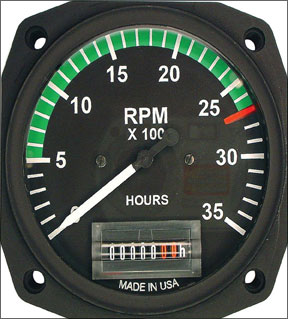
Counting Digitally
Of course, the microprocessor in digital instruments does little more than count. Conveniently, a mechanical tachometer does the same thing. The big difference between the two involves how they receive a signal: The microprocessor counts electrical impulses sent to it via wiring, while the mechanical tachometers many moving parts count the number of times a cable attached to the engine revolves. The former is lighter, more accurate and less likely to fail, at least as long as the aircrafts electrical system powers the microprocessor. The latter is none of those things.
Electronic tachs also have something else going for them: They can do more than just count. Since they generally tap into the magnetos electrical impulses-although some models can be configured to use a gear-driven tach generator-they also compare the received signals, alerting the pilot to a magneto failure. Further, they can display the mag drop during runup and even advise of a loose p-lead, resulting in a hot magneto. Using LEDs, they also can alert to overspeed situations or when operating in a restricted RPM range. And, of course, they count up the hours the engine is running, although each does it differently, something we’ll get to in a moment. The current market for electronic tachometers suitable for certified aircraft includes three products: the Electronics International R-1, Horizon Instruments P-1000 and an analog but still electronic offering from UMA Instruments, the T19-801 series. As a rule, these tachometers are designed for piston singles, though we are aware of dual installations in twins. Each is approved under TSO C49a and both the EI and Horizon products come with a supplemental type certificate including a broad approved model list allowing use as a primary instrument. Since its TSOd, the UMA electronic tach can be installed either as a minor alteration and a logbook entry, or with a Form 337 as a major one.
Other electronic tachs are available but lack a TSO or an STC/AML, making problematic their installation in a certified piston aircraft. These are mainly marketed to the experimental or ultralight/LSA crowd. If youre flying a turbine, you have other choices. Through our online sister publication www.avweb.com, we surveyed pilots and aircraft owners flying an electronic tach. With only one or two exceptions, respondents were uniformly happy with their decision to install an electronic tach and frequently reported that they identified unknown magneto issues and helped isolate other known problems with e-tachs. The table above summarizes these three products main features.
The Contenders
Electronics Internationals R-1 ($529 list, before options) offering is the smallest of the electronic tachometers, sized to fit into a 2-inch panel opening (an adapter plate is available for 3-inch openings). Its size and design complements EIs other instruments, so if youre re-doing your entire panel now or later with EI stuff, everything will look and function pretty much the same. In its center is a four-digit