











Control Visions Anywhere Map and the Garmin GPSMAP 496 do pretty much the same things. They both offer GPS-driven moving maps with an extensive aviation database. Both can display datalink aviation weather and traffic.
Weve reviewed both the GPSMAP 496 and the Anywhere Map suite in these pages before, but our objective this time was a head-to-head comparison. To test these devices we went flying, using them side-by-side on one flight and individually on one or more additional flights.
In a features and ease-of-use comparison they each win some and lose some. The real differences, in our opinion, come down to the display and convenience.
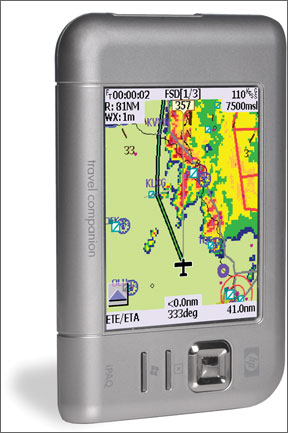
The display on the Pocket-PC-based Anywhere Map system is inadequate in direct sunlight and the plethora of external sensors, receivers, antennas and power cables Anywhere Map requires is difficult to manage. This isn’t as important if you can “install” all this in the airplane once, but it was a real factor as we installed and removed the equipment for each flight.
Few Issues with the 496
The GPSMAP 496 is the newest version of a long line of portable navigators. Its features include aeronautical databases, terrain, WxWorx weather, XM radio, an approach fix database, airport taxi diagrams, an airport database, a crisp, sunlight-readable display, GPS-derived basic emergency instrumentation and even highway and marine modes for when you want a GPS outside your aircraft.
It can display a flight plan entered in a Garmin panel-mount GPS or TIS-based traffic from a Garmin Mode-S transponder. It can also output frequency information to Garmins SL series radios. These features require dedicated wiring installed in the aircraft. The 496 retails for $2595.
The 496 is intuitive in its basic functions but can be more challenging with less-used or more-ambitious functions. Between skimming through the manual and experience with a Garmin GPS from years ago, we had no trouble with the 496.
There is one notable limitation of Garmins handheld navigators: no keyboard or touch screen. You select a field for input, select the first character in that field, scroll through the list of meaningful choices for that character, then move on to the next character and repeat. This works well, even in turbulence, but is time consuming and can be frustrating.
Using GPS alone, Garmin is able to derive a reasonably seamless emergency simulation of all the basic instruments except the attitude indicator. In an emergency, its possible to fly using nothing but these simulated instruments (see sidebar).
Garmin has long included an approach-fix database with its handheld navigators. In practice, you typically append the final approach fix (FAF) after the last en route fix. The 496 navigates directly to the FAF from that last en route fix, and then