









Bush planes are a breed apart, with design criteria that are distinctly different from the average light airplane. A premium is placed on short-field capability and ruggedness, at the expense of speed, creature comfort and snappy handling. These airplanes are built to be routinely operated in environments considered hostile: short, rough strips, and low-level flight. Typical uses are pipeline patrol, ranch surveying and traffic spotting.
Airplanes like the Piper Super Cub, Maule and American Champion Scout are all intended to meet this mission. All are relatively old designs that have changed little over the years, but then this is mature technology: it works, so there’s no pressing need to change it.
The Aviat Husky (formerly Christen Husky) is a well-built, good-performing airplane meant to compete against these bush veterans. Given that it was designed and certificated in the moribund 1980s, it has done we’ll in its market niche.
The Husky does offer some features that differentiate it from its competition, which we’ll detail later on. One significant aspect of the airplane that doesnt show is its certification: it is one of the few designs built to comply with FAR Part 23, rather than CAR 3.
History
Aviat, Inc. started life as Christen Industries in the early 1970s making specialized accessories for aerobatic airplanes. Notable products included inverted oil systems, fuel pumps and restraint systems.
Christens products have been of uniformly high quality, so much so that the inverted oil system was purchased by Lycoming and offered as a factory part. Christen is still in this business, operating out of a plant in Afton, Wyoming.
Christen branched out into the homebuilt market with the Christen Eagle, a highly capable aerobatic biplane in the mold of the Pitts Special. The Eagle was significant in many ways, not least of which for its highly professional, complete and detail-oriented packaging complete with an extensive, step-by-step manual. This approach to building airplanes-packaging them as extensive kits-is now commonplace. At the time, however, homebuilding was generally a matter of buying plans and figuring it out yourself.
In 1982, Frank Christensen made a shrewd business decision and purchased the type certificates for the Pitts, along with the factory, thus effectively cornering the market for aerobatic biplanes. Since then, several potent designs have come forth from builders like Extra and Sukhoi, but at the time the Pitts was the star of the show. The Pitts has remained viable, and continues in production as does the Eagle kit.
Christensen had a factory, a workforce skilled in building tube-and-fabric airplanes, and a family of solid, proven products. Still, the market for aerobatic airplanes is a small one, and Christensen saw opportunity in the bush plane market.
At the time Christensen began the Husky project, the only competitor being manufactured was the Maule, and precious few of those were rolling out the doors. He tried to buy the rights to the Super Cub, the Champion line and the Interstate/Arctic Tern, but considered the asking prices (including the assumption of product liability for previously produced airplanes) unrealistic.
The answer? Simple. Build an all-new airplane.
He and E. H. Herb Andersen, Jr. determined that they could develop and certify their own design at lower cost and in less time than would be required in taking on an existing product. This really says something about the management of Christen. The costs of development and certification have stopped many would-be aircraft manufacturers dead in their tracks.
Also revealing is the startlingly short time it took to bring the Husky to market. The A-1 Husky was designed and proved in 18 months from initial design work to certification, which was obtained in July 1987. The prototype was flying in just seven months.
Production of the Husky is a low-volume affair. Only 68 were produced the first year, and about 30 per year since. The A-1 was joined by the A-1B in 1999, which features a 110-pound gross weight boost. The company also updated the venerable Pitts S-2B into the S-2C and is still building Huskies, Eagles. Aviat also plans a new incarnation of the Swift, though details on that project are sketchy.
Good, basic design
Christensen returned to the basics for the new airplane. Principal design objectives were good short- and rough-field performance; ruggedness, accessibility and serviceability to simplify support in primitive conditions; outstanding slow-speed handling coupled with docile stall characteristics; good endurance and reasonable cruise capability.
The end product is a quite conventional-looking two-seat, tandem tail dragger that, frankly, looks just like a Super Cub. Thats not a bad thing: the Super Cub has remained popular for decades, for good reason.
In terms of materials and structure also, the Husky is very straightforward. The fuselage is welded 4130 chrome/moly tubular steel with a full-depth aft fuselage for greater strength. The aircraft is powered by a Lycoming O-360-C1G (88-922 models) or an O-360-A1P (later models) rated at 180 HP mated to a TRW/Hartzell constant-speed propeller. The engine cowl and forward fuselage are skinned with aluminum. The aft fuselage and flying surfaces are covered with polyester; the seams are taped with cotton and fastened to the structure by oversized pop rivets.
One advantage designers of new airplanes have is the ability to examine similar designs and correct any shortcomings. Christensen did a number of things to avoid some of the problems that had cropped up in other utility airplanes. Rather than using rot-prone wood spars as Champion had, the wings are fabricated with dual aluminum spars and aluminum ribs. They are supported by fore and aft struts. These were designed to eliminate corrosion and other problems that have been encountered in a large number of strut-braced airplanes, such as certain Pipers and older Champions.
Airplanes designed in the 1950s and 1960s are often difficult to work on. Not so the Husky: much of the airplane can be taken apart quickly. For instance, the nose bowl is split to permit fast removal without touching the propeller; the cowl has large doors on either side for easy engine compartment access (good for preflights); the fuselage is metal-clad to the aft end of the cabin and is made up of several removable panels. The aft fuselage, which includes the battery bay, is accessible through a large panel on the port side. (A baggage door was optional, so not all have one.)
The gear uses reliable, proven design, with shock absorption provided by bungees mounted inside the fuselage to reduce drag. The brakes are good and the track wide, which helps ground handling.
The Husky is approved for both retractable and wheel replacement skis. The latter are available in widths of from eight to 16 inches. It also is approved for banner or glider tow hook installation and on EDO 89-2000 floats. Other manufacturers are working on floats as well. Large, 24-inch-diameter tundra tires for serious bush work are available.
To simplify manufacturing and provide inventory control, all A-1s are built with float attach fittings installed. The only additions required for float operations are lifting rings and ventral fin. For the same reason, dual-puck brakes-required for the tundra tires-are standard on all aircraft. These brakes are quite good, and offer plenty of stopping power.
All changes have been incremental improvements, largely as a result of real-life service experience. To its credit, the company has designed all improvements to be field-retrofittable to existing airplanes. Since early units can be updated by later improvements, there is no better or worse model year. The key for any prospective buyer is to ensure that all modifications and any mandated changes have been performed, and to be careful of overall condition.
Aerodynamic goodies
The Fowler-type, slotted flaps are hinged to move aft as they are deployed for high lift. Even at full-30 degree-deflection, they provide more lift than drag, making for good short-field performance.
A great deal of aerodynamic attention has been paid to the ailerons, as well, to compensate for the real estate taken for the flaps. They are symmetrical in section, and the leading edge has a larger radius than the wing trailing edge it abuts to maintain attached air flow during low-speed and high angle of attack flight.
Counterbalanced aerodynamic spades hang from the bottom of the aileron leading edge. The spades act to boost aerodynamic authority of the ailerons and to reduce pilot input forces. These devices, common on aerobatic airplanes but unique on utility airplanes, were borrowed directly from the four-aileron Pitts. The design permits full roll authority we’ll into the stall.
Used marketplace
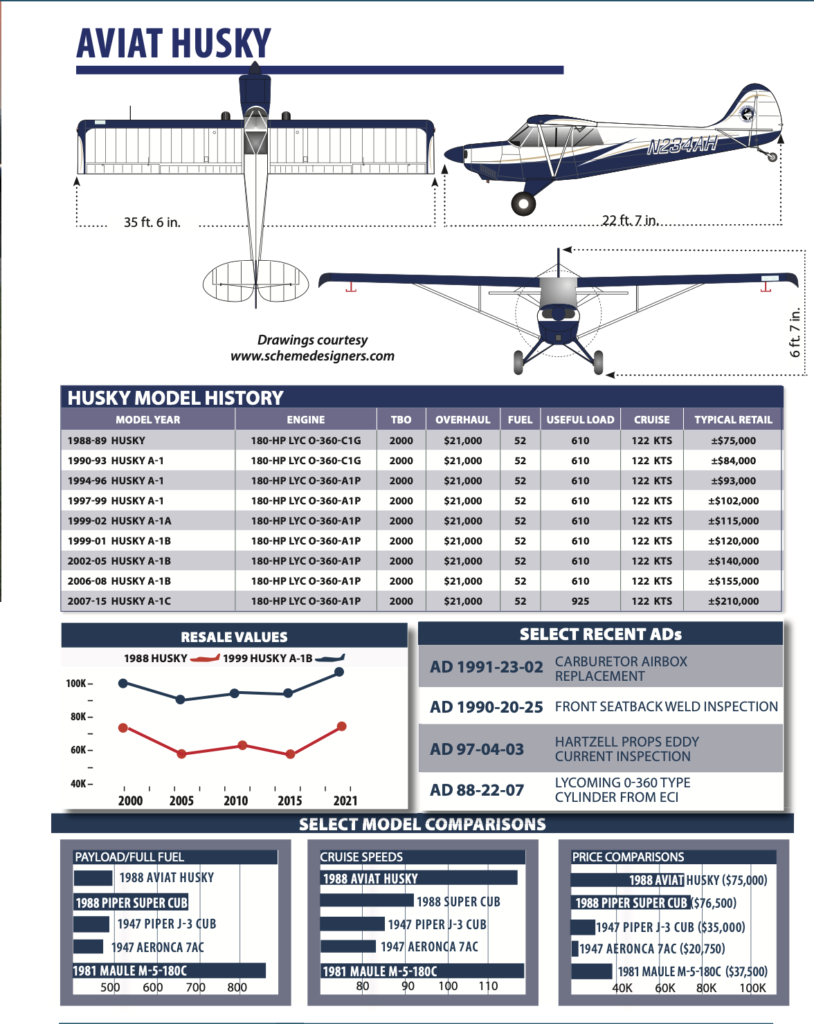
There arent many Huskies, so the used marketplace is small. They hold their value quite well, as shown on the price history chart (most airplanes dive steeply in value during the first couple of years, and often take a very long time to recover).
Competition includes the Super Cub, various Maules, and the American Champion Scout. The Maules never left production, and the Scout and Super Cub returned after the Husky was introduced. So, relatively new examples of each can be found.
Prices for this class of airplane are quite close, with about 10 to 15 percent separating the costliest from the cheapest for the same year and condition. The most expensive airplane in the class is the Super Cub, despite the fact that it has 30 fewer horsepower than the others.
Naturally, with only relatively new Huskies available, its possible to buy a utility airplane for far less money than an A-1 would cost. But buyers should be very careful, particularly of older utility planes, regardless of manufacturer. These aircraft were built as working tools, not pleasure craft, and many have been flown hard. In addition, many strut-braced airplanes, especially the Piper and Champion lines, have suffered from corrosion of strut attach fittings.
A number of Husky A-1s were put to work in demanding environments, such as spotting and patrol. Some of these have been operated in excess of 100 hours per month. The comparative newness of the design doesnt mean a given Husky has not had time to be exposed to abuse. So with any airplane in the light utility category, a thorough evaluation of the airplane and supporting records is very important.
In many respects, including fit and finish, performance, good flying qualities and maintainability, the Husky is the class of the category. Aviat has shown that it is a well-managed, viable company, so despite the relatively low volume we feel confident that its not going anywhere.
Cockpit/cabin comfort
Getting into the airplane is hard to do elegantly, but then, if youre not willing to mount up properly, you shouldnt be flying an airplane like this. Rather than sliding in like a car, the pilot and passenger more or less hoist themselves aboard.
For a conventional-gear airplane, forward visibility is very good for pilots of average to tall height despite the large, high wing (shorter pilots can adjust the view by using thicker seat cushions). There is a transom light overhead which helps spotting traffic in turns.
Long missions in other light utility aircraft can be fatiguing, both because of the constant need to keep the airplane right side up during low-speed operation, and also because control forces-especially roll control-are high and therefore fatiguing. The Husky ranks very favorably in this category, especially after pilots learn to adjust pitch forces by anticipating trim input.
Visibility and comfort is best in the rear seat. The seat is wider, the angle of the back rest is better, and there is more leg room fore and aft. One shortcoming noted by our respondents, however, is the lack of heat for the back-seater.
One of the biggest shortcomings of the Husky, at least for tall pilots, is the front seat. It is a fixed part of the structure. All adjustments are made by changing cushions. But after an hour or two, discomfort becomes the most noticeable element of flight, overwhelming the good performance, fine visibility and relatively low control effort.
With relatively little soundproofing the noise level is high, but not so much so that owners complain about it. Headsets are, of course, a must.
Handling
Handling is typical for this class of airplane, which is to say that it likes lots of rudder input, and its not overly twitchy. Also, transitioning pilots are at risk of groundloops until they have some taildragger experience (this shows up in higher insurance rates for those without the necessary experience).
Wing loading is light at 9.8 pounds/sq. ft., so the ride in turbulence can be bumpy. Its an inevitable trade-off for STOL performance.
Control harmony is fairly good, which is sadly uncommon in this class of airplane. Rudder and aileron forces are pretty linear in relation to airspeed. Because of the bungee trim system, elevator deflection forces are fairly high, even at low speed. In fact, it trims like a heavy airplane-a little bit at a time, and almost always in response to any power or attitude change. Rudder authority is good right down through low-speed flight, and the aileron spades to wonders to maintain control at low speeds.
For a lightly wing-loaded airplane, the Husky is quite well-mannered in cruise. Properly trimmed, it does not require a lot of attention to maintain course. This makes it a better instrument platform than many of its peers, and some owners fly IFR. However, thats not the Huskys primary mission. There isn’t really room for a full avionics stack, anyway.
The big virtue of the Husky is that even during slow flight, properly configured, the attitude of the aircraft is flat; it is flying on the wing rather than hanging on the prop. This is a big safety advantage for spotting, patrol and other low-altitude, low-speed operations, since at these speeds the Husky is not flying on the edge of a stall, and the airplane very largely takes care of itself so that the pilot can safely look elsewhere. Power-on stall speed is only 33 MPH with flaps.
Tailwheel steering authority on the Husky is good, which makes ground handling simple except in high winds. A touch of differential brake swings the aircraft around briskly. The brakes are powerful. Even at low taxi speeds, over enthusiastic application will bring the tail off the ground (and too much can mean damage to that very expensive constant-speed propeller).
Ground handling, by the way, is aided by convenient handles on both the aft fuselage and elevator. These give line personnel little excuse to mishandle the airplane when moving it around on the ramp.
Stalls, spins
The Husky is a forgiving, though mildly demanding, straightforward airplane to fly. As such, it would be a good trainer or recurrent reminder for experienced pilots. Bad handling or bad speed control will be rewarded with loss of control. At least recovery can be made quickly.
Thanks to the good aileron and rudder authority, combined with the Fowler flaps, the pilot really has to provoke the Husky to get it to bite. Anything resembling proper stall technique results in very mild stalls and near-instant recovery. Spins are virtually impossible to get into with flaps deployed.
While the Husky is nearly spin-proof with full flaps, it will reward uncoordinated control input with a snap over the top in power-on stalls in the clean configuration. It will not spin, but the resultant spiral or corkscrew maneuver is more alarming.
Speed builds very quickly during this exercise, and must be attended to immediately. However, almost any reaction leads to recovery. Also, during cruise in turbulent air, speed control is important at most altitudes since indicated airspeed is fairly close to the Vno of 103 KIAS (Vne is 132 KIAS).
STOL
Slow flight and STOL performance are where the Husky really shines. Takeoff distance with full flaps is 200 feet, with landings in 350 feet. Figure about 500 feet total over an obstacle. Even at high density altitude, takeoff speed is reached quickly, and the effective brakes help make short stops easier. The best technique for assuring the airplane will stay on the ground is to retract the flaps during the brief ground run.
Even maximum performance takeoffs result in continuous climb. There is no sagging-off even while flaps are retracted. It is a credit to the airplane that, once a pilot is familiar with it, such performance does not require superior technique. One owner noted that its not necessary to lift the tail during takeoffs: the airplane simply doesnt need it.
No-flap takeoffs require more ground run, naturally, but taking off in the three-point attitude produces a short run and healthy climbout (1,500 FPM at sea level at the best rate of climb speed of 63 KIAS).
During approach, precise control of airspeed and vertical speed are important. The correct combination of alignment, sink, airspeed and attitude is elusive at first, but once mastered results in truly impressive STOL performance.
In the hands of a qualified pilot, the Husky can be a good neighbor even at busy airports with a mix of traffic. Recommended approach speeds are very low (52 KIAS), which would give your average Westchester County controller fits. But it can be flown at an indicated 100 knots right to the threshold and slowed to proper touchdown speed easily.
Aside from managing speed and sink rate control, the biggest trick to landing the Husky is to ensure that the trim is full aft. This requires a high effort if the proper speed is not achieved first, because of the nature of the bungee trim system. This is most difficult in solo flight, because of the forward CG bias of the airplane.
With the trim full back, there is still an inch or so of elevator travel in the stick, and it takes some effort to get the tailwheel-low attitude that makes for a satisfactory landing.
The best recovery technique for bounced, poorly aligned or otherwise botched approaches, at least initially, is to add power and go around. The Husky will bounce mightily and can easily get sideways-not a good way to recontact the ground. With full power, the airplane leaps back into the air; with just a touch, it still flies.
Performance
As already mentioned, slow flight is the Huskys strong suit. It was not designed as a cross-country hauler. But the airplane also has a reasonable cruise speed, quite competitive with modern light aircraft such as the Cherokee, Skyhawk, Skylane and Tobago.
Cruise at 55 percent power is 113 knots; at 75 percent, 121; top speed at sea level is 126. Listed fuel consumption at 55 percent is 7.7 GPH; at 75 percent it is 9.3 GPH. Still-air range at 55 percent is 695 NM. With power set for an airspeed of 96 KIAS, endurance is seven hours.
After some practice, you can operate the Husky from a football field. Factory numbers for ground runs at sea level are: maximum performance takeoff, 150 feet; landing 250 feet. Even in high density altitude conditions (for instance, at seven to eight thousand feet) and at full gross weight, the Huskys performance is impressive.
It performs very we’ll on floats. Part of this is attributed to close attention to the relative angle of incidence between the floats and the wing. Cruise at 5,000 feet is a quite respectable 106 knots. It will get off the water in eight seconds (approximately 500 feet) in zero wind conditions.
Load carrying
When loading a Husky, center of gravity is not an issue, since the bias is toward the front end of the range with just one aboard due to the relatively large engine and constant-speed prop. Standard useful load is 610 pounds. A full load of fuel-50 gallons usable, or 300 pounds-leaves 310 pounds of payload available. The baggage compartment behind the rear seat is rated at 50 pounds.
The baggage compartment is reached by folding the rear seat back forward, which can be a little awkward. One owner complained of the lack of a baggage door.
Maintenance
The Airworthiness Directive picture for the Husky is a good one. Only two ADs are specific to the aircraft. One, 90-20-5, applies to 88-90 models and calls for inspection of welds on the seat back, and addition of reinforcements if needed. The other AD, 91-23-2, applies only to 1988 models and calls for the replacement of the carburetor air box.
The Husky, like many airplanes, is subject to AD 98-2-8, calling for possibly repetitive inspections of the crankshaft at 100-hour intervals if corrosion pitting is found. The first inspections are to have been completed by the time you read this.
There havent been too many squawks on the airplane, but it would be a good idea to check the stainless steel control cables for wear, and look for any vibration-related problems in the baffles and cowling that might be related to the relatively rigid engine mounting.
Conclusion
For its mission, its hard to find fault with the Husky. It does its thing remarkably well, and owners are very happy with it and with the manufacturer. Aviat is one of those too-rare aviation success stories, though its not exactly a household name.
If youre in the market for a working airplane, the Husky is definitely worth a look.
Owner comments
I purchased my 1994 Aviat Husky from Scott Erickson Aviation in Omaha. Scott runs the worlds largest Husky dealership, and probably knows more about the Husky than anyone outside of Afton. Scott has been most helpful in answering all my questions about the Husky, and gave me a thorough checkout before turning me loose from the North Omaha Airport.
For me, the joy of flying the Husky is in its amazing short field takeoff and landing performance. With a little headwind, your speed at touchdown is about that of a fast walk. Ailerons are effective throughout the flare, making it easy to hold a wing down into a crosswind. The toe brakes work well, but on most landings there is no need for any braking at all. You do need to trim nose up for landing, or else you find yourself fighting the bungee trim system during the flare. If you decide to make a wheel landing instead of a full-stall landing, just set up an approach at 65 mph with full flaps and set the Husky down gently. Unlike many tail-wheelers, the Husky sticks to the runway without any of that nasty tendency to leap back into the sky.
Its hard to say whether landing or takeoff is more fun. On takeoff pull on full flaps, hold the stick back, advance the throttle, and you will find yourself airborne without ever pushing the stick forward to raise the tail. Just no need to do so. Hold 58 m.p.h. in the climb, and at most airports you will be at pattern altitude before reaching the departure end of the runway. This is when the tower operator comes back on the radio wanting to know more about your airplane! (Huskys are sufficiently rare that Ive been called a Piper, a Cessna, and an Experimental all by the same controller.)
With just 150 hours on my Husky, I do not yet have experience with long term maintenance costs. The Husky is so basic in design, and the 180 HP Lycoming has such a good reputation, that I expect the maintenance costs will be very low. During the 150 hours this Husky has logged, the following have been replaced: starter motor, battery, manifold pressure gauge, master solenoid, and alternator circuit breaker. There have been no other problems.
My insurance cost, hull and liability, is $2200 per year. This is high, but reflects the fact that I had no recent tailwheel time when I purchased the aircraft.
For my money, the Husky is the most fun flying machine around, although some minor things could be improved. On cold days there is a nice blast of hot air from the heater ducts for the front seat pilot, but the rear seat passenger freezes. It would seem to be an easy matter to run another heating duct along the floor to the rear seat. Another nice change would be a higher maximum flap extension speed. If I could ask for just one change on the Husky though, I would ask for a baggage door. Climbing over the rear seat to get to the baggage compartment really is awkward.
Both Wipaire and Baumann have announced amphibious floats for the Husky. I plan to convert to amphibs in the future, but right now Im having too much fun on wheels!
Harry Garland
Palo Alto, California
I purchased a 1993 Husky new from the factory and still own it. It now has 460 hours of work under its belt. Basically it works as we’ll as it did the first day I bought it. The name surely applies: Husky. It was built to withstand all the punishment I can place on it, and survive!
Performance figures include: File 100 knots with 6 1/2 hours fuel. Expect to climb with full fuel, baggage, two 200-pound adults and density altitude of 3000 feet at 800 FPM to 5000 feet; with this load, expect to clear a 50-foot obstacle in 500 feet from a stopped position. Expect to land and stop with no wind and the same load in 500 feet with good brakes. don’t expect to get there fast.
I keep it at my home, on a 1200-foot grass strip with power lines and trees at each end. In four years Ive only had one other plane land there, and he said hed be foolhardy to return.
The Husky thrives on southern Georgia density altitude. The rougher the strip, the more you’ll appreciate the Husky. My Husky spends as much time on cow patties as it does on asphalt.
Regarding flying characteristics; slow, but sure. Gross movements of the stick will not awaken a sleeping passenger. Average speed is about 100 knots. Climb in the Rockies during summer at 12,000 feet is about 200 FPM. Fuel burn is 8.5 GPH.
Outside air temperatures of less than 20 degrees F will numb the back seat passenger even with the heater blasting. Visibility is excellent, even considering the huge wings. Endurance with IFR reserves is about five hours, which is way beyond my bladder capacity.
Speaking of IFR, Aviats avionics technicians are the best. Ive had zero problems with my King KX155 with glideslope, ADF, audio panel and encoding altimeter. I fly many severe IFR days and nights in the Husky with confidence. One can shoot approaches at 60, 90 or 120 knots.
Loading is no problem. The Husky can carry a passenger, a 200 pound pilot and all the luggage one can place in a 2 x 2 x 4-foot space, yet still have enough left over for a decent amount of fuel.
I fly about 100 hours per year. Costs include $500 for an annual inspection, $500 for parts, $1000 for insurance and $50 per year for miscellaneous operating expenses. This totals to $7000 per year, not counting fuel and oil. Since I keep it at home, I don’t have to pay for a tiedown or hangar. Not bad.
In general, maintenance and insurance are less than the two previous planes Ive owned and its a really fun plane to fly…no aerobatics and no speed, but a forgiving IFR taildragger!
Jim Tinley
Also With This Article
Click here to view charts for Resale Values, Payload Compared and Prices Compared.
Click here to view the AVIAT A-1 Husky features guide.