










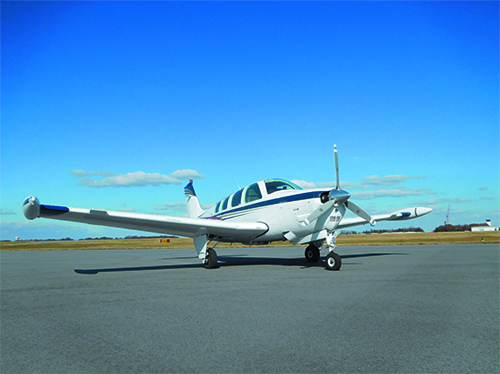
Beechcraft 36 Series

[IMGCAP(1)]When it comes to the inevitable airplane/automobile analogy, the Beech 36 series Bonanzas can borrow a line from Mercedes: Expensive, but worth it.

The 36s have earned a reputation that ranks them as one of the best single-engine airplanes ever built. They have an enduring appeal among pilots of all skill and income levels for their fine workmanship, excellent handling characteristics, good performance and top-grade materials and finish.

The prices, too, reflect the fact that many pilots regard the Bonanza as the ultimate flying machine. A new A36 tops $500,000 and even an early 1980s model can top $200K. In a recent issue of Trade-A-Plane, a vintage 1968 with nearly 10,00...

When it comes to the inevitable airplane/automobile analogy, the Beech 36 series Bonanzas can borrow a line from Mercedes: Expensive, but worth it.

The 36s have earned a reputation that ranks them as one of the best single-engine airplanes ever built. They have an enduring appeal among pilots of all skill and income levels for their fine workmanship, excellent handling characteristics, good performance and top-grade materials and finish.

The prices, too, reflect the fact that many pilots regard the Bonanza as the ultimate flying machine. A new A36 tops $500,000 and even an early 1980s model can top $200K. In a recent issue of Trade-A-Plane, a vintage 1968 with nearly 10,000 hours on it was priced at $125,000-roughly three times what it cost new.

In some ways, Beechs 36 series is a derivation of the popular V-tail S35 Bonanza. But the cabin stretch, tail modifications and other changes that turned the sprightly V-tail into the luxurious 36 created a remarkable airplane. And during the 36 Bonanzas 33-year production run, Beech has continually refined the airplanes accommodations and equipment to ensure its popularity.

Market Position
On the surface, it may seem the 36s primary competition would come from other six-place airplanes, such as the Piper Saratoga/Lance and the Cessna 206/210. But the Bonanza also competes up and down the market.

It challenges the Piper Malibu/Mirage and the Mooney. Some owners report moving out of twins to fly a Bonanza-an unusual backwards trend that defies most owners tendencies toward bigger and faster.

The 36 series originally was aimed at plugging a hole in the Beech lineup for a utility airplane that Cessna filled with the 206. The V-tailed S35 had been stretched 19 inches in 1964 to create a six-seat airplane to compete with the 210, but the S35 and the 210 both suffered from cramped rear seats that nearly eliminated baggage space. The S35 carried the added complication of a narrow center of gravity range.

To create the 36, Beech stretched the cabin of the 33 Debonair by 10 inches ahead of the wing. The new offering featured the overwing door on the left side, but also a set of doors at the rear of the airplane. Base price of the first 36 Bonanza was $40,650, which rose to an average of $47,050 equipped.

The original 36 was powered by a six-cylinder Continental IO-520-B that produced 285 HP through a two-bladed prop. Standard fuel capacity was only 50 gallons, although an 80-gallon option was offered.

Beech initially targeted the airplane as an air taxi and cargo hauler and the base version was much more utilitarian than other airplanes in the Bonanza line, particularly the V-tails. It could be flown with the rear doors removed, presumably for such tasks as parachuting or aerial photography.

The airplane could also be ordered with an interior that was more properly Bonanza-like to be used as a business airplane or upscale transport.

After only two years of production, the 36 was replaced in 1970 by the A36, which featured club seating as a popular option. Beech saw the writing on the wall and positioned the A36 as an extension of the Bonanza line rather than as a utility airplane. Many of the features that were previously options became standard and the classic was born.

Improvements continued as the airplane evolved, with many of the upgrades made to better tailor the airplane to the mission of a businesspersons IFR airplane. In 1976, an autopilot was standard, along with a basic suite of IFR avionics. By 1980, the 80-gallon tanks were also standard equipment.

The biggest change came in 1984, when the engine was swapped for a 300 HP Continental IO-550, the throwover yoke was replaced by dual yokes and the panel was redesigned. This essentially modern Bonanza was priced at more than $160,000 and currently carries an average retail value of about $248,000. A couple of years later, the airplane was being delivered with RNAV, DME and other IFR niceties.

Power Choices
The IO-550 can be retrofitted to older airplanes and that seems to be a popular option when it comes time for an overhaul. Both engines carry the same TBO of 1700 hours, but those who have made the switch report better performance on very little additional fuel burn.

The estimated overhaul cost of the IO-520 is about $1500 less than the $20,000 the IO-550 may demand. The IO-520 has been notorious for case and head cracking, a shortcoming that has not plagued the IO-550 to the same extent.

The 36 also comes in a turbocharged package, with the A36TC introduced in 1979. The sophisticated TSIO-520-UB featured a variable absolute pressure controller that automatically maintained manifold pressure during climbs and descents, as we’ll as those due to changes in ambient air temperature.

The limited fuel capacity of the Bonanza at the time-74 gallons-meant that the turbo wasnt quite the long-range high flier owners wanted. Beech sold 272 in three years, then introduced the B36TC. It boasted a Baron 58 wing-four feet longer and with a new carry-through structure that boosted fuel capacity by 40 gallons.

Gross weight went up by 200 pounds to 3850 and a new prop and hub improved ground clearance. Other changes resulted in an airplane that was both simpler to operate and much more capable than the A36TC.

Both turbo models are well-regarded on the used market, with all but the newest models selling for we’ll over their new prices. The TBO for the turbo models is 1600 hours, but prudent owners plan on a top overhaul somewhere in the 800 to 1200-hour range. The turbo engines tend to run hot, partially due to a lack of cowl flaps and partially due to inadequate baffling.

The engine/boost-pump combination on the A36TC requires some extra fiddling by the pilot on takeoff. The book calls for a fuel flow of 32.5 to 34.0 GPH on takeoff, which may require putting the fuel pump on Low or Auto and then leaning the mixture back to the correct fuel flow.

The same procedure must be continued throughout the climb in warm weather. The B36TC book warns the pilot not to use the boost pump in the HI position because of excessive fuel flow.

The 520 engines are subject to the notorious cylinder-crack AD 86-13-4, which calls for inspection of the cylinders for cracks every 50 hours. They are also prone to crankcase cracks. Check carefully for cracks on any 520-equipped Bonanza considered for purchase. A bad crack will cost at least $5000, mostly because of the teardown costs. However, since most 36s have been overhauled with the heavier crankcase, cracking is less of an issue.

Handling and Performance
The hallmark of Bonanzas, of course, is that theyre a pleasure to fly and go pretty fast. All of the 36 series share these attributes, although pilots used to the sporty handling of the V-tails may find the 36 a bit ponderous. This has its advantages, however, as it give the airplane a stable ride and makes a better instrument platform.

The stretched fuselage improves the loading envelope and also eliminates the annoying tail-wag the V-tails and 33 exhibit in turbulence. Control forces are higher in the 36 than in other Bonanzas, but are well-harmonized and many pilots prefer the Bonanza feel to what youd find in a competing Cessna or Piper.

The higher control forces are intentional on Beechs part, as a relatively high stick-force- per-G control force is less likely to depart into a spiral if the pilot is inattentive or disoriented.

Cruise speeds are competitive with other models and better than some. A Bonanza will outrun a Mooney 201, although at the expense of more fuel, and it will pace a Cessna 210. It blows the doors off a stock Piper Saratoga, although speed mod guru Roy LoPresti has modified Piper Lances to run neck-and-neck with the Bonanza.

Typical cruise numbers call for about 170 knots on 16 GPH, depending on altitude and power setting. The turbo models motor along at 190 knots at 20,000 feet at 75 percent power on 17 to 18 GPH, with speeds slowing to the 180 knots in the middle teens.

On landing, most pilots agree that the 36 series feels a bit nose-heavy when flying solo or with only a front-seat passenger, and some opt to carry ballast in the back when the mission calls for a lightly loaded airplane. Like most big singles, carrying a bit of power into the flare helps ensure smooth landings.

Cabin and Loading
The interior of the 36 is comfortable, with plenty of headroom and good visibility. Four aboard makes for a spacious cabin, but filling the seats makes the airplane feel cramped. This is really a six seater only if several of the passengers are kids.

On airplanes with club seating, which is virtually all of them, putting four adults in the back requires some leg-locking that may make some passengers a bit uncomfortable. The airplanes rear doors and opening emergency egress windows make it more pleasant for passengers, particularly on hot days, if the air conditioner is on the blink. The added safety of multiple exits is also a real plus.

The biggest shortcoming in the cabin is lack of baggage space. The airplane does not have a nose compartment like the Saratoga, and only later models have any space at all on the floor behind the rear seats.

Most 36 pilots are forced to make do by stuffing a bag or two between the front seats and the aft-facing middle row and using a small hatshelf behind the rear seats.

Many owners simply remove one or both of the rear seats and use that space to pile luggage. This sometimes creates too much space at the expense of a passenger seat. For most owners, however, the airplane is really a four-placer, for which it has enough baggage space.

Gross weight is 3600 pounds for the normally aspirated models and climbs to 3850 pounds for the B36TC. Typical payload with full fuel is 960 pounds for the A36, about 750 pounds for the A36TC and 950 pounds for the B36TC.

Compared to the V-tails and the Debonair, the Bonanza offers much more flexible loading. While a V35B might have a CG range of only 2.3 inches and an F33A 4.6 inches, a 36 Bonanza has a range of 6.7 inches at 3600 pounds.

Safety
The attention to crashworthiness and safety is more apparent in the Bonanza than in virtually any other airplane other than new designs such as the Cirrus and Lancair. Some of what we’ll call safety features are design choices Beech made that have resulted in a safer airplane. Foremost among them are the aforementioned opening windows in the back. Should disaster strike, the Bonanza has four emergency exits, two on each side of the airplane. That makes sense, in our view.

Beech also installed shoulder harnesses for all passengers, with double straps for the front occupants. Some models may not have shoulder harnesses, as Beech discontinued them as standard equipment for several years because people werent using them.

We also see the landing gear design as a plus. The design shares much with the Baron, which is heavier, and was subjected to military specs with the T-34 trainer in mind. The resulting cabin frame and keel structure along the underside of the airframe greatly improves crashworthiness by absorbing energy and protecting the occupants.

That the gear is powered by electric motors instead of hydraulic pumps is also a benefit. Cranking down the gear manually is a relatively simple affair, as long as the spar cover has not inadvertently been installed over the manual handle.

Finally, the fully opening engine cowling makes preflight inspection easier. Being able to really see the hoses and pumps is better than having to peer through the oil filler door and cowl inlets to get a peek at the engine compartment. This relatively simple design element is one that might make all airplanes a safer, since it encourages the kind of pre-flight inspection that might actually reveal faults inside the engine compartment.

A check of accident records for 1994 to 1998 is perhaps unsurprising given the 36 series mission. The total accident rate is relatively low, showing that pilots are generally more experienced, but the fatal rate is relatively high, demonstrating that when accidents happen they tend to be serious. About 34 percent of fatal accidents were weather related, encompassing VFR into IMC, poorly flown approaches and fatal encounters with icing or thunderstorms. Other fatal accident causes were fuel exhaustion, pilot disorientation and engine failure.

Among all accidents, engine failure and fuel exhaustion were the most common. The engine failures included both catastrophic failures of internal components and accidents following modification work, especially turbocharger installation.

Many of the fuel exhaustion accidents involved a common scenario: Crashing with the fuel selector on an empty tank when the other tank contained fuel. Another major cause of accidents was pilots overrunning the runway while trying to take off or land on short grass fields.

ADs
There are a few ADs of note that apply to the 36 Bonanza. AD 2000-26-16 raises the troublesome possibility that some of the rivets may be missing from the right side of the airplane. AD 2001-08-08 applies to engines modified by STC to include a turbocharger.

The STC may call for Aeroquip V-band exhaust clamps that can fail, causing the exhaust pipe to detach from the turbocharger. AD 77-13-22 requires inspecting IO-520 engines that have the light case every 100 hours. The heavy case engines, produced from 1976 on, are not subject to the AD but may crack, too.

AD 93-24-3 deals with the rudder forward spar assembly and rudder center hinge. These parts were found to be cracking and the AD calls for an inspection every 500 hours.

Perhaps the biggest complaint owners have when it comes to maintenance is the cost of Beech parts. Availability doesnt seem to be an issue, but the price tag can be a shocker.

Support, Mods
There are a host of mods available for the Bonanza, ranging from props to vortex generators. The best source of current information about mods is the American Bonanza Society, which also offers service clinics, fly-ins, pilot proficiency training and a good magazine. The ABS is located in Wichita, Kansas. (316) 945-6913, or www.bonanza.org.

The factory is also there, with Raytheon still producing new Bonanzas. The company doesnt seem to be in any sort of financial trouble, and that says something. However, there are persistent rumors that Raytheon or the Beech division may be about to be sold.

Several years ago, Beech announced a program that allows owners of late-model Bonanzas to make maintenance easier. Called STARS (for Service Tracking and Reliability System), the program monitors maintenance and inspection requirements and alerts operators as items come due.

The program is meant to make it easier to plan, schedule and budget for maintenance. It applies to A36 Bonanzas, serial numbers E-1241 and up (that airplane was built during the 1978 model year) and all 36TC Bonanzas.


Owner Comments
I have owned an A36 Bonanza since June, 1985. N3028W is a 1973 model that I have upgraded extensively since purchase. Most recently, I installed a new Garmin GMA 340 audio panel and a Garmin 530 GPS/comm moving map display.

When I purchased the airplane it had an IO-520BA engine with a McCauley two-blade propeller. In 1989, I upgraded to an IO-550B with a McCauley 409 series three-blade propeller. In my opinion, the 550 upgrade is mandatory for this aircraft. I fly to Denver frequently and the 550 gives my A36 the power that it missed with the old engine.

It climbs much better and cruises at least 10 knots faster than with the old engine and prop. The only downside with the 550 and 409 propeller was that the aircraft interior noise level went up. In nearly 12 years and more than 1100 hours of flying with the 550, I have never had a problem with the engine.

It uses hardly any oil and still has excellent compression. I think frequent use of the airplane is the answer. I fly at least once a week, even if its just a short hop to warm the engine up.

The A36 is a great instrument platform. My aircraft has a useful load of 1286 pounds, so I can haul six adults as long as I fly with reduced fuel. The side doors and reversible middle seats make loading a snap, especially when you have older passengers who cant get up on the wing to get in the front.

The real virtue of this airplane is its speed and handling. My airplane will fly between 4000 and 9000 feet at 175 knots. It easily outruns a friends Mooney 201 and anothers Seneca II. The handling is a joy.

It does not land as we’ll as a V-tail unless you have people in the back seats. I have considered purchasing a Baron, but the huge increase in operating costs and reduced safety of the light twin have ruled that out for me.

I have also considered a newer (post-1984) Bonanza. The control wheel arrangement and dual brakes of the newer models is preferable to the throw over control wheel that my airplane has. In addition the central radio stack is closer to the pilot by about six inches, which puts a Garmin 530 in a more viewable location than in the older panel.

However, its hard to find a newer aircraft with an S-Tec autopilot. For some reason, Raytheon puts all Bendix/King autopilots in the newer Bonanzas. I think pilots who have flown with both prefer the S-Tec because its all electric, rate-based and will work even if the vacuum system fails.

The A36 is not a cheap aircraft to own and operate. I figure almost $100 an hour for direct operating costs and another $35 for fixed costs flying around 100 hours per year.

Any one who owns an A36 should join the American Bonanza Society. They have excellent training programs and regular aircraft inspections that are of great value to an owner.

-Greg Siemann
Carroll, Iowa

———-

I have owned my 1981 A36 for one year and have flown it for more than 100 hours. I have been pleased with it, my first single in many years after a series of twins.

N111lJ has been upgraded to the IO-550 with GAMIjectors. Fuel flows at 65 percent are about 13 GPH, yielding 155 knots at low altitudes. Flying characteristics are great, as with most Beech products.

My first annual was just finished, costing about $2500. No great surprises. The prior owner put all the speed mods on: flap, aileron gap seals, sloping windshield, but Im not sure of the speed benefit. He also added vortex generators, but to what end? I added an oil pan silicone pad heater for operating in cooler weather. So far, Ive had no unpleasant surprises.

The airplane is well-equipped, with a Garmin 430 with coupled Stormscope displayed on-screen and a KFC-200 autopilot with flight director. The airplane is not equipped with air conditioning, which is a real need in the summer climes.

-Walter Erston
Via e-mail

———-

I purchased a 1979 Bonanza five years ago, replacing a Cessna 310, which I found needed constant attention to systems maintenance. The A36 has been comparatively free of such problems, costing about one third to maintain and delivering 165 knots cruise.

DShannon tip tanks allowed an additional 180 pounds in useful load, which is now 1310 pounds. GAMIjectors smoothed idle vibration and reduced cruise fuel flow a bit.

Comfort and handling in weather arent as good as in the twin, but the airplane is good enough to allow very long (800 nm+) cross country flights.

There have been three Achilles heels: The air conditioner system has been trouble-prone and I am presently replacing a condenser and compressor. Poor quality maintenance by the local Beech shop hasnt helped much. And the high cost of replacement parts, even non-OEM parts, drives up the cost of ownership.

Perhaps the biggest advantage of owning an A36 has been that Bonanzas are one of the first airplanes to get STCd modifications. This helps keep Raytheon honest and supplies owners with genuine quality upgrades.

-Charles Burnett
Memphis, Tennessee

———-

Ive owned an A36 since 1985. It was bought used from the original owner and has served me very well. There is no doubt that its the best private airplane flying and I still get goose bumps on seeing it when opening the hangar. Ive averaged 100 hours a year and have repeatedly demonstrated its long legs by flying from Burbank to Pensacola, where my wifes family lives.

We make the trip down with one stop at Fort Stockton, Texas. Its usually two stops on the way home, but weve made it on one stop on three or four occasions. Were always legal on landing with 45 minutes of fuel on board.

We havent added much: GPS and a fuel totalizer as we’ll as an HSI. It has a 900-pound useful load with full fuel and lives up to all the specs in the POH.

We had oil all over the windshield once at 1675 hours and, instead of fixing the blown propeller seal and rings on one cylinder, we went with a factory reman engine from American in Arlington, Texas and have had no problems since. The original radios are still in it and function well, and the original wing leveler can still track well.

Annuals have averaged about $1300 to $1400 and fuel burn at altitude is 13 to 14 GPH. With the six-probe Alcor, we always run on the rich side of peak.

I get offers to buy it at least every other week for three times what I paid. My son is now buying a half interest in it.

-Jim Helsper
Via e-mail

———-

I purchased an 1985 B36 in February. After doing months of research on the accident history, loading and performance of the Saratoga and the Bonanza, my decision came out in favor of the Bonanza.

I had spent some 35 hours in a Saratoga last fall and was fairly impressed by it. It had better payload and roominess, but that didnt outweigh the performance, resale, accident history and, most of all, the handling of the Bonanza. Its a very well-built airplane. Everything on it is very solid and built to last, from the internal controls to the solid retractable gear. I only have 35 hours in it so far, but I continue to get excited each time I take it up.

I purchased it with a high-time engine, 1500 hours, and am having Superior install a new Millennium engine in it. From all the people I have spoke to and information I have read, this should make this awesome bird even more enjoyable.

The numbers: 174 knots at 10,000 feet, burning 17 GPH. Insurance runs $5800 per year, but I just got my private last fall (175 TT, 0 time in type).

That cost should drop considerably next year after I earn some time in type, enroll in the Bonanza Pilot Proficiency Program and get an instrument rating. Maintenance has been minimal. I spent $2400 on the pre-buy, which included the annual.

-Todd Kimmes
Hamel, Minnesota

———-

I bought my 1977 A36 in 1996 with only 1400 hours total time. In nearly 40 years of flying, I have owned a 180 HP Mooney, S35 Bonanza, Cessna 340, Cessna 182P and a turbocharged 1974 A36.

The Mooney was the cheapest to fly and the 340 the most expensive. The A36 is the best compromise among all of the airplanes I have owned. It goes fast, hauls a good load and is reasonable to maintain. Annuals run $2500 per year, the same as insurance.

The original IO-520BA engine was replaced at 1600 hours. Oil consumption was 1 quart per hour, compression was in mid 70s and the log books showed no work was ever done on the engine except for normal maintenance in over 24 years.

Flightcraft in Portland installed a factory new 300 HP IO-550B special edition balanced and blueprinted engine using their STC. Ive also added a Beryl DShannon baffle kit, new McCauley three-blade propeller, Knots-U aileron/flap gap seals, Horizon digital tachometer and new windows. I do not miss my previous turbocharged A36 at all. This normally aspirated IO-550B gets off the ground quicker, climbs faster and burns less fuel for the three-hour flights I normally fly. Its also just as smooth as the Victor engine in the 1974 A36, plus the potential warranty coverage couldnt be better because Continental has worldwide locations.

In 1996, the original Bendix/King 170 generation avionics were replaced by Silver Crown 155s and a KLN89B. Last year, they were all replaced by the Apollo/UPSAT stack you see advertised (GX60, SL30, SL70 and MX20 MFD).

The panel is now cooler (no cooling fan needed) and electrical current draw is greatly reduced. This airplane has a 12-volt system and something like a Garmin 530 will run the battery down real quick.

Safety items include an extended baggage area behind the last row of seats, like on the new Bonanzas, to get some weight farther back when flying solo. Precise Flight speed brakes help keep the engine warm while flying 140-knot approaches (when mixing with jet traffic) and still make the first turnoff.

A B & C 20-amp auxiliary alternator, standby electric pressure air for the HSI and gyros (and Century 2000 autopilot), WX-500 Stormscope, standby electric attitude indicator and Comet Flash Strobes, along with a Precise Flight pulse light and auxiliary landing lights on the main gear by Alpine. Even with all this stuff, I still have 1250 pounds of useful load.

The A36 does not have the Dutch roll tendencies like my previous S35 V-tail did, but using the yaw damper results in a much more comfortable ride in turbulence. That was money we’ll spent and highly recommended.

-Jim Theda
Portland, Oregon

———-

I have owned my aircraft for two years and flown 250 hours on trips all over Europe. Its a 1984 model with the big panel, separate yokes, conventional controls and the IO-550 normally aspirated engine. Mine is one of only six A36s on the British registry.

I am most impressed with the quality of construction and finish of the A36. There’s a reassuring solidity throughout. Mine has original paint and interior, which looks much better than you would expect to find on other 16-year-old airplanes.

The big plusses are in performance, handling and comfort where, in my opinion, the Beech has no equal. I can do a 1300-mile round trip from London to the south of France in only eight hours flight time and, because of the ability to run the IO-550 lean-of-peak, I use less fuel than I did with the Piper Arrow.

I am 6-feet-4-inches tall and usually get a backache after only one hour driving a car. But I can get out of the A36 after 4-plus hours with no discomfort whatsoever.

There’s no question that an A36 is expensive to operate. In Europe, we have to pay landing/parking fees and fuel is running about $5.50 per U.S. gallon.

Raytheon parts prices are eye-wateringly expensive to purchase, although credit is due to the American Bonanza Society for their efforts to get more sensible prices. Incidentally, the ABS is a very professional and worthwhile group, we’ll worth joining. Their CD-ROM Reference Library is an absolute gold mine of information on maintenance and operation.

In the final analysis, you get what you pay for. I think the way Bonanza values have appreciated says it all.

-Neil OSullivan
London, England

Also With This Article
Click here to view “Accident Record: Engine Failure and Oddballs Lead the List.”
Click here to view charts for Resale Values, Payload and Prices.