










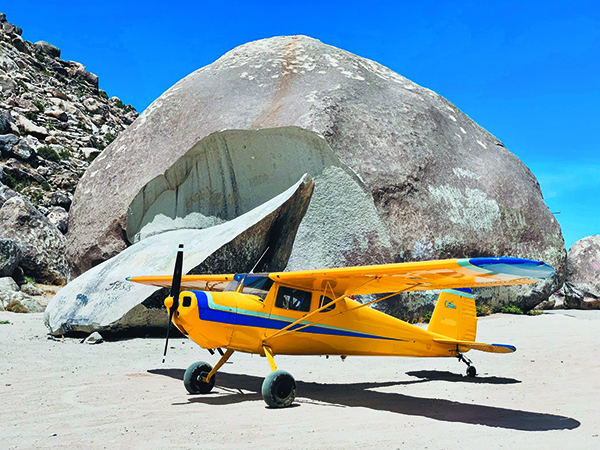
The general aviation industry as we know it-at least as far as large numbers of aircraft are concerned-traces its beginning to the period immediately after World War II. Piper was churning out Cubs and eventually Cruisers and Pacers and during these halcyon days, Cessna also came into view as a major manufacturer. (But the company had actually been in business since 1911.)
Like virtually every other manufacturer of the day, with the exception of Beechcraft, Cessna produced taildraggers and the first of these to be built in volume was the diminutive Cessna 120, which was followed in short order by a fancier model call the 140.
These aircraft were and are perfectly serviceable and practical two-place airplanes that are reasonable to buy and cheap to own. Although they lack the panache of the yellow Cubs, the 120/140 series airplanes are cheaper to buy and probably have more forgiving handling qualities. Better yet, theyre made of metal-some have fabric wings-so they can live outside without benefit of hangaring. Further, they don’t need periodic recovering and parts are readily available.
Model History
The 120s model history is rather short, since it was only produced for four years. The first 120 emerged from the factory immediately after World War II, in 1946. Cessna had in mind the training market so the 120 sold for a mere $3245.
And if you don’t think the cost of airplanes has escalated, consider this: when adjusted for inflation, that $3245 is the equivalent of $31,216 today. Yet a new trainer in the 2004 market cant be had for anything close to $31,216. Start the bidding at three times that value.
As airplanes go, the 120 was about as simple as they come. It had side-by-side seating, yokes instead of sticks, no flaps, no rear window and no electrical system as standard equipment. (An optional generator system was available, and many aircraft have that feature.)
Following the lead of the automotive industry, Cessna offered a luxury version of the 120 which was dubbed the 140. It has flaps, an electrical system, fancier seats and rear windows along the side of the fuselage, not the Omni-view windows that later became standard in the Cessna single-engine line. These airplanes sold moderately we’ll and although there was demand, there was also competition. Piper was building acres of Cubs and other companies such as Taylorcraft, Swift and Luscombe were also offering two place taildraggers. Altogether, Cessna made some 7000 120s and 140s.
In 1949, Cessna dropped the 120 entirely and tarted up the 140 into what became known as the 140A. The new airplane had a re-designed, all-metal tapered wing with a single strut and an optional 90-HP Continental four-banger in place of the 85-HP engine used in the 120/140 series. At a glance, the easiest way to recognize the 140A is by the single strut, a signature feature in Cessnas to this day. The 120/140 had a two-piece strut with a single-attach point at the fuselage and two attach points under the wings.
Whether because of competition or a tired market, the 140A didnt sell as we’ll as the 120/140 had. Only about 500 were made before the line was shut down in 1951, a period in which Cessna turned to other models, including the 195. But Cessna wasnt through with light singles. In 1959, Cessna used the 120/140 airframe as the basis of the most successful trainer of all time, the Cessna 150, of which thousands were built. Many a pilot owes his or her basic skills to the 150 and the 150 owes its existence to the 120/140 line.
Construction, Systems
As noted, the 120/140 is an all-metal design, at least for the fuselage. The skins are riveted over ribs in conventional monocoque construction. Nothing special but also durable and easy to fix. Early 120s had fabric-covered wings and this was carried to the 140, as well. With the advent of the 140A, the wings were all metal. While there’s certainly nothing wrong with fabric wings, they do require care and maintenance. If the airplane will be a ramp dweller, we think the 140A is the better choice.
And, of course, many of the older airplanes that originally came with fabric wings have been converted to metal. Oddly, a few 140s even sport 120 wings, so theyre 140s without flaps. (Does that make them 130s? asks one wag on the International 120-140 Associations open forum.)
Systems, such as they are, are stone simple. The fuel system consists of a 12.5 gallon tank in each wing, connected through a left-right-off tank valve. Later models had a both position and a fuel-tank crossover line.
Again, given the airplanes age, any example thats considered for purchase could have been modified so check the logs carefully. When originally delivered, airplanes with electrical systems had generators and a few flying have them still. But the better set-up is an alternator conversion, which is available via STC.
As far as engines go, the 120/140 came from the factory with only two choices. The 120/140 has the 85-HP Continental C-85-12 while the 140A got the 90-HP C-90-12F, all with metal propellers. Peruse Trade-A-Plane, however, and you’ll see all manner of engine upgrades, including the Continental O-200 used in the Cessna 150 and the O-235 used in the Cessna 152. The O-200 is said to be a bolt-on conversion. A recent STC allows installing an O-200 crankshaft and cylinders while retaining C-85 crankcase.
While these newer engines may improve performance, the real reason for having them is serviceability. The older C-85 and C-95 engines grow ever more difficult to support.
As noted, the 140s have flaps while the 120s don’t. Do you need them? Probably not. One owner wrote us a few years ago and said he considered the 140 flaps to be a joke. In any case, these airplane fly so slowly that the benefit of flaps is questionable. Any taildragger pilot worthy of the title can put an airplane into a pea patch without need for flaps.
Cabin, Accommodations
Push your nose against the window of a Cessna 120 and scan the panel. It wont take long because there’s not much there. Panels in these airplane tend to be Spartan at best, although some owners have jazzed them up with GPS and other goodies.
There are a pair of side-by-side yokes and the flight instruments-such as they are-are grouped toward the center of the panel. Weve seen 120/140s with a full set of gyros, including an AI and a turn-and-bank or a turn coordinator and weve seen them with one or the other of these.
Or neither. It depends on the airplanes state of restoration and what the owner considers important. There’s no reason that these aircraft, if properly equipped, cant be flown in a little light IFR.
Most aircraft of this vintage sport exterior venturi horns for vacuum, although some have vacuum pumps, too, depending on the engine.
Although some think its insane to fly a venturi-equipped airplane in actual IFR, we don’t see the problem. The venturi is actually more reliable than a pump, as long as you can keep it from freezing up. (Heated versions are available.)
Anyone who learned to fly in a Cessna 150 knows how cramped the seats and interior are. A Cessna 120 is no better. The seats are 1940s-style bench designs and both shoulder and leg room is limited.
Tall pilots may find their knees tangling with the control wheels, while short ones may need a pillow to reach the rudder pedals. The seats don’t slide but are fixed in place. (Weve seen a few of these airplanes modified with later-model Cessna 150 seats.)
Visibility from inside the cockpit is marginal, at best. Its not bad out the side windows but the 120s have no rear window so the pilot is essentially blinded from 4 oclock aft. The 140s, with the rear window, are a bit better.
Compared to modern trainers such the Diamond Katana or even older models like the Piper Tomahawk, visibility forward is rather dismal. But during ground handling, the 120s stance is not so pitched up that you cant see over the nose, a real plus compared to other taildraggers. You don’t need to sashay down the taxiway making S-turns to keep from creaming another airplane coming the other way.
Owners consistently complain about one 120/140 shortcoming: cabin noise. The cabin is small and the engine is nearby, with the exhaust dumped overboard very near the occupants feet. The din can be deafening, making us wonder how pilots ever got along without headsets.
The best modern solution to this old problem is, of course, noise canceling headsets. Heating and ventilation in the 120/140 is not quite up to modern standards but is adequate, say owners. Some airplanes have been fitted with vents in the wing and/or blast vents in the side windows to improve airflow in hot weather. The front cabin windows also open for ventillation during taxi.
Performance, Handling
Owners say performance of the 120/140 series is best described as slow but thrifty. But they do better than most traildraggers of the same vintage. A 120/140 pilot can expect to see between 95 and 105 MPH true airspeed on a fuel flow of about 5 gallons per hour. Thats right in line with a Cessna 150 that goes a bit faster on 6 GPH. The O-235 engines push the airplane up to the higher end of the cruise range, but even at that, a cross country of any length will take most of a day and if several states must be spanned, plan on a couple of days.
Climb rate in these airplanes is about what youd expect: adequate at mid-weights but somewhat anemic at gross weight. Gross, by the way, is 1450 for the 120 and 1500 for the 140, with a typical useful load of 600 to 650 pounds; a load-hauling utility airplane the 120 isn’t. Nor will it set any time-to-climb records. One owner jokingly told us that when he takes off, I know we’ll get to altitude eventually; its just a matter of when.
That owner reported a maximum altitude of about 11,500 feet with two aboard and half fuel but some owners say higher altitudes are possible. If thats true, there arent many of the 85 to 100 horses left at any altitude above 10,000 feet.
As post-War taildraggers go, the 120/140s handling is quite good, with brisk and crisp if not aerobatic roll rates and pitch a bit lighter than you might expect from the typical Cessna. For its size, the airplane has a large elevator and tail surface, which probably accounts for its good crosswind handling characteristics, on both grass and paved runways.
As taildraggers go, it is considered somewhat more forgiving than a Luscombe but not as forgiving as a J-3 Cub. But all taildraggers are ditch lovers compared to tri-cycle gear airplanes, which explains why the 150 became so popular.
One thing that aids ground handling is toe brakes, a vast improvement over the heel brakes found in the typical aircraft of this vintage. Landing a 120 is not especially difficult as taildraggers go. The fact that it has better visibility over the nose than most airplanes of its ilk helps, as does the ability to solo it from the front rather than a rear seat.
It does have a propensity for great ballooning and bouncy landings if the mains are forced on at too high a speed. But the airplane will happily do three pointers or wheelies all day if the pilots skills are up to par.
Because it doesnt have the option of placing much weight rearward, the airplane has a tendency to nose over. Owners say its quite likely that any 120/140 on the market has a nose over or two in its history.
Thats no big deal if any needed repairs are done correctly. Nosing over is a big enough concern in this aircraft that many 140s have been equipped with wheel extenders; spacer blocks on the main gear legs that move the wheels a few inches forward.
This reduces the tendency to nose the airplane over and if youre looking at an example that doesnt have the extenders, we think its worth considering them.
Maintenance, ADs
Owners buy vintage airplanes for many reasons and one of them is low cost of operation. While thats not true of every post-war spam can out there, its certainly true of the 120/140, which occupies that sweet-spot niche of having been produced in large enough numbers to provide a good parts reservoir but isn’t so rare that it has classic collector value.
The Continental engines can be kept perking along with effort and/or upgraded with newer versions, the latter being the preferable choice, in our view. Try to find an airplane which has the engine conversion already done.
As far as the airframe is concerned, there’s not much to go wrong. (Yeah, we know, weve heard that before.) Most owners who report spending a lot of money on the 120/140 are in restoration mode, bringing a barn dweller back to flyable status.
If you want an Oshkosh show piece, you can get there but you could easily spend as much as you paid for the airplane to do it…and thats before you pay for the paint and upholstery.
Other than engine overhaul, the major cost for a 120 is re-covering the wings, if theyre still fabric. Depending on the fabric and whether the airplane is hangared, recover intervals range between seven and 20 years.
Metal wings are, of course, heavier than the fabric versions by about 30 to 40 pounds. But most owners consider the penalty worth it in reduced maintenance costs and, in any case, these airplanes are bought for the massive load hauling capability.
As do all airplanes, the 120/140 models have some weak spots. Here are some things to look for:
Look for damage in the lower door posts, near the strut attach point. This critical structural member may be damaged by rough field operation, ground loops or corrosion.
Corrosion in the carry through spar can be a problem. The top skylight leaks water into this structure and years of moisture will take a toll. The water collects in the channeling and can cause serious corrosion.
Cracks in the tail structure and rear fuselage. Those familiar with the 120/140 tell us the airplanes tail is the weakest part of the design. Its especially vulnerable around the tailwheel attach point. This is repairable but make it a condition of the sale during pre-buy.
Landing gear boxes take a beating on all Cessnas and the 120/140 is no exception. The gear box-the support structure for the attachment of the landing gear to the fuselage-may have taken a abuse from pilots over the years, thanks to hard landings and maybe even a ground loop or two. The box can be inspected from the outside by removing an inspection plate in the cabin floor.
Broken tailsprings are fairly common. Check to ensure that the steel leaf-type tailwheel spring is still springy but not saggy.
A broken spring will cause complete loss of control on landing and could do major damage to the airplane, particularly the elevators. Even if the springs look good at time of purchase, they should be inspected regularly.
The list of ADs which apply to the Cessna 120/140 is quite long more by dint of age than in any serious shortcomings in the aircraft. Some of the ADs are absolutely ancient, dating back to the late 1940s, when the airplane was new. Many are shotgun-type ADs that apply to the engine and may or may not require compliance in the model 120/140 at hand. One of the most recent applies to the Lycoming O-235 engine, calling for inspection of the crankshaft.
The International Cessna 120-140 Association maintains an excellent current list of ADs online along with a wealth of other information. These can be found at www.cessna120-140.org.
Mods, Owner Groups
The list of mods and STCs for these airplanes is nothing short of awesome. Again, the International Cessna 120-140 group maintains an exhaustive list on its Web site, including contact information.
The fact that the airplane has been the subject of so many mods speaks we’ll of both its basic design and that it remains flying in large enough numbers to make such mods economically worthwhile.
Some of the more interesting mods include the aforementioned engine upgrades, including the Lycoming O-235, metal and fiberglass coverings for the wings, alternator kits to replace the older generators, improved brakes and instruments, autogas STCs-that one is offered by the Experimental Aircraft Association-and even approval to install the dual-chamber vacuum pump we reported on in the November, 2003 issue of Aviation Consumer and elsewhere in this issue.
As for groups, the International Cessna 120-140 Association maintains a terrific Web site and support network. It can help with buying advice, parts and other support.
Contact them at www.cessna120-140.org or P.O. Box 830092, Richardson, Texas 75083-0092.
A second on-line based group is www.cessna140.com. Its a member-only Web site with a wealth of technical data.
Owner Comments
Ill be surprised if you don’t get an unusually large response from Cessna 120/140 owners. The International 120-140 Association is one of the most supportive type clubs extant and their web site forum is very helpful with members questions and problems. The 120/140 comes as close to being a practical personal airplane as there is. It can be operated from the most rudimentary airport, will carry two normal size people, full fuel and modest baggage, cruise at better than 100 miles per hour burning just over 5 gallons of gas.
It will handle windy conditions that keep most light airplanes tied down. Admittedly the climb is a little anemic at gross weight with just the original 85 HP, but there are a number of power upgrades available. The most popular is the installation of the O-200 engine.
I have had my 120 for something over seven years and have had it as far afield as the west coast, Georgia, North Carolina and regularly all over the midwest. I have a venturi vacuum system with DG and attitude gyros although Im not instrument rated. Avionics is limited to a single digital com, transponder with encoder and a handheld GPS which is Velcrod to the top of the control yoke.
I keep the airplane at a private field just 10 minutes from home and do my own maintenance (Im an A&P with I.A., although mostly retired). Its no more expensive to maintain than my car. I used to think I wanted a bigger, faster airplane but have come to the conclusion that the 120 is a perfect fit for me.
-W.D.Dip Davis
Marengo, Illinois
Ive been flying 140s for years and did my first few hundred hours of flight instruction in them. Except for a little hearing loss from those early non-headset days, the airplane never bit me once.
Safe, forgiving, predictable; it teaches the pilot very quickly what to do with his feet, how to handle the wind in every sense. Its easy to fly, but a challenge to maneuver to perfection-in other words, just an excellent trainer.
The 140 is one of the easiest tailwheel planes to check out in. But its a tailwheel just the same. Start out on grass if you can, get a competent instructor, take on the wind a little bit at a time and you’ll be fine.
The main things to watch out for are the same as any older airplane. Beware of unapproved or undocumented modifications, missing or improper maintenance records and inaccurate weight and balance data.
Be sure there is an actual weighing of the airplane somewhere; many of them are quite a bit heavier than expected, with metallized wings, gyro panels, kiddie seats and so on.
The complexity of FAA field approvals will make improving the airplane a real challenge if you want it technically legal. For instance, many are seen with non-original wheel fairings or original fairings used with the Cleveland brake conversion. Getting that done on a field approval these days can be a headache.
The original electrical system has a limited output and pretty much makes it a daytime airplane; alternator conversions are a good deal, but may be more complicated than you think.
Again, as with any older airplane, find a mechanic who knows the airplane. Parts availability is not bad and routine maintenance is simple.
Both owners groups are excellent. Cessna 140.com has an overabundance of political commentary from chatty members; but some of them know a great deal of actual technical data and share it very well. The technical manual from the International Cessna 140 Association has lots of good material.
The original-engine Cessna 140 will go close to 100 miles per hour on 5 gallons per hour as long as you can stand the noise. Its a little cramped for anybody over about 6 feet tall, but visibility is good. Side-by-side seating is nice.You have toe brakes, electrical system, and a reasonable baggage space.
Theyre inexpensive to buy and operate, and really fun to fly. My insurance this year is less than $1000 including hull coverage.
-Dan Tannas
Fort Wayne, Indiana
Also With This Article
Click here to view “Resale, Payload, and Prices Compared.”
Click here to view “Accident Record: No Surprise, Its Groundloops.”