










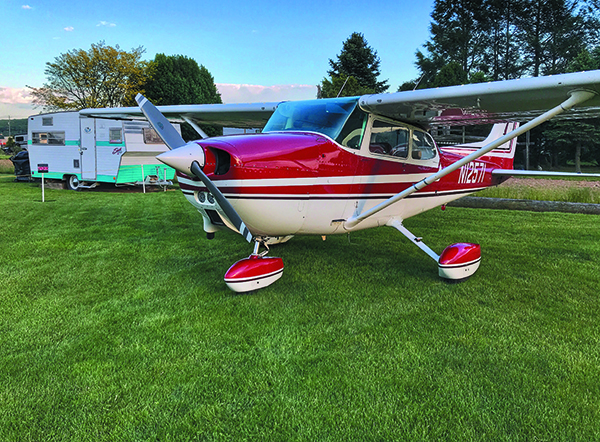
The Cessna 172 probably ties with the Piper Cub as everymans vision of the little airplane. Probably more people recognize the Cub name; but more recognize the shape of the Skyhawk.
A grand total of 35,773 were built during its original 31-year production run, and there are better than 20,000 of those flying in the United States plus thousands more flying around the world. (And don’t forget: it was a C-172 that was the first private airplane to visit Red Square in Moscow.)
Plus, the evergreen 172 is back in production again, complete with a new fuel-injected engine, various tweaks and a price tag exeeding $150,000.
Even for the less adventurous, the 172 continues to appeal for its simple virtues, undemanding flying characteristics, good value and availability. A lot of readers have shared their 172 experiences and expenses with The Aviation Consumer. Despite the wide variety of comments, enthusiasm for the aircraft is universally high. Two readers sum up its qualities quite well:
The Skyhawk is the benchmark for a docile, easy-to-fly airplane with no rude surprises. It wont eat your lunch at the gas pumps, the maintenance hangar, or on short final. But if youre looking for speed or style, look somewhere else.
It is the perfect all-around airplane-economical, easy to fly, easy to maintain, stable in all flight modes, roomy enough for all the stuff youd want to haul with the back seat out or comfortable enough for four less-than-FAA-sized folks, full tanks and a couple of small daypacks with the seat in.
History
The 1949 170A taildragger was the progenitor of the C-172-and practically every other Cessna single.
Incidentally, tales about the 170 and 172 and other fascinating episodes in the development of all Cessna singles, including the Skyhook helicopter, are related in Cessna: Wings for the World; The Single-Engine Development Story, by William D. Thompson. He spent nearly 30 years at Cessna as an engineering test pilot; at retirement, he was Manager of Flight Test and Aerodynamics.
The original fabric-winged 170 suffered a bit because of poor roll response (the ailerons were lifted directly from the smaller and lighter-and shorter wing span-140).
The 170A/B cured the problem of aileron power, but introduced new ones. The design update also included a dorsal fin. A modified Frise-type aileron was used to minimize adverse yaw, which was accomplished at the cost of poor aileron centering in cruise. According to Thompson, this hampered the performance of low-cost autopilots (a characteristic well-known by many 172 pilots.) It also exhibited less desirable characteristics in the stall, so the outer portion of the wing was twisted, or washed-out. Other forms of aerodynamic tweaking took place, all of which showed up in the 172.
Near-death experience
The 172 really is a tricycle gear 170, but one that nearly did not make it.
Met-Co-Aire of Fullerton, California had already developed a tri-gear modification for the 170. Pipers Tri-Pacer was selling well, and for a simple reason: ease of handling. One reason why the hoped-for scenario of getting everyone into the sky did not occur was that flying did not come easily to most people. It took considerable work to achieve even the lowest level of skill, and a taildraggers inherent instability on the ground kept a lot of would-be pilots from succeeding in their efforts. The tricycle gear promised to simplify things considerably. It was to be the wave of the future.
But not everyone saw the handwriting on the wall. In what may have been a bit of right stuff attitude mixed with a sense of what a real airplane ought to look like, many in the industry tended to look down on nosedragger designs. But some of the crew at Cessna saw that there was a real place for a trigear airplane, and started to work on one. What happened next nearly cost the world one of its most popular and enduring designs.
Thompson says in his book: Unfortunately, Frank Martin, Sales Manager, was aware of our experimental freedom and frequently made weekend visits through the shop. The result of one such visit, during which he saw the tricycle gear mockup, was a formal order to destroy it. Fortunately for Cessna, it was disassembled and stowed away, Thompson noted. Reportedly, the concern of Cessna management was that a tri-gear airplane would not be able to handle unpaved strips and would be prone to upset during taxi. Meanwhile, the competition and the after-market were stealing sales. The upshot of competitive pressures and evaluation of the after-market mod was authorization of a secret development program to develop a tricycle gear version of the 170C, which had been certified but not put into production. The R&D effort that became the 172 was conducted at an isolated farm strip.
First flight occurred on June 12, 1955. Among the development issues and problems were controllability versus stability, the above-mentioned ground handling concerns plus fear of propeller strikes, yaw or directional stability and the need to ensure enough elevator power to overcome the high thrust line, which tended to press down the nose gear (and encourage prop strikes).
Other issues were developing a sufficiently strong firewall structure to handle the nose gear stresses, proper alignment of the main gear, nose wheel centering in flight (and in-flight disconnect from rudder inputs) and nose wheel shimmy problems.
The 172 main and nose gear that resulted were fairly short, achieving the lowest possible center of gravity to improve ground handling and to avoid upset. A total of 2,318 landings were made during the service test program by a number of pilots with widely varied experience to prove the 172s characteristics.
Thus was born what was called the Land-O-Matic gear, and advertisements that basically related driving and flying: drive it into the sky, drive it into the ground (the last phrase came to have a double meaning, however). It was not quite that simple, however, and a number of modifications were made over time to improve the ground handling and crosswind runway qualities of the Skyhawk.
There was a performance penalty to pay for putting the third gear element in front, too. Speeds and service ceiling were degraded compared to the 170.
Models and development
The 172 as introduced in 1956 was powered by a Continental O-300-D six-cylinder engine rated at 145 HP turning a fixed-pitch propeller. Gross weight was 2,200 pounds. It had a straight, upright vertical stabilizer and a straight-backed fuselage. It was a success, with more than 1,100 being produced that year.
The 172A, with the vertical tail swept, was introduced in 1960. The new modern empennage was heavier; rudder power was reduced, and directional stability was degraded somewhat. So why do it? Marketing, evidently. And the result is rather attractive, with the lines of the fastback fuselage blending we’ll with the swept tail.
The 172B was developed for the 1961 model year. The landing gear was shortened by three inches to improve crosswind and taxi handling while the motor mounts were raised by the same amount to retain propeller ground clearance.
A baggage door was incorporated for the first time. The upscale (it even included a starter button!), Skyhawk version was introduced. (Most pilots use the monikers 172 and Skyhawk interchangeably, and in later models the two did become one; but early on there was a distinct difference in trim and equipment levels.)
The first float plane version was introduced in 1961. In 1962, the C Model featured a 50-pound increase in gross weight, to 2,250 pounds.
In 1963, the Omni-Vision rear-window 172D version was introduced. To help overcome the further degradation in handling, the span of the horizontal tail was increased by eight inches. The center strip in the windshield was gone, replaced by a one-piece windshield. An optional childs seat for the baggage bay was introduced. Gross weight was increased another 50 pounds, to 2,300.
Models 172 E through H (1964 – 1967) featured such tweaks as a shorter nose gear stroke (by three inches). Electrically operated flaps were introduced on the 172F. Many people lamented the passing of the manually operated versions because these were more precise, less distracting and easier to maintain, a viewpoint we agree with. Also included were such improvements as better laid-out instrument panels and improved panel lighting.
Engine switch
A significant change occurred with the 172I of 1968: the switch to Lycoming power in the form of the 150-HP 0-320-E2D. In addition to new cowling and motor mounts, the new propulsion package included an oil cooler.
In his book, Thompson notes that the force for change was an earlier corporate conviction that the 177 Cardinal-the airplane of the future-would kill the 172. So Cessna ordered 4,000 engines from Lycoming. When management admitted that the 150-HP Cardinal was woefully underpowered, the Skyhawk inherited the engine. It included the troublesome dual Bendix magneto (really, an almost two-in-one with a single drive).
The 172K of 1971 featured a switch from the famed Wittman spring steel main gear to tapered steel tubes that provided more fore and aft flexing to supposedly improve ground handling on rough surfaces.
The landing light was moved from the leading edge of the left wing to the nose bowl of the cowl. This improved airflow over the wing (poorly installed lenses and frames cause airflow separation and wing drop in the stall) but complicated cowl removal and greatly reduced bulb life.
The 172L of 1972 incorporated an extended dorsal fin. This improved longitudinal stability, reduced the full-flap pitch-down tendency in slips and made it more difficult to enter a spin. The latter was a negative for training applications, however.
Bonding, which Cessna developed extensively, especially in its multi-engine and turbine models, was first tested in the fabrication of 172 baggage doors and then cabin doors. It was never used all that extensively in the basic structure of the airplane, however. Other manufacturers (Grumman-American) did wind up using bonding of major airframe components with good success.
Camber Lift
The popularity of after-market slow-flight modifications, such as the Robertson STOL kits, led Cessna to use a recontoured leading edge with the 1973 172M. The Camber Lift droop, or increased radius, leading edge made it possible to operate at a higher angle of attack at low speed. However, aileron effectiveness in the stall and spin recovery were degraded. Spin entry also was made more complicated.
According to Thompson (and other factory pilots at the time), there was no measurable improvement in performance, and-tellingly-the performance data in the operating manual did not change. As Thompson notes, Our customers typically approached and landed too fast. Not incidentally, the accident record bears out that observation.
In 1974, cruise performance was improved through an effort to reduce drag and improve airflow through the cowling. This turned out to be a greater improvement than many of the other changes. At 8,000 feet, according to the factory, 75 percent cruise increased from 113 to 120 knots. This notable improvement suggests that if Cessna had paid more attention to aerodynamics than to perceived market movements, the 172 and other airplanes would have performed far, far better.
With the mandated change to low-lead (a misnomer in itself), theoretically less-polluting fuels for political as opposed to technical reasons, engines designed to operate with 80 octane fuel (the bulk of the general aviation fleet) showed various signs of distress. Lead fouling of plugs and valves rose to epidemic proportions. Deposits caused hot spots that, in turn, caused premature failure of engine components. Fuel system elements deteriorated because of new and incompatible aromatics and other additives.
Low-lead solution
The Cessna and Lycoming solution to a 100LL compatible powerplant was a disaster. In 1977 the 172N, fitted with the now-infamous O-320-H2AD, was introduced. (AD stands for airworthiness directive or anguished driver.)
The good things were 10 additional horsepower, an increase in service ceiling (and high density altitude performance) and a slight increase in speed. This was overwhelmed by the bad news, which reduced to its simplest form is poor lubrication of the valve train. This is particularly noticeable in cold weather. It was found that cold starts could cause terminal damage very quickly, with large metal contaminants introduced to bearings, oil pump and other critical components in short order.
To their credit, Cessna and Lycoming supported owners to a generous degree, as aviation goes, but it took a long time to understand the nature and cause of the problem and to devise ways to alleviate it. More than 5,000 were built.
There are three major ADs on the H2AD engine, and resale value of the airplane is dependent on compliance. AD 77-20-7 calls for replacement of the tappets, AD 78-12-8 calls for replacement of the oil pump impeller, and AD 78-12-9 (the big one) mandates replacement of the crankshaft. Its absolutely critical that these ADs be checked; we think it unlikely, though, that there are any H2ADs left that arent in compliance.
The benighted H engine was replaced in the 1981 172P with another model, the O-320-D2J. This is the last of the original Skyhawks. Production ceased in 1985.
To his credit, Cessna Chairman Russ Meyer stood by his promise to restart piston single production, and the Skyhawk was reintroduced in 1997. The new airplane is not terribly different from the old one: the changes in evidence are obvious, common-sense ones, like the substitution of a metal panel for the old, ugly Royalite one and the installation of a fuel-injected variant of the Lycoming engine (IO-360-L2A). In all, its an update much like that of the new American General Tiger. In a quest for more performance, the 180 HP 172SP version also joined the ranks.
The best, the worst
Until fairly recently, it was easy to pick the worst 172: the notorious O-320-H2AD engined 172N. However-at least for those willing to get the information and take the extra care in terms of correct oil, proper additives and thorough pre-heating as we’ll as commitment to regular flying, the problems of the H engine are manageable.
It is now a foot race as to whether the 172N is less desirable than the 172 through 172H -Continental O-300-D powered-models. Overhauls on the six-cylinder engine are more expensive-the Aircraft Blue Book Price Digest says $14,000-than on the four-cylinder Lycoming engines, which run $11,500 for the E2D and D2J (first and last) and $12,000 for the H2AD. If price is not the major concern, the last version 172P-all things being equal-is the most desirable for the average pilot looking for IFR-capable transportation.All things being equal includes at the minimum no flight school history, no power or pipeline patrol history; good maintenance and average time; complete records; no wrecks, no corrosion and fair equipment. Infrequent use and poor maintenance probably are the biggest negatives for any 172.
Wichitas variation on the don’t buy a car that was built on Monday or Friday largely is a reflection of degraded quality when production was being increased. As one reader claims: The decline in Cessna quality control from about 1975 through 1979 is evident in the airframe. The 50s models have much less dimpling and oil canning skin. However, much of the factory-induced trouble-such as the widespread corrosion problem introduced by poor pre-paint preparation in the late 1970s-should have been corrected in most 172s by now.
For basic day VFR flying, an earlier 172 might be best. The original Skyhawk with the straight tail and fastback fuselage is the best handling. Best translates into the one with the most straightforward, verifiable history and usage at a price you can handle.
Generally, a lot of the modifications developed by Cessna for the 172 are not improvements. Empty weight tended to go up. Handling characteristics sometimes were degraded. And most, except for the aerodynamic cleanup introduced on the 1974 172M, resulted in performance reduction. don’t be fooled by the higher-powered models. Aside from hot and high capability, the additional operating, maintenance and overhaul costs are not worth the marginal performance increases.
The 172 is the best basic transportation airplane for a price and for the average pilot ever devised. Stick to the basics.
Some readers are delighted with their Continental-powered Skyhawks, some with their H2AD (modified or unmodified) 172Ns. The O-300D is unquestionably one of the most successful and comparatively trouble-free engines ever to come from Continental. But it is old, and it has two extra cylinders to maintain and repair. And neither the pre-H E2D nor the post-H D2J Lycomings are free from valve train and other problems. The D2J is not completely happy with 100LL, either.
All the high-versus-low wing arguments included, it gets down to a matter of preference. But on sheer numbers, the 172 is the winner.
Performance
Reader letters on the 172 are interesting in their realism. Most refer it as a two-to-three place airplane with poor performance at high altitude or high density altitude. It is variously described as honest and forgiving in handling.
Most owners settle on eight gallons per hour, more or less, as the average fuel burn. Allowing for leaning errors and other variations, most owners figure their Skyhawks to be three-and-a-half to four-hour airplanes, and most who operate them IFR use 100 knots as the flight plan speed.
The 172 can easily be operated out of 2,000-foot strips. we’ll flown, it can handle even shorter ones. But it takes less room to land over the traditional general aviation 50-foot barrier than it does to take off, which traps many pilots. And, it is very sensitive to density altitude.
The aircraft also is sensitive to loading. CG range is quite generous, to be sure, but tolerance to overloading is slim. The relative interior spaciousness, including the baggage bay, belies its payload limitations (and, to beat the dead horse, the performance variations with temperature and altitude).
There are few complaints about the handling qualities. And for the average-non-aerobatic-pilot, there shouldnt be. Pitch forces are the highest of the three axes, but good speed control minimizes this.
Properly flown, the 172 can handle stiff crosswinds. Improperly handled, it suffers a high level of landing accidents. Unfortunately, too many pilots (and their instructors) believe those old drive-it-into-the-sky-and-back ads.
Another strong tendency of the 172 family is pilot-induced oscillation. In stressful approaches, such as poorly-planned ones, or those made in gusty conditions, and in recovery from bounced landings, there is an almost universal tendency among pilots unfamiliar with the 172 to chase pitch control with out-of-sync inputs that can cause alarming pitch excursions. The end result frequently is a loss of directional control, prop strike, nose gear failure-or all three.
Few vices
The truth of the matter, however, is that the 172 has few vices. It has proven itself as an incredibly forgiving airplane. And it probably has enabled a great many people to be pilots who otherwise would not have survived the cut.
The 172 is well-mannered. However, low-time pilots and those unfamiliar with the type can be brought to grief with the pitch changes that occur with configuration (flap) and power changes, especially in a poorly-planned approach or during a panicky go-around or balked landing. Just a little bit of practice and experience go a long way.
One of the great strengths of the 172 is its comfort. While its dimensions are not generous, for all but the longest or widest of pilots and passengers, it is comfortable. For sightseers, the back seat of a Skyhawk is one of the best places to be.
Seats in earlier (and unmodified) models are somewhat skimpy and uncomfortable after a couple of hours. In later models, both the comfort and adjustability of the seats are good.
Modifications
Forty-five years ago, the general aviation industry was busy putting the tail wheel in front. Now, there are modifiers that have developed kits to put the nose wheel in the tail. You can make your 172 look like a 170! The number of modifications and suppliers for the 172 is too long to list. Everything from thicker windshields and cabin windows (reduce noise and vibration) to aileron and flap gap seals to STOL kits and engine upgrades is available.
It is worth taking the time to evaluate possible effects. For instance, additional fuel capacity is good to have, even necessary for some operators. But the reduction in payload has to be considered and the tradeoff weighed. Perhaps a combination of auxiliary tanks and a gross weight increase-which has its own limitations-is advisable.
There are owners who swear by an auto gas STC and others who have it but don’t use it; those who like the extra performance of a more powerful engine (180-HP conversions are the most popular) and others who feel it is better to put the money into good overhauls of the original engine type. One owner wrote: I considered a 180-HP O-360 kit estimated cost was close to $20,000, or the equivalent of two H engine overhauls a high cost for 13-17 knot increase at altitude.
Some owners feel flap and aileron gap seals pay off both in low-speed handling and improved cruise. Others say there isn’t any difference.
Perhaps the best advice is to spend the time and money, initially at least, on careful inspection, replacement and repair of the basic airplane and its systems.
Maintenance
One fairly well-to-do pilot, who has owned a variety of airplanes, has described the 172 as the only aircraft he really could afford to own and operate. Most owners, particularly those who have had their Skyhawks for a few years, report fairly low annual costs.
Depending upon the service history of a particular 172, the first year or two can be very expensive. Heavily used airplanes will need a lot of parts replaced. Landing gear elements such as main gear attach bolts, nose gear mount and the firewall suffer gross abuse and also are showing the cumulative effects of age.
An article in the April 1993 issue of our sister publication LightPlane Maintenance called Skyhawk Owners Survival Guide makes several useful suggestions. One that applies literally to every engine installation is that the condition of baffles requires regular inspection and replacement. Another is that cam and tappet spalling is a fact of life with Lycoming engines. About the only sign is metal in the oil.
Any 172 without a replaceable-element filter should have one installed; they should be cut open and examined for metal particles during frequent oil and filter changes. Oil analysis is a useful investment, too.
For a design as old and with so many airplanes operating, the number of SDRs and airworthiness directives (ADs) is surprisingly small. There are only a few recent ones: 98-2-5 calls for replacement of specified mufflers; 98-1-1 mandates inspection of the alternate static air valve; 97-12-6 calls for a check of gascolator and tailpipe clearance around the cowl, and 95-11-8 mandates inspection of the prop.
The SDR and AD records do not cover all the potential problems that 172 owners and prospective owners should inspect for carefully. Some serious corrosion has been uncovered in the flying surfaces, in the belly of the fuselage and around the main gear fittings. This is a function of poor or no corrosion protection at the factory and the exposure of the individual airplane. Also, a lot of Skyhawks have been notorious leakers (and many have spent most if not all of their existence tied down outside).
Rigging and condition of control cables, pulleys, fairleads and fittings should also be carefully checked. Many 172s have been poorly or improperly rigged over the years. Corrosion has been found between cable strands that has not been visible to external inspection, and many elements of the primary flight control and flap actuating system are very hard to get to. Thus, they tend to be inspected infrequently if at all. Things like this tend to be disguised rather than fixed by a new paint job.
The design is notorious for poor nose-gear shimmy dampening. The problem is exacerbated by poor pilot technique: too much forward pressure (down elevator) on the yoke during takeoff and too many nose-wheel first or three-point landings. The latter is good technique in tail draggers; not in tricycle gear airplanes.
Accidents
A representative five-year period yielded 1,618 accident/incident reports on the 172. By our count, 1,473 of these qualify as accidents (damage or injury), including 140 fatal accidents.
On face value, this seems like a whopping wrecking rate. If accurate information were available to convert the gross accident numbers to accidents per operating hour (or per 100,000 hours, as the NTSB does), the number would not seem very big. Especially if one considers the exposure, as well. For instance, relating the accidents to pilot experience and to type of operation would suggest that the 172 and similar learning airplanes such as the PA-28 are surprisingly forgiving.
While we don’t hold as an absolute with the school that claims aircraft don’t cause accidents, pilots do, there is a lot to support that in the 172 accident record.
If many of the accidents were thoroughly analyzed, the proximate cause would not be, for instance, botched landing or loss of directional control. It would be preflight actions or decisions, or failure to adhere to operating limitations, or failure to obtain current information.
The bulk of the accidents are of the fender-bender variety. A great many of them support that earlier-quoted observation of Thompsons that 172 pilots tend to approach and land too fast (a related phenomenon is that pilots tend to quit flying the airplane too soon, or during takeoff don’t start flying the airplane soon enough). don’t blame it all on junior birdmen, however. Senior birdmen bend them, too. Part is familiarity or just gross contempt or its close neighbors, neglect or carelessness.
There are a large number (65) of fuel exhaustion accidents. This suggests improper flight planning or poor in-flight decisions in many cases.
This and other accidents suggest another trap that is related to familiarity. Given the variations in 172 models and with aftermarket modifications, habit or expectation can lead to grief. As one owner notes, someone used to an airspeed indicator calibrated in knots might make a mistake in a 172 with a statute-mile ASI. Someone used to a 172 with additional fuel might be surprised by a silent engine in one with only 38 gallons usable.
The vagaries of the fuel system might mean very even fuel burns with the tank selector on Both in one airplane, but horribly uneven (and out-of-trim handling) in another.
There are many potential traps. As gentle a bird as the Skyhawk may be, there still is much to be gained through proper initial and proficiency training. This is as true for grizzled veterans returning to the 172 from heavier, faster machines as it is for the fledgling. Honest high-time pilots can relate very humbling experiences in getting reacquainted with the Hawk.
Mods
There are many ways to jazz up the Skyhawk. STOL mods are available from Bush, Horton, and Sierra Industries. Engine upgrades can be had from Penn Yan, Bush, Air Plains Services, Isham Aircraft and Avcon. And auxiliary fuel tanks are available from O&N and Flint Aero.
More information
The Cessna Pilots Association (www.cessna.org, (805) 922-2580) offers the usual benefits of such groups, including an insurance program, monthly newsletter, and fly-ins. It is widely considered to be the best source of information and support for most Cessna piston aircraft. The association runs a variety of type-specific maintenance and operational clinics, including sessions on owner-performed maintenance.
A strong design
In terms of the original design objectives-loosely paraphrased as a true four-place, low cost airplane with the most efficient (low power) propulsion system-the 172 is a design achievement that ranks up there with the DC-3 and P-51. An airplane without parallel.
Owner comments
Parts are widely available for everything Ive wanted done, with competition keeping the prices reasonable. Kinzie interior replacement parts are better than original and easy to install. Polyfix plastic repair kits take care of small cracks in the original Royalite. Texas Aeroplastics fairings were perfect fits.
Tall passengers (6′-2″ or more) should be put in the front seat. A tall passenger in the back will make the trip side-saddle because of roofline intrusion. Two tall passengers in the back will be miserable.
The most valuable information resource has proven to be the Cessna Pilots Association (CPA). Their focus is more technical than the Cessna Owners Organization, which also does a good job of supporting the brand. Most supportive of the brand is John Frank, President of the CPA. His availability on CompuServes AVSIG forum has been invaluable, giving me almost immediate high-quality answers to every question Ive ever asked him.
Alan R. Walter
Rockford, Ill.
The plane had a history of blowing its cowl-mounted dual landing lights. We subscribed to the Skyhawk Assn. newsletter that had a modification (addition of a lord mount to the alternator mount that Dzused to the cowl nose) that took care of part of the problem. Getting a 250W bulb meant more light and a beefier element that so far has outlasted our memory of the last replacement. (Just don’t operate both lamps at the same time; the circuit cant handle it).
The strut fairings that Cessna makes basically do nothing but crack. You cant glue them, so you stop-drill them, maybe tape them, but if you replace them (an expensive process), they crack again. Also, interior trim plastic is cracked from exposure to UV (most likely).
The high wing makes it great for lazing around the countryside at a thousand feet at 70 MPH with the window open with all the world spread out below you. It is no speed demon, but thats a small compromise.
Doug Brazil
Portland, Ore.
I have a Petersen STC for mogas, and its saved me tons of money. Ive never had as much as a burp out of my 145-HP Cont. engine in spite of the horror stories concerning mogas in airplanes.
I do have some mods that have made some difference in performance, and I would recommend them to any Skyhawk owner. Les Leonard in Aquila, Ariz. (602) 685-2471, has a set of flap gap seals that are worth the money and add about 5 MPH to the cruise speed and subtract about 5 MPH from the landing speed. The other mod, Met-Co-Aire Wing tips also help performance.
David W. Dietz
Gainesville, Texas
The annual maintenance cost on the two C-172Ps in our Paramus Flying Club is $2,819. This includes engine and airframe repairs, oil and filter changes, oil analysis, static and transponder checks and exhaust valve cleaning every 400 hours. Annual avionics cost is $551, annual inspections $1,233 per airplane.
We have not had any difficulty in obtaining parts for the Skyhawks. We have experienced three stuck valves in a two-year period, and since the last incident have gone to a religious schedule of cleaning the exhaust valves every 400 hours.
William M. Shannon
Cedar Grove, N.J.
Also With This Article
Click here to view charts for Resale Values, Payload Compared and Prices Compared.
Click here to view the Cessna 172P Skyhawk features guide.