










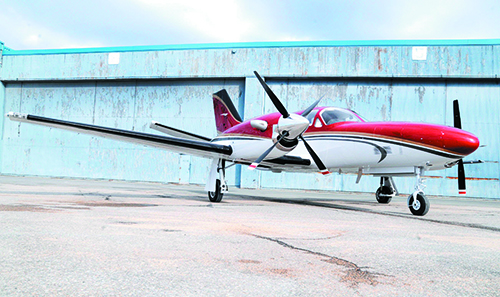
Cessna 425 Conquest I

[IMGCAP(1)]

Called the turbine 421, Baby Conquest, the baby carriage, entry-level turboprop and other diminutives, the 425 is in our book the best all-around businessman pilot-operated jetprop. Just be prepared to pay a price that extends far beyond initial purchase.

Cessna filled out its broad range of aircraft with turboprop models very late in the game. The company leapfrogged the category by going directly to jets early in the 1970s. Beech already largely owned the turboprop market by then, which may have affected the thinking of Cessna management.

History
The original Conquest, the Garrett TPE-331-8-powered 441, was introduced in 1977. The 425, originally dubbed Cors...

Called the turbine 421, Baby Conquest, the baby carriage, entry-level turboprop and other diminutives, the 425 is in our book the best all-around businessman pilot-operated jetprop. Just be prepared to pay a price that extends far beyond initial purchase.

Cessna filled out its broad range of aircraft with turboprop models very late in the game. The company leapfrogged the category by going directly to jets early in the 1970s. Beech already largely owned the turboprop market by then, which may have affected the thinking of Cessna management.

History
The original Conquest, the Garrett TPE-331-8-powered 441, was introduced in 1977. The 425, originally dubbed Corsair, was brought out in 1979 and certificated in July, 1980. The bloom was off the rose for general aviation by then, and Cessna had been going through several very difficult years.

Several Cessna high-performance twins were suspected of design errors that led to inflight airframe failures, particularly the 441, its piston-powered look-alike 404 (Titan) and the 340. Expensive, utility-destroying ADs were applied while the company tried to fix the problems. For instance, the 340 empennage had to be inspected every 10 hours of operation for a period of time.

The 425, in short, was introduced in inauspicious times. Its production life was short: while the 425 was offered by Cessna as a new airplane through 1987, it is thought (not confirmed) that production actually ended in 1984. Approximately 236 airplanes were built.

The competition
At least in terms of current engines and principal components, it is highly unlikely that Cessna will ever again build a Conquest. The company is said by dealers to have evaluated starting up 425 and 441 production but have decided that the asking price would be too high in relation to what the market might accept and what other airplanes cost. With equipped little King Airs (the C90B) priced at about $2.3 million and larger ones ranging from $3.5 to nearly $5 million, turboprops are competing with turbofans in price.

For instance, a new Citation sells for approximately $3.8 million. Beech, Cessna and Lear all offer a variety of jets priced competitively with King Airs.

Even the single-engine TBM-700 turboprop costs more than $2 million, and the unpressurized utility Cessna Caravan is $1.2 million.Despite the comparatively small population, the market for used 425s is quite active and, for the most part, the airplane is favorably regarded. Its key strengths are relative economy with good performance, including good balanced field numbers, excellent handling characteristics (including face-saver landings), a very-well-designed cockpit for single-pilot operation, good CG range and loading options, and a comfortable cabin.

For a properly maintained airplane, dispatch reliability is high, and operational simplicity makes it comparatively undemanding to fly.

One of the elemental strengths of the design is the nearly bulletproof Pratt & Whitney of Canada PT6 free turbine engine. The A-112 version installed in the 425 is a fairly unsophisticated one that is not highly stressed. It is flat rated at 450 SHP. For pilots transitioning to turbine power and for operators at smaller airports, PT6 power is the right choice and is easy to support.

The in-flight shutdown rate is impressively low, which is why so many pilots call it bulletproof.

Not a 421
The 425 is widely referred to as the turbine 421. Not true. Aside from the powerplants, there are a number of distinctions and very different systems, so that it makes as much sense to call a 421 a pressurized 411, or a 414 a wide-body 340.

All are products of the same basic design and design philosophy. Fortunately, the later 400 series airplanes reflect many of the lessons learned in designing, developing and building the 500 series Citations.The wing span of the 425 is about three feet wider and wing area 10 square feet greater than the 421 wing. The 425s horizontal stabilizer has a distinct dihedral (and, as a former senior Cessna official later said, it really should have been a cruciform tail to negate the adverse affects of propeller wash [now called whirl mode vibration], but the company did not want to spend the extra bucks).

The aft fuselage structure is much beefier than that of the 421. Just count the rivets from the cabin door aft on the two airplanes.

A lot of performance numbers are fairly close. But that is at a takeoff weight of 7,450 for the 421 and 8,600 for the 425-more than half a ton heavier. Basic empty weights are about 250 pounds different, but the 425 lifts nearly double the fuel weight of the 421 (2,452 and 1,236 [1,572 with aux. fuel on the 421]). Both all-engine and single-engine rate of climb are fairly close (1,950/345 for the 421 and 1,875/380 for the 425. The 421 wins the accelerate/stop race (3,630 to 3,800 feet), but the 425 runs away in accelerate/go (4,960 for the 421 to 3,360 for the 425).

The 425 has the advantage of propeller reverse and an autofeather system-a no-go system, by the way-that greatly simplifies aircraft control in the event of an engine failure. At comparable weights, of course, the power and higher aspect ratio wing advantages of the 425 enable it to run away and hide from its piston-powered cousin. Then, compare the in-flight failure and unscheduled removal/repair rates of the two engines. No contest. The turbine is far superior.

For the properly trained pilot of a well-maintained airplane, the superior systems and performance of the 425 result in greatly reduced workload compared to the 421 or any other piston twin.

Characteristics
At its introduction as the Corsair, the 425 had a maximum takeoff weight of 8,200 pounds and basic empty weight of 4,870. Full usable fuel weight of 2,452 pounds (366 gallons) and average optional equipment weight of 375 pounds left a pretty miserly 503-pound payload.

Maximum takeoff weight was increased to 8,600 pounds in 1983; basic empty weight increased by 52 pounds, leaving most of the increase for payload. At the same time, the 425 was formally inducted into the Cessna Propjet family: it was renamed the Conquest I. No more privateering.

Earlier 425s could be modified to the new weights quite easily, and all have been. Zero fuel weight increased from 6,740 to 7,000 pounds; maximum landing weight remains 8,000 pounds. Most other changes to the 425 are system or operationally related, such as improved static wicks and additional avionics options.

Probably the most important of the latter is the optional Sperry (now Honeywell) SPZ-500 flight control system. Even at its $75,000 additional cost, it is a big improvement over the ARC (Cessna) 1000 FCS, which has been one of the weak links in the 425 and other Cessna twin systems. Some 425s were equipped with the ARC 800 series autopilot, which is even less desirable than the 1000. One Aviation Consumer reader says the 800 in his airplane has a mind of its own despite many attempts to correct its abrupt pitch excursions.

From the beginning, Collins avionics have been an option worth the price differential over the standard ARC system. To be fair, it should be noted that a number of operators had good experience with their ARC avionics (and a Cessna technician, when asked about the early experience with the 425, said everything was great …except for those @#$![:~^[ Collins radios). The Aircraft Blue Book Price Digest has a footnote that suggests reducing the price of a used 425 by $15,000 to $20,000 if it is equipped with ARC 1000 series avionics.

As a requirement for British certification, a master caution warning system was added. This is a useful addition because the annunciator panel can be hard to see in direct sunlight, even though it is mounted at the top of the panel, under the glare-shield.

Another noticeable improvement was made in the later run of 425s: better interior design, fit and finish. Appearance, comfort and durability all were improved. Redesigned cabinetry also provided more leg room for passengers in the principal four club chairs.

Another factory option made available in 1982 was Cessnas Cescom maintenance program. A genuine programmed maintenance scheme in its later form, Cescom provided more flexible inspection options that could reduce total hours and cost for those who scrupulously followed the recording and reporting requirements. A service life recorded on Cescom would be a strong plus for any used 425. Regular readers of aircraft resale advertisements will note that such programs as Cescom, various engine maintenance programs and good service bulletin compliance history are considered sales advantages.

A number of improvements have been missed by operators who do not carefully review product information, improvement and service bulletins from Cessna and component manufacturers. These include glass replacement windshields (although some technicians claim this change has not completely solved cracking and delamination problems), replacement of troublesome torque gauges with electric ones, water drains to control circuit breaker and avionics systems contamination and shorting and a number of engine modifications.

The best Conquest I is one fully up-to-date on hourly, cycle and calendar maintenance, ADs, service bulletins and kits, product improvements, updated electrics-including connectors, good and current avionics. It should also pass the most meticulous, every-nook-and-cranny inspection by an experienced 425 technician. Theoretically that means one of the last off the line. Realistically, it can be one of the first.

The best-looking Conquest I, with the newest interior and latest paint job may be a beast in disguise. Cosmetics are appealing, but they are the least important part of any airplane purchase. There are many thousands of buyers who were lured by good looks, only to find they had bought turkeys.

Performance/loading
While the 425 does not have the payload lift capacity of a C90 King Air, it is very nearly a fill-the-seats airplane. With lots of lard and luggage toward the rear of the airplane, cg has to be checked very carefully, but the loading range is quite wide.

Zero fuel weight (anything between 7,000 and 8,600 pounds has to be fuel) still leaves a healthy maximum payload of crew, passengers and baggage or freight of 1,673 pounds for a typically equipped airplane.

The typical 425 can seat eight: two seats in the cockpit, four club seats, an additional full seat on the left rear side of the cabin and a belted potty seat. Even with maximum number of seats, there is a generous baggage area in the aft cabin (about 30 cubic feet and up to 500 pounds). The cavernous nose houses another 22.4 cubic feet of baggage area with a maximum load of 400 pounds.

There is a lot of cubic space in both the cabin and baggage areas that could tempt those lacking caution and experience to exceed load limits. Yield not to temptation. Aside from cg concerns, exceeding maximum loads can cause serious performance deterioration, especially in high density altitude conditions.

In sea level, standard temperature conditions, at gross weight the (well-flown) 425 can clear a 50-foot obstacle after a run of 2,420 feet and land over the same barrier in 2,120 feet. With the already mentioned accelerate/stop and accelerate/go distances of 3,800 and 3,360 feet, a properly qualified pilot can safely operate from 4,000-foot runways with room to spare. If you are used to flying a Skyhawk or a Cherokee, that may sound like a lot of runway. For a nearly 9,000 pound airplane, however, it is very good.

Rate of climb is good enough to make it practical to climb into the flight levels for even relatively short trips. The 425 operates best between FL230 and 280. While maximum speed of 260 knots comes at 18,000 feet, fuel burn is high. At FL260, max cruise power produces 251 knots and 1,240 NM still-air range. In the mid-20s, the 425 is a five-hour-plus-reserves airplane. With a maximum operating speed of 230 KIAS and max gear operating of 175 and approach flap of 174, the 425 can return to pattern altitude very quickly when necessary.

Systems limits
When you move into this category aircraft, systems become major factors in defining performance. A properly equipped 425 is approved for operation in known icing conditions. Its equipment, thanks to the ability to bleed heated air from the engines for more than pressurization and vacuum systems, is more capable than most piston twins so long as everything is maintained properly (dirty, aged deice boots are as likely to leak, and ice is as likely to stick to them in strange places and shapes as any other airplane).

Better systems tend to lead pilots to accept worse conditions. It becomes a vicious cycle. For instance, heavy precipitation or the chance of icing conditions require that the engine inertial separators be extended. This device forces inlet air to make a sharp turn, separating large rain drops, ice particles and snow, which are shunted overboard. The system results in a decrease in torque and an increase in inter-turbine temperatures (ITT). In itself a power reduction, ITT must be closely monitored. If it exceeds limits, power must be further reduced to keep temperatures within allowable limits.

The operating manual, on the other hand, recommends higher power settings and higher speeds to reduce ice accumulation on unprotected parts of the airframe. In a notes section, it mentions that half an inch of ice accumulation results in a cruise speed reduction of as much as 30 knots. For too many of us, the more capability we have, the further we push conditions.

Flight operations
As noted above, the Conquest cockpit is we’ll organized. It also is quite comfortable for most pilots of average to large size. Visibility is very good. Control harmony in flight is fair. Pitch is the heaviest force, and this is by design. Appropriate trim input is a key to flying the 425 smoothly.

Pitch changes with configuration changes are modest. They are more obvious with power changes-particularly gross power changes as from approach to missed approach or go around.

There are not peculiar tricks, however. From both the pilot eye-level perspective and physical/reaction demands, the 425 probably is the simplest of all the turboprops to transition too. Thus the nickname baby carriage. Pilots transitioning from light twins will have a bit of trouble at first with control pressures, trim use, aircraft performance and weight (inertia). But good training and a bit of experience quickly leads to confidence. Engine management, from start-up to shut down, is as important as how we’ll you can shoot an ADF approach where the flying budget is concerned. Poor power management can lead to premature failure or, at the least, much higher HSI and overhaul costs. They cost gobs of money.

Flying the airplane entails extra time and extra care during pre- and post-light operations. There are good tricks to learn. For instance, if a quick landing and turnaround is planned, shutting off the bleed air source from one engine about 15 minutes out, then starting that engine first on the turn around means lower start temperatures and lower stress on both engines.

On the ground, both before and after flight, it needs special care, and operations such as ground towing and refueling must be closely monitored.

Comfort levels
Starting with the first 400 series twin, the abominable 411, Cessna has advertised the wide oval cabin. Sure enough, like an oval laid on its side, the Cessna cabin affords a good bit of elbow room. This, together with generous windows and reasonably comfortable seats, creates a comparatively high degree of comfort.

The combination of good basic cockpit design and roominess makes the 425 pilot more comfortable than many other turboprop designs. Accommodation of tall pilots is determined largely by the type of cabinets installed between the flight deck and the cabin than by available room to adjust the seats.

A Conquest with well-balanced rotating components and a fully-functioning propeller synchrophaser can be relatively quiet and comfortable at cruise power settings, especially at propeller RPM less than 1900. Each airplane has an ideal RPM that can be figured with practice. Good propeller balancing makes it even better. For a number of 425s, the best compromise of noise and vibration occurs at propeller settings of between 1825 and 1850 RPM. Experimentation pays off, because once cruise power is established, vibration is more of a noise-generating factor. The two major sources are prop vortex hitting the nose cone and being transmitted forward through the tail (the fuselage acts like a megaphone).

Noise level is competitive. Crew and passenger space is more than competitive. The 425 is a good airplane in these respects.

Support
At least the Conquest is not an orphan. Despite the fact that no 425s have been produced for more than a decade, Cessna support is commendable, according to a number of operators, particularly in comparison with what is offered by most other manufacturers or former manufacturers. Cessna also can be a good source of research materials for determining what the proper maintenance status of a 425 should be. The few bucks (or hundreds of bucks for all materials) represent a worthwhile investment.

So, too, it pays to get to know someone in customer service at Pratt & Whitney. While the PT6A-112 is a fairly old and mild version, there is much to learn about modifications and recommended procedures. For instance, one reader who bought a 425 had a nearly $55,000 shock when discovering the original cobalt inlet guide vanes had been replaced by nickel vanes (that large payment included hot sections inspections).

More basic changes have occurred-which operators on Cescom or on the mailing lists at Cessna and PWC would have known about-that increase propulsion system serviceability and durability (and reduced major maintenance costs). Among these are compressor washes. A mod was introduced that adapted a fitting much like the one on a garden hose to make compressor washes easier to perform.

PWC has a lot of eye-opening information for operators. Among these are some of the reasons for regular compressor washes. You might accept the necessity in a high salt-content environment. Pratt specialists can show you maps of concentrations of contaminants such as sulfur that occur at cruise altitude in parts of the North American continent where you might expect the air to be pristine. Among the relatively simple modifications that can be made to the 425s engines is one that reconfigures the inlet nozzles to reduce temperatures in the combustion section of the engine during starts.

What some operators of turbine engines never learn and others learn only after very expensive inspections and overhauls is that heat is both the friend of performance and the enemy of endurance. Going for maximum performance all the time means running temperatures to the recommended limits. Given the vagaries of most gauges and the benefits of just a few degrees lower temperature, a little touch of conservatism can mean literally thousands of dollars reduced cost during a HSI or overhaul, not to mention diminishing the stress that could result in one of those rare in-flight failures.

Decisions
Even during its heyday, there were not many qualified Conquest support organizations. Today, they are few and far between, and some are qualified in nameplate only. One reader writes that he wishes he could turn back the clock and swap his 425 for his old 421, which he remembers as superior in every way to the Conquest.

Another, after a long period of research, comparison and number crunching bought a 425 to replace a 414. Despite the considered approach, there were a number of surprises related largely to the condition of the airplane at purchase and to the demands for maintenance in terms of frequency, downtime and cost.

While the care and feeding of a high-performance piston-powered airplane and a turbine are not that different, proper maintenance is more important for the latter if for no other reason than the higher costs involved to fix problems. Everything related to 425 is more serious and potentially more expensive.

This is not the kind of airplane to use for on-the-job training for technicians for your local, or favorite but unqualified shop. Thats a major reason for unhappiness with the 425 and similar airplanes for many operators. Selecting the wrong shop can be as expensive as neglecting proper maintenance altogether. The best approach is to talk to other Conquest I operators to get their recommended service and information sources. Keep meticulous records, too. Get involved in an information-sharing network of operators and service/support organizations. It can serve as effective early warning and help keep operational readiness up and costs down.

Modifications
Most of the mods available for the 425 are fuel management systems and conversion of the standard nickel cadmium batteries for lead acid types. Also, McCauley has an STC to covert the standard three-bladed propellers to the four-blade Black Mac system, and there are speed brakes available from Precise.

Maintenance
The known maintenance record of the 425 fleet, consisting mainly of service difficulty reports (SDRs) and airworthiness directives (ADs), has disclosed some shortcomings of the design. While there has been no overwhelming weak point, several problems identified in the field have resulted in ADs. There are a few that suggest careful inspection in hard to get at areas is required. These areas include control cables at pulleys, fairleads and pressure vessel seals and window retainers.

Service difficulties that resulted in ADs include wing spar cap cracks caused by landing gear loads (AD 91-25-8, repetitive inspection or replacement), windshield attach point failures (84-3-4, repair or replace the windshield), nose landing gear actuators (84-20-2) and horizontal stabilizer attach fittings.

There have been a few reports of accessory corrosion and contamination, including air conditioning tubing, oxygen system elements, engine mounts, oil lines and hydraulic system elements. When you consider the temperature and humidity variations between sea level at summer and operation for a few hours in temperatures of -20 to 30 degrees centigrade, the possibility for condensation/contamination/corrosion is evident.

Thorough pre-purchase and periodic maintenance inspections are essential. Selection of a knowledgeable maintenance site is key. Again, talk to experienced operators to solicit advice. For the most part, the low bidder for airframe or engine work should be avoided like the plague, unless there is evidence to suggest it really is a bargain.

Owner Comments
After over 4,000 hours in 11 years in our C414 Chancellor, we replaced her (Oct. 91) with the best Cessna 425 that I could find. We couldnt be happier. This aircraft continues to amaze me with its reliability, capability and performance. At first glance, I expected a 414A with 45% more power, 25% more speed and much greater load capacity. It is certainly all of that plus a lot more.

As for handling, it has a much more solid and stable feel (especially above 200 KIAS) and far superior quality of control in approach and landing in the gustiest of crosswinds, than the 414A, which was very good. Performance meets or exceeds the POH in every respect. The new Beech C90A and slightly used Cessna 441 that we tried out were a little short of their POH predictions.

Loading: You still must watch the aft CG, but it is friendlier than the 414A in that respect. Our Conquest is loaded, but you can still carry almost 600 lbs. plus pilot with full fuel for 1500+ NM or almost 1,400 lbs. plus pilot for 900+ NM.

Comfort: We were spoiled by the 400 Cessnas wide-oval cabin. It is also much quieter than the high-powered C-441. I think that the 414A was quieter. However, it was also much slower and not nearly as smooth. Performance: The first owner regularly ran top-of-the-green power and was getting 280 knots in the low to mid twenties. For the first 400 hours I ran max-cruise-power from the POH. This resulted in TASs of 250 to 270 knots, average fuel use of 76.2 GPH and a block speed of 220 knots (average trip 0:58).

For the past 108 hours I have been enjoying max-range-power or something in between (depending on the hurry, and the winds aloft). Now I am running along at TASs of 210 to 260 knots with an average fuel use of 63.6 GPH and a block speed of 209 knots (average trip 1:17). I enjoy a quieter ride along with 14% less fuel and 5% more flying, plus cooler ITTs.

This aircraft has been on the Cescom program since new and the factory support has been very good, and parts availability has not been a problem. The main advantage over the old aircraft has no doubt been reliability. Less than a third the down-time for maintenance, and inspections are just inspections-no surprises.

The most obvious weakness is that the cabin pressure system is not quite equal to the performance potential of the aircraft. It has the same differential pressure capacity as the 414A with twice the climb and three times the descent rates. (It does have a much greater bleed-air supply for this, which also contributes to the noise factor.) The most troublesome maintenance factor has been the electrical system. You have to watch for loose connectors, terminals and wires as we’ll as bad breakers and hidden fuses.

-Art Johnson
Cape Coral, Fla.


I now have approximately 400 hours in a Conquest, including several long trips. The plane is a dream to fly and provides a very stable platform for IFR conditions. The PT6 engines are almost bulletproof and provide plenty of power. The fuel-burn rates for flight planning equated to about 500 pounds the first hour and 400 pounds each hour thereafter.

The Cessna 1000 Series Radios, contrary to rumor, have performed well. The only exception is the LED lighting, which has a tendency to need replacement. The only other weakness is the engine gauges (torque, fuel flow and fuel gauges), which are a constant problem. In summary, I couldnt be more pleased with my Conquest and find it a pleasure to fly.

-Howard J. White, III
Palo Alto, Calif.


Also With This Article
Click here to view charts for Resale Values, Payload Compared and Prices Compared.
Click here to view the Cessna 425 Conquest I features guide.