










Cessna Cardinal RG

Thirty years after emerging from the factory, these singles still look sleek and modern. Performance and market prices are respectable but to avoid headaches with the landing gear, shop for a later model.

To some, the Cessna 177 Cardinal RG is the sleekest and most attractive piston single Cessna ever built. The Cardinal RG shares its fixed-gear siblings strutless wing, rakish cowl and windshield, along with a seating position that lets the pilot see past the leading edge of the wing, while allowing all four occupants to ride in the shade.

Many say that its also the best compromise for its class: faster than all but the Mooney, roomier than all but the Beech Sierra, better useful load than any and very hard to load out of CG.

Of course, its also had its share of problems. The landing gear has been a major weak point, although owners point out that with good maintenance, the landing gear is no more problematic than any other aircraft. The fuel system also had early problems, which were fixed about halfway through the model life. And finding good maintenance is an issue. With a relatively small population, there are many more mechanics who claim to know the Cardinal RG than really do.

Cardinals-both fixed and retractable-have one more big advantage: an owner organization, Cardinal Flyers Online (CFO), that many say is the most active and supportive owner organization in general aviation.

History
The Cardinal RG is basically the same airframe as the fixed-gear Cardinal. This may not have been a favor to the RG, since the fixed-gear model, introduced in 1968, had a number of well-publicized problems that took a couple of years to sort out. The lack of power in the original FG Cardinal (150 HP) was fixed with an upgrade to 180 HP. Reduced stabilator authority in the flare was fixed with leading-edge slots in the control surface. The RG, however, started and stayed with a fuel injected 200-HP Lycoming IO-360 engine and had the leading-edge slots in the stabilator from the get-go.

The larger engine gives the Cardinal RG a welcome boost in gross weight compared to the fixed-gear airplane (2800 vs. 2500 pounds), although empty weights are higher as well. The net gain in useful load is about 100 pounds.

The competition in 200-HP four-seat retractables at the time of the Cardinal RGs introduction in 1971 was fierce. Piper had been building its successful Arrow for four years, Mooney was we’ll established with various flavors of the M20 and Beech had just started selling the Sierra. It was a lucrative market segment, attracting buyers wanting a high-performance single but without the means to afford a more powerful airplane like the Debonair.Cessna didnt help itself with a base price on the RG of $24,795-several thousand dollars more than the Mooneys of the time.

The original fuel system was an unusual (for Cessna) design that had only on and off settings. This occasionally caused problems, since its possible for one tank to empty more quickly than the other. But ingenious Cardinal RG owners have found that this can be resolved in flight with a short but healthy sideslip. The tanks then feed equally for the remainder of the flight. The problem also occurs in later models with left-both-right-off fuel selectors, but here, the fix is simply to switch to the fuller tank for a few minutes.

There were several minor improvements to the Cardinal RG during its production run. The 1972 model gained a few knots in cruise and a slightly better climb rate thanks to a new prop. The gear system also gained some improvements, with mechanical switches moving to a more trouble-free magnetic setup. Both the hydraulic and electrical control systems changed, each step a small improvement. Also, the fixed cabin steps were dropped. They tended to expose the bottom of the fuselage to even more grief if the aircraft landed with the gear up. Instead, small foot pads were placed on the main gear struts. In addition, landing and taxi lights were moved from the wing to the nose, a feature that many feel wasnt an improvement because the higher vibration levels in the cowl shorten the life of cowl-mounted landing lights.

In 1973, the fuel capacity was raised from 50 gallons to 62 (60 gallons useful), improving the airplanes flexibility and usefulness for instrument flight. Along with the bigger tanks came a more conventional left-both-right-off fuel selector. The doors sprouted latch pins to help hold them closed in flight and the cowl was streamlined.

Prior to 1976, the instrument panel was higher in front of the pilot than the right-seat passenger. This was nice for the passenger but limited panel space for added avionics. In 1976, the instrument panel was redesigned and enlarged and a simplified landing gear hydraulic system was offered. This gear configuration was maintained through the end of production except for the powerpack change in 1978. For the 1977 model, the aircraft received a fuel selector that gave it commonality with other Cessna singles, had a more positive detent and was supposed to be more easily maintainable. And finally, in 1978, the aircraft got a 28-volt electrical system and an improved gear retraction power pack that cut retraction time in half, to six seconds.

Production of the Cardinal RG ended after the 1978 model year, with 1366 aircraft built. Unlike many designs, the 177RG didnt linger on with production trailing off to a trickle; about 100 airplanes were built that last year. However, in 1978, Cessna introduced the larger, more powerful Skylane RG and its likely the manufacturer didnt want to wind up competing with itself. Interestingly, 177 Cardinals were built in France under contract and occasionally turn up in the U.S. These were internally corrosion proofed with zinc chromate.

Cabin
Cessnas are big favorites with passengers, for several reasons. The cabins are generally quite roomy and the high wing makes for a cool, shady ride as we’ll as a better view. The Cardinal adds to this with a wider cabin than the 172 or 182, low sill height and wide doors.

But those big doors-four feet wide-can be a problem on windy days. Theyre fairly light and can fly right out of your hand if they get caught by a gust, causing damage to the hinge or the skin ahead of the door, or both. The doors also have proven to be leak-prone. Some of the doors fit too tightly, others too loosely, due to either poor quality control in production, subsequent wind damage, or both.

Air leaks mean cold air and some Cardinal owners report that the back seat gets pretty chilly despite Cessnas attempts to warm things up with heater ducts. Careful sealing of potential air leaks in the cabin can bring some improvement, but a lap blanket for backseat passengers is useful when the ambient temperature falls below zero.

Many owners assume that if the door leaks air it also leaks water. The windshield has also been implicated in water leaks. But water leaks, for the most part, seem to come from the fairing joint at the wing root and owners and mechanics have come up with a fix for this leak that owners can do easily. Still, many owners find a hand towel is a useful checklist item for IFR flight.

As noted earlier, visibility from the front seats is among the best in any Cessna. With the seats slid forward into flight position, the pilot sits about even with the wings leading edge. This allows a view around the wing during maneuvering. The seats themselves could be ordered with vertical height adjusters-a boon to both short and tall pilots.

At the other end of the cabin, the baggage compartment is, to put it mildly, oddly shaped. Cessna had to put the wheels somewhere and they wound up in the baggage bay. The usual Cessna cavern has a big hump in the middle of it, right next to the baggage door. This sounds worse that it is in practice. The baggage compartment holds a huge volume and Cardinal RG owners use the hump as a divider. The baggage door is wide, but what wont fit through the baggage door will go in over the backseats.

One owner commented: We had occasion to stuff the entire contents of a freshman girls dorm room into the baggage compartment one time. we’ll OK, her trunk had to go into the backseat, but everything else went into the baggage compartment. Try that in your Mooney.

An interesting exercise is to try to load a Cardinal RG out of CG. Its tough to do. You are more likely to go out the front end of the envelope than the back, especially with a heavy pilot and instructor and no baggage. In the Cardinal RG, at least, the 25 to 50 pounds of undefined stuff most of us leave in the baggage compartment becomes useful to counteract forward-CG problems.

Performance
Pilots say that the Cardinal RG makes for a good, stable instrument platform, but its still nimble. Compared to a Skylane RG, said one, its like a sports car. As noted above, the speed is good in its class, although not up to that of the Mooney. Owners report cruise of about 140 to 145 knots at 11 to 12 GPH, or about 135 knots at 9 to 10 GPH. The RG doesnt get its speed from raw power, so proper rigging is important in obtaining book speeds.

Cessnas flaps are among the biggest in the business and the Cardinal RG uses them to get respectable short-field performance for a four-place retractable. Landing distance over a 50-foot obstacle is a claimed 1220 feet, shortest in its class.

Despite the higher horsepower, the Cardinal RGs takeoff performance (T/O Roll: 890 feet, T/O over an obstacle: 1585 feet) falls short of the later fixed-gear Cardinals (T/O Roll: 750 feet, over an obstacle 1400 feet). While some of this is due to the higher gross weight, another factor is the large nosegear door that sits immediately behind the propeller when the gear is down. Cardinal RG pilots say they can tell if the nosegear is down without looking at the gear lights simply by the vibration the gear door induces.This vibration also means that the nosegear door hinge is an item to watch for wear.

Because all three gear legs retract aft, there is a noticeable pitch-trim change during both extension and retraction. On takeoff, experienced owners take advantage of this by letting the aircraft accelerate to the target climb speed and then retracting the gear. The change in CG brings the aircraft into climb attitude with almost no input required from the pilot.

The pitch change during gear extension is easily canceled by lowering 10 degrees of flaps at the same time. In IMC, some pilots like to take advantage of the gears drag and pitch change by lowering it right at the outer marker.If you set up your speed carefully in advance, you will find that only slight power adjustments are necessary to maintain a stabilized descent on a 3-degree glideslope. The stabilator in the Cardinal RG has been the subject of a lot of discussion. While its less sensitive than some other stabilator-equipped aircraft, its much more sensitive than the stabilizer/elevator combination that most Cessna pilots know and love. More than a few folks transitioning from the 172 or 182 to the Cardinal RG have embarrassed themselves by crow-hopping down the runway. A good checkout with careful attention to the special needs of the stabilator is a must, but once mastered it becomes a non-issue.

That Landing Gear
Through the eight years of its production, the Cardinal had four different landing gear systems, as Cessna strived to correct all its quirks. Major components remained the same but plumbing and controls evolved. The first, most problem-plagued one on the 1971 and 1972 Cardinal RGs, was a Rube Goldberg combination of electrical and hydraulic components. Its weakest links were electrically actuated main gear downlocks and mechanical position switches.

The 1973 Cardinals got magnetic position sensing switches which held up better to the elements, hydraulic downlock actuators that improved reliability and direct control of the gear movement through a hydraulic valve rather than an electric switch. By 1974, the hydraulic system was almost completely in control of the gear, although a complex electrical control system remained. There are many stories told about Cardinal gear issues, most of them inaccurate, but perhaps more than any other Cessna, the early Cardinal gear systems benefit from a mechanic with prior Cardinal knowledge.

In 1976, Cessna finally got it right, removing all of the electrics from the gear system in favor of fully hydraulic gear using only two switches: a pressure switch to control the hydroelectric gear pump and a squat switch to keep the gear down while on the ground. While any of these gear systems are dependable if properly maintained, 1976 and later Cardinal owners are most likely to report a fully trouble-free ownership experience.

Finally, with the 1978 models, the 12-volt Prestolite hydraulic power packs were eliminated in favor of a 24-volt power pack of Cessnas design.This has proved to be the most satisfactory of all the gear systems and, of course, would be the one to choose if cost considerations and availability permit-only 100 RGs were built in 1978. There are other landing gear issues too, not related to the hydraulics. The most serious is the main gear actuating cylinder rod ends, which had a nasty habit of breaking off at inopportune moments, rendering the main gear inoperative. Actually, the main gear dropped to in-trail position and for a while, there was talk about carrying boathooks to reach down and pull it into the locks. But replacing the rod ends is a more permanent solution. Have your mechanic check for grease zerk fittings on the rod ends. If they are there, you have the old rod ends.

At any rate, buyers should check to see which, if any, of Cessnas recommended service instructions have been applied to the model being considered. There are at least eight of them, including numbers 71-41, 72-26, 73-28, 74-26, 75-25, 76-4, 76-7 and 77-20.

The landing gear raises the issue of proper maintenance. Experienced Cardinal RG owners will tell you that properly maintained, the landing gear is every bit as reliable as the gear on any other aircraft. The problem is finding a mechanic who really understands the landing gear, as we’ll as the rest of the airplane. Proper rigging of the gear is set forth in great detail in the maintenance manual and careful adherence to these procedures usually results in a reliable landing gear system. This is where the owner organization proves its worth, with a lot of useful and detailed advice as we’ll as referrals to knowledgeable Cardinal mechanics.

Other Maintenance Issues
The Lycoming IO-360-A1B6D engine in the 1973 to 1978 Cardinal RGs has a couple of notable idiosyncrasies. One is that it uses the infamous dual magneto that puts two magnetos on a single shaft, making the shaft a potential single-point failure item that can rob you of all engine power instantly if it fails.

The Cardinal RG is not the only aircraft using a dual-magneto engine – some Mooney models and Beech Duchess models do also. The 1971 Cardinal RG used the IO-360-A1B6 engine, with separate magnetos. This engine is approved for all Cardinal RGs, but getting an exchange at overhaul time can be costly.The dual-magneto engines were recently a subject of Special Airworthiness Information Bulletin NE-06-08, which alerted owners and mechanics to a prop governor hazard that could result in loss of engine oil leading to engine failure. Not only could it, it has. The oil loss results from omission of a plate between the prop governor drive pad and the prop governor itself. The plate is between two gaskets and is often thrown away with the gaskets when the old governor is removed. Unfortunately, the gasket without the plate often takes 15 minutes or so to fail, setting up the pilot for an off-airport landing.

Owner Organizations
One of the biggest selling points for all Cardinals is Cardinal Flyers Online (CFO). This model-specific organization with over 2000 members maintains a large and complete Website (www.cardinalflyers.com) that is a treasure trove of data and advice on Cardinals. Much has been contributed by members, but the operators of the site, Keith Peterson and Paul Millner, have become experts in every detail of Cardinals. CFO was the first organization to call attention to the prop governor plate problem and was instrumental in getting the recent SAIB published. Most of the fixes or techniques noted in this article have been documented on the CFO website.

In addition to the website, CFO sends out an almost daily email digest containing messages from members, replies from other members and comments from both Millner and Peterson. Past digests are maintained on the site, with a search facility that lets you search all the digests from the most recent (#2851 at this writing) to the earliest digest in March 1997. Membership in CFO is $34 a year. Many owners find that the Cessna Pilots Association (www.cessna.org) is also a good source of assistance.

MODS
Because it attracts somewhat of a cult following, the Cardinal has also attracted quite a few modifications over the years, with some shops specializing in the type. You can turn the airplane into a fast flight level flyer with a turbonormalizing system from Tornado Alley Turbo at www.taturbo.com or 888-359-4264. Another engine mod is available from Firewall Forward (www.firewallforward.com or 800-444-0556) to install high compression pistons in the stock IO-360. Speed modifications of various kinds are available from several sources, including wing tip mods and fairings for the exhaust pipe. Contact www.aircraftspeedmods.ca or 204-728-7618 for more information.

As mentioned earlier this issue (“Vortex Generators” article), vortex generators are available for the Cardinal from Micro Aerodynamics at www.microaero.com or 800-677-2370. Owners report good results with these mods. Along the same lines, Horton makes a STOL kit. Contact Horton at www.airsport.com.

Hartzell and McCauley continue to offer good deals on three-blade prop conversions. Contact http://www.hartzellprop.com/ or 937-778-4376. Find McCauley at www.mccauley.textron.com or or 800-621-7767.

Owners Comments
This Cardinal RG is my third aircraft (following a 1979 Warrior II and 1977 Arrow III, both purchased almost new). I use N1587H for carrying machinery throughout the eastern U.S., as we’ll as for holiday trips. My enthusiasm for the 177RG is tempered only by what it has cost me to bring a 30-year-old, neglected bird into acceptable condition. I wouldnt have attempted the task without the detailed technical information and support available through Cardinal Flyers Online. If you want to tell people anything about Cardinals, get them to the CFO website.

The 177 cabin is very spacious for its class and its great visibility and legroom make it very popular with backseat passengers. The strutless design, with low sills and wide-opening doors, make passenger and machine loading a breeze.

The baggage compartment is divided by the landing gear, but it carries a remarkable volume and the rear seat can easily be removed for more space as required. For example, two beach chairs, three large suitcases, groceries and linens for a week, normal tools, oil, chocks and covers. And did I mention the two full-size bicycles?

As far as operating costs, Ive averaged about $25/hour on fuel and oil. Insurance now costs me just over $1400 per year for $80,000 hull and $1 million smooth, a few hundred less than when I had no time in type. (I have something over 1000 hours, instrument rating, annual recurrent training and an outside tiedown.)

There are two tasks that can trip up new Cardinal pilots: planning descents and flaring for landing. Newbies need only refer to the CFO site for thorough discussions and suggestions. Other than that, flying the RG is simply delightful, but not delightfully simple. It calls for well-developed and practiced operating procedures, but it repays the competent pilot with great traveling performance, especially after the first hour of fuel is burned off.

My carefully rigged RG trues around 160 to 162 MPH rich of peak (10+ GPH) around 155 MPH lean of peak on about 8 GPH. Most of my trips are solo with 300 to 400 pounds of payload, plus charts, tools, baggage and full fuel, using most of the 1037 pound useful load. Cruising lean of peak, the 60 gallons available provide far more endurance than I want to use.

Ken Towl
Via e-mail


This was my first injected engine and I always hated the hot start. The problem was cured with a LASAR Ignition System. My mechanic put her up on jacks for a gear swing during the first annual. We found that the nosegear door did not close properly and that an item called a snubber was missing from the lower cowling. We replaced all the hydraulic hoses, cowl flap hinges, the gear door with hinges and added the snubber back. I was surprised that these changes resulted in about a 4-knot speed increase.

I generally burn 9 to 10.2 gallons per hour, depending upon power setting.At 25 inches squared, I cruise in the 155 to 160 MPH range. I flight plan for 132 knots. I try to limit each leg to approximately 3 to 3.5 hours, but that has more to do with the size of my bladder than fuel burn.

As with any airplane, there are some downsides to the Cardinal RG:

1. The rear seat is cold in the winter months. This is due to the combination of the big doors that don’t seal very we’ll and a poor heating system design.

2. Hot weather (80-degrees plus) tends to kill rate of climb to a boring 200 FPM with full fuel and three on board. Put the temperature in the 70-degree range and shell climb at about 500 FPM. Temperature in the 60s and below will provide a wonderful 1000 FPM rate.

3. One of the very common problems is an uneven fuel burn. Early models like mine have a fuel selector that is on-off-both. I have learned to overcome the problem during the preflight. I remove the fuel caps from both tanks.

I then find the weep hole about four inches in from the vent opening and block it with one finger while blowing into the vent as though I were playing a wind instrument. I stop the process when I can hear the fuel gurgling in the opposite tank. I repeat the process on the other side, replace the caps and go. This usually works very we’ll with the resultant even fuel burn.

4. The big doors can be difficult on windy days. I generally make the right seaters wait for me to exit and walk around the airplane to open and hold the door. Because of the sleek, strutless design coupled with the big doors, it doesnt take much wind to rip the door out of your hand. If the wind is strong enough, it can fold the door back against the forward fuselage, which is a costly repair.

Fred Coste
Via e-mail


We have owned N177BS for 10 years. We bought it as a salvage airplane and it has become a labor of love. The restoration has gone we’ll and we have won several awards at Cardinal fly-ins around the country.

We are active members of Cardinal Flyers Online. Their Website is a goldmine of knowledge and is a must for a Cardinal owner. Not only are there people that write in with tips on care and maintenance, but also resources for complete care of the Cardinal. We couldnt do without it!

The retractable Cardinal is a beautiful airplane in flight and looks fast just sitting on the ramp. Our fuel burn is less than 10 GPH on a cross-country. Very economical to maintain. There’s one thing that we recommend: Be proactive in the maintenance. If the owner does his job and follows up on the checks and changes the hydraulic hoses every five years or so, there will be no problems. As far as we know, there have been no ADs on the landing gear.In fact, there are very few problems with the airplane. It is a joy to maintain and fly. The RG is definitely a cross-country airplane. It was built to go. If you want to stay in the pattern, get something else. This airplane almost demands to be flown places. We have the long range, 62-gallon tanks.Often we fly four hours and could fly longer except for physiological factors.

During my time, I have owned 13 planes. My last was a Turbo 210. For us, the Cardinal RG is a perfect balance between economics, comfort and speed. We cruise at 135 to 145 knots and travel from Florida, the Bahamas, Texas and all over the East Coast.

Jimmy and Sandy Honeycutt
Via e-mail


Also With This Article
“Cessna 177 Cardinal RG Charts and Specs”
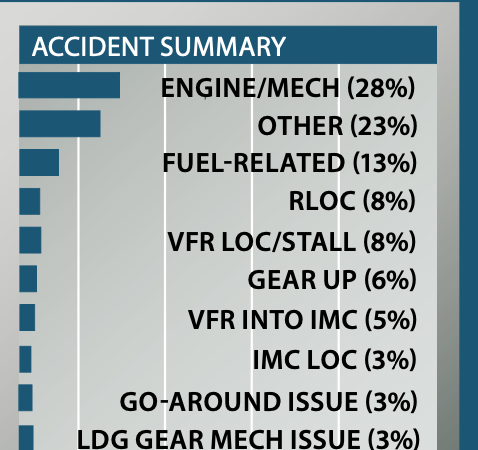
“Accident Scan: Oddballs and Engines”