










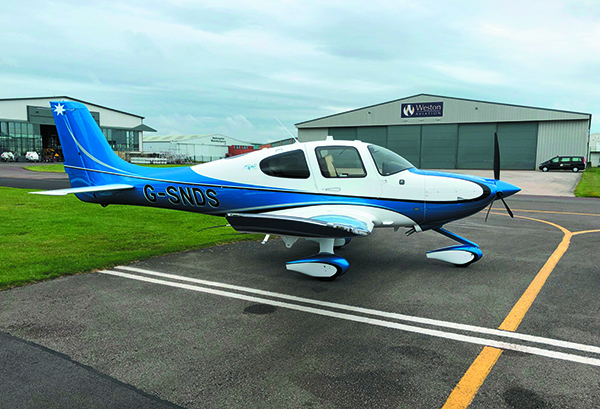
Cirrus SR20

The new centurys aviation success story hits the used market. Look for good buys on relatively recent models.

At Oshkosh in 1995, a little-known company by the name of Cirrus Design arrived with a slick plastic composite airplane that it audaciously claimed would be the future of general aviation. To stoke the hyperbole, a series of high-profile ads in major aviation magazines featured the airplane mysteriously shrouded in a dimly lit Hangar X. All would be revealed at OSH.

And so it was. Although Cirrus didnt quite deliver on its speed claims and the price of the airplane has escalated a bit, even cynics will concede that the company made good on its tall claim: Cirrus has turned out to be the future of general aviation, as the company booms along making about a dozen airplanes a week.

Through a savvy combination of good looks, respectable performance, cushy comfort and the promise of unheralded safety with its built-in ballistic parachute, Cirrus has not only survived but thrived. Ten years into the effort, Cirrus models are joining the rest of the crowd as used airplanes.And with some 1500 flying, the market churn is sufficient to make buying one realistic with the promise of good buys.

Like its arch new-age competitor, Lancair, Cirrus began life as a kit company, offering the quirky VK30 composite pusher. By 1993, Cirrus founders Alan and Dale Klapmeier announced that kits were a dead end. They had a better idea, specifically the notion that traditional airplanes from Cessna, Piper and others were too hard too fly, lacked intelligent safety features and failed to push the technological edge in both design and manufacturing. We have to lose a lot of this macho stuff, Alan Klapmeier told us in a 1997 interview. Making it too hard to fly is not a good value.

What eventually became the Cirrus SR20 emerged from that philosophy and from the beginning, the airplane was different. Rather than a dowdy yoke, it had the fulfillment of every Walter Mitty fighter pilot: a side-stick controller, just like an F-16. Although initial models had steam gauges, the new airplanes panel was dominated by a then state-of-the-art multi-function display.

But the real eye opener was the Klapmeiers plan to make a ballistic parachute standard equipment on every Cirrus sold. Although they had been demonstrated on larger airframes, no one had proposed equipping an airplane as large and fast as the Cirrus would be with a ballistic parachute. Reaction to the idea was mixed, with many predicting Cirrus would never convince the FAA to sign off on the parachute idea.

But they were wrong. Working with Ballistic Recovery Systems, Cirrus worked through a number of design iterations for the canopy and rocket deployment system before the first type-conforming airplane emerged from the factory in late 1998. After months of testing, Cirrus and BRS got it right and in production airplanes, the Cirrus Airframe Parachute System or CAPS, lives in a wastebasket-sized cylinder above the rear baggage compartment. The 85-pound system contains a rocket motor, firing devices and a 2400-square-foot round canopy. The canopy requires a 10-year inspection and repack cycle and there’s a six-year replacement cycle for a pair of line cutters used in the deployment process.

Despite the raised eyebrows of critics, as of late fall 2004, the CAPS system had been deployed four times in anger, with all of the occupants emerging uninjured. In one of those deployments, a Texas accident in which an aileron became detached in flight, the airplane was recovered, repaired and returned to flight status. In two others, the airplanes were expected to be repairable. The fourth was destroyed. No significant injuries were reported in any of these deployments.

Model History
The Cirrus line has undergone continual if minor evolution since the first airplanes were delivered in 1999. Throughout the model evolution, Cirrus has offered the SR20 and its follow-on SR22 in three option tiers, originally designated A, B and C. (Trade-A-Plane ads often use this nomenclature.)

Although originally specd with the now-defunct Trimble line of avionics, no aircraft were shipped with these boxes. When Trimble bailed out of the light aircraft avionics market, Cirrus wisely adopted Garmin for its panels.The A airplanes have a GNS430, a GNC250XL, an audio panel and GTX320 transponder, plus the ARNAV ICDS 2000, a then state-of-the-art multi-function display. For autopilots, the A aircraft have S-TEC System 20s, upgradeable to System 30s, which include altitude hold. All of the early aircraft used vacuum instruments but each had an electric back-up vacuum pump.

B airplanes have a GNS420 in place of the GNC250XL, the System 30 is the standard autopilot and in place of a vacuum DG, these aircraft have the Century NSD360 vacuum/electric HSI. C airplanes have dual GNS430s, System 55 autopilots, dual alternators and Century NSD1000 electric HSIs. Options for the B included dual alternators, leather seats and three-blade propellers, with some 70 percent of SR20s being C models with many of the options.

Beginning in 2002 with serial number 1268, Cirrus did away with vacuum systems and introduced the all-electric airplane. The A, B and C designations evolved to 2.0, 2.1 and 2.2, respectively. The all-electric airplanes have dual alternators-a 75-amp main alternator and a 35-amp secondary unit-and dual batteries. There are also two busses, a main bus and an essential bus for critical load items such as nav and comm functions and lighting.

The 2.0 airplane didnt change much over the old A airplane except in place of the ARNAV ICDS 2000, Cirrus switched to the Aviydne EX3000C, a higher resolution more sophisticated MFD but one intended for the VFR pilot, since it wont accept external sensors such as a remote Stormscope. The all-electric 2.0 offered an electric DG but most owners opted for the NSD1000 HIS. The 2.1 airplanes have an Avidyne EX5000C and NSD1000 HSI as standard while the 2.2 airplanes feature a pair of Garmin GNS430, the EX5000C and a Sandel SN3308 electronic HSI. Again, most airplanes delivered have the 2.2 package.

Cirrus made its biggest splash in 2003 when the Avidyne Entegra primary flight display came on the market and became standard for all Cirrus aircraft, even the newly announced VFR-only SRV version of the SR20. Many would-be buyers might wonder if an early SR20 is retrotfittable with a PFD or if a vacuum model can be converted to an all-electric model. Cirrus says these upgrades arent possible but kits are available to replace the ARNAV ICDS 2000 with the more capable Avidyne EX5000C. This accommodates such state-of-the-art options as remote Stormscope, Skywatch traffic, EMAX engine monitoring, XM weather datalink and CMAX, Avidynes new electronic approach plate system.

The follow-on model to the SR20 is the SR22, which first appeared in late 2000 for the 2001 model year and which has since become Cirrus best seller.As of winter 2004, Cirrus said that 467 SR20s and 1124 SR22s had been built. The SR22 is faster and has a higher payload by dint of its 310-HP Continental IO-550-N.

Although not yet a player in the used market, in early 2004, Cirrus introduced the G2 models (both SR20 and SR22) which feature a new door design, better interiors, a redesigned firewall for improved crashworthiness and other upgrades. Cirrus says G2 airplanes have slightly less drag and are thus a knot or two faster than previous models.

Engines, Systems
For the SR20, Cirrus selected the 200-HP six-cylinder Continental IO-360-ES, a somewhat unusual choice but one which yields sufficient power and remarkable smoothness. TBO is 2000 hours but overhaul costs are on the high side, about $28,000. Most of these airplanes have three-blade props whose RPM control is largely automatic through a cable-and-cam arrangement that sets prop relative to throttle position; there’s no manual prop control. This works we’ll enough but there’s no way to find an RPM sweet spot and owners have complained about difficulty in getting the cable rigging adjusted.

With the exception of aluminum control surfaces, the airframe is entirely composite, with the fuselage halves laid up in molds, joined and then baked in a convection oven. The wing is similarly constructed and is a single-piece with a beefy, continuous spar. Control surfaces are activated via cable from side controllers mounted on the cockpit walls. Trim is electric only, with coolie hat buttons on each stick, another sore spot for some owners, who say they would like a manual trim wheel for back-up and to fine-tune trim.

The Cirrus wing has a unique stepped leading edge thats supposed to be benign in stalls and resistant to spinning. For that reason, the airplane is not approved for spins and the anti-spin response is first roll input with ailerons and, if a spin develops, to deploy the parachute.

Cirrus airplanes are designed with crashworthiness in mind. The fuel, for example-60.5 gallons, 56 gallons usable-is stored between the wing spars and we’ll outboard of the cabin, providing significant crash protection. The landing gear is designed to flex into the wing inboard of the fuel cells, thus leaving them intact in the event of hard landing or crash. The seats are 26G impact designs and absorb crash forces by stroking slightly and through compressible foam. Each seat has four-point harnesses with inertia reels and, if the worst does happen, the airplanes are equipped with a crash hammer so occupants can extract themselves. One major safety feature is the lack of yokes to impale the front seaters during impact.

As noted, the SR22 has a larger engine and more fuel to quench its thirst: 84 gallons. The SR22s wings are 18 inches longer and its landing gear was moved inboard to create clearance for a larger prop. Although identical in section, the SR22s wing spar is substantially beefier than the SR20s and the energy absorbing seats were modified to accommodate the airplanes higher weight.

Performance, Load, Comfort
Performance-wise, the SR20 should be examined in dual context, as both a high-performance airplane and as a fixed-gear cruiser. As a fixed-gear cruiser measured against the likes of the Cessna 172 or 182 or the Piper Archer, its respectably fast. Although Cirrus initially claimed 160-knot cruise speeds, 150 to 155 knots is more like it. If owners have an overarching complaint about Cirrus, its that the company over-promised cruise speed. (Some owners say they flight plan for 145 to 149 knots but Cirrus Ian Bentley told us no properly rigged and maintained SR20 should be that slow.)

Against high-performance airplanes-say a late model Mooney 201 or a mid-1980s Bonanza, the SR20 is sucking wind, giving up anywhere from 10 to 20 knots.

Although the SR20 is adequately powered, its not overpowered. At 3000 pounds, its heavier than most airplanes with 200 HP. At moderate weights, expect 700 to 800 FPM initially, falling off to 500 FPM above 4000 feet and the airplane is somewhat of a dog in high density altitude situations. Owners say the POH is on target for fuel burn at about 10.5 GPH for typical cruise, although some report higher fuel burns. Still air range is about 675 miles, with 45-minute reserve, planning the full 56 gallons usable. Down fueling to the tabs allows more cabin load but dramatically cuts endurance to under two hours.

Initial max weight for the SR20 was 2900 pounds but a later service bulletin, if complied with, allowed a gross of 3000 pounds. Cirrus initially claimed a standard empty weight of 1875 pounds for a useful load of just over 1025 pounds. Not really, say owners. Empty weights are typically 2000 pounds or more with useful loads of just under 900 pounds. With full fuel, that leaves 560 pounds for people and stuff. CG tends forward rather than aft.This requires heads-up flying for the airplane is not blessed with an over-abundance of elevator authority. With a forward CG, its possible to prang the nosewheel on landing.

Both the front and backseats of the airplane are exceptionally comfortable by GA standards. With no yoke to obstruct the view, the front seats are like flying from an easy chair, with an expansive view out the generous side windows. The side controller is easy to adapt to by using a rest provided for your forearm. Expect a little wrist fatigue after long periods of vigorous yanking and banking, but the airplane generally rivals the Bonanza in handling ease.

Maintenance, Support
Cirrus largely achieved its goal of building a low-maintenance airplane. There are only four ADs on the airframe and two are related to minor issues with the parachute firing mechanism. Initial problems with hard starting of the IO-360 and failed starters were addressed with tweaks to the fuel system.Early models had landing lights mounted on the cooling baffling in the air inlet, which caused them to fail frequently. The mount was reworked and newer models have the light in the cowling.

One complaint involves failures and frequent repairs for the Century NSD1000 HSI, something not unique to Cirrus aircraft. We would consider replacing this with a used Sandel or a Bendix/King system. Service difficulty reports show several incidents of cracked crankcases due to vibration in the alternator bracket, which Cirrus has addressed.

Another area of complaint is poor fit of the doors and inflight openings. This has been addressed in the G2 airframes and Cirrus concedes that the design and fit of the early doors isn’t the best. However, the company insists that any door on any model can be made to close securely, if adjusted correctly.

Many owners have been through four or five annuals and none who contacted us reported unusual costs. Its too soon to say that composite airframes are less maintenance-intensive than metal models, but indications are positive thus far. Cirrus gets high marks from owners for factory support, after shaking off a difficult period and retrenchment in 2001. Owners rave about the Cirrus Owners and Pilots Association support group. (Contact www.cirruspilots.org.) It maintains an excellent Web site with both public access and members-only forum sections. Its a must for any would-be Cirrus buyer.

Reader Feedback
Exactly one year ago my wife and I purchased a 2000 SR20. Since then we have put 102 hours on it. It is a joy to fly and very comfortable. Adjusting to the side stick and single-lever throttle took only a few minutes. Learning the two Garmin 430s, Avidyne EX5000C and S-TEC 55, however, required study.Payload with full fuel is 560 pounds and this allows 4.5 hours with reserve.Filled to the tabs, payload is 730 pounds, but you only have 1.75 hrs with reserve. We can cruise at 150 knots but I file 145 knots, which usually works perfectly. Fuel flow for us is 10.5 GPH.

I had an annual done at the time of purchase and there were only a few minor problems. Labor cost $900 and parts $134.52. Since then, there have been two oil changes and numerous SBs, some paid by Cirrus and some by me.Total spent this year after annual: $967.05. Although the airframe has 735 hours, the engine has only 180 hours because of a case crack and a factory reman was installed under warranty.

With my time of 589 hours, IFR rating and no previous Cirrus time, $1 million smooth insurance was $4880 with the requirement that I have training with a University of North Dakota Cirrus instructor. Although this was expensive ($1800 for three days), the training was excellent and I thought valuable. I would strongly recommend this type training if you have not previously used a complex panel and a fast slippery aircraft.

The Cirrus owners web site is excellent and has numerous suggestions.Immediately throw away the horrible tow bar that comes with the plane and get an aftermarket unit like Aerotow. My throttle control became very hard to move and I had heard about some very costly repairs, but COPA suggested lubrication of two cables, which worked beautifully. COPA also rates maintenance facilities, although some are very new. In summary we love this plane and have very few complaints.

Byron Gustin
Via e-mail


I started shopping for an airplane in early 2000 but I was reluctant to wait two-plus years for delivery. At the time, I purchased a New Piper Archer III. When a used SR20 came on the market at my home field, I had a look at the airplane and arranged a demo flight. I was immediately comfortable with the side stick and the airplane performed beautifully. It was love at first flight! I made an offer for the SR20 and listed my nearly new Archer for sale.

The SR20 is faster than any airplane I had flown and it took a while to get in sync with it. Initially, I was always behind the airplane, but I quickly got up to speed. The SR20 is a joy to fly. The view out the window is spectacular. The large windows and low instrument panel combine to provide unobstructed views. The flight controls are responsive and it maneuvers easily. Slow flight performance is predictable and stall behavior is gentle.The airplane has no bad handling characteristics that I can find.

The cockpit is very comfortable. Two adults can travel without having to get too personal. The seats are designed with great support. Ive flown the SR20 from Atlanta to San Diego in a single day. When I completed the flight, I was still comfortable.

I flight plan for 150 knots true and 12 GPH.

My SR20 was delivered prior to the change to all electric and all glass cockpits and Ive heard it referred to as the antique panel. The electrical system has two alternators and a single battery. Cirrus uses an integrated MCU that contains the regulators and other power delivery circuits for the aircraft. Ive had one fail under warranty and it took the entire charging system down. The battery, however, was still holding up the system.

The situational awareness of the SR20 in IMC is nothing short of fabulous. The large map display and terrain data on the MFD instantly let you know if the flight is progressing as planned. My biggest complaint about the airplane is the trim system. The airplane has electric trim with a coolie hat on the stick; manual trim is not available. Its difficult to get it trimmed for straight and level flight. I normally let the autopilot handle this chore.

The Cirrus Owners and Pilots Association (COPA) is a terrific support organization. In general, Cirrus owners are enthusiastic about their airplanes. The message board is active and members are always willing to share their experience and knowledge. COPA has been a valuable resource and it is a bargain at $40 per year.

The experience with Cirrus has been good. Even though I was not the original purchaser of the airplane, they were responsive about transferring the remaining warranty for my use. Persistence was required in a few cases but generally Cirrus has gone out of their way to insure that I was satisfied. Their customer service has been steadily improving as they have grown.

The first year, my insurance premiums were identical to what I paid for my Archer. This seemed reasonable because the hull values were comparable.During that first year, there was an unfortunate string of Cirrus accidents and subsequently many insurers were not willing to write coverage for the type. My coverage was maintained but my premium has increased by 30 percent for identical coverage. Premiums have stabilized at this higher level. Also, I am now required to accomplish type-specific training to renew the policy.At last renewal, I had a selection of companies to choose from.

The useful load of my SR20 is about 850 pounds. With full tanks and me aboard, I can add about another 300 pounds without having to offload fuel.Load balancing is generally easy. I can get to max gross without much concern for where stuff is placed in the airplane. The only exception is if all of the weight is in the front seats. With a heavy person in the right front seat, I can be at gross and the CG will be forward of the limit.

Mechanically, the airplane is conventional and does not seem to present any difficulties for most mechanics. After I got through the initial new plane issues, the airplane has been light on maintenance, suffering the normal items found in any piston aircraft.

I include insurance, hangar, GPS database updates and the annual inspection as part of the fixed expense of keeping the airplane. Counting these items, the fixed cost works out around $700 per month not including depreciation. I perform my own oil changes and other chores allowed as owner maintenance by the FAA. With other repairs and fuel, my variable expenses are less than $70 per hour, not including engine reserves.

Ive had the SR20 for nearly three years now and Ive flown it for over 600 hours. It has comfortably taken my wife and me all over the United States, from San Diego, Las Vegas and Denver to New England and Key West and points between. Our SR20 has been a trusted part of our travel plans with excellent availability.

Ted Rabenko
Duluth, Georgia


I have flown and maintained a Cirrus SR20 for two years; during that time, the aircraft was covered under the factory warranty. Since I am an A&P, I chose to do all the servicing and repair with Cirrus providing the replacement parts. The few problems that have been found relate to improper installation at construction. Leaking brake line fittings, ill-fitting fillets, improper location of anti-chafe tape on the flaps and a misaligned landing gear are examples.

Cirrus has issued a number of service bulletins, which can be found by accessing their Web site. Future used Cirrus buyers would obviously need to see that the important ones were done (some are optional) before buying. The first annual inspection only required fixing a seeping brake line fitting and re-attaching an anchor to a composite structure. The second annual found a fuel tank rib that had a fuel stain. Between annuals, I perform inspections and repair/replace any discrepancies, so annuals are usually not a surprise.

Since the airplane is so new it is hard to form any basis for an opinion on future maintenance issues. One unknown area is the cost of replacing the parachute/rocket motor scheduled for 10 years from the date of manufacture.

My aircraft is equipped in the A configuration (single alternator), which may explain why I have had virtually no problems with the electrical system or flap relay failures-a source of some complaints by other owners. I elected to stay with the ARNAV ICDS 2000 multi-function display over the Avidyne.

I subsequently upgraded the ICDS 2000 hardware/software to the H version and installed the EMM-35 Engine Monitoring under the ARNAV STC. I would strongly recommend that all prospective buyers look for aircraft with engine monitoring, whether ARNAV, Avidyne or an other brand. The ARNAV system records the engine operating data every 60 seconds for the TBO of the engine.As part of a pre-purchase inspection, buyers should review the engine data information to see how the engine was operated.

A note of caution: Airplanes straight from the factory (without engine monitoring) have only one CHT probe and one EGT probe installed. My experience is that the factory installed cylinder head temperature probe (number 3 cylinder) is not on the cylinder with the highest operating temperature. And the factory installed exhaust gas temperature probe (cylinder number 6) is not on the cylinder that reaches peak EGT first or last.

On the subject of operation, buyers should include a check of the fuel injection setup as part of the pre purchase inspection. My aircraft was delivered with the system operating too lean. Correctly set up, the engine will operate without any one cylinder exceeding 380 degrees cylinder head temperature on 100-degree days throughout climb.

Aircraft performance is, in my opinion, good for an aircraft of this size and power. The factory numbers were clearly inflated. On several occasions, I have gotten 157 knots at a power setting of about 75 percent. Virtually all of my flying has been at reduced power and 50 degrees lean of peak EGT, which yields a TAS in the mid/upper 140-knot range at 6000 to 7000 feet and a fuel burn of just over 9 GPH. Higher altitudes yield somewhat slower airspeeds, but along with that is a lower fuel burn of just over 8 GPH.

Useful load is 910 pounds and I have operated the aircraft several times at or near full gross weight and experienced acceptable performance. I have flown the aircraft in mountainous terrain several times and as high as 14,000 feet, but one should be careful of runway/takeoff performance on high density days.

Insurance for low-time pilots may be a problem. I am a CFII with 2200 hours, 280 hours in type, with no accidents/violations/claims. The first year I had full hull coverage and $1million liability for $2138. The second year the quote doubled. I don’t consider in-motion coverage any more, electing to have not-in-motion and liability coverage for about $1460 per year. Potential buyers should explore this before deciding.

The airplane is wonderful to fly. It has a certain feel which is probably common to other composite aircraft. It has a comfortable ride in turbulence-due in large part to the high wing loading. The side stick control is mastered without a second thought, however the sensitivity of the electric trim will probably cause frustration for some.

Upgrading pilots will probably find that learning to use the MFD and GNS430 (along with the landing technique) is the most challenging part of learning to fly the Cirrus. Screen fixation, like instrument fixation, will be a hard habit to break for pilots training in this type.

J. Porter
Via e-mail


Also With This Article
“Cirrus SR20 Charts and Specs”
“Accident Scan: Dismal But Improving”