










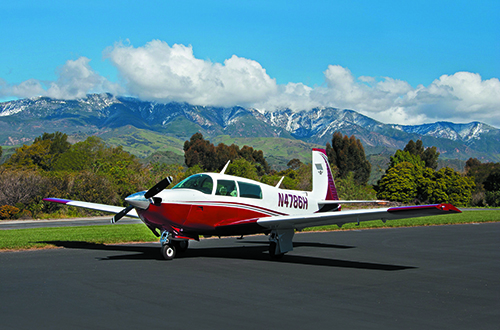
Mooney’s J-model is one of those rare ideal compromises between speed, economy and payload. It’s not the fastest retrac on the block, but as complex aircraft go, it’s relatively affordable to own, plus it’s easy to fly and maintain.
Mooney pumped out nearly 2200 201s between 1977 and 2008 and the current used market has plenty for the taking. There’s a lot to like, which makes it easy to overlook some of the aircraft’s nits.
As we’ve discovered in previous used aircraft reports on the entry-level Mooney, owners rave about their 201s, thus it was no surprise that—once again—our query for comments on the airplane drew more feedback than any other model. Here’s a look.

History
Amazingly, even the latest speed champion from what’s now called Mooney International in Kerrville, Texas—including the $769,000, 242-knot Acclaim—traces its heritage to the original Mooney type certificate. The basic airframe has evolved over the years, but the concept of a semi-monocoque rear fuselage mated to a metal-skinned steel-tube cabin, a long and slender tapered wing and distinctive reverse tail has endured.
The J-model evolved most directly from the F-model, which was itself descended from the short-body C-models of the mid-1970s. The first J-model or 201—the number derives from its supposed top cruising speed in MPH—appeared in 1977. It sported a 200-HP Lycoming four-banger—the IO-360—improved landing gear and a sloping windshield, among other changes. All of these were the product of a concerted effort by Mooney to kick the model line up a couple of notches.
The 201 is, to the surprise of many, very much the work of the late LeRoy LoPresti. LoPresti had a long aeronautical background, including a stint on the Apollo lunar program at Grumman. He became a near legend for his ability to get the utmost from an airplane through aerodynamic cleanups, which he’d done with success on the Grumman Tiger.
Applying his magic to the M20F model, LoPresti and the Mooney team created the M20J. A number of changes were made, the most visible being a new cowling and a more aerodynamic windshield. The interior was addressed, too, with adjustable seats and a contemporary flat panel with organized electricals and circuit breakers rather than the typical dog’s breakfast arrangement of the 1960s and 1970s.

The old Mooney naming conventions—Executive, Chaparral, Statesman—were chucked in favor of the top speed moniker. To be fair, it should really be more like a Mooney 184, since this model doesn’t honestly cruise at 175 knots. As a marketing ploy, Mooney even went so far as to reserve as many 201 registration numbers as possible for the new airplanes. Even by 1970s standards, the 201 was a smash hit, selling more than 1000 copies in the first four years.
By 1985, the general aviation slump was taking its toll so Mooney tarted up the J into the 201 LM (for “Lean Machine”), a stripped-down version with basic IFR avionics for a bargain price. Two years later, the M20J got some more tweaks (gear doors) and was renamed the 205. Inexplicably, the 201 was still being produced, as was the 201 LM. Mooney was selling three airplanes that were more or less the same: all M20Js, but with different equipment. In 1988, the 201 was dropped and the 205 became the 205SE.
Bring Back the 201

By 1989, Mooney realized it was simply confusing customers and returned to the 201 name. That same year, a trainer version was introduced, called the AT. It was intended only for flight schools and is notable for the inclusion of speedbrakes. The new ones we flew at a busy aviation university had minimal avionics—rare for the model that’s usually loaded.
In 1991, Mooney abandoned numerical names and re-dubbed the 201 the MSE. There was a version with special equipment in 1992 called the MSE Limited. In 1993, all special variants were dropped and just before it abandoned the J-model, Mooney gave it one more name: the Allegro, ostensibly to go along with the Ovation and the Encore, the redo of the 252 that was also dropped just after it reappeared. Very few Allegros were made, but they’re arguably the most luxurious of the 201 litter.
Total production of the M20J—regardless of name—totaled about 2150 with about 1600 registered in the U.S. The airplane retains a loyal following and the fact that demand for it remains strong is evidenced by price trends: The 201’s base price more than doubled in the first six years, from $46,725 (1979 base) to $97,500 (1985). On the used market, the 201 continues to be a strong seller. Long gone are the days when a clean model would fetch $200,000, but a mid-1980s J or LM will still command about $90,000. A good one will sell quickly, even against lower-priced hangar queens.
Mooney Evolution
Here is a rundown on the more significant changes to the series: The biggest operational shortcoming of the original M20J was its low gear-operating speed (Vlo) of 107 knots for both retraction and extension.

This, together with the low flap extension speed (Vfe of 114 knots), caused pilots grief in high-density areas and led to the airplane’s reputation as a hot-handling, hard-to-land performance machine, which it really is not.
Vle (gear extended speed) and Vlo/e (maximum gear operating/extend speed) were increased to 132 knots for the 1978 model year. The 107 knots maximum retraction speed remains. Even these speeds are low, given the slickness of the airframe. Speedbrakes were offered as a factory option in 1986 and aren’t a bad feature to have; you can retrofit the Precise Flight boards to any model.
Where the first 201s have throttle quadrants with a pistol power lever, carried over from the C-model, in 1978 this was changed to conventional push-pull engine controls. The panel and central console/pedestal were redesigned twice. In 1980 (1981 model year), the panel and glareshield were changed to the same configuration as that in the 231, with the extended section over the radio stack to provide more room.
This change also is credited with solving vibration and rattling that had been an annoying problem in earlier 201s. For all its reliability, the IO-360 isn’t the smoothest engine out there. The ventilation system also was improved and the shaped wingtips with faired navigation and strobe lights that were first introduced on the 231 were added.
Further aerodynamic and several serviceability changes were made for the 1984 model year. The nosegear doors were redesigned to make them close fully on retraction, a fairing was added to the tail cone and a one-piece belly fairing was installed. This is a desirable feature; otherwise maintenance access to the belly is a pain. The single fairing, which is fastened with 38 Dzus fasteners, replaces eight separate access panels with 175 screws. Engine access was improved, too.

Over the years, empty weight increased by roughly 80 pounds; basic empty weight was 1640 pounds in 1981, 1671 pounds in 1984 and 1726 pounds in 1992. Some versions have more than 200 pounds in optional equipment and end up with full-fuel payloads around 460 to 470 pounds. In any case, don’t plan on much more than 600 pounds with the tanks full.
The big changes in the 205 were in the electrical system and landing gear. The 205 electrical system is 28 volts compared to the 14-volt system in earlier M20Js. The higher-capacity system is an improvement even though the 70-amp maximum output of the alternator is unchanged, because it can produce 70 amps whereas the earlier system is capped out at roughly 60 amps.
Battery rating also increased. Along with that, Mooney added an improved electric load monitoring system to supplement the high- and low-voltage annunciators—idiot lights that don’t help manage demand to any great extent.
The 205 gear system incorporates the M20K doors that fully enclose the gear when retracted and is the major contributor to the modest claimed speed increase of 4 MPH. The mechanical, three-position cowl flaps were replaced by an electrically operated, infinitely adjustable system. We like the manual flaps better, but they need to be kept in adjustment.

Gear speeds were raised to a Vlo/extend of 140 knots and Vle of 165. A flap preselect system was offered for the first time and Vfe/approach (15 degrees) was raised to 132 knots. The higher speeds were lost when the 201 returned in 1989.
With the 1991 introduction of the MSE, the maximum takeoff weight was increased by 160 pounds, from 2740 to 2900 pounds. The increase can be retrofitted (primarily a paperwork change and airspeed indicator exchange) back to some 1989 models, from serial number 24-1686 on.
Mooney M20J Accidents: Landings
Our review of the 100 most recent Mooney M20J accidents revealed that although the greatest proportion fell into the “landing related” category, the news regarding landing those machines is quite good compared to other airplanes. To start with, there were so few landing accidents overall, 26, that we lumped the usual suspects—runway loss of control (RLOC), overshot landings, hard landings and blown go-arounds—into one category rather than listing them separately.
For nosewheel airplanes, we would not be surprised to see 26 RLOC events alone—there were fewer than 10. We think a total of 26 landing-related accidents is an indication that the M20J series has above-average landing manners.
We do note that an M20J will float if final is flown too fast and may we’ll bite if the pilot doesn’t get it slowed down before putting it on the ground. One owner tore up his airplane after coming down final at AirVenture at the speed of heat. When he neared the colored dot he had been told to land on he forced the airplane onto the runway. Not surprisingly, his M20J played pogo stick—bouncing repeatedly as it ran off the runway—eventually to be stopped by some heavy military vehicles that happened to be between it and rows of parked airplanes.
We add a cautionary note to our praise of the M20J’s landing manners. Of the 26 landing-related accidents, more than 10 involved a prang on go-around from a landing that had not gone well. Proper rudder inputs, applied assertively, are necessary when the power is advanced on a go-around.
We found nine fuel-related accidents in our review. That seemed about right for an airplane with a fuel system that doesn’t have a “both” or “on” position as pilots seem to have a way of mismanaging the fuel on board. To our amazement, only one of those nine accidents involved the classic “air in one tank, plenty of fuel in the other” scenario so often observed after the dust of the forced landing clears.

Instead, all of the others involved engine stoppage due to water in the fuel. In at least two of the accidents it was clear that rainwater had gotten into the tanks because the flush-type fuel caps did not provide a complete seal. Having looked at dozens of water-in-the-fuel accidents due to aging flush-type fuel caps, we hypothesize that most of the other accidents had the same cause.
We are not fans of flush-type fuel caps. We recommend that M20J owners that have them replace them with umbrella-style caps, if possible. If not, inspect them for condition and seal regularly and be hyperalert for water contamination if the airplane has been parked outside during rain.
We noted what we consider to be a relatively high percentage of accidents due to either stall or other type of inflight loss of control—24. Most of the stall accidents were shortly after takeoff or go-around in high or hot conditions with the airplane fairly heavy. Uphill runways and/or intersection takeoffs on warm days are not friends to Mooney pilots.
We were surprised to see so many inflight LOC events, VFR and IFR. We do not think that the handling of the M20J is unusually demanding, but it obviously requires that a pilot take regular recurrent training in maneuvering in all regimes of flight.
Performance, Comfort
Performance is the bottom line for most Mooney owners. At 60 to 65 percent, true airspeeds average 150 to 155 knots and endurance with reserves at 4.5 hours or better. Some owners report 160- to 165-knot airspeeds and, while some airplanes definitely are faster than others, we’re skeptical of these claims. Plan on 150 to 155 knots on about 10 GPH.
Typically equipped 201s can haul three 170-pounders plus about 40 pounds of baggage. With partial fuel loads—say 50 gallons—the Mooney still offers good range with seats filled. The 201 has outstanding altitude performance for a low-power, normally aspirated single, thanks to its comparatively high aspect ratio and efficient wing. Its performance is good enough to make cruising at 14,000 to 15,000 feet a practical matter, with oxygen of course. Service ceiling is 18,600 to 18,800 feet, depending on the version and if light, a 201 can go there.
The J-model isn’t a rough-field airplane, although it will handle short runways admirably well. The gear doors almost brush the ground and the prop has less than 10 inches of clearance. Well-manicured turf runways are no problem; rutted gravel will beat up the doors, as will muddy surfaces.
Mooneys in general have a reputation for being cramped, but are in fact nearly as wide as a Bonanza. It’s the shape of the cabin section that makes them feel snug.
The small frontal area of the airplane means that the seating position is rather sports-car-like, with feet stretched out in front. This is in contrast to, say, a typical Cessna, which is more like sitting in a kitchen chair. There is definitely lots of legroom: Pilots shorter than 5 feet 9 or so may have to use a booster cushion to reach the pedals. For folks with bad backs, the Mooney can be an irritant and it’s not easy to ingress and egress gracefully.
The M20J is a relatively noisy, vibey airplane, some examples being worse than others. Cracks in cowls, baffling and cowl flaps aren’t unusual. Good headsets, an intercom, a thicker windshield and sound insulation help with the noise. So does prop balancing.

The baggage bay is of adequate size and is approved for up to 120 pounds. Most owners don’t mind the location of the hatch, which requires you to lift baggage over the sill rather than place it in. The baggage door doubles as an emergency exit for rear seat passengers (although some owners say it’s too small or too hard to reach). The earlier models have fixed rear seat backs, which occasionally causes loading problems for really bulky items. The baggage door isn’t all that large so muscling golf clubs into the airplane isn’t easy. There are mods for fold-down rear seats to address this.
Handling
Control pressures in the 201 are higher than in other airplanes of similar size and power, thanks to the push-pull tubes rather than cables used to actuate primary flight controls. The result is direct, fast and linear response. The stiff roll feel is due to the tubes bearing against rub blocks that help carry the aerodynamic loads without binding.
Rudder is the lightest control in the three axes, but it also is the least powerful, although there’s plenty of rudder to handle crosswinds. We’ve landed 201s with 20 knots across the runway, with control authority to spare. Pitch changes with configuration and power changes are significant. A go-around or missed approach with full flaps requires anticipation and generous use of trim.
In landing configuration, application of power results in a strong pitch up. One trick of note is that the flap and trim motors run at the same speed, which means that the pitch change with flap extension can be nicely balanced by running the trim in the opposite direction at the same time.
Stalls in a well-rigged 201 with the stall strips properly located on the leading edge are brisk but not tricky. There can be a pronounced wing drop as the nose falls through, as it usually will. The airplane isn’t approved for spins and they should be avoided. They’re recoverable by conventional means but may require more altitude than the pilot is willing to give up or has available.
Mooneys have long had a reputation as floaters on landing. And they will float, if flown too fast on final, which most pilots tend to do. Nail the speed, however, and you can plant the airplane right where you want it, with minimum runway used.
Touch down too fast and force the airplane on, and you’ll be in for a wild wheelbarrowing or skidding ride that could end in a prop strike or damaged gear. Similarly, takeoffs can be sporting and bouncy, too. The trick during takeoff is to set the trim properly, use flaps as recommended and apply a little back pressure. When the airplane wants to fly, don’t try to hold it on the ground.
The biggest handling challenge occurs not in the air but on the ground. The turning radius is fairly large. This, coupled with the long wingspan and low seating position, creates taxiing and ground maneuvering problems for transitioning pilots. The limited nosewheel turning radius also creates maintenance problems. Untrained or careless ramp people towing Mooneys occasionally exceed the limits and damage steering horns, trusses and other nosegear components.
Maintenance
Besides engine and steel-tube corrosion, Mooneys are plagued with fuel tank leaks and the 201 is no exception. Repairs are expensive and some owners have chronic problems. Others have none. Reseal quotes run from $6000 to as much as $12,000, if the tanks need major work involving hand scraping the old sealant through hard-to-access fuel bays.
Another recurring fuel system problem is water contamination caused by faulty fuel cap seals and/or corroded fillers. Advice: Change the cap O-rings at annual.
Leaking water also is responsible for another expensive problem. Poorly sealed (or deteriorated sealant in) windows or leaking storm windows allow water to seep into insulation, which leads to corrosion of the tubular cabin structure on the pilot’s side. One shop said 50 percent of all 201s have the problem to some degree; another one said early (through 1982) Mooneys are the most affected.
Inspection and repair is expensive because the interior and insulation have to be removed. Even if an airplane has been repaired, replacing tubes is frequently required and the problem can recur if an improved type of insulation was not installed or if window leaks recur.
One repair operation recommends detailed inspection of all flight control elements, especially if an airplane has been repainted. Paint stripper can penetrate and corrode torque tubes, bell cranks and other elements of the system. Exhaust system elements, especially flame tubes and mufflers, also are repeat maintenance items, in part due to poor quality, according to some maintenance technicians.
Despite a variety of fixes, the cowl-mounted landing lights fail at an annoying rate, largely due to vibration. One owner says he went through 27 landing lights in nine years. One solution is to install an HID lamp. These are expensive, but effective.
The ram air system also is prone to failure and regular inspection for deteriorating gaskets and proper operation is suggested. Some owners recommend sealing it and forgetting it. Using it adds a barely discernible bump in MAP. Finally, the next best thing to a warm, bird-free hangar are cockpit covers and cowl plugs. Birds like to nest in the tail cone and plugs in gaps will help. They don’t seem to like the nose openings as much as in Cessnas or Pipers.
Mods, Owner Groups
There are a couple good resources. The Mooney Flyer is at www.themooneyflyer.com. This is a monthly online magazine with other benefits. The Mooney Aircraft Pilots Association (MAPA at 830-315-8008) also has a magazine and other benefits, such as an insurance program.
There are a number of shops that specialize in Mooneys. Some mods are intended to make older Mooneys more like the 201, with sloping windshields, newer cowls, speed mods and the like. Others are mechanical and systems improvements.
Of particular note are Lake Aero Styling and LoPresti Aviation. Reach Lake Aero at 707-263-0412 and www.lasar.com and LoPresti Aviation at 772-562-4757 and www.loprestiaviation.com. Check out Precise Flight for speed brakes (www.preciseflight.com or 800-547-2558). Hartzell has prop upgrades; contact www.hartzellprop.com and 800-942-7767.
Owner Feedback

I have owned my 1979 M20J for 10 years and wish I had bought it 10 years earlier. This is my fifth airplane and the one that fits my needs better than any of the ones before. Oh sure, I would like to have something faster, roomier, with more useful load and maybe a turbo, but I do not think there is a normal-category airplane that does as many things as we’ll as my Mooney.
Living on the West Coast, nearly all my trips involve crossing mountains. If weather is no factor, I fly at either 9500 or 10500 feet and flight plan for 150 knots at 10 GPH. With full tanks, that is a comfortable 700-NM range with IFR reserves. The extended cabin of the Mooney M20J is quite comfortable on long flights. With only two people aboard, the front seats can be pushed back to where even a tall person can’t reach the rudder pedals. This creates a lot of space for the leg exercises I like to do on long flights. Ventilation is also good and the heater is excellent, even for back seat passengers.
Airplanes prior to 1980 had instrument panels that prevented deep avionics from being mounted near the top of the panel. Two years ago I designed a new panel that integrates an Aspen PFD with my existing (older) avionics. While not as flashy as a new glass panel, it provides an uncluttered layout and the same capability at a fraction of the cost. With ADS-B Out and a Stratus II on a rear window, an iPad mini fits nicely on the yoke and provides a moving map, weather and traffic.
Having flown heavy aircraft for over 30 years, I appreciate the solid feel and stability of a Mooney. I owned a Beechcraft 33 for many years and got used to the tail-wagging that’s common to most Beech singles. I was pleased to find that the Mooney has none of that and is an excellent instrument platform.
Most Mooney parts are available from the factory through a network of Mooney Service Centers as we’ll as from many third-party venders. Numerous modifications are also available, but few are really needed. Deactivating the ram air system makes sense and the one-piece belly mod saves a couple of hours at each annual inspection. An LED landing light is also a good addition.

0)]
As for maintenance, there are certain things that Mooney owners have come to accept. The fuel tanks generally need to be resealed every 20 years. Sealing one leak at a time works for a while, but eventually the tanks need to be professionally stripped and resealed. Additionally, the landing gear “donuts” need to be replaced occasionally. For any Mooney parked outside, it is imperative that the side windows are properly sealed to prevent corrosion of the steel tubing.
It’s said that the Lycoming engine in the 201 is one of the most proven and reliable engines in the industry. If flown regularly, one can expect it to reach TBO without a top overhaul. According to some reports, three-blade props do not always get along with this engine. What they gain in climb performance, they lose in cruise speed and often have vibration issues. The two-blade McCauley the factory choose for the airplane has proven to be a good choice. Dynamic balancing can make a noticeable difference in taming vibration.
My only recurring problem has been the autopilot. My aircraft came from the factory with a Century 41—a full-featured autopilot designed for much larger aircraft. In addition to weighing nearly 30 pounds, it is difficult and expensive to repair. The King KFC-150 autopilots found in most 201s are a better match. Otherwise, the systems in a 201 are simple, reliable and fairly easy to work on. If something out of the ordinary needs to be repaired, however, I would recommend a Mooney service center. Not all shops have the same expertise in caring for Mooneys.
For the past several years, my annuals have averaged $2000. There currently seems to be a lot of competition between insurance companies, which has resulted in some very good quotes. This year my insurance (based on $110,000 hull and $1 million liability) was $975 through AOPA. Needless to say, I am very happy with my Mooney.
Charles Raines
Camarillo, CA
I sold my 1967 M20F in 2011 and purchased my second Mooney, N1165N, a 1983 M20J Missile 300. Rocket Engineering upgraded 40-something M20J aircraft by replacing the 200-HP IO-360 with a normally aspirated 300-HP IO-550 with a three-blade full-feathering prop. Think of it as a baby Mooney Ovation. The STC is no longer available; however, support from Rocket is outstanding. N1165N has extended-range Monroy fuel tanks with a capacity of 98 gallons and a useful load of 1067 pounds (a gross weight increase occurred as part of the STC). This mid-length Mooney is 200 pounds lighter than an Ovation and thus climbs faster.
When I took my wife (then girlfriend) for her first flight after the Rocket upgrade, she felt the acceleration on the short takeoff roll and exclaimed “Hank wants to fly!” The aircraft is named Hank after its previous owner. It’s a hot rod. I have excellent runway performance and can cruise all day at 180 knots true, mixture set rich of peak at 14.5 GPH at 8000 feet. My max speed run is 188 knots true, but that’s burning close to 20 GPH rich down low. If you power back to 170 knots true, it burns 12.5 GPH. I can power back to stock J-model speeds and fuel burn, but I have become addicted to speed. The Missile has a heavy nose, drinks more fuel than a standard J and is generally priced between a standard J and an Ovation. I can fly 1000 statute miles in five hours or nearly 1500 statute miles in 10 hours.
My next upgrade will be a pressurized six or eight seater, but I don’t think I’ll ever sell the Missile.
Seth Meyers
via email
I have been flying for more than 40 years and have owned at least a dozen aircraft, including two Mooneys. Since I am 81 years old now, I expect this will be my last airplane and I wanted to get her as close to a new Mooney J as I could. Lake Aero Styling and Repair (LASAR) in Lakeport, California, does all my maintenance and we keep my Mooney at a “no deferred maintenance” level. My prior Mooney (16 years of ownership) was a 261 Trophy conversion by Mod Works.

1)]
This was a great airplane that I flew to the British West Indies, Alaska, Canada, many islands in the Bahamas, the Cayman Islands, Mexico (including many trips to Baja) and the Dominican Republic. This time I wanted a simpler aircraft for more local flights, although I have crossed the country in N335BB and made a few trips to Baja for whale watching. The J is fast enough at non-oxygen altitudes for me and is economical to operate.
This airplane has the electric speedbrakes which I much prefer to the vacuum ones I had in the 261. Both aircraft have backup electrical vacuum pumps because I strive for as much redundancy as prudent.
Over the years, I lost two vacuum pumps in IMC and in both cases switching on the electrical backup pump made the failures a non-event.
Bennett Bibel
South San Francisco, CA
I purchased a 1990 Mooney M20J three years ago. I previously owned a 2000 Cessna 182, a 2004 Cirrus SR22-G2 and a 2007 Cirrus SR22-G3T. I learned to fly in the Cessna and upgraded to the first Cirrus when I began traveling farther distances for business and often flew night IFR. I loved flying the Cirrus but found the operating costs to be unjustifiable once my travel was no longer related to business.
I wanted my next aircraft to be fast, fuel efficient, reliable and economical as I eased into retirement. I found a one-owner M20J that had been we’ll loved and upgraded with a Garmin G500 PFD/MFD and WAAS navigator.
The Mooney uses half the fuel of my previous aircraft, costs less to insure ($2000 per year), has much cheaper annuals ($1000 to $2000) and even though it is 26 years old, it has much better dispatch reliability than both factory-new Cirrus aircraft I owned. I give up 20 knots in speed, which is barely noticeable on my average flight missions. At the same time, I save at least $50 per hour in fuel costs alone—even running ROP.
Getting into the aircraft is obviously more difficult than in a Cirrus and takes some practice, but once inside, travel is comfortable. The flight controls are tight and responsive. Landing is easy once you learn to fly slow enough across the numbers.
My Mooney handles beautifully in IMC. If you are looking for a well-made, fast, safe and fun aircraft that many folks can actually afford to fly, I highly recommend the four-cylinder-powered M20J.