










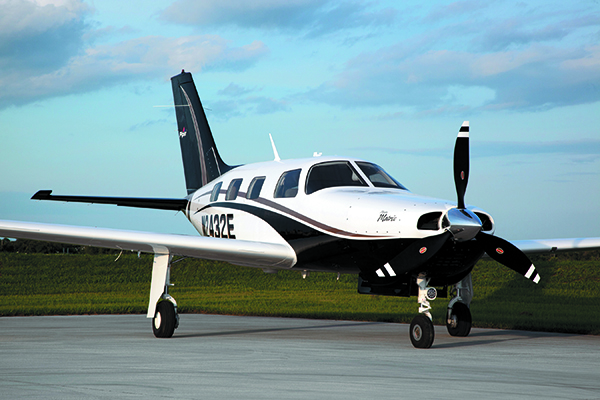
If any airplane suits the old adage about much being lost betwixt lip and cup, it must certainly be Pipers ill-starred Malibu and Mirage series. When it first appeared in the mid-1980s, the Malibu rocked the GA world. Here was a pressurized, high-flying luxury ride capable of 200-knots and with impressive range to boot.
There was nothing quite like it and Piper soon found a loyal market for its new flagship product, mostly among well-to-do owners who could afford to sink a half-million bucks into a new airplane and who flew the kind of trips the Malibu was capable of.
But for as good as the basic idea was, Pipers execution of it left something to be desired. Although owners generally raved-and still rave-about the airplanes impressive capabilities, the Malibu soon gained a reputation as a problem airplane. The engine and systems were finicky to operate and dispatch reliability ranged from barely acceptable to just awful, according to some owners.
Unfortunately, as the model evolved and became the Mirage, its reputation didnt improve. Indeed, some owners believe that with the Mirage, Piper jumped from the pan into the fire, especially with regard to engine longevity. (Or lack of it.)
Yet the fact remains, nothing quite does what a Malibu does or, as one owner puts it, its expensive to operate for a piston single but cheap for what it does. We think that fairly sums up the Malibu. Anyone contemplating buying one should be ready to pay what we consider to be substantial maintenance bills, with the reward being fast cruise speeds above the weather in pressurized comfort and reasonable payload.
Model History
The PA-46 is the last from-the-ground-up new airframe Piper has produced. The turbine-powered Meridian uses the same basic airframe the Malibu pioneered but with substantial modifications. The Malibu prototype emerged from the Vero Beach plant in late 1982, amidst much fanfare and excitement.
No one had seen anything quite like it. It had a long, rakish snoot housing a six-cylinder Continental TSIO-520BE rated at 310 HP and with two turbochargers, providing enough bleed air to keep the cabin comfortably inflated at FL250.
With its 43-foot wingspan, the Malibu looked as much like a glider as a powered aircraft. As one owner said, the thing looked like it was going 200 knots sitting on the ground. The base price was an eye-watering $275,000 but with accessories, the typical invoice swelled to more than $320,000, or $550,000 in 2003 dollars.
Ironically, Piper launched the Malibu in 1984 into what was an overall GA slump. Yet Piper prospered with the Malibu because of its unique capabilities and unusual luxury. Although the company succeeded, its success was haunted by engineering decisions made early in the program.
As is often the case, the production airplane was heavier than intended but this was offset by a boost in takeoff weight. Useful load worked out to be 80 pounds less than planned; not a deal breaker but a weight equivalent to fuel for IFR reserves.
For an airplane of the Malibus ambitious leanings, the right engine is a must. Piper never seemed able to find the right powerplant, however. From the beginning, buyers favored a Lycoming because of a perceived reputation for reliability and robustness.
The would-be owners turned out to be correct, at least initially. The Continental package evolved into such a nightmare-piston pins and crankshaft bearings in particular-that in 1987, Piper asked owners to ground their airplanes voluntarily until the problems could be worked out.
Many owners maintain that the Continental was and is a superior engine for the Malibu but in 1989, Piper introduced the Malibu Mirage with a Lycoming engine. It was essentially the same airplane with a Lycoming TIO-540-AE2A of 350 HP. The new engine weighed 113 pounds more but the maximum takeoff weight was boosted by 200 pounds. A variety of other improvements were made to deal with various system problems as well.
Continental Woes
The Malibus Continental powerplant got lots of attention early on-little of it favorable-but some of the airplanes other systems didnt distinguish themselves, either. The complex nosegear, which rotates 90 degrees to fit into its bay, proved delicate.
The hydraulic system which powered the landing gear wasnt especially reliable, was sensitive to dirt and grime and required continuing maintenance. The hydraulics also ran the flaps on early models. To make the airplane appealing to what Piper thought was its core market, the company called for exceptional range we’ll beyond the fuel specifics of most six-cylinder engines. Continental thus specified operating requirements for the engine that were unusual at the time, specifically lean-of-peak EGT operation.
To beat down the fuel flow, Continental required pilots to lean the engine to 50 degrees lean of peak for all operations below 80 percent power, which is the maximum recommended cruise setting. That goes against what most pilots had been taught-at least before the current rage about lean-of-peak ops-and a fair number ignored the instructions and ran rich of peak.
Many engine problems in the Malibu have been blamed on improper leaning, rightly or wrongly. Owners complain that no matter how carefully they operate the airplane, cylinder woes are just around the corner. The Lycoming in the Mirage was, if anything, worse in this regard. One owner noted, You can blow through cylinders in under 500 hours without absolute vigilant operation.
Whoever was to blame for Malibu engine problems, squabbles between owners, Piper and TCM grew heated and ugly at times. The irony is that the fixes applied to the Continental made it as good as the Lycoming installation. Both are sensitive to proper operating technique. (The pilot we quoted above said the same thing about Lycomings.)
With the introduction of the Mirage, some of the systems were addressed. The hydraulic system was improved, the engine cooling system was redesigned, the cabin door was improved, the seats were strengthened and the flaps were changed from hydraulic to electric operation. (Actually, some of the later Malibu models got the electric flaps and improved hydraulics for the gear.)
The Mirage also got some big-airplane type features that owners appreciate: a dual-bus electrical system, internal windshield deice, standard dual alternators and vacuum pumps and an auxiliary heater for the cabin. It needed it. Its cold back there in the flight levels, even during the summer. (Again, some of these mods appeared on later Malibus.)
Lycoming Better? Debatable
Unfortunately, substituting one engine for another didnt solve all of the Malibus problems and it brought some of its own, not the least of which is higher fuel consumption.
Maintenance continues to be a big headache for PA-46 owners, regardless of the powerplant type. Alternators, vacuum pumps and, in particular, the exhaust system are all items mentioned by our survey respondents. One owner shared the maintenance expenses for the first two years of ownership for his Mirage, which came to we’ll over $46,000. While this total might be seen as unusual, spending $20,000 on a Malibu or Mirage for a years worth of wrenching is not unusual.
Cylinder and valve-train problems have been evenly dispersed between the two engines, by our estimation. Turbocharger problems on the Mirage seem more frequent while the notorious main bearing shift has been the most frequent cause of grief to 310P operators.
Lycoming operators also have experienced higher-than-normal oil consumption that has proven difficult to remedy. One theory labels valve guides as the probable culprit. Magneto problems seem to be everyday occurrences for both powerplants, often caused by moisture contamination of pressurized mags. Preventive inspection and maintenance is strongly recommended.
And, of course, a number of Mirage owners got burned in the massive Lycoming crankshaft recall beginning in the late summer of 2002 and extending into the spring of 2003, including some that had new aircraft or fresh overhauls. Down time ranged from weeks to months.
The perceived reliability of the Mirage is so bad among some owners that a class action lawsuit was filed in 2000 against New Piper and Lycoming by the Fred Misko Jr. law firm of Dallas, Texas. The suit claimed that the Mirages engine reliability was so poor that New Pipers claims of the Mirage being a safe, efficient means of transportation were false and thus owners had been damaged. (See Aviation Consumer, November 2000 for more information.) The suit was recently settled after the court failed certify the class.
Lycoming disputed claims that the Mirage had suffered a high percentage of in-flight engine failures but the evidence is convincing. To explore the market for his Magnum series mods for the Mirage-see photo, above-owner Jonathan Sisk surveyed 92 fellow Mirage owners. He found that 10 of those owners had suffered in-flight engine failures that required immediate emergency landings, an obviously worrisome finding. NTSB records reveal that more Malibus than Mirages have had engine failures leading to accidents. But, as noted elsewhere, many engine failures don’t result in accidents and thus don’t make it into NTSB records.
The PA-46 nosegear is tender and the hydraulic system continues to pose problems. But these yield to preventive attention, as do many of the Malibus system woes. Even ardent supporters of the airplane admit that it requires frequent and ongoing maintenance. Both the Malibu and Mirage have had problems with loose rivets in the wing and tail as we’ll as cracked ribs and, on some Mirages, missing rivets in the fuselage. A number of problems with primary flight control cables have occurred, as well. The latter reinforces the value of having a knowledgeable maintenance shop doing routine and ongoing work on the airplane. The Malibu is not an airplane that just any shop can fix.
More than a few owners have had experience with several Malibus and/or Mirages. Is one better than the other in terms of maintenance? Our impression is that theyre about the same and that any owner contemplating buying a PA-46 should simply budget a pile of cash for annual maintenance and fix stuff as it breaks. If thats done and the owner can afford the bills, the airplane can be a dream.
Cabin, Cockpit
The PA-46s claim to fame is that its a six-place airplane with cabin class comfort. Well, yes. Starting up front, however, the cockpit isn’t exactly cavernous. Getting into the seats requires minor contortions through a narrow aisle between bulkheads walling off the rear cabin.
Pilots who are wide of girth and long of leg will be a little cramped up front; the seats don’t slide back as far as they do in a Mooney or a Cessna. The cockpit is we’ll designed in both models with well-placed gauges and plenty of room for all the avionics you could ever want. Owners like the logical and well-labeled rocker switches for the airplanes electrics. Later models have overhead switches which are a challenge for the presbyopic set.
The cabin arrangement is superb, with the Mirage somewhat better than the original Malibu. The airstair door is a plus, making for relatively easy entry and egress. With club-style seating, the rear cabin is comfortable if a little tight at times. Rear-seat passengers complain about too little heat-fixed with the aux heater-but the air conditioning/pressurization system is quite good, when it isn’t broken. Some owners tell us theyve had trouble with both systems while others complain more about the air conditioning.
Cabin and cockpit noise are on the low side as GA airplanes go. The Continental in the Malibu is noticeably less vibey than the Lycoming in the Mirage, according to owners.
Like most airplanes, the Malibu is not a fill-the-seats-and-tanks six seater. But it will comfortably carry four people and baggage with full tanks, yielding a non-stop range of about 1400 miles for the Malibu and 1000 to 1200 miles for the Mirage. Typical useful loads are 1600 pounds and 1500 pounds, respectively, but this may be considerably less in real world examples.
Baggage space is generous, with two baggage bays, one just aft of the engine compartment and the other behind the rear seats, making loading within limits easier. Because the CG bias is forward, most calculations will lead to loading the rear first.
The Mirages Lycoming engine is larger and the accessory layout is different, so the forward baggage bay in the Mirage is a bit smaller than that of the Malibu. The inclusion of an access panel in the firewall is a good tradeoff, since it makes it much easier to get at the backside of the powerplant.
Performance, Handling
Malibu performance puts the airplane in a category with many twin-engine airplanes but on less fuel. Malibu pilots report cruise speeds of 208 knots TAS at FL220 at 67 percent power and 212 knots true at FL250 at 75 percent. Mirage pilots pay more at the gas pumps but in exchange, they go a little faster, with speeds typically of 220 knots at FL230-250 at 75 percent power burning 18.8 GPH.
Owners of both models say they can fly 1100-NM trips with IFR reserves. But we have our doubts about the fuel-guzzling Mirage matching range with the Malibu in real-world conditions. The power setting and leaning would have to be right. The -310P, with its lower fuel consumption- as much as 4 to 5 GPH when flown by the book- has nearly 25 percent better range and is only about 5 percent slower. One owner cited this as the reason he chose the Malibu over the Mirage.
For those who cant imagine staying aloft for five-plus hours, there’s a pilot relief tube stowed in the spar cap between the cabin and cockpit. Using it requires some discretion and also regular washing of the belly to stave off corrosion.
On trips of any length, most owners climb rapidly into at least the high teens but the airplane is perfectly at home up to FL250. One place its not at home is taking off from short runways. Initial acceleration is sluggish, although the airplane will get in and out of 3000-foot strips at sea level with relative ease. We would pause operating out of 2500 feet or less, at least at gross weight.
How about handling? A delight to fly, high or low, says one owner. The handling characteristics of the PA-46 are indeed excellent, although they lack the rocklike stability that many instrument pilots prefer.
Were not talking Bonanza handling here but the controls are responsive, with pitch the lightest and roll the heaviest. The PA-46s long, high-aspect-ratio wing is good for climb and high altitude-performance, but along with it comes a low maneuvering speed in the mid-130s KIAS at gross, decreasing as the airplane gets lighter.
The long wings produce another undesirable trait: roll rate at slow speeds is somewhat ponderous compared to other singles. Sharp stick-and-rudder work in crosswinds is a must.
During descents, its easy to get above maneuvering speed or even red line if youre not paying attention. This, along with the autopilot and weather factors, was implicated in a string of in-flight break-ups that led to a great deal of consternation (and an AD-mandated restriction on operations) in 1991. But no positive link was confirmed and the airplane was given a clean bill of health.
Speed control is a must. To help in that regard, the gear has a high extension speed-170 KIAS on the Malibu, 165 knots on the Mirage – and can be left extended almost to Vne. The first notch of flaps can be extended at the same time as the gear. Pilots report that the gear makes an effective speed brake. Retraction speed is much lower, at 130 knots (Malibu) and 126 knots (Mirage) KIAS.
Many PA-46 incidents occur during landing. There isn’t anything particularly difficult about landing a PA-46 but the long wing encourages floating and when lightly loaded, the CG is forward. These two characteristics sometimes lead to abuse of the relatively delicate nosegear.
As owners report, the PA-46 is well-supported by one of the best owner groups in general aviation, the Malibu/Mirage Owners and Pilots Association found at www.mmopa.com. The group has excellent information on ownership issues. MMOPA also tracks mods for the PA-46, which include three- and four-blade props, IO-550 conversions, long-range tanks, interior mods, plus the Enhanced Fight Groups redo of the Mirage engine package.
Owner Comments
Two and a half years ago, I moved up from a Turbo Saratoga, which I owned for eight years, to a Malibu. I was originally looking at a Mirage but Jonathan Sisks survey had just come out detailing the Lycoming engine problems so I bought a later model (1987) Malibu with the TSIO-550 and four-bladed prop conversions. It was also equipped with spoilers, moving map and TCAD.
The transition from the Saratoga was significant. The Malibu controls are lighter, especially in pitch. It will also float much longer if approach speeds are too high. Its much greater speed demands that one stays ahead of the airplane even more.
With one significant exception, the reliability of the airframe and engine has been very good with only a few squawks between annuals. Still, these are complex aircraft and two of the three annuals were in the $8000 range. The third annual was under $5000 due to the fact that a new engine had just been installed and many items forward of the firewall were new.
I decided to buy a Continental-powered Malibu when learning of all the Lycoming engine problems. Ironically, I suffered a catastrophic engine failure. Luckily, it happened under the best of conditions, daytime VFR at 17,500 feet. I made it into Atlantic City 40 miles away after the engine seized in descent at about 9000 feet. The Malibu has one of the best glide ratios of any GA aircraft at 2.4nm/1000 feet. Since there wasnt any bent metal, my engine failure does not appear in any NTSB files.
Fortunately, the FAA red tagged the engine, which required a failure analysis. The culprit was a crack originating from the number 4 position stamping in the number 4 piston crown. The crack caused a hole to burn through the piston, which pressurized the crankcase and forced all the oil overboard in a matter of minutes.
In my research, I found this failure occurred several other times. In November of 2000, there was a non-fatal crash of a Malibu in Texas for the same reason originating from the same number 4 stamping. Through the Malibu/Mirage Owners and Pilots Association, I found two other owners who experienced identical failures and had to make emergency landings. Again, since there was no accident, these do not appear in the NTSB database.
One of these owners found cracks in pistons 1 and 5 originating from the position stamps in those piston crowns at a subsequent annual. The FAA MIDO for Continental told me there were others but wouldnt divulge how many.
I am also surprised that the FAA has not issued an AD regarding this issue. It seems that the TSIO-550 engine is more prone to this sort of failure because the piston crowns are dished rather than flat topped as in the TSIO-520s. This results in a thinner cross section in the crown, making it more prone to cracking from stress risers caused by the stamping process.
Continental realized they had a problem, so in December of 2001, they stopped the piston position stamping process. Unlike Lycoming, which issues service bulletins regarding safety related problems, Continental is remaining silent. They are quietly giving affected owners generous warranty adjustments on engines which are long out of the original warranty. Even though my engine was seven years old with 1000 hours, Continental gave me full core credit on my trashed core and a substantial warranty adjustment toward the new engine. The engine mount is also prone to cracking at the nose gear actuator attach point.
Insurance, with my level of experience, commercial license with 1550 hours, is $7480 for $1 million smooth and $425,000 hull. My carrier is USAIG.
My main reason for moving up to the Malibu was the pressurization and the cabin-class interior. Pressurization allows flying above most of the weather comfortably without having the entire family wearing oxygen. The pressurization system is reliable and has a high pressurization differential (5.5 PSI).
Spoilers are a worthwhile addition to this slippery airframe. Although the gear can be extended at up to 170 KIAS, I cringe at the thought of doing so. Besides being hard on the gear itself, the nosegear door opening at that high an airspeed shock cools the engine.
I generally cruise climb at 120 knots at 2500 RPM and 35 inches. Climbs to the flight levels during summer and max gross weight are in the 700 to 800 FPM range. During winter, at lighter weights, climbs of 1200 to 1300 FPM can be expected. After breaking in the new engine, I equipped it with GAMIjectors. I now routinely cruise at 70 to 80 degrees F lean of peak EGT.
The Malibu is an excellent high-altitude performer, especially with the IO-550 conversion . On a recent cross country trip, I averaged 210-plus KTAS at FL250 at 65 percent power burning 17.5 GPH at 75 degrees lean of peak. Cruise speed drops to 200 KTAS at FL200.
At 75 percent power, TAS will go up to 220 KTAS but lean-of-peak operation would not keep CHTs under 400 degrees F, my personal maximum for top-end longevity. So I had to run rich of peak and pour 25 GPH through the engine to manage CHTs to 400 degrees F. This is not worth the extra 10 knots. Incidentally, I calibrated my airspeed indicator using the procedure at www.reacomp.com.
The Continental engine mated to the four-bladed MT propeller is a combination that is nearly turbine smooth. According to data supplied by Hartzell and MT, the four-blade prop produces about 25 percent more static thrust. This improves the anemic short field performance of the stock Malibu. By 125 knots, the thrust difference between the two props is negligible so there is no discernible difference in climb performance. The smaller diameter of the four-blade prop reduces cockpit noise. I measure 85dBA in cruise at the pilots ear.
Totaling fuel, maintenance and reserves, including a mid-time top, I calculate a direct operating cost of about $185/hour. The MMOPA is a very active and helpful organization. The annual conventions are the best organized and classiest GA events Ive ever attended. The speed, room, load carrying capacity and efficiency of the Malibu is hard to beat.
-Greg Wroclawski
Kinnelon, New Jersey
I just acquired a 1985 Malibu with the TIO-550-C conversion. Although I am a commercial instrument-rated pilot with over 750 hours, my insurance required that I take a training course (ATM) and 25 hours dual in the Malibu before soloing in the airplane. My initial insurance for the first year is about $7600 and I expect about $5500 next year, assuming I have over 100 hours in the airplane.
With the 350 engine, I cruise at about 30 inches and 2300 RPM and can run up to 100 degrees lean of peak for about 190 knots TAS. Typical 50-degrees lean-of-peak cruise gives me about 15 GPH while climb at 35.5 inches and 2500 RPM yields about 35 GPH at 130 knots TAS.
-James A. Lawson
via e-mail
We own a 1986 Malibu. After researching the various models available, we concluded that a 1986 or later model was the best example of the type. In the 1986, the flaps are electric, which is a superior arrangement to the original system, which overstressed the hydraulics.
The original Malibu is far superior to the Mirage, in our opinion, for the following reasons: The engine is much less prone to in-flight shutdown, the rate of fuel burn is an honest 5 GPH lower (16 versus 21 GPH) which translates to a significant rangeand payload advantage, performance is substantially equal given that the aircraft is about 200 pounds lighter.
Performance is equal to book specs. In cool weather at light weights, rate of climb is about 1200 FPM to 15,000 feet,falling to about800 FPM by FL200. Summer, fully loaded climb slowsto about 800 FPM to 15,000 feet and down to 400 FPM by the time you get to the flight levels.
Figure on about 12 minutes-two passengers, 70 gallons of fuel, cool weather-to 15,000 feet from a 500-foot field elevation. The same run to 25,000 feet (gross weight, 90 degrees) will take half an hour, plus. Speeds average 185 knots at 10,000 feet,75 percent power at 16 GPH; 195 knotsat 15,000 feetand 75 percent power on 16 GPH; 200 knots at 20,000 feet,70 percent power on 15 GPH. Summer speeds are abit lower, about 2 to 3 knots on a half-gallon less fuel per hour.
Range is amazing. Wehave flown from St. Louis to Challis, Idaho (1113 miles) into a 40-knot headwind and landed with over an hour of fuel. The engine wont stay cool at 75 percent up high in summer weather; figure on 65 percent max over 20,000 feet.
Loading is easy to keep within CG with front and rear baggage. Payload isgood. With about 1300 poundsuseful, a 500-mile tripand an hour reserve, you need about 70 gallons, leaving almost 900 pounds for people and baggage.A 1000-mile trip still leaves about 600 pounds forpayload.
With 1000 hours and 300 hours in type, insurance is about$6500 for decent coverage. Training is a pain because the insurance companies require type-specific training by a narrow list of approved schools. We go once per year to Kansas City (Tom Duetch) for a day and have learned at lot over the years. I intend to do the two-day Simcom course this year.
Maintenance is the biggest issue in a Malibu. You simply have to bite the bullet and take your airplane to someone who specializes in the type. I researched this issue extensively before buying the airplane. We had Kevin Mead do our pre-buy and all subsequent annuals. This is a real pain since Kevin is in Hutchinson, Kansas.
We hire a pilot to ferry the airplane. This is worth it no matter what the effort. Kevin knows the airplane. He doesnt have to look it up or call the factory. He is the source. Most local shops simply don’t do enough work on these airplanes to know all of the idiosyncrasies.
A typical annual at Meadmay not be cheaper, but will result in a lot more work being done. We believe safety is greatly enhanced and could site several examples but we don’t want to disparage anyone. Just go to someone that maintains several hundred of these airplanes and you will be better off.
This is a high-performance and very weather-capable airplane. It is expensive to operate for a piston single but cheap for what it does. Figure on $150 per hour and that wont give you extra money for upgrades, paint or interior. But it should cover all variable expenses. In addition, we put in $12,000 annually for fixed costs ($500/month each).
No piston twin can match the performance, payload and range of a Malibu, although some can beat a Mirage. The minimum step up is a King AirE90 or a TBM 700. Neither a Meridian nor a King Air C90 has sufficient range to meet our needs. Either upgrade will increase your costs by about a factor of four.
Aftermarket upgrades are generally notworth it and, in our opinion, most are worse than stock. The 550 engine is hard on cylinders, the four-blade prop is high maintenance, speed brakes are not needed, the three-blade prop is nice but costs $20,000.
The original avionics are a mixed bag. Figure on a few thousand dollars a year to keep everything perfect. The altitude pre-select is great as is a yaw damper. The heated windscreen is no longer made but is excellent, since youre not looking through a hot plate. The Sperry Weather Scout radar is worthless, in my view. Get rid of the radar boot and install a standard boot when it needs to be replaced. The auto pilot (KFC150) is a go/no-go item for me. It is very expensive to maintain but worth it.
Get an engine monitor and digital fuel flow. This engine will go to TBO if you watch it-we got 2100 hours on the first and have 1400 hours on the second. You must runby the book, lean of peak.
We just let a contract with Thunder Aviation to redo the entire stack using the new Apollo equipment. With the WSI NEXRAD,WX- 500 and new integrated nav units we hope to enjoy increased safety and reliability. For $60,000, you can have a nicer stack than a new Mirage. I cant understand how they sell any of the new ones.
The airplane is a dream to fly. It is a stable IFR platform and a nice cabin-class airplane. Room for baggage and passengers is great. The biggest handling issue is crosswinds.
Full control deflection is needed at 17 knots crosswind. Add some bumps and its a handful. A bit of extra speed helps. Turbulence can be sickening to rear passengers; a yaw damper helps.
Descent planning is required. You may have to descend 25,000 feet at a cruise power setting in a very clean airplane. The airplane handles ice we’ll and the de-icing equipment is very effective.
Safety statistics are muddied by the Mirage, which has a poor record in the area of engine failure.In summary, we believe the Malibu is the safest, most capable airplane that can be flown with a purchase price below $1 million and annual operating costs below $100,000.
-Bud King
St. Louis, Missouri
I purchased myPiper Malibu Mirage brand new from the factoryin 1999 and I have put1130 hours on the Hobbs in business and pleasure trips.The Malibu Mirage is close enough to the ideal to give its owners and passengers a vision of what a personal, cabin-class traveling machine could be like.
That vision issometimes a bit of afrustration to theowner because you must live the contrast betweenthis vision withthe realities ofowning a complex GA airplane.
Lets do the upside first. Most places Igo, especially around small airports, heads still turn and I constantly receive heart-felt ramp compliments on what a beautiful, glamorous airplane I own. Passengers and pilots of normal GA type airplanes speakwith awe in their voices onthe executive cabin-class creature comforts, the smooth ride,the comfort of pressurization, the speedand the beauty and elegance of this machine.
The bird is extremely capable. I recently flew mine on 1000-milelegsfrom California to Alaska and then for thousands of nautical miles aroundAlaska going in and out ofshort dirt strips with four people and luggage without a problem.
On the downside, Malibus were manufactured in the same milieu and function amidstthe same economic backdropwhich overhangs all GA aircraft.Small airplanes are manufacturedin the same way thatflintlocks were made in the 18th century; by hand, one at a time.This hurts QC.
Despite this, my Mirage seems basically we’ll made, albeit a little rickety. The engine recalls, theconstant barrage of service bulletins, the extreme expense of replacement parts-if they are available at all-and the constantmalfunctioning of avionics, coupled with thehassle, expense and inconvenience of getting anything fixed are an inevitable part of PA-46 ownership.In an aircraft this complex, with lots of components made in small batches, an owner must simply be prepared to bespend a lot of time in the shop.
My airplane is on its third engine, having endured the Lycoming fiasco, which groundeditfor six months.The weather radar has never really worked as advertised.It took a dozen trips to the shop to get the auto pilot to work right and now its broken again.
The airbrakes can be counted uponto fail after being used a dozen times or so.
Something on the panel seems to break every 20 hours.This has afforded me the opportunityof beingon afirst name basis with the managers of more airplane repair facilities thanI would have thought possible.I have come to accept this and just keep flying in between trips tovariousrepair facilities.I rationalize this by comparing the costs of these headaches with the cost of owning a small jet.That doesntchange anything and it doesnt even excuse anything, but italways makes me feel better.
Having said all this, would I recommend a Malibu to someone who has never owned one?
Absolutely. If mine crashed, I would buy another one tomorrow.Why? Because for all its flaws, it comes as close tosingle engine-perfection as anything available.
It falls short in the execution-far short, sometimes-but when it works, there’s nothing like it.
There are a lot for sale now in these hard times and incredible bargains await those willing to look past its flaws to the awesome performance and beauty of this airplane.
-Robert Mills
via e-mail
Also With This Article
Click here to view “Resale Values, Payload and Prices Compared.”
Click here to view “PA-46 Accidents: Engine Failures Are the Top Worry.”