










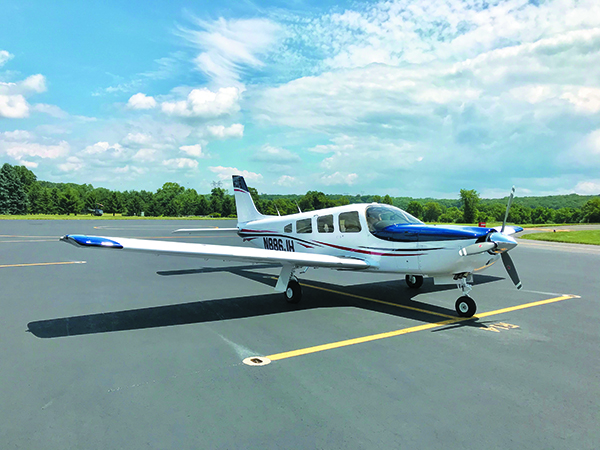
Piper PA-32R Lance/Saratoga SP

[IMGCAP(1)]

There's a lot to be said for airplanes that have a whole lot of room inside. Theyre comfortable and flexible, and usually have the power needed to provide good takeoff and climb performance when lightly loaded. These advantages come with a price, however. A big airframe means a big engine, and that means a big appetite for fuel. Often, it also means less-than-stellar cruise speeds.

Still, if the owners needs lean more towards hauling ability and roominess than getting to point B in a real hurry, a big airplane might be just the ticket. The aerial equivalent of a minivan, if you will.

This is the mission of the Piper PA-32 series. Like the PA-28 series, the PA-32s come...

There’s a lot to be said for airplanes that have a whole lot of room inside. Theyre comfortable and flexible, and usually have the power needed to provide good takeoff and climb performance when lightly loaded. These advantages come with a price, however. A big airframe means a big engine, and that means a big appetite for fuel. Often, it also means less-than-stellar cruise speeds.

Still, if the owners needs lean more towards hauling ability and roominess than getting to point B in a real hurry, a big airplane might be just the ticket. The aerial equivalent of a minivan, if you will.

This is the mission of the Piper PA-32 series. Like the PA-28 series, the PA-32s come in many varieties, with different powerplants, landing gear and even tail configurations.

In the 1950s and 1960s, when a pilot wanted an airplane with six seats, the usual choice was a twin. Inflation and rising fuel costs made big singles more and more attractive as time went on. These airplanes are compromises, and its possible to find a six-seater that will meet almost any mission profile, from straight utility (Cessna 206) to fast, high-flying business transport (Beech B36TC or Piper Malibu).

The PA-32R leans more towards the cross-country transport end of the spectrum, with retractable gear for some extra speed and turbocharging available to get up above some of the weather. Its not all that fast when compared to competing airplanes like the Beech A36 or Cessna 210, however-150 to 155 knots-but it certainly has its place.

History
In the early 1970s Piper suffered a setback in the form of a flood that destroyed much of its Pennsylvania plant. Among the casualties was the tooling for the Comanche, Pipers popular, but complex and labor-intensive six-seater.

The company decided to abandon the Comanche in favor of a new airplane derived from the fixed-gear PA-32 Cherokee Six. The company was already having success with the Seneca, a light twin derived from the same airframe, so it made sense to build on a familiar design. Not much needed to be done to the Cherokee Six: the PA-32 was already available with the 300 HP Lycoming IO-540, so essentially the only change was to fit a retractable landing gear. That meant a new engine mount and changes to the wing. Piper also modified the wing spar in the process, allowing a 200-pound boost in gross weight, to 3600. The new airplane was dubbed the PA-32R Lance and introduced to the public in 1976.

The powerplant was the 300HP Lycoming IO-540 K1G5D with a 2000-hour TBO in the normally aspirated airplanes and the TIO-540-S1AD with a TBO of 1800 hours in the later turbocharged models. (The first 140 Lances built had K1A5D engines, the only difference being in fuel pump design.) The D means that the engine has the infamous Bendix dual magneto system. The fuel system originally held 94 gallons in four tanks, later upped to 102 gallons.

The PA-32R borrows heavily from its siblings. The main landing gear is very much like the Seneca-logical, since the basic airframe is the same-and the nose gear resembles the Seneca and also the Arrow. The PA-32R also came with Pipers automatic extension system for the landing gear. The fuel system is also similar to the Senecas.

The Lance remained essentially unchanged for two years. In the late 1970s, though, someone at Piper decided that T-tails were a good idea. We believe it unlikely that the responsible parties were aerospace engineers, based on the aerodynamic qualities of the Piper T-tail singles in general. The Lance wasnt the only T-tailed Piper. This was also the period when the PA-38 Tomahawk was rolled out, and the T-tailed Arrow IV debuted. Piper combined the introduction of the T-tail with the addition of a turbocharged variant. These two aircraft, the Lance II (PA-32RT-300) and Turbo Lance II (-300T), were not very we’ll received. Though Piper ballyhooed the supposed advantages of the T-tail (smaller size and weight, reduced pitch changes with trim and flap application), the truth was that when the stabilator was moved up out of the propwash, the airplanes handling suffered. In particular, takeoff runs increased significantly since it took a good deal of speed for the stabilator to become effective, and when it did, the result was a pronounced pitch-up. Some complained of lack of rudder authority. The T-tailed Lances were also sensitive to trim settings. The T-tail was also a pain to preflight, especially in winter, when a ladder is required to remove snow from the stabilator.

When pilots found out about these traits, sales plummeted. In 1980, two years after the T-tails introduction, Piper saw the light and reverted to the original tail design. At the same time, the company applied the same wing upgrade that had already appeared in the PA-28 series. The Hershey Bar wing was replaced with a semi-tapered planform. Piper also simplified the designation of the entire PA-32 series, renaming the whole lot of them Saratogas. The airplanes that had been Cherokee Sixes were now called Saratoga, while the Lance became the Saratoga SP. As before, there were turbo versions available, designated by a T at the end of the model number.

The Saratoga SP lives on as the Saratoga II HP and the turbo is now dubbed the Saratoga II TC in the New Pipers lineup. Notable differences include a new, axisymmetric (round) low-drag cowling. Average price of a 1998 model is about $370,000: steep, but a new one starts at about $456,000, reasonably equipped.

Used values of the T-tail models have historically been lower than those of the conventional-tailed airplanes, which makes the T-tail a relative bargain in a six-place airplane. Owners of T-tails seem to like them. It should be noted that although T-tail owners without exception stand behind their airplanes and claim that the poor reputation is undeserved, the airplane nevertheless has documented performance differences from the otherwise identical straight tail version (more on this later).

Turbo differences
The turbocharged engines have AiResearch turbos with waste gates mechanically linked to the throttle controls. The pilot has to adjust the throttle to maintain manifold pressure during climb, and it is possible to overboost the engine if too much throttle is applied. (The MP gauge is inconveniently located in front of the pilots right knee, but there is an overboost warning light on the panels eyebrow.)

The Turbo Lance II has an unusual updraft engine-cooling system that takes air in through a low-mounted fish-mouth oval scoop, forces it up over the cylinders, then back down and out through cowl flaps. Owners say the system is ineffective and requires the use of extra fuel and step-climbs to avoid engine meltdown. The Turbo Saratoga SP has a more effective cooling system that replaces the cowl flaps with louvers mounted on top and on the bottom of the cowling. A popular mod is to add an intercooler.

Interior
Most find the interior of the PA-32R quite comfortable. The cabin is over ten feet long, and 3.5 feet high. Shoulder room for the front and center seats is four feet, and 3.5 feet for the back row. Most 32Rs have club seating, and there’s a big side door for the passengers, who need not clamber over a wing to enter the airplane. Its remarkably quiet, due in no small part to the presence of a nose baggage compartment located between the cabin and engine. The rear seats are easily removed for cargo, and some owners just leave the rear ones at home most of the time.

Because of the wide cabin, there’s plenty of room on the panel for any gadget one might want. Other than that, its pure Piper single. The fuel selector is a bit different from the familiar PA-28 sidewall-mounted pointer, being sensibly located on the center pedestal. One thing we don’t like is the sump-draining procedure. Not a simple matter of sticking a fuel tester in a quick drain, the procedure requires the pilot to first put a bucket under a nozzle located belly, then get back in and hold down a lever located under the right center-row seat while simultaneously switching tanks.

This gymnastic routine continues for a minimum of 18 seconds due to the length of the fuel lines, after which the pilot gets to go back outside, look in the bucket and try to figure out which tank the water came from.

Later PA-32s have some good crashworthiness features, including seats with S-shaped frames designed to progressively crush on impact and a thickly padded glareshield.

Load carrying
Typical of single-engine airplanes, the Lances and Saratoga SPs force the pilot to choose between filling the cabin and filling the tanks. Still, an airplane this size is very practical when it comes to hauling, because carrying four with baggage and full fuel is possible.

The turbo models are a bit more limited. With six FAA-standard people aboard, a PA-32R can carry enough fuel to fly 2.5 to 3.5 hours. The CG range is quite wide; but with only two people aboard, care must be taken to avoid exceeding the forward limit. There are two baggage compartments, both with a 100-pound capacity: the nose bay and a large one aft of the rear seats (compare this with the A36 Bonanza, which has a hat shelf and the narrow slot between the front and center seats). As mentioned earlier, its easy to remove the seats and convert a Lance or SP into a cavernous freighter. One of our favorite marketing photos shows a Cherokee Six (same fuselage) being loaded with, believe it or not, a piano.

Performance/handling
Large airplanes tend to have rather heavy controls, and the PA-32R is no exception. Of the various configurations, the Saratogas are the best, though the pitch forces are a bit stiff. The tradeoff, of course, is stability. PA-32s make good instrument platforms.

As noted, the T-tailed Lance II has the least desirable handling characteristics of the lot. Despite this, T-tail owners say that the reputation is undeserved, its just that the T-tail version takes some getting used to. They also say that the key to avoiding the T-tails squirelly-handling reputation is to put 50 pounds or so in the aft baggage compartment to bring the CG aft into the center of the range.

While 150 knots isn’t all that bad, when compared to other big retractables the PA-32Rs are rather slow. A36 Bonanzas and Cessna 210s walk away from the 32R, being about ten knots faster. At 75 percent power, a Lance cruises at 158 knots while burning 18 GPH. The Saratoga SP isn’t faster but improvements in induction air cooling allow their engines to be leaned to peak EGT, saving a couple of gallons an hour. The turbocharged airplanes can cruise at 177 knots while burning nearly 20 GPH up high, but at lower altitudes theyre only a couple of knots faster on the same fuel.Because of the T-tail, the Lance II has a significantly longer ground roll than the conventional-tail models. The books indicates a 1,650-foot ground roll under standard conditions and notes that the roll will be one-quarter longer if the airplane is loaded toward the forward CG limit. Ground rolls for the Lance and SP are posted as 1,380 and 1,200 feet, respectively. Initial rate of climb is a tad over 1,000 FPM for all models.

Maintenance
Several Turbo Lance II owners complained about their hot-running engines. (One said his mill once toasted the forward baggage compartment sufficiently to melt plastic diaper bags that had been stowed there.) However, as noted below, there are modifications designed to eliminate the heat problem.

Among recurrent ADs are: 77-12-06, which requires the shanks of Hartzell Y-blade propellers to be inspected and cold-rolled every 2,000 hours or five years (90-2-23 also calls for a one-time inspection and possible replacement of the hub, and 94-17-13 requires recurrent inspection of hub grease fittings); 78-23-01, which requires the fuel drain lever doors in naturally aspirated Lances to be checked every 100 hours until theyre replaced; 93-5-22, which addresses the fuel injector lines on the TIO-540-S1AD engine; 95-26-13, which requires recurrent inspection of oil cooler hoses.

A rash of engine fires in Piper Turbo Lances and Saratogas prompted an Airworthiness Directive requiring portions of their exhaust systems to be periodically inspected and eventually replaced. The AD targets the fittings on a 90-degree elbow between exhaust ports and turbocharger in the Lycoming TIO-540-S1AD engine that powers the big Piper singles. In 1988, NTSB issued a warning about the fittings when it concluded its investigation of a Turbo Lance that crashed a year earlier during an attempted emergency landing in Lincoln, Nebraska.

The Safety Board found that the elbow fitting in the Lance had separated, allowing hot exhaust gases to flow into the engine compartment and start a fire. The board noted the gasket and flange on the fitting had been misaligned during maintenance on the exhaust system about a month before the accident occurred.

FAA responded with an AD (89-12-4) requiring periodic inspections of the exhaust elbows and fittings, and replacement with modified components developed by Lycoming. The FAA estimated that compliance would cost $858 per engine.

However, later evidence of a string of exhaust system-related accidents and incidents involving both the Turbo Lance II and the Turbo Saratoga SP prompted the NTSB to call for a more stringent AD. Four such crashes occurred in 1990 alone. The Safety Board, noting that some of the crashed aircraft had received new parts called for by the AD, declared the AD was not an effective solution and called for a revision mandating repetitive inspections whether or not new parts are installed. It also asked that Lycoming develop new exhaust parts that would beat the cracking problem.

Landing gear problems are prominent in SDR reports, accounting for about a quarter of the total. Chief among them were broken nose gear actuators and cracked or broken nose gear trunnions. Other frequently cited problems were cracked engine mounts, exhaust system leaks and separations, broken magnetos and loose stabilator attachments.

Modifications
Several companies have developed means to alleviate the heat problems that plague the Turbo Lance II. Aircraft Modifications, Inc. has taken over the sale of intercooler and cooling system mods developed by Turboplus. Air Parts offers conversion to the Turbo Saratoga SP engine-cooling and induction system changes. Aerodynamic clean-up kits are available from a number of companies, including: General Aviation Corp, Knots 2 U, and Laminar Flow Systems.

Precise Flight offers speed brakes, a standby vacuum system and a pulse-light anti-collision system. An auxiliary vacuum pump kit is available from Parker Hannifin Corp.

Owners group
About 4,000 owners of PA-28 and -32 series airplanes belong to the Cherokee Pilots Assn., (813) 855-4996. The group holds an annual convention and regional fly-ins and publishes a monthly magazine focusing on maintenance and operational information.

Owner Comments
I purchased my PA 32R normally aspirated T-tail Lance in 1981. Since that time, I have flown it approximately 4500 hours. After having some initial problems with the single/dual/single mag, the aircraft has been very reliable. It is an honest four-place, full fuel and bags for the weekend cross-country airplane.

The weakest part of the airplane is the alternator. The alternator mounting bracket must have been designed during Happy Hour on a Friday afternoon. It is not unusual to find the bracket broken or the mounting nut backed off every 100 flying hours or so. This causes a great deal of aggravation, and one must always be prepared for an alternator failure. I fly with a hand-held navcom and a back-up hand-held GPS, so an alternator failure is no big deal. I learned to carry these two accessory items after a failure in IMC.

Last year I installed a factory-overhauled engine. After some initial warranty problems, the engine has operated flawlessly. I have great confidence in the IO-540, even with the single/dual/single mag. I have the mag checked every 100 hours for peace of mind.

True cost per hour is approximately $100 to $120. This includes allowance for engine and prop reserves, avionics repairs, routine maintenance, and paint.

Insurance consisting of high liability limits and actual hull value costs about $1200 per year. Anyone having at least 250 hours of high performance time should have no trouble finding insurance.

The T-tail Lance still has an undeserved reputation as being rather squirrelly to handle. It is no more difficult to fly than any other high performance single. You simply have to take a couple of hours to get used to it. The T-tail does have the disadvantage of making for long ground rolls. A flight out of Walkers Cay can be a heart-thumping experience!

Overall, I am very happy with the airplane. Ive had it so long now that it fits like an old shoe. Its the best deal in the six-seat, high performance single engine market. I have removed the two rear seats, and my children love to sit in the back on long flights because they can actually lay down or otherwise stretch out. The airplane is a good instrument platform, and my wife no longer chews her fingernails while flying in clouds.

-Harry D. Brooks
Atlanta, Ga.


I have owned a 1978 PA32RT-300 since 1980. I have no mods, as I am not convinced of their effectiveness, though I have spent a lot on maintaining the airplane.

The Lance excels in payload, room and a wide CG range. Speed at 65 percent is in the 140 knot range, burning a very consistent 15 GPH. With full fuel, the airplane has about six hours of endurance. Given that biological endurance is about 3.5 hours, IFR alternates are no problem. Its very stable in turbulence, although passengers in the back do occasionally complain about fishtailing. It is also excellent in gusty crosswinds, despite the T-tails reputation.

I have yet to observe any problem with flying the T-tail. You have to yank the control wheel at takeoff because of the forward CG and make sure to flare adequately on landing or the nose will slam down. My mechanic just replaced the nosewheel tire this year, not because of abuse, but simply due to age cracking.

Because it is a heavy single, it does take some strength to get it to do what you want, but regular use of the trim wheel takes care of the majority of control issues. The Lance is not a bush plane, so short fields are out.

The roominess is useful on long trips when you have a lot to carry. The forward baggage compartment is limited. First of all, its easy to bend the door by accident. Also, though its convenient, you cant put much up there with two in the front and full fuel, or itll put you at the forward CG limit. I rarely need that room anyway. Ive had no problem filling the plane with stuff, but have had difficulty getting it all into my Subaru station wagon at the end of the trip.

It costs about $16,000 to $18,000 a year to run the airplane. Thats $85 a month for tiedown, $1500 for insurance, $3000 for gas and the rest for maintenance and restoration. I suppose Ive replaced or refurbished most everything in the plane, but then you cant pull over if you have a problem. I did an IRAN at Mattituck after eight years and 800 hours after the major, something about the valve guides. Of course, once they opened the engine they found other things, too. I guess you pay for cold starts and peace of mind.

The heating system is very good for the front passengers (the pilots right leg doesnt cook like in the Warrior), but is less effective for those in back. Extra blankets cure that. There are overhead and floor vents, all of which are very effective. No need for air conditioning once you get into the air. The small windows limit the pilots view, but help in keeping the sun out. Pilots and owners seem to like club seating, but passengers don’t like facing backwards. Expect them to sit in the rear seats, facing front. (its a good thing the Lance has that long nose for balance).

Control and instrument placement seems very comfortable. I havent had trouble monitoring the engine and vacuum instruments, even if they arent in the best locations. The annunciator panel is we’ll placed, but only gives the minimum required information. By the way, I like the automatic gear extension system, even though Ive never had to use it. You need to extend the wheels to slow down anyway. While were on the topic of memory aids, there’s no problem remembering to switch tanks. With the two outboard tanks draining first, after about 30 minutes it begins to take a lot of muscle to keep the wings level. So tanks get switched every half-hour no matter what.

For the money, its hard to think of a better plane for my needs. I especially have to thank those who have given the T-tail bad press because I could not have paid the Saratoga purchase price (it must have been the difficulty clearing snow from the T-tail that got to people). Obviously a little more speed would be nice, but I rarely fly more than two hours at a time, so the few minutes saved hardly seem worth the price.

-Dennis Vaccaro
Wellesley, Mass.


I fly a 1978 turbo T-tailed Lance. I love the plane. Its a heavy hauler, stable, a great IFR airplane and the turbo fits my frequent trips to 6000-foot-plus airports.

After I purchased the Lance it became apparent that the turbo is a different breed of cat. The old leaning and power setting rules did not apply and could cause engine damage. I had to know what was going on in my engine and two temperature probes werent enough.

I had an Insight Engine Analyzer installed. It was like hooking state-of-the-art technology up to stone-age technology. The investment has paid for itself. It seems that one of the most important factors in long engine life is cylinder head temperature. The factory CHT probe is not on the hottest cylinder. Without a multiple-probe CHT, its nearly impossible to keep the CHTs where theyre supposed to be on a non-intercooled turbo. Engine fuel/power settings are now done with a combination of CHT and turbine inlet temperature (TIT). Forget the other rules about leaning.

At overhaul I had a Turbo Plus intercooler installed. I can now control my CHTs on climb out. I seldom fly below 10000 feet, and often between 14000 and 16000. Without the intercooler the CHT would get up over 500 degrees. With the intercooler I can keep the temps in the low 400s.

Speed before the intercooler at 10000 was between 150 and 155 KTAS. After the intercooler its 155-160 KTAS. With just me on board I cruise at 165. Fuel burn did not improve that much with the intercooler. It would if I wanted it to but I like to get where Im going as soon as possible without burning something up. My rule of thumb is 12 GPH on climb and 17 GPH in cruise. The fuel usage comes with the turbo. Its a given, and if you don’t like it, don’t fly one.

The new cowl that came with the intercooler altered the descent performance. It went from high green way up into the yellow arc. Now when I see a slam-dunk approach coming up I slow to 130 KIAS and lower the gear. This allows a rapid descent without excessive speed and I can control the CHT.

A few words about the T tail. The rumors about it were, I believe, started by some Cessna pilots griping about not being able to feel the prop wash over the stabilator. These pilots keep pulling back until they reach rotation speed, then naturally over-rotate. You fly this tail just like you should fly any plane: you accelerate to rotation speed, then rotate. You fly it off the ground, and fly it to the ground. Another pilot who flies my Lance has several thousand hours in Lance straight tails. He says he cannot tell any difference that is of any importance. Neither can I.

To the new Lance pilot the airplane will seem very heavy. After you learn to trim, it is a pleasure to fly. The empty Lance, with just the pilot, is very nose-heavy and requires a lot of trim on landing. Under these conditions I put 50-70 pounds in the rear baggage area. With this aft weight, landing is nearly trim-free with one notch of flaps. High altitude takeoffs require a check of density altitude. The fat-wing Lance can be a ground hog, so run the numbers.

The interior of the Lance is big, comfortable and very nice for the passengers and pilot. I am at or near gross a lot of the time and flying with the CG back at the aft limit is no problem. It just takes a little longer to reach altitude.

-Lloyd K. Parrish Jr.
Wichita, Kan.


We bought a 1979 Lance II in 1991 for less than $46,000. The airplane had full Collins IFR plus coupled autopilot, Stormscope, HSI, loran and club seating. It was drastically undervalued because of an undeserved reputation as a squirelly-flying groundhog. Not true! The stabilator needs a few more knots to be effective; otherwise, it flies almost exactly like a straight tail. Laces are heavy load haulers and rock-solid instrument platforms with decent speed, relatively low maintenance, bullet-proof engines and enormous cabins. Our T-tails low price means all that capability for thousands less than any other big single.

With one or two people in front and no load in back, the CG is at the forward limit, which makes for truck-like handling on takeoff and landing. A 50-pound weight in the aft baggage compartment moves the CG to the middle of the envelope. This is the secret that tames handling idiosyncrasies. Keep the airplane on the ground past 70 knots and the takeoff is solid and sure. Landings are easy with some weight in the back and 90 knots in the flare.

Though I routinely see speeds in the low 150s on the loran, I plan for 16 GPH and 145 knots block-to-block. The 79 Lance has one 47 gallon tank in each wing, so fuel management is simple. Over 5 hours of fuel makes for legs as long as you and your bladder can stand. Full tanks allow 823 pounds of people and baggage, or fuel for three hours can be carried with half a ton of payload. Ive never come up with a loading arrangement that put the CG out of limits.

I think of owning and operating costs as separate categories. Ownership costs, including hangar, insurance and annual total about $5000 a year. Flying it runs $75 per hour, including fuel, oil, maintenance and engine reserve. The biggest maintenance headache has been the nosegear with two repairs and one AD, but fragile nosegear is apparently common to all the big Piper singles. Its been trouble-free since putting the weight in the aft baggage compartment.

I love the looks of the airplane. Except for Bonanzas, all of the other six-place singles are pretty pedestrian looking…solid and capable, but painfully plain. The T-tail Lance is just as practical but with that long, low nose and high, sweeping tail, its also pretty sexy. Easily the best looking single engine airplane Piper has built since the Comanche.

-William R. Amick
Lexington, S.C.


Also With This Article
Click here to view charts for Resale Values, Payload Compared and Prices Compared.
Click here to view the Piper Lance features guide.