










Tempted by Taildraggers? Here Are 5 Standouts

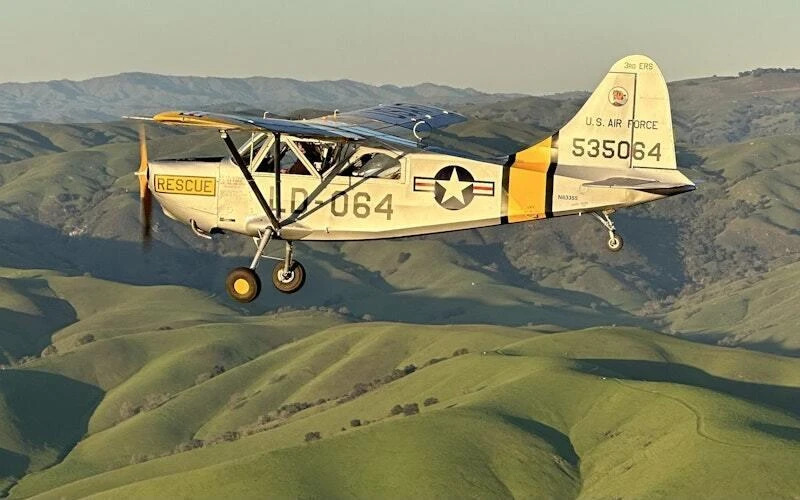
Stinson L-5G Sentinel is among the interesting taildraggers on the market. [Credit: Jan Johnson]

Recently, while gardening on a clear, sunny day, I heard the throb of an aircraft engine in the distance. As the sound grew clearer I suspected it came from an older model, maybe powered by a vintage Continental, 90 hp or less.

The engine’s tone was relaxed, as if just cruising along at relatively low power, in no hurry. Soon a Cessna 140 appeared over a nearby ridge and flew overhead. It looked great with the sun shining on its cream-colored paint with dark blue trim. As usual I started thinking about how much fun it would be to own an airplane like that and travel in it regularly, low and slow enough to truly take in the surrounding splendor. I know I am not alone.

Tailwheel Appeal

Tailwheels are having more than a moment in general aviation. After seemingly heading toward extinction in the decades after the mid-1950s introduction of the tricycle-year Cessna 172, aircraft in the taildragger configuration have become more common sights on airport ramps.

The advent of the light sport category and growth of experimental aviation played roles in reviving interest in tailwheel aircraft over time. The recent boom in backcountry flying and STOL competition also helped raise the tailwheel’s profile among pilots and in popular culture.

Overall, though, I believe the strongest motivating factor bringing private pilots into the taildragger community is the sense of joy and satisfaction that comes with the successful completion of challenging tasks.

In general, pilots do not necessarily take the easiest route toward destinations and other goals. Operating a tailwheel airplane comes with a higher degree of difficulty compared with tricycle gear models, so the attraction is clear. I say “operating” instead of “flying” because tailwheel airplanes differ little from other types in flight. On the ground is where they show their true nature.

Skills Worth Learning

Despite the many tales we have heard of crosswind mayhem, ground loops, runway excursions, and damaged landing gear, taildraggers are not unreasonably difficult to handle. Indeed, they demand frequent practice and heightened awareness that improve overall pilot skill—and enjoyment. Only after receiving a tailwheel endorsement years ago did I learn to truly relish landings. 

The good news is that there are a lot of affordable tailwheel airplanes on the market. The five examples that follow, drawn from Firecrown Media’s Aircraft For Sale listings, cover a range of styles, vintages, interior layouts, and personalities, suggesting there might be something for everyone.

Aeronca Champion [Credit: Samuel Rogers]

1946 Aeronca 7AC Champion, $38,000

A perennial rival to the classic Piper J-3 Cub, the Aeronca Champion has a reputation as a friendlier, easier-to-fly aircraft than the Cub, largely because its visibility on the ground is better in part because a solo pilot sits in the front seat instead of the rear, as in the J-3. Having flown the Champ and the Cub, I would recommend the Champ to taller pilots, who are sure to appreciate its roomier cabin. It is worth mentioning that the Champ is the immediate predecessor to the Citabria, which also remains a popular taildragger today.

Piper J-3 Cub [Credit: Rich D]

1946 Piper J-3 Cub, $45,000

Cub enthusiasts—and there are many—will tell you that soloing from the rear seat has its advantages, including extra space to stretch your legs. Either way, the J-3 Cub outranks other tailwheel trainers of its era due to its greater production volume and overall recognition. Many people who know little about aviation can recognize the Cub. Fans also claim that nothing else flies like a J-3 Cub. They have a good case, as the J-3’s long-wing seems to generate an impossible amount of lift from minimal forward motion. I think it is the king of “low and slow,” which is what many pilots are looking for when buying a vintage taildragger.

Luscombe 8E [Credit: Seitz Aviation]

1948 Luscombe 8E, $27,500

Unlike some others in this group, and most of its contemporaries, the Luscombe 8E has an all-metal structure that sets it apart from the fabric-covered “rag-and-tube” airplanes that were popular for decades before and after World War II. Its pioneering metal construction is a claim to fame for the Luscombe, but the aircraft has other features that many pilots prefer, including the rare combination of side-by-side seating and control sticks instead of yokes. The Luscombe is also a handsome airplane whose metal skin gives it a sleek, rounded look that is remarkably modern for its age. Pilots also tout the Luscombe’s nimble, engaging handling that, they say, makes it more fun to fly than some less-responsive vintage aircraft.  

Taylorcraft F-19 Sportsman [Credit: Seitz Aviation]

1979 Taylorcraft F-19 Sportsman, $48,500

Not all fabric-covered, two-seat tailwheel airplanes date back to World War II. Some, like the Taylorcraft F-19, were built during the 1970s by Taylorcraft Aviation, which took over where Taylor Brothers Aviation and successor Taylorcraft left off in the late 1940s and 1950s. The F-19 was an updated version of the Taylorcraft B first flown in the 1930s. While its airframe was essentially the same as the older model’s, the F-19 had a Continental O-200 engine generating 100 hp under its cowling. While this engine seems modest by today’s standards, it turned the lightweight Taylorcraft into a hotrod with sparkling performance compared with earlier models with 50, 65, and 85 hp. 

Cessna 172H tailwheel conversion [Credit: Laverne Attfield]

1967 Cessna 172H Skyhawk, $75,000

This might not be the taildragger most aircraft shoppers have in mind, but there are many Cessna 172s that have been converted to tailwheel configuration and they occasionally surface on the used market. This is an interesting development because the 172 as we know it, with its famously easy-handling tricycle gear, was originally conceived as a tailwheel model called the 170C. Cessna designed it as a modernized evolution of the earlier 170B. While it is safe to say the 172’s success stemmed from its tricycle gear, it also seems that a conversion like this one might be the most approachable taildragger, especially for pilots who trained in standard 172s.

Jonathan Welsh

Jonathan Welsh is a private pilot and lifelong aviation enthusiast who has been a reporter, writer and columnist for 35 years. His career includes stints with the Wall Street Journal, Flying Magazine and the Aircraft Owners and Pilots Association. He recently returned to Firecrown to lead Aviation Consumer.