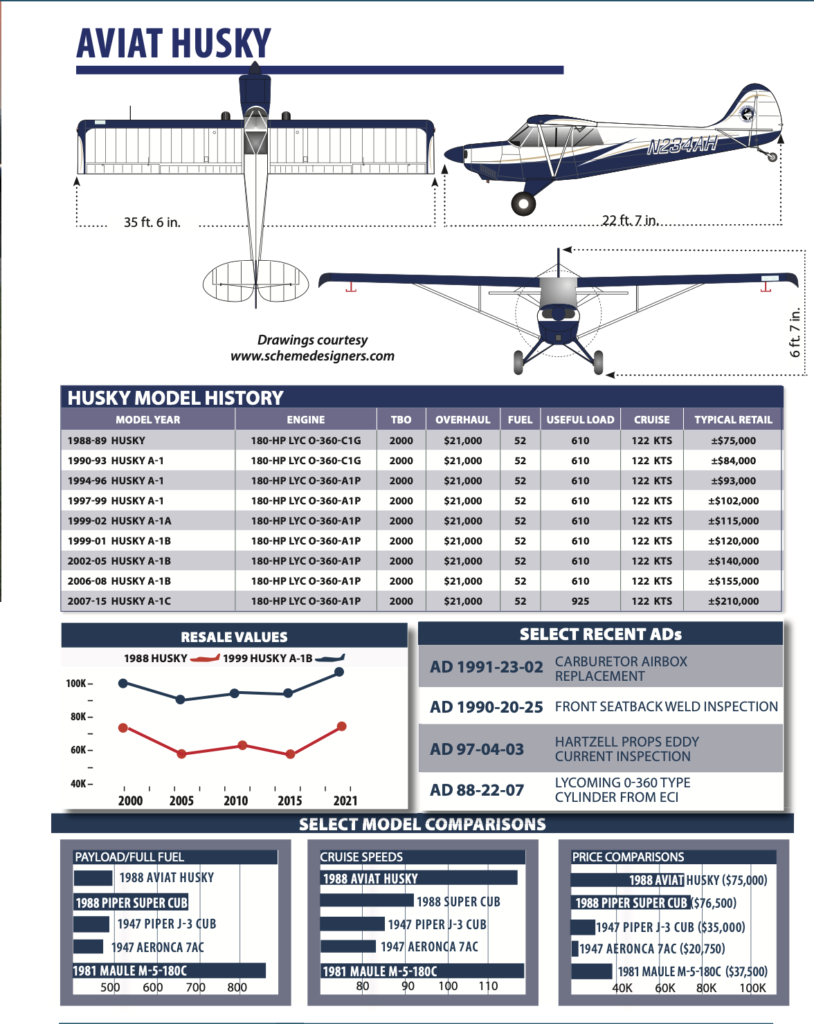










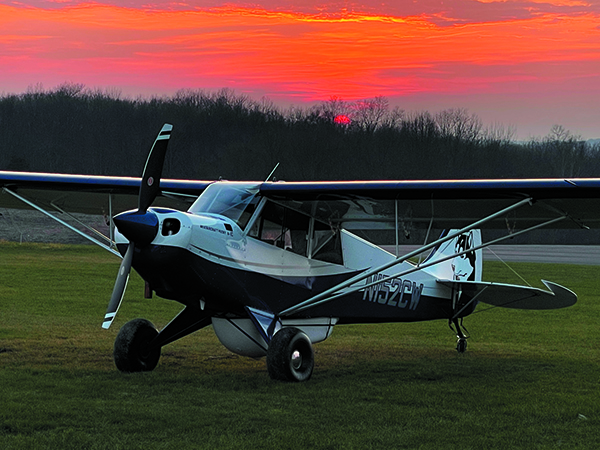
Aviat Husky

A thoroughly modernized rag-and-tube utility aircraft that shines on floats or wheels.

The term working airplane has a specific connotation for most pilots and owners. A working airplane is one that earns money hauling people and stuff, often without regard to creature comfort or fancy amenities. A DeHavilland Beaver is a working airplane. So is a Piper Super Cub. Add one more: the Aviat Husky.

The Husky meets all the criteria for a working or bush airplane, in which a premium is placed on short-field capability and ruggedness, at the expense of speed, creature comfort and snappy handling. These airplanes are built to be routinely operated in environments considered hostile: short, rough strips and low-level flight typically required by pilots who do pipeline patrol, spot fish or traffic or do ranching from the air.

In a sense, the Husky is a bit of a surprising anachronism. Its surprising because it established itself as a player in the utility airplane field long after the likes of the Super Cub, Maule and Champions had carved out enduring niches. Its an anachronism because like those other aircraft, the Husky is a throwback in a world of slick white plastic airplanes with dazzling electronics.

The Aviat Husky (formerly Christen Husky) is a well-built, good-performing airplane meant to compete against these bush veterans. Given that it was designed and certificated in the moribund 1980s, it has done we’ll in its market niche. One reason for that is that Husky offers some features that differentiate it from its competition, which we’ll detail later on. One significant aspect of the airplane that doesnt show is its certification: it is one of the few designs built to comply with FAR Part 23, rather than CAR 3. It may be rag-and-tube but its a thoroughly modern rag-and-tube airplane.

History
Aviat, Inc. started life as Christen Industries in the early 1970s, making specialized accessories for aerobatic airplanes. Notable products included inverted oil systems, fuel pumps and restraint systems which developed a small but loyal following in the aerobatic world.

Christens products have been of uniformly high quality, so much so that the inverted oil system was purchased by Lycoming and offered as a factory part. Christen is still in this business, operating out of a plant in Afton, Wyoming, where Aviat also builds the Husky and other aircraft.

Christen branched out into the homebuilt market with the Christen Eagle, a highly capable aerobatic biplane in the mold of the Pitts Special. The Eagle was significant in many ways, not least of which for its highly professional, detail-oriented packaging complete with an extensive, step-by-step manual. This approach to building airplanes-packaging them as extensive kits-is now all but standard in the industry. But when Christen introduced the idea for its products, homebuilding was generally a matter of buying plans and figuring it out yourself.

In 1982, Frank Christensen made a shrewd business decision and purchased the type certificates for the Pitts, along with the factory, thus effectively cornering the market for aerobatic biplanes. Since then, several potent designs have come forth from builders like Extra and Sukhoi, eclipsing the Pitts as a competitive airplane. But at the time, the Pitts was the star of the show and one rarely sees an airshow where at least one doesnt perform. The Pitts has remained viable, and continues in production as does the Eagle kit.

Christensen had a factory, a workforce skilled in building tube-and-fabric airplanes, and a family of solid, proven products. Still, the market for aerobatic airplanes is a small one and Christensen saw opportunity in the bush market.

At the time Christensen began the Husky project, the only competitor being manufactured was the Maule, and precious few of those were rolling out the doors. Thats still the case today. Christensen tried to buy the rights to the Super Cub, the Champion line and the Interstate/Arctic Tern, but considered the asking prices (including the assumption of product liability for previously produced airplanes) unrealistic.

The answer? Simple. Build an all-new airplane. He and E. H. Herb Andersen, Jr. determined that they could develop and certify their own design at lower cost and in less time than would be required in taking on an existing product, a decision which then and now goes against the flow of typical thinking in the GA aircraft world. This really says something about the management of Christen. The costs of development and certification have stopped many would-be aircraft manufacturers dead in their tracks but Christensen and his team forged ahead in what was then near the bottom of the valley in a sharp GA sales drop.

Also revealing is the startlingly short time it took to bring the Husky to market. The A-1 Husky was designed and proved in 18 months from initial design work to certification, which was obtained in July 1987. The prototype was flying in just seven months, which still stands as somewhat of a record in the GA industry. Diamond surprised the world with its fast-track certification of the DA40 Star but it took much longer than seven months to get a prototype in the air.

Production of the Husky was and is a low-volume affair. Only 68 were produced the first year, and about 30 per year since. The A-1 was joined by the A-1B in 1999, which features a 110-pound gross weight boost. The company also updated the venerable Pitts S-2B into the S-2C and is still building Huskies and Eagles.

Simple Design
Christensen returned to the basics for the new airplane. Principal design objectives were good short- and rough-field performance; ruggedness, accessibility and serviceability to simplify support in primitive conditions; outstanding slow-speed handling coupled with docile stall characteristics; good endurance and reasonable cruise capability. The end product is a quite conventional-looking two-seat, tandem tail dragger that, frankly, looks just like a Super Cub. Thats not a bad thing: the Super Cub has remained popular for decades, for good reason.

In terms of materials and structure, the Husky is very straightforward. The fuselage is welded 4130 chrome/moly tubular steel with a full-depth aft fuselage for greater strength. The aircraft is powered by a Lycoming O-360-C1G (1988 to 1922 models) or an O-360-A1P (later models) rated at 180 HP mated to a Hartzell constant-speed propeller. The engine cowl and forward fuselage are skinned with aluminum. The aft fuselage and flying surfaces are covered with polyester; the seams are taped with cotton and fastened to the structure by oversized pop rivets.

One advantage designers of new airplanes have is the ability to examine similar designs and correct any shortcomings. Christensen did a number of things to avoid some of the problems that had cropped up in other utility airplanes. Rather than using rot-prone wood spars, as Champion had, the wings are fabricated with dual aluminum spars and aluminum ribs. They are supported by fore and aft struts. These were designed to eliminate corrosion and other problems that have been encountered in a large number of strut-braced airplanes, such as certain Pipers and older Champions.

Airplanes designed in the 1950s and 1960s are often difficult to work on because no one thought much about the poor mechanics who had to keep them running. Not so the Husky: much of the airplane can be taken apart quickly for maintenance.

For instance, the nose bowl is split to permit fast removal without touching the propeller; the cowl has large doors on either side for easy engine compartment access (good for preflights); the fuselage is metal-clad to the aft end of the cabin and is made up of several removable panels. The aft fuselage, which includes the battery bay, is accessible through a large panel on the port side. (A baggage door was optional, so not all have one.) The gear uses reliable, proven design, with shock absorption provided by bungees mounted inside the fuselage to reduce drag. The brakes are good and the track is wide, which helps ground handling, something most taildraggers arent very good at. Narrow wheel tracks don’t help stave off the major bugaboo of traildraggers: a tendency to groundloop when the wind isn’t straight down the runway.

The Husky is approved for both retractable and wheel replacement skis. The latter are available in widths of from 8 to 16 inches. Its also approved for banner or glider tow hook installation and on EDO 89-2000 floats. Other manufacturers are working on floats as well. Large, 24-inch-diameter tundra tires for serious bush work are available.

To simplify manufacturing and provide inventory control, all A-1s are built with float attach fittings installed. The only additions required for float operations are lifting rings and a ventral fin. For the same reason, dual-puck brakes-required for the tundra tires-are standard on all aircraft. These brakes are good and offer plenty of stopping power, something that cant generally be said of other taildraggers in this class.

Having come out of the box just two decades ago, the Husky benefits from what went before it and the company has wisely made incremental improvements as the aircraft has matured, many of these the result of real-life service experience. To its credit, the company has designed all improvements to be field-retrofittable to existing airplanes. Since early units can be updated by later improvements, there is no better or worse model year, something we think argues strongly in the Huskys favor.

The key for any prospective buyer is to ensure that all modifications and any mandated changes have been performed, and to be careful of overall condition. Aviat is helpful in providing this information and much of it can be found on the companys Web site at www.aviataircraft.com.

Handling, Performance
A great deal of aerodynamic attention has been paid to the way the airplane handles and performance. For instance, the Fowler-type slotted flaps are hinged to move aft as they are deployed for high lift. Even at full 30-degree deflection, they provide more lift than drag, making for good short-field performance. The ailerons, as well, compensate for the real estate taken for the flaps. They are symmetrical in section and the leading edge has a larger radius than the wing trailing edge it abuts to maintain attached air flow during low-speed and high angle of attack flight.

Counterbalanced aerodynamic spades hang from the bottom of the aileron leading edge. The spades act to boost aerodynamic authority of the ailerons and to reduce pilot input forces. These devices, common on aerobatic airplanes but unique on utility airplanes, were borrowed directly from the four-aileron Pitts. The design permits full roll authority we’ll into the stall.

Handling is typical for this class of airplane, which is to say that it likes lots of rudder input and its not overly twitchy. Also, transitioning pilots are at risk of groundloops until they have some taildragger experience and this shows up in higher insurance rates for those without the necessary experience.

Wing loading is light at 9.8 pounds/square foot, so the ride in turbulence can be bumpy. Its an inevitable trade-off for STOL performance. Control harmony is fairly good, which is sadly uncommon in this class of airplane.

Rudder and aileron forces are linear in relation to airspeed; in other words, the controls don’t stiffen up much at higher speeds. Because of the bungee trim system, elevator deflection forces are fairly high, even at low speed. In fact, it trims like a heavy airplane-a little bit at a time, and almost always in response to any power or attitude change.

Rudder authority is good right down through low-speed flight and the aileron spades do wonders to maintain control at low speeds.

For a lightly wing-loaded airplane, the Husky is quite well-mannered in cruise. Properly trimmed, it does not require a lot of attention to maintain course. This makes it a better instrument platform than many of its peers and some owners fly these airplanes in challenging IFR. However, thats not the Huskys primary mission.

The big virtue of the Husky is that even during slow flight, properly configured, the attitude of the aircraft is flat; it is flying on the wing rather than hanging on the prop. This is a big safety advantage for spotting, patrol and other low-altitude, low-speed operations, since at these speeds the Husky is not flying on the edge of a stall and the airplane very largely takes care of itself so that the pilot can safely look elsewhere. Power-on stall speed is only 33 MPH with flaps.

Tailwheel steering authority on the Husky is good, which makes ground handling simple except in high winds. A touch of differential brake swings the aircraft around briskly. The brakes are powerful. Even at low taxi speeds, over enthusiastic application will bring the tail off the ground (and too much can mean damage to that very expensive constant-speed propeller).

Ground handling, by the way, is aided by convenient handles on both the aft fuselage and elevator. These give line personnel little excuse to mishandle the airplane when moving it around on the ramp.

The Husky is a forgiving, although mildly demanding, straightforward airplane to fly. As such, it would be a good trainer or recurrent reminder for experienced pilots. Bad handling or bad speed control will be rewarded with loss of control. At least recovery can be made quickly.

Thanks to the good aileron and rudder authority, combined with the Fowler flaps, the pilot really has to provoke the Husky to get it to bite. Anything resembling proper stall technique results in very mild stalls and near-instant recovery. Spins are virtually impossible to get into with flaps deployed.

While the Husky is nearly spin-proof with full flaps, it will reward uncoordinated control input with a snap over the top in power-on stalls in the clean configuration. It will not spin, but the resultant spiral or corkscrew maneuver is more alarming.

Speed builds very quickly during this exercise and must be attended to immediately.

However, almost any reaction leads to recovery. Also, during cruise in turbulent air, speed control is important at most altitudes since indicated airspeed is fairly close to the Vno of 103 KIAS (Vne is 132 KIAS).

As already mentioned, slow flight is the Huskys strong suit. It was not designed as a cross-country hauler. But the airplane also has a reasonable cruise speed, quite competitive with modern light aircraft such as the Cherokee, Skyhawk, Skylane and Tobago.

Cruise at 55 percent power is 113 knots; at 75 percent, 121. Top speed at sea level is 126 knots. Listed fuel consumption at 55 percent is 7.7 GPH; at 75 percent it is 9.3 GPH. Still-air range at 55 percent is 695 NM. With power set for an airspeed of 96 KIAS, endurance is seven hours, making the Husky one of the longer legged airplanes in this class.

STOL Ops
After some practice, you can operate the Husky from a football field. Factory numbers for ground runs at sea level are: maximum performance takeoff, 150 feet; landing 250 feet. Even in high density altitude conditions (for instance, at 7000 to 8000 feet) and at full gross weight, the Huskys performance is impressive.

Takeoff distance with full flaps is 200 feet, with landings in 350 feet. Figure about 500 feet total over an obstacle. Even at high density altitude, takeoff speed is reached quickly and the effective brakes help make short stops easier. The best technique for assuring the airplane will stay on the ground is to retract the flaps during the brief ground run.

Even max performance takeoffs result in continuous climb. There is no sagging-off even while flaps are retracted. It is a credit to the airplane that once a pilot is familiar with it, such performance does not require superior technique. One owner noted that its not necessary to lift the tail during takeoffs: the airplane simply doesnt need it. No-flap takeoffs require more ground run, naturally, but taking off in the three-point attitude produces a short run and healthy climbout (1500 FPM at sea level, at best rate of climb speed of 63 knots).

During approach, precise control of airspeed and vertical speed are important. The correct combination of alignment, sink, airspeed and attitude is elusive at first, but once mastered results in truly impressive STOL performance. In the hands of a qualified pilot, the Husky can be a good neighbor even at busy airports with a mix of traffic. Recommended approach speeds are very low (52 KIAS), which would give your average Westchester County controller fits. But it can be flown at an indicated 100 knots right to the threshold and slowed to proper touchdown speed easily.

Aside from managing speed and sink rate control, the biggest trick to landing the Husky is to ensure that the trim is full aft. This requires a high effort if the proper speed is not achieved first, because of the nature of the bungee trim system. This is most difficult in solo flight, because of the forward CG bias of the airplane. With the trim full back, there is still an inch or so of elevator travel in the stick and it takes some effort to get the tailwheel-low attitude that makes for a satisfactory landing.

The best recovery technique for bounced, poorly aligned or otherwise botched approaches, at least initially, is to add power and go around. The Husky will bounce mightily and can easily get sideways-not a good way to re-contact the ground. With full power, the airplane leaps back into the air; with just a touch, it still flies.

The Husky performs very we’ll on floats. Part of this is attributed to close attention to the relative angle of incidence between the floats and the wing. Cruise at 5000 feet with floats is a respectable 106 knots. It will get off the water in approximately 500 feet in zero wind conditions.

Cockpit, Comfort
Getting into the airplane is hard to do elegantly, but then if youre not willing to mount up properly, you shouldnt be flying an airplane like this. Rather than sliding in like a car, the pilot and passenger hoist themselves aboard.

For a conventional-gear airplane, forward visibility is very good for pilots of average to tall height despite the large, high wing (shorter pilots can adjust the view by using thicker seat cushions). There’s a transom light overhead to help in spotting traffic in turns.

Long missions in other light utility aircraft can be fatiguing, both because of the constant need to keep the airplane right side up during low-speed operation and also because control forces-especially roll control-are high and therefore fatiguing. The Husky ranks favorably in this category, especially after pilots learn to adjust pitch forces by anticipating trim input.

Visibility and comfort are best in the rear seat. The seat is wider, the angle of the back rest is better, and there is more leg room fore and aft. One shortcoming noted by our respondents, however, is the lack of heat for the backseater.

One of the biggest shortcomings of the Husky, at least for tall pilots, is the front seat. Its a fixed part of the structure. All adjustments are made by changing cushions. But after an hour or two, discomfort becomes the most noticeable element of flight, overwhelming the good performance, fine visibility and relatively low control effort. With relatively little soundproofing, the noise level is high, but not so much so that owners complain about it. Headsets are a must.

When loading a Husky, center of gravity is not an issue, since the bias is toward the front end of the range with just one aboard due to the relatively large engine and constant-speed prop. Standard useful load is 610 pounds. A full load of fuel-50 gallons usable, or 300 pounds-leaves 310 pounds of payload available. The baggage compartment behind the rear seat is rated at 50 pounds. The baggage compartment is reached by folding the rear seat back forward, which can be a little awkward.

Maintenance
The Airworthiness Directive picture for the Husky is a good one. Its not quite AD free, but close. We found four ADs for the Husky, two of which are older notes and two of which are shotgun ADs on Hartzell props. AD 90-20-5, applies to 1988 to 1990 models and calls for inspection of welds on the seat back and the addition of reinforcements if needed. The other AD, 91-23-2, applies only to 1988 models and calls for the replacement of the carburetor air box. Both ADs should be long-since complied with and retired. The two prop ADs apply to Hartzell props in general and relate to quality control issues. The Husky, like many airplanes, is subject to AD 98-2-8, calling for possibly repetitive inspections of Lycoming crankshafts at 100-hour intervals if corrosion pitting is found. The first inspections are to have been completed by the time you read this. There are a number of active service bulletins on the airplanes and these can be accessed at the companys Web site.

There havent been many squawks on the airplane, but it would be a good idea to check the stainless steel control cables for wear and look for any vibration-related problems in the baffles and cowling that might be related to the relatively rigid engine mounting. Overall, owners don’t have many maintenance-specific complaints about the Husky.

Owner Comments
I purchased a new A1B last September and have been very happy with the airplane. Its STOL ability is amazing. I am a CFI, CFII and MEI and have flown many aircraft, but this one is different and underrated, in my view. The airplane weight 2000 pounds fully loaded and will be airborne in 150 feet. Being a taildragger, you need to fly the airplane until you tie it down. But you develop a real feel for stick and rudder. As for performance, I see 138 MPH at 75 percent power and 9.2 gallons, 132 MPH at 55 percent power and 8.2 GPH. This is max economy cruise.

My airplane has a useful load of 627 pounds with an empty weight of 1373 pounds. Its loaded, panelwise, with a Garmin 530 IFR package. I use the airplane for business travel and for pleasure. Insurance costs $2300 and the only annual Ive done cost $1000.

-Paul Hydok
via e-mail


Also With This Article
“Resale Values, Payload, and Prices Compared”
“Accidents: Groundloops”