










All a

and lets us carry all the stuff we’ll need upon arrival.
In the six-seat, retractable piston-single market, there are three basic choices: Beechs Model 36 Bonanza, Cessnas Model 210 Centurion or Pipers PA-32R series, the Lance and Saratoga. The Bonanza arguably handles better than the other two while probably squeezing out a knot or two over the Centurion. The 210, on the other hand, generally has better short-field performance than the Bonanza and offers an improved hand-flown IFR platform. Pipers Lance/Saratoga series, however, can carry more than the other two, albeit more slowly, and usually is thought of as the most stable of the three when flying IFR. All three are growth versions of earlier, smaller airframes, all three are available in factory turbocharged models and, except for the Bonanza, all three come in fixed-gear versions, too.
If trying to describe their differences by referring to the automotive world, the A36 Bonanza might be thought of as a BMW station wagon; the 210 as a Ford Explorer; the PA-32R as a Chevy Suburban. All three make fine platforms when there are two or three people and a few bags. But when there are a lot of bags and people, the Suburban can easily get the job done. So it is with Pipers Lance/Saratoga. You just might have to stop for fuel a bit more often.
History
In the early 1970s Piper suffered a major setback when a flood destroyed much of its Lock Haven, Penn., plant. Among the casualties was the tooling for the Comanche, Pipers popular, but complex and labor-intensive six-seater.
The company decided to abandon the Comanche in favor of a new retractable derived from the fixed-gear PA-32 Cherokee Six. The company was already having

success with the Seneca, a light twin derived from the same airframe, so it made sense to build on a familiar design. Not much needed to be done to the Cherokee Six: The PA-32 was already available with the 300 HP Lycoming IO-540, so essentially the only change was to fit a retractable landing gear. That meant a new engine mount and changes to the wing. Piper also modified the wing spar in the process, allowing a 200-pound boost in gross weight, to 3600. The new airplane was dubbed the PA-32R Lance and introduced to the public in 1976.
The powerplant was the 300HP Lycoming IO-540 K1G5D with a 2000-hour TBO in the normally aspirated airplanes and the TIO-540-S1AD with a TBO of 1800 hours in the later turbocharged models. (The first 140 Lances built had K1A5D engines, the only difference being in fuel pump design.) The D means that the engine has the infamous Bendix dual magneto system. The fuel system originally held 94 gallons in four tanks, later upped to 102 gallons.
The PA-32R borrows heavily from its siblings. The main landing gear is very much like the Seneca-logical, since the basic airframe is the same-and the nose gear resembles the Seneca and also the Arrow. The PA-32R also came with Pipers automatic extension system for the landing gear. The fuel system is similar to the Senecas.
The Lance remained essentially unchanged for two years. In the late 1970s,

though, someone at Piper decided that T-tails were a good idea. We believe it unlikely that the responsible parties were aerospace engineers or experienced pilots, based on the aerodynamic qualities of the Piper T-tail singles in general. The Lance wasnt the only T-tailed Piper. This also was when the PA-38 Tomahawk was rolled out and the T-tailed Arrow IV debuted.
Piper combined the T-tails introduction to the PA-32 airframe with a turbocharged variant. These two aircraft, the Lance II (PA-32RT-300) and Turbo Lance II (-300T), were not very we’ll received. Though Piper ballyhooed the supposed advantages of the T-tail (smaller size and weight, reduced pitch changes with trim and flap application), the truth was that when the stabilator was moved up out of the propwash, the airplanes handling suffered. In particular, takeoff runs increased significantly since it took a good deal of speed for the stabilator to become effective, and when it did, the result was a pronounced pitch-up. Some complained of lack of rudder authority. The T-tailed Lances were also sensitive to trim settings. The T-tail was also a pain to preflight, especially in winter, when a ladder is required to remove snow from the stabilator.
When pilots found out about these traits, sales plummeted. In 1980, two years after the T-tails introduction, Piper saw the light and reverted to the original tail design. At the same time, the company applied the same wing upgrade that had already appeared in the PA-28 series. The constant-chord “Hershey Bar” wing was replaced with a semi-tapered planform. Piper also “simplified” the designation of the entire PA-32 series, renaming them Saratogas. The fixed-gear versions were now

called Saratoga, while the retracts became the Saratoga SP. As before, there were turbo versions available, designated by a T at the end of the model number.
In Pipers current lineup the Saratoga SP lives on as the Saratoga II HP while the turbo is now dubbed the Saratoga II TC in Pipers latest lineup. Notable differences when compared with earlier models include a new low-drag cowling. Average price of a non-turbod 2000 model is about $275,000; a new one will run you about $529,200, with average equipment.
Used values of the T-tail models have historically been lower than those of the conventional-tailed airplanes, which makes the T-tail a relative bargain in a six-place airplane. Owners of T-tails seem to like them. It should be noted that although T-tail owners without exception stand behind their airplanes and claim the poor reputation is undeserved, the airplane nevertheless has documented performance differences from the otherwise identical straight-tail version (more on this later).
Turbo Differences
The turbocharged engines have AiResearch turbos with wastegates mechanically linked to the throttle controls. The pilot has to adjust the throttle to maintain

manifold pressure during climb, and it is possible to overboost the engine if too much throttle is applied. (The MP gauge is inconveniently located in front of the pilots right knee, but there is an overboost warning light on the panels eyebrow.)
The Turbo Lance II has an unusual updraft engine-cooling system that takes air in through a low-mounted “fish-mouth” oval scoop, forces it up over the cylinders, then back down and out through cowl flaps. Owners say the system is ineffective and requires the use of extra fuel and step-climbs to avoid engine meltdown. The Turbo Saratoga SP has a more effective cooling system replacing cowl flaps with louvers mounted on top and on the bottom of the cowling. A popular mod is to add an intercooler.
Interior
Most find the interior of the PA-32R quite comfortable. The cabin is over 10 feet long, and 3.5 feet high. Shoulder room for the front and center seats is four feet, and 3.5 feet for the back row. Most 32Rs have club seating and there’s a big side door for the passengers, who need not clamber over a wing to enter the airplane. Its remarkably quiet, due in no small part to the presence of a nose baggage compartment located between the cabin and engine. The rear seats are easily removed for cargo, and some owners just leave the rear ones at home most of the time. Because of the wide cabin, there’s plenty of room on the panel for any gadget one might want. Other than that, its pure Piper single.
The fuel selector is a bit different from the familiar PA-28 sidewall-mounted pointer, being sensibly located on the center pedestal. One thing we don’t like is the sump-draining procedure. Not a simple matter of sticking a fuel tester in a quick drain,

the procedure requires the pilot to first put a bucket under a nozzle in the belly, then get back in and hold down a lever located under the right center-row seat while simultaneously switching tanks.
This gymnastic routine continues for a minimum of 18 seconds due to the length of the fuel lines, after which the pilot gets to go back outside, look in the bucket and try to figure out which tank the water came from.
Later PA-32s have some good crashworthiness features, including seats with S-shaped frames designed to progressively crush on impact and a thickly padded glareshield.
Load Carrying
Typical of single-engine airplanes, the Lances and Saratoga SPs force the pilot to choose between filling the cabin and filling the tanks. Still, an airplane this size is very practical when it comes to hauling, because carrying four with baggage and full fuel is possible. The turbo models are a bit more limited. With six FAA-standard people aboard, a PA-32R can carry enough fuel to fly 2.5 to 3.5 hours. The CG range is quite wide; but with only two people aboard, care must be taken to avoid exceeding the forward limit. There are two baggage compartments, both with a 100-pound capacity: the nose bay and a large one aft of the rear seats (compare this with the A36 Bonanza, which has a hat shelf and the narrow slot between the front and center seats).
As mentioned earlier, its easy to remove the seats and convert a Lance or SP into a cavernous freighter. One of our favorite marketing photos shows a Cherokee Six (same fuselage) being loaded with, believe it or not, a piano.
Performance/Handling
Large airplanes tend to have rather heavy controls, and the PA-32R is no exception. Of the various configurations, the Saratogas are the best, though the pitch forces are a bit stiff. The tradeoff, of course, is stability; PA-32s make good instrument platforms.
As noted, the T-tailed Lance II has the least desirable handling characteristics of the lot. Despite this, T-tail owners say the reputation is undeserved; its just that the T-tail version “takes some getting used to.” They also say the key to avoiding

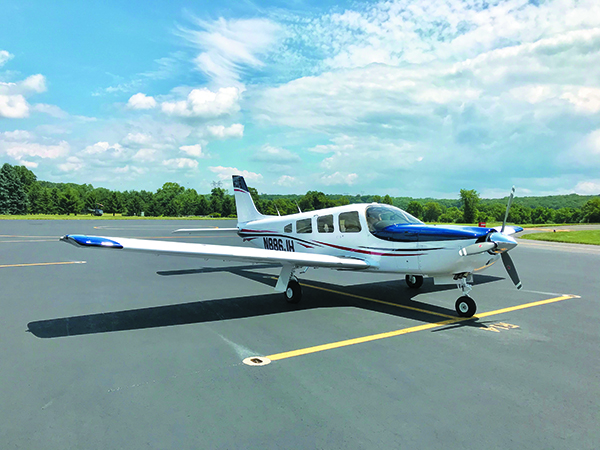
Photo by Brian Spurr
the T-tails squirrelly-handling reputation is to put 50 pounds or so in the aft baggage compartment to bring the CG aft into the center of the range.
While 150 knots isn’t all that bad, when compared to other big retractables the PA-32Rs are rather slow. Almost any A36 Bonanza or Cessna 210 will walk away from the 32R, being about 10 knots faster. At 75 percent power, a Lance cruises at 158 knots while burning 18 GPH. The Saratoga SP isn’t faster but improvements in induction air cooling allow their engines to be leaned to peak EGT, saving a couple of gallons an hour. The turbocharged airplanes can cruise at 177 knots while burning nearly 20 GPH up high, but at lower altitudes theyre only a couple of knots faster on the same fuel.
Because of its T-tail, the Lance II has a significantly longer ground roll than the conventional-tail models. The books indicates a 1650-foot ground roll under standard conditions and notes the roll will be one-quarter longer if the airplane is loaded toward its forward CG limit. Ground rolls for the Lance and SP are posted as 1380 and 1200 feet, respectively. Initial rate of climb is a tad over 1000 FPM for all models.
Maintenance
Several Turbo Lance II owners complained about their hot-running engines. (One said his mill once toasted the forward baggage compartment sufficiently to melt plastic diaper bags that had been stowed there.) However, as noted below, there are modifications designed to eliminate the heat problem.
Among recurring ADs are: 77-12-06, which requires the shanks of Hartzell Y-blade propellers to be inspected and cold-rolled every 2000 hours or five years (90-2-23 also calls for a one-time inspection and possible replacement of the hub, and 94-17-13 requires recurrent inspection of hub grease fittings); 78-23-01, which requires the fuel drain lever doors in naturally aspirated Lances to be checked every 100 hours until theyre replaced; 93-5-22, which addresses the fuel injector lines on the TIO-540-S1AD engine; 95-26-13, which requires recurrent inspection of oil cooler hoses.
A rash of engine fires in turbocharged Lances and Saratogas prompted an Airworthiness Directive requiring portions of their exhaust systems to be periodically inspected and eventually replaced. The AD targets the fittings on a 90-degree elbow between exhaust ports and turbocharger in the Lycoming TIO-540-S1AD engine powering the big Piper singles.
In 1988, NTSB issued a warning about the fittings when it concluded its investigation of a Turbo Lance that crashed a year earlier during an attempted emergency landing in Lincoln, Neb. The Safety Board found the elbow fitting in the

Lance had separated, allowing hot exhaust gases to flow into the engine compartment and start a fire. The board noted the gasket and flange on the fitting had been misaligned during maintenance on the exhaust system about a month before the accident occurred.
The FAA responded with an AD (89-12-4) requiring periodic inspections of the exhaust elbows and fittings, and replacement with modified components developed by Lycoming. The FAA estimated that compliance would cost $858 per engine.
However, later evidence of a string of exhaust system-related accidents and incidents involving both the Turbo Lance II and the Turbo Saratoga SP prompted the NTSB to call for a more stringent AD. Four such crashes occurred in 1990 alone. The Safety Board, noting that some of the crashed aircraft had received new parts called for by the AD, declared the AD was not an effective solution and called for a revision mandating repetitive inspections whether or not new parts are installed. The revised AD, AD 91-21-01, requires new exhaust parts that would beat the cracking problem
Landing gear problems are prominent in SDR reports, accounting for about a quarter of the total. Chief among them were broken nosegear actuators and cracked or broken nosegear trunnions. Other frequently cited problems included cracked engine mounts, exhaust system leaks and separations, broken magnetos and loose stabilator attachments.
Mods, Owner Groups
Several companies have developed means to alleviate the heat problems plaguing the Turbo Lance II; if this is the model youre interested in, check to see if one of these kits has been installed in a candidate airplane. Turboplus, recently acquired by Allied Eagles LLC, still offers intercoolers for the turbod Lance and Saratoga.
Aerodynamic clean-up kits (e.g., gap seals and fairings) are available from a number of companies, including Knots 2 U (www.knots2u.com) and Laminar Flow Systems (www.laminarflowsystems.com). LoPresti (www.speedmods.com) offers gap seals, too, along with a redesigned cowling, which the company says improves engine cooling and reduces drag.
Precise Flight (www.preciseflight.com) offers speed brakes, a standby vacuum system and a pulse-light anti-collision system. Upgraded propeller systems are available from both Hartzell (www.hartzellprop.com) and McCauley (www.mccauley.textron.com) for most PA-32R models.
About 4000 owners of PA-28 and -32 series airplanes belong to the Cherokee Pilots Assn., 813-242-7814, (www.piperowner.com). The group holds an annual convention and regional fly-ins, and publishes a monthly magazine focusing on maintenance and operational information.
Owner Comments
I bought my 1980 Turbo Saratoga (intercooled by Turbo Plus) in 1994 after obtaining my instrument rating in my first plane, a Cherokee 180. I had begun to travel longer distances and I was ready for a plane with more speed, room and capabilities. The Turbo Saratoga fit the description. I have not regretted the choice.
Flying can be expensive or it can be more expensive. Its never been cheap and it never will be. My way of maintaining an airplane is the expensive way. I have installed speed mods, cosmetic enhancements and almost every avionics update available. After eight planes and over 20 years as an owner/pilot, Ive come to believe that you get what you pay for.
Most years my Saratoga annuals run about $5000, but have been as high as $15,000. A 1996 brand-name engine overhaul was about $35,000. This year, at 1200 hours, the crankcase cracked. The Lycoming factory rebuilt zero-time engine I chose was $61,000, plus somewhere between $12,000 to $15,000 for installation and “incidentals.”
A less fussy owner can certainly maintain a plane like this for less money. For example, its not necessary to have a custom designed, machined, powder-coated instrument panel. Its also not necessary to have ones airplane maintained by the most expensive FBO around, one that, in my opinion, meets airline standards, replacing every loose screw. Yet in my view, this is what it takes to have a fully operational, first-class, cross-country machine always ready to go with no doubts. This airplane carries my granddaughter and Im not willing to compromise anything that I see as a safety issue in order to save some money.
Every pilot wants more speed, but Im satisfied with 185 to 190 KTAS at long-distance cruise altitudes in the mid-teens, where I am above most of the weather. I never have to worry about weight, balance or room. In the four years my son was a student in Washington, D.C., a 240 mile trip, we drove our Jeep Grand Cherokee exactly once. It simply could not handle the load that the Saratoga could carry, and the plane made overnight stays optional, not mandatory. Another four years of school in Philly only reinforced that view.
The Saratoga was also the only practical way for my late father to visit his older brother in Maryland. Both men, in their 80s and 90s, were too old and too physically impaired to travel either by ground or airline. The Saratoga interior volume means that almost anyone can enter, exit or ride in comfort.
Neither my Dad nor my uncle would have been capable of even boarding a lot of faster airplanes, like Mooneys, Columbias or Lancairs. Almost anyone can get into or out of a Saratoga with a plastic footstool and that big-ass rear passenger door. For SCUBA or ski trips I can literally toss all the equipment I want into the back without even thinking about it. That just wont work in the faster airplanes. I don’t deny that I would like another 20 knots or so, but I would lose almost all the utility for the kind of flying I do.
The Saratoga is also perfect for our regular 115-mile trips to Vermont. With no ice protection, there are times when the weather makes us take the car, but thats true of almost every airplane.
Ive made a lot of very long trips in my Saratoga (1500 miles or more) and the ability to stretch out, read a book, use a laptop or have a sandwich cant be equaled without a much bigger and more expensive plane.
Of course Id love to own a Meridian or a TBM, but realistically that wont happen. For pilots whose need for speed outweighs the need for space, and who don’t need to save 5 or 6 GPH, there are better choices. But when I balance the speed of the little airplanes against the room and practicality of the Saratoga, there’s no contest.
Brian Peck
Middlebury, CT
I own a 1999 II HP based in Florida with about 2100 hours. The biggest selling points are its stability as an instrument platform and the comfortable seats up front. Minuses include climb performance at altitude, the long takeoff roll and the very limited full-fuel useful load. I limit myself to airways no higher than 12,000 feet and always ask for the longest runways at high altitude airports, even then using short-field techniques as a safety measure.
The post-1999 togas have great panels sporting HSIs and Garmins, and often come with TCAS and a Stormscope. I have added a panel-powered 396. I definitely recommend the S-Tec 55X autopilot vs. the non-“X”-model, as it saves you from constantly adjusting the tracking. Annuals run between $3000 -$7000 as there are usually a couple of things that need to be replaced. The perfect progression for this plane would be via Cherokee/Archer, Arrow and then Saratoga. From there its a small jump to a Seneca, followed by a somewhat bigger one to a Mirage or Meridian.
Compared to a Bonanza, the Saratoga trades speed for comfort. Versus a 206, you trade speed for useful load. Compared to its predecessor, the Lance, the Saratoga gives you many creature comforts at the price of the Lances load utility. A problem is getting a CFI who is really intimately familiar with the plane for the initial training. Its better with A&P mechanics and parts.
Given that the pre-glass-panel Saratogas were virtually unchanged between 1999 and 2006 save for the upgrade to a GNS530, the earlier versions represent excellent value. If I had to do it over again, Id get a TC for my flying in California. The HP is much more economical, however, if used mostly in eastern, southern or Midwest states.
Jim Jiao
Florida