











Tom Reid
300
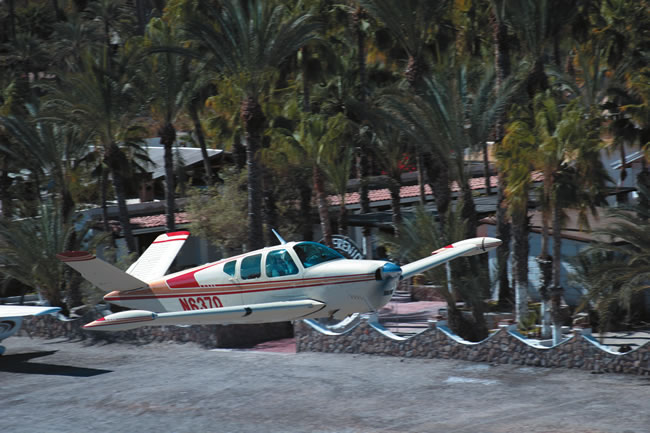
If Piper put general aviation on the map with the J-3 Cub, Beechcraft made it possible to actually go places on that map, thanks to the incomparable Bonanza.
With antecedents dating to 1947, the venerable V-tail remained in continuous production until 1982, something no other model can claim.
The Bonanza’s unique combination of good looks, cabin comfort, high performance and good load carrying capability earned it a loyal following that continues yet today.
Indeed, some owners say the early models are among the best values on the used aircraft market, but we urge a dollop of caution. Unless those 50- and 60-year-old airframes have been we’ll maintained, they can be, in the words of one owner, a money pit.
But the good news is that there are plenty of upgraded Bonanzas to pick from and owners are rabidly loyal to these airplanes. Although not cheap to operate, they aren’t unreasonable, either. Parts and support remain easily available, although owners concede parts can be expensive.
The V-tails suffered a bad rep thanks to a series of breakups during the 1980s, but these airplanes have been subjected to a Beech-developed tail beef-up kit that has all but eliminated the breakup issue.
Model History
The first V-tail Bonanzas were so ingeniously conceived that it appears they sprang from the mind of designer Ralph Harmon and others full-blown in the dim past of 1945. At the outset, the airplane was like nothing else on the market: fast and slick and great looking. The basic format was retained for decades through fine-tuning, strengthening and bigger engine iterations, yielding a plethora of model designations and no shortage of mods.
In keeping with Beechcraft’s reputation for excellence, the early Bo’s got the benefit of wind tunnel testing and study to find ways to boost speed and increase safety, something not commonly done in the 1940s. This shows in the details, such as fully retractable tricycle gear, with no projecting bumps or humps as on some other aircraft and extensive use of flush-riveting. A unique fuselage design incorporates a sled-like keel arrangement and box structure to increase crashworthiness.
This structure extends into the engine compartment, with the motor mounted on keel extensions, making it easy to access for most maintenance operations. Huge side windows were hinged at the top with quick release openings at the bottom to allow easy escape in an emergency, a side benefit enjoyed by rear-seat passengers.

Straight 35
The first so-called “straight 35” model Bonanza had a 165-HP Continental engine that produced an amazing 175 MPH at cruise speed. These models are among the cheapest Bonanzas on the market these days, but we would counsel potential buyers to be cautious.
Unlike later models, the straight 35 lacks a shear web in the main wing spar—a design strategy undertaken to save weight. And although Beech offered a 35R wing strengthening conversion in 1951, there weren’t many takers for the expensive mod, priced at $6000.
Beech offered a number of wing mods and there was an aftermarket mod called the Jourdan-Flannagan mod.
Some advise avoiding these, but if you’re considering one, the American Bonanza Society believes they can be operated safely if you do your homework. That means a careful prebuy inspection and a checkout that emphasizes operating limitations.
With the succeeding A35, Beech made important strengthening improvements, added a new wing carrythrough structure and thicker wing skins and fuselage stringers. They beefed up the fuselage bulkhead at the tail attachment. On the B35, a slight power boost during takeoff of 11 HP was engineered through slightly higher RPM.
With the C35, major changes were made to the stabilizer. The chord was increased by 14.4 percent and the dihedral increased slightly in an attempt to reduce yawing. The chord increase was made by simply extending the leading edge, but leaving the front spar where it was.
This created a greater overhang forward of the spar that would figure in tail-twisting during in-flight breakups and would later be secured by a bracket after a big FAA/Beech investigation into the breakup problem.
With the E35, buyers had the option of a 225-HP Continental engine. Also, aileron trim was added for the first time and back-seat passengers got a couple inches more leg room. The magnesium flaps were replaced with aluminum ones. In the G35, the wing was beefed up once again. And gear extension speed went up from 125 to 140 MPH, the first in a series of speed boosts that would make the landing gear an effective speed brake.
Modern Bonanzas
The H-model represents what Larry Ball in his book, The Incomparable Bonanzas, calls the beginning of a second generation of Bonanzas. The airplane got a bigger 240-HP powerplant which, for the first time in the line, offered identical takeoff and max continuous horsepower. This was the first wet sump design for the Bonanzas, allowing oil to be carried internally rather than in a separate oil tank, thus simplifying the plumbing somewhat. Additional strengthening was also added to tail, fuselage and wings.
The major change on the J35 was a switch to a 250-HP fuel-injected engine. On the K35, the standard fuel capacity was boosted from 40 to 50 gallons, which with the 20-gallon aux tanks gave 70 gallons and moved the airplane up into the serious cross-country machine it is today. Also, an optional fifth jump seat was offered, allowing more chances to load aft of the weight-and-balance envelope. Throw it away is our advice and many owners seem to agree.
Elongated, curved rear side windows were added to the N35. Horsepower went up to 260 and fuel capacity rose to 80 gallons, while the number of fuel tanks was reduced to two. This was done by offering optional 40-gallon tanks in place of the standard 25-gallon tanks. Along with “full-time” fuel quantity gauges provided to both tanks, fuel management was simplified, a good safety feature.
The addition of new, long leading-edge fuel tanks displaced wing landing lights, which in turn were moved to the nose and nose gear strut, where they remain in modern designs. Landing light bulb replacement is thus among the easiest of all GA models. Pilots concerned with tracking troublesome magnesium components might also note the ailerons were converted to aluminum, thus easing repairs and repainting somewhat.
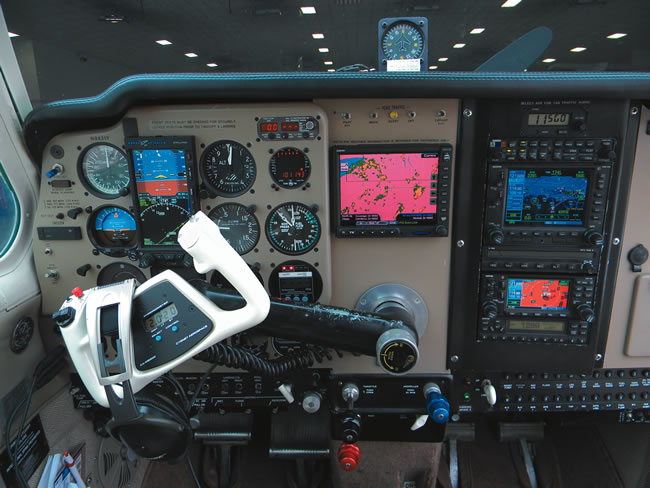
On the used market, the P35 is one of the best values, perhaps because it got a completely redesigned instrument panel, with the famous “piano keyboard” switch arrangement of the early models abandoned in favor of conventional switches, albeit not always located in the best places along the lower panel eyebrow. The P-model saw a higher landing gear extension speed, up from 140 to 165 MPH. Although the P-model was a large step forward, Beech had even bigger ideas.
The S35 Bonanza got a 285-HP powerplant and a longer cabin with a new aft window shape like that found on Barons. The aft bulkhead was moved back 19 inches and although this made for a comfy cabin, it planted the seed of what has become a chronic complaint among Bonanza owners: aft CG. To address that in the S-model, Beech added a 25-pound lead weight to the nose for balance.
Theoretically, the S-model was a six seater. But not really. It’s just not practical to stuff passengers back there, unless they’re lightweight kids. The larger baggage compartment door is a nice plus, however. Visibility out front improved with the V35 model as a one-piece windshield was made standard. And on the V35A that followed, a bigger, swept windshield was added that allowed more space behind the instrument panel for maintenance.
A V35TC turbocharged model was added to the line for the first time, also. Normal gear-down speed went from 165 to 175 MPH. The big safety improvement on the V35Bs was the addition of anti-slosh fuel cells to prevent inadvertent unporting during slips, skids and turning takeoffs, a shortcoming that had caused mishaps. Some models carry placards advising of minimum takeoff fuel, but many have anti-slosh baffles to address this.
Performance
Bonanzas are famous for their speed and justifiably so. With the largish engines and relatively low drag, owners report cruise in the 150- to 175-knot range, depending on engine power. The real eye opener with regard to raw speed is the conversion to an IO-550, which a number of owners have done.
Tom Reid
300
That speed comes at a price, however. Like Mooneys and other high-performance airplanes, the Bonanza is slick and will build speed quickly in a dive or an upset; thus it requires attention from the pilot in instrument conditions or potentially moderate turbulence. Bo pilots are wisely taught the desperation tactic of lowering the gear to arrest an out-of-control dive or unusual attitude.
Anyone who has stepped into a Bonanza from another model is immediately impressed with how we’ll the V-tail (and straight tails) handle. The controls are silky smooth and light with nearly perfect harmony between aileron and pitch pressure. However, the stick-forces-per-G are also light, which means that the ham-fisted pilot has less margin in turbulent air. Even with the tail mods, the airframe can still be bent.
As with any high-performance airplanes, landings require good speed control. Although they can be done power off, most pilots seem to fly the approach with just a bit of throttle to improve ruddervator response and avoid sink fests. Consistent, smooth touchdowns are achievable but, more to the point, really screwing up a landing in a Bonanza is hard to do. It doesn’t have the Mooney’s vicious porpoise or the Saratoga’s tendency to plop.
What it does have is the famous Bonanza tail waggle in turbulence, which is bound to make backseaters with tender stomachs somewhat queasy. Oddly, many believe the tail waggle is unique to the V-tail, but the straight-tail 33s have it too. Some owners ignore it; some say a yaw damper is required equipment.
Weight and Balance
Apart from the tail waggle, passengers give Bonanzas high marks. For one thing, there’s plenty of shoulder and head room; the interior feels more like a 1950s Chevy than the cramped interior of the typical high-performance single. The front seats are relatively upright and comfortable, but lack much forward and rearward adjustment. Leg room is adequate in both front and rear seats. By GA standards, the giant windows give unmatched airiness and visibility, especially out the rear side windows and forward through the windshield.
When carrying passengers, Bonanza pilots learn to brief them carefully on closing the cabin door. Most pilots do it themselves, for if not properly secured, the door is almost certain to pop open on rotation. It’s not an aerodynamic hazard to further flight, but can be dangerously distracting.
The aircraft’s loading Achilles’ heel is its relatively narrow weight-and-balance envelope, a peccadillo owners bitch about. Even without big-butted passengers, it’s easy to load aft of the rear CG, a potentially nasty situation in any airplane, but doubly so in one with controls as light as those on the Bonanza.
And on later models, as fuel burns out of the leading edge wing tanks, the center of gravity shifts farther to the rear, aggravating the situation. V-tail Bonanzas have generally stricter rear CG limits than the straight-tail models, which means that the same load will put you a lot closer to the aft limit in a V-tail.
Maintenance
Buyers should be alert to three main problem areas: Damaged control cables, rods, fittings, malfunctioning, out-of-order landing gear components and corrosion. The landing gear and corrosion problems can be especially expensive to repair.
There’s also the tail inspection that’s required by Beech Aircraft Corp. as part of the tail-brace installation.
Obviously, the tail fix will have been completed more than 20 years ago, but that doesn’t mean corrosion will stop. The airplane should be inspected carefully. Proper ruddervator balance has always been a critical matter on the V-tail Bonanzas to prevent flutter or vibration, which can contribute to severe structural damage and even inflight break-ups.
We found at least four of these incidents in our recent scan of accidents. The balance margin is so narrow that unbalance could—and has—resulted from repainting the ruddervators without rebalancing afterwards. Most shops know all about this, but some still make the error anyway.
Corrosion is often encountered with magnesium components like the ruddervators and on some Bonanzas, the flaps and ailerons. But check other components as well, as the Bonanza fleet ages. Some corrosion may have been we’ll hidden. The 35 series is not exactly slammed with ADs, but a prospective buyer should check the list carefully, especially the tail fix AD.
Mods, Owner Group
A lot of mods are available for Bonanzas, from STOL kits (Sierra, www.sijet.com) to engine swaps (D’Shannon Aviation’s IO-550, www.beryldshannon.com), to speed brakes (Precise Flight, www.preciseflight.com) to TKS anti-ice systems from CAV Aerospace at www.weepingwings.com.
D’Shannon also offers vortex generators, which are a worthwhile investment. Speaking of things worthy, The American Bonanza Society (www.bonanza.org) provides a good-looking four-color magazine, plus lots of technical advice. It sponsors pilot training and maintenance clinics around the country through its affiliated Bonanza Pilot Proficiency Program.
We would consider membership in this group a must for Bonanza owners, but especially any owner new to the airplane. Contact P.O. Box 12888, Wichita, KS 67277, 316-945-1700 or www.bonanza.org.
Owner Feedback
I’ve owned my 1979 V35B Bonanza for 22 years, having flown it nearly 2600 hours throughout the United States, Canada and the Bahamas. I am the second owner and purchased the plane in 1992. The Bonanza’s capabilities—in terms of comfort, handling and mission—have more than exceeded my expectations. Over the years I have looked at replacing it with an A36, a Cirrus SR22 and a Beech Baron, but I found after analyzing the investment, operating cost, speed and capability that the V35B was always the best fit for my overall mission.
When I did look at upgrading to a Baron, my mechanic showed me the maintenance bills of a friend’s 1979 BE55 and it was clear that cost of operation would triple for the sake of a few knots. As my missions are generally during the daytime and not over mountains or water, I decided to pass on the Baron.
Mods to my airplane include the Mike Smith gap seals, yaw skeg and tail bulkhead, plus D’Shannon IO550B engine conversion and baffles, in addition to GAMIjectors.
Rich of peak, I true out at 180 knots with a fuel burn of 17 to 18 GPH. While at lean of peak, I typically see 172 knots with a fuel burn of 11 to 12 GPH.
I upgraded to a new AirTex interior that was installed in 2010. At the same time, I had all the glass replaced with thicker glass and UV protection. Accomplished by LP Aero Plastics, Inc., the mod has made the cabin cooler and quieter.
The Bonanza makes an excellent IFR platform. My Garmin GMX200 MFD and Garmin GNS480 GPS makes an ideal combination, along with a Garmin GDL69 for XM datalink weather and entertainment. I am struggling with what to do about ADS-B compliance. I like my current setup so much I will probably update my GTX 330 mode S to an ES for ADS-B out only.
Garmin has assured me that a one-time software update is in the works for the GNS480 to make it a WAAS-compatible (and mandate- compliant) position source for driving the GTX330ES.
Tom Reid
300
One thing that makes owning a Bonanza great is the support of the America Bonanza Society (ABS). This type group actively supports Bonanza, Debonair, Baron and Travel Air operators through its technical advisory services and efforts to minimize the impact of ADs. Through the ABS air safety foundation it promotes pilot safety with the Bonanza Pilot Proficiency Program (BPPP), which provides both online and classroom training, as we’ll as flight training with specifically type-trained instructors.
The ABS Maintenance Academy conducts training seminars for mechanics in the proper techniques of maintaining the Bonanza, thus insuring that there is a cadre of qualified service technicians to maintain the fleet into the future.
With regard to maintenance, I think it’s important to have the aircraft maintained by a shop that is knowledgeable in Bonanzas and Barons. I use George Barker Aviation in New Smyrna, Florida, whose principal—Curtis Boulware—is an ABS Technical Advisor.
Operating costs average about $20,000 per year and based on an average of 100 hours a year or $200 per flight hour, excluding an engine and propeller reserve. Annuals on my V35B have averaged roughly $2100 for the past three years, with additional maintenance items averaging $2000 to $3000. Insurance is $1900 for $1 million smooth and for a $150,000 hull value.
Joe Palazzi
via email
The following thoughts come from my 37 years owning a 1959 K35 Bonanza. lnitial selection of the Bonanza over competing singles is a natural if you like quality design and construction, nimble flight controls, good traffic watch (with the low wing) and of course, go-fast performance. The cabin is a roomy 49 inches wide and seats four, but is better considered a three place if you fill up the fuel tanks. The CG shifts aft with fuel burn, so you need to figure out what the CG will be during the later parts of a flight.
The 35 Bonanza has a number of different fuel configurations and like most things aviation, fuel tank management requires attention. The K35 has two 25-gallon mains and two 10-gallon aux tanks. I added two 15-gallon tip tanks for range and comfort because the aircraft’s tendency to fishtail in turbulence is somewhat diminished thanks to the good-looking canted tanks. If longer range is on your list, it will go from San Diego, California, to Wichita, Kansas, nonstop with IFR reserves. The basic airframe is quite sturdy and designed to utility category standards. The landing gear can take punishment, but must be maintained to specs by a mechanic that’s familiar with Beechcraft models.
The K35 is a consistent 160-knot TAS performer, burning 13.5 GPH.The best way to operate it is at 75 percent power or full throttle at altitude and 75 degrees rich of peak.
You buy a Bonanza to go fast. Descent planning is essential because the airframe is slick and comes downhill with a lot of airspeed to manage. The gear is a great speedbrake, but can’t be used above 140 MPH. The stock 250 HP lO-470-C engine rewards those who do not yank the power off to descend. This engine is less susceptible to the case cracking problems experienced by its 520 and 550 big brothers. The generator or alternator is belt driven, which avoids the gear driven problems found in the bigger displacement models.
Annuals might run around $3000 on a well-maintained and cared for airframe. As with any airframe, that figure can mushroom if one lets things slide. As an ATP, insuring the hull for $75,000 and $1 million, $100,000 limit liability, the annual insurance bill wanders around either side of the $1400 mark.
Parts availability is good even for the older models, but they will be pricey. There are too many STC-approved modifications to entertain, but look for the speed slope windshield, opening side window vents, tip tanks, shoulder harnesses and Cleveland wheels and brakes as popular additions. You’ll also want to consider the age of fuel cells, wing bolts, gear and flap motor overhauls and any landing gear work as you shop the market.
Probably one of the greatest aspects of Bonanza ownership is the support available through membership in the American Bonanza Society. The ABS has a great team of technical advisors at your disposal, a fine safety foundation and a slick monthly newsletter with lots of good information on maintenance and operation. The service clinics (inspections) put on all around the country have got to be the best value in aviation and (if they can be coordinated) could be used as a great prebuy look-over. If not, ask if the Bonanza you are looking at has been through one recently.
The BPPP (Bonanza pilot proficiency program) offers a weekend of Bonanza ground and flight training with some seasoned pros instructing. Your insurance company will be impressed. The ABS annual convention and Oshkosh tent gatherings are also a great source of learning all things Bonanza. You might even want to join a 100 Bonanza formation fly-in to OSH and camp under your wing.
All V-tails got the tails beefed up to one degree or another by a mandatory AD back in the 1980s. There are a number of other not terribly onerous ADs depending on the model, so a careful prebuy inspection performed by a savvy Bonanza mechanic is a must. Most Bonanza owners take pride in their ride and that will be reflected in the asking price. Beware of a bargain.
Al Boyce
Coronado, California
Ever since I was a teenager learning to fly, I have admired the V-tail Bonanza. When I could finally afford to own one (more than 30 years ago) I bought a 1963 P-model that was equipped with an IO-470N engine and 80-gallon fuel tanks.
I was attracted to the aircraft not only because of its appearance, but also for its comfort for up to four people, its ruggedness and its relatively high speed. I added an STC allowing a 100-pound gross weight increase, resulting in an aircraft that could carry four people and full fuel, but no baggage—or baggage and either less fuel or fewer people. It was very flexible. Since the rear seats are easily removable, they were often taken out to make room for cargo The low wing loading and rugged gear allowed me to operate from grass strips as we’ll as paved runways.
I installed GAMijectors and attempted to run lean of peak, but the IO-470 did not run we’ll in that mode, so I was forced to run rich of peak. With a full load, the plane would cruise at 150 knots on 12.5 to 13.5 GPH. When my engine reached 1500 hours roughly 12 years ago, I installed a new IO-470. Continental had changed something in the design because this engine ran fine at lean of peak and I could easily fly at 150 knots on 11.5 GPH in the 5000- to 8000-foot altitude band, where the airplane performs the best.
Several years ago I moved to a low-time 1977 V35B Bonanza with an IO-520 engine and the same 80 gallons of fuel. This gave me a large baggage door, better soundproofing, better lighting and a smoother power-plant. With GAMI fuel injectors, this engine runs fine at lean of peak.
The airplane has a gross weight that’s 200 pounds greater than the P-model, but the empty weight is also up by that amount, so I still have the same 1000 pounds of useful load. Even though I am effectively carrying the weight of an added passenger, the plane performs a bit more efficiently. I flight plan 150 knots on 11.2 GPH. Of course I can bump that all the way up to 170 knots, but the airplane is noisier and burns about 17-18 GPH. To get this performance, I have to run rich of peak.
At that conservative 150-knot cruise setting, I have we’ll over six hours of range. I do a fair amount of IFR flying and like to do 600-mile legs. At the lower power setting I can do that and have sufficient IFR reserves. I could add tip tanks and push the speed up, as many have, but payload would be degraded.
One last item that may be of interest. The empty CG of the P-model was we’ll forward and I had a lot of loading flexibility. In the V35B, the empty CG is much further aft. Also, since the gross weight is higher, the full-load CG range is smaller so loading is much more critical. With four people, even with partial fuel, a modest amount of baggage can cause an out-of-range CG. Since I seldom have two rear seat passengers, I usually can add needed baggage without a problem, but need to check the CG carefully as I consume fuel.
Bill Foley
via email