











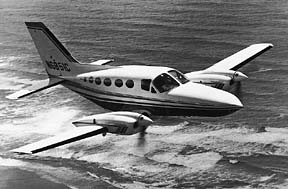
The 421 Golden Eagle stands at the head of Cessnas 400-series piston twins. Its roomy and relatively quiet, fast and efficient. Performance approaches that of some turboprops, but purchase and operating costs are considerably lower (though still considerable – they only look good when compared to propjets).
However, the 421 uses unusual geared engines that must be operated with care, and have seriously high overhaul costs.
History
The 421, which shares its basic airframe with most of the other 400-series Cessna twins, was introduced in 1968. Cessna aimed it at buyers who wanted better carrying capacity and performance than other piston twins offered, but who were put off by the high cost of turboprops.
To get the performance these buyers were looking for, Cessna decided to use Continental GTSIO-520 geared engines producing a healthy 375 horsepower apiece. Thats nearly three-quarters of a horsepower per cubic inch, and the inevitable stress meant short service life. Originally, the TBO was a mere 1200 hours. Later engines sported heavier crankcases that increased TBO to a still-low 1600 hours.
While most owners report that the engines will reach TBO with good care, the fact that theyre so unusual means that theyre very expensive to overhaul: an estimated $31,000 each. While thats pretty steep, its actually less than the overhaul cost for the 421s two direct competitors. The Beech Dukes mills cost $35,000 each, and the Piper P-Navajos engines cost $39,000 a side to overhaul.
The first 421s shared many of the features of the smaller 400s and the 300 series. The Stabila-Tip fuel tanks, 170-gallon fuel system, and electromechanical landing gear were all quite similar to those of the 310. The original 421 also had a short nose. Maximum gross weight was a respectable 6800 pounds. The standard fuel system gave a range of some 800 miles, while an optional 255-gallon system boosted the range to nearly 1200 miles.
The airplane was an immediate hit, with 200 sold that first year. Clearly, the Golden Eagle was something the market was looking for.
As is common, refinements were immediately applied and the 1969 model was redesignated 421A. The alterations were minor: a three-inch stretch, five more gallons of fuel, and a 40-pound increase in gross weight.
In 1971 the 421B got some more significant improvements. Weights (both gross and empty) increased significantly, with a maximum gross of 7450 pounds. The wingspan was increased two feet, raising the service ceiling by 5000 feet. The nose was stretched two feet to accommodate a baggage compartment capable of carrying a six-foot-long, 600-pound object, assuming the space was not taken up with extra avionics. (The compartment is about 51 inches long with the avionics bay fully occupied.) The aft cabin area could handle another 340 pounds, with a further 200 in each wing locker for a total capacity of 1340 pounds. The wing lockers serve as bays for optional fuel tanks, so they may or may not be usable for baggage.
The B model gained a few extra refinements over the next four years. The pressurization system was improved, raising the pressure differential first to 4.2, then 4.4 inches. The cabin and windows were made larger, and in 1975 a known-icing package was made available.
In 1976, Cessna brought out the 421C, incorporating the sweeping design changes that the company was applying to most of its twins at the time. The distinctive Stabila-Tip tanks (with their bladders) were gone, replaced by a simpler, bonded wet-wing fuel system. This system raised the standard fuel system capacity to 213 gallons, or 270 with all optional tanks installed.
Removing all that weight from the wing tips increased the airplanes stability, as did an increase in the size of the fin and rudder. The end result was better handling in both normal and single-engine operations.
The new wing also improved single-engine performance, with increased single-engine service ceiling and rate of climb.
The electromechanical landing gear was replaced by a hydraulic system. This featured trailing-link mains and a high-pressure nitrogen blow-down bottle for emergencies. The new system increased reliability slightly.
The maximum gross weight of the C model was 7450 pounds – the same as the B – but the standard empty weight was higher.
The C model was produced, relatively unchanged, for nine years. In 1985 it, like all the other piston Cessnas, was discontinued for lack of sales. Overall, the 4212C represents about half of the production run of 1920 aircraft.
Creature comfort
Where the 421 really shines is in its comfort, especially for passengers. While aircraft owners and pilots can debate the relative noisiness of various airplanes, the fact remains that theyre all loud: its just a question of how loud. The 421s cabin is among the quietest in the business, thanks mostly to its geared engines that produce plenty of power at low prop speeds.
The pressurization system delivers shirt-sleeve comfort at altitude, providing sea-level pressure up to 10,000 feet and maintaining at 10,000-foot cabin altitude at true altitudes of more than 26,000 feet.