











Those who make money in conjunction with airplanes do so by finding a niche demand that is unfilled and proceed to fill it effectively before any other supplier figures out it exists. Manage such a feat and you can chortle all the way to the bank. Four manufacturers have been coining money by filling a niche that the majority of the aviation market seems to have ignored: The market for owner-flown, single-engine turboprops.
Birds of a Feather
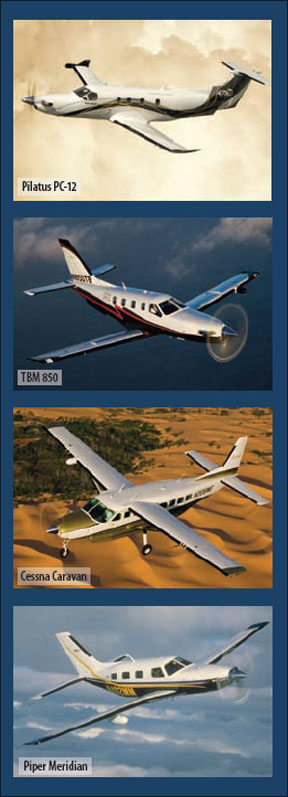
EADS-Socata, Piper, Pilatus and Cessna have been building single-engine turboprops for several years now, and their assembly lines appear at or near capacity as there are healthy waiting lists for new airplanes. Pilatus and Cessna originally built their airplanes for cargo, bush and military operators but found, to their delight, that owner-pilots got in line to buy.
On the surface, these four airplanes are quite different. Despite all being powered by a version of the PT6, cruise speeds and cabin sizes differ noticeably, as does the ability to carry a load. Yet the series seems to attract a certain kind of buyer: one who wants the reliability of a turbine, doesnt want the hassle and expense of a type rating and more than one engine; who desires an airplane that can go in any weather the pilot is personally capable of handling, and will either go fast or carry a big load. (We recognize that there are a few other single-engine turboprops, such as the new Quest Kodiak and the PC-6 Turbo Porter, but we are limiting our comparison to airplanes currently built in bulk for the owner-flown market.)
Two distinct methods of grouping these airplanes emerge: either by price, with a well-equipped Cessna 208B Grand Caravan or Piper Meridian at roughly the $2 million mark and the TBM 850 and Pilatus PC-12 hovering near $3 million; or by size, the personal traveling machines being the Meridian and TBM 850 with the PC-12 and Grand Caravan the swallow-it-all loadhaulers.
There are no dogs here. All are without handling vices. Fit and finish is generally excellent, as one would expect when plopping down a few million. And all have the useful ability to fit in no matter what the ATC environment; mixing at whatever speed is needed in the traffic pattern at small airports or staying with the jets at 160 knots until short final and then slowing rapidly to 85 knots over the fence.
Each of the airplanes is approved for flight into known icing and all now have glass cockpits with varying degrees of integration, the PC-12 being the most advanced.