Maintenance

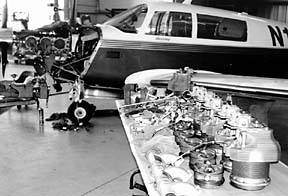
Top Overhaul Survivor Guide

[IMGCAP(1)]

During that week your airplane is in for its annual, you have to dread the phone ringing. Or worse, the message that starts out, Yeah, this is Joe at AeroMech, we found three soft cylinders on your engine and need to know what you want us to do.

At that point, you have two options, neither pretty. Return the call and get the details behind the headlines or drive out to the airport, allowing a few quiet moments for 600 milligrams of denial to kick back the pain of a $6000 maintenance invoice. Yet most owners will face the cylinder replacement dilemma, either at a mid-time top or an overhaul. And then the recriminations start. Where did I go wrong? Should I have picked anot…

Read More »

Maintenance Matters

When was the last time your airplane got weighed?

Back when Ike was golfing, when it left Lock Haven or Wichita, right? Meanwhile radios have come and gone, engines have been overhauled, changed and re-accessorized, seats have been replaced-or maybe removed entirely. Its probably been painted two or three times, at least.

Perhaps youve had a couple of things 337d aboard with some quick arithmetic to recalculate weight and balance. Who knows what your airplane really weighs in 1998? Certainly not you.

Surprise, Surprise
I didnt know either, it turns out, although my homemade Falco was carefully weighed as recently as 1991, just after I finished building it….

Read More »

You Gotta Top It?

By their very nature, air-cooled airplane engines are a hand-crafted liability. From the very first hour of operation to the last gasp, aircraft engines suffer a baffling combination of wear patterns, which makes the prospect of making TBO a crap shoot.

Clearly, most of the critical wear happens in the cylinders and the savvy aircraft owner has to resign himself to some mid-time attention to the jugs, a process known less-than-affectionately as topping.

As routine maintenance goes, this is a big-dollar item and probably one on which more than a few owners waste money. Sometimes topping a wheezy engine makes sense, sometimes it doesnt. Sometimes its a close call either way. In th…

Read More »

CermiNil Or Not?

Permit me a war story: During the summer months, the air around New Braunfels, Texas is as thick as concrete. At the airport, the ramp temperatures begin to soar at first light and pitchers of iced tea are downed for breakfast.

Id flown there on a warranty trip put together in a hurry. Inadvertently, the wrong ring set was installed in all 12 cylinders attached to a very nice, but older Cessna 310. While it was in for maintenance, the cylinders were to be pulled and the rings replaced before anyone got wise to the error.

The job took about eight hours longer than normal because the heat slowed everything down to a crawl. During one of the many iced tea breaks, a wiry man with an…

Read More »

The Oil Argument

What is it about oil that makes people crazy?

Historians looking back on the 20th century will probably point to oil, and its effects, as defining our era. So it is in aviation as in the rest of society. Owners, engine shops and manufacturers seem unable to agree on the best oil to use in aircraft engines.

Lately, the debate has focused on so-called straight-weight (often erroneously referred to simply as mineral) oils versus the newer multi-weight oils.

Ten years ago, everyone seemed to agree that the higher-priced multi-weights were better. Today, there’s growing sentiment that cheaper straight-weight oils may indeed be the better choice, especially from a corrosion c…

Read More »

Radome Repairs

If your airplane is radar equipped, you probably give the radome little more than a passing glance on each pre-flight. After all, its nothing but a simple nose cone that should last forever.

Chips, dents and scars? No problem. Its just fiberglass. Come your annual, the local body shop can whip up a quick repair and the thing is as good as new in no time.

Yet nothing could be further from the truth. A radome is far more than a simple nose cone but a carefully designed electromagnetic window costing up to $10,000 or more on some corporate aircraft.

When flawed, a radome can degrade the efficiency of radar and lure an airplane into destructive weather hazards. It has happened….

Read More »

Gyro Replacement Strategies

Other than the powerplant, the most critical system for safety of flight are the gyroscopic instruments. Why do you think they call it instrument flight?

Unfortunately, the pesky things break and since these are life-and-death devices, you don’t want to mess around with deferred maintenance. So what do you do when those all-important gyros go kaput?

When the motor acts up, you select the course of action appropriate to the problem. The tracks are less clear with gyros, particularly since theyre damaged as much by installation and shipping as by mechanical failure. In this article, we’ll examine failure modes and the solutions, while explaining the options.

As you recall fro…

Read More »

Building a Better Panel

Ive owned a 1967 Skylane for eight years and during every IFR flight, I had dreamed of getting my scatter shot flight instruments corralled into some meaningful arrangement on the panel.

To me, that means T-grouped, ergonomically clustered analog data that I can scan quickly and interpret accurately.

Unfortunately, as is the case in many 1960s vintage aircraft, my panel was designed with no particular logic. Piper seems to have been the first manufacturer to use the basic T-six design, in part as a response to the training boom of the mid-1960s. Cessna came along with a spacious, casually T-grouped panel in the 1968 Skylane, following Beech, which created an airline-type T-grouped…

Read More »

New Cylinder Shoot Out

In the not-too-distant past, the purchase of factory new cylinders for an engine overhaul was rare, expensive and usually reserved for those with fat wallets. It was nothing to find an $1800 price tag attached to a bag containing a factory-fresh cylinder and copious amounts of cosmoline. Because of this price gouging, cylinder overhaul companies flourished in the 1960s and 1970s. Things have changed dramatically. Now, factory new cylinders arent much more expensive than reworked jugs. Only supremely skin flinted owners wont at least consider them when overhauling or topping an engine.

Competition is such that on some engines-certainly not all-you can buy new cylinders from two or mor…

Read More »

Hangar Envy

As any seasoned broker will tell you, the phrase always hangared is likely the most popular fantasy spun by owners with an airplane to sell. Of course, no one really believes it. But the notion of an airplane thats never suffered the rigors of a New England winter or the harsh Florida summer sun has undeniable appeal.

Make no mistake, it usually is a fantasy. Only a tiny portion of the general aviation fleet is hangared and given how often airplanes change hands, always hangared is as improbable as no damage history.

But the fact that hangaring adds perceived value tells you something about its desirability. In our experience, most owners do seek shelter for their aircraft, b…

Read More »

Maintenance Matters

At least they can heave a sigh of relief in Williamsport.

Just as Lycoming was digging out from a widespread problem with piston pin plugs, Teledyne Continental got its night in the barrel with a massive crankshaft AD affecting 3200 engines with cranks made in 1998. As we go to press, TCM was fanning inspectors into the field as shops were popping jugs to open up each engine for ultrasonic inspection, a process that takes less than an hour. Following that, the engine is buttoned up and returned to service, with costs covered by TCM, to include the cylinder R&R and crankshaft replacement, irrespective of warranty state.

Seven Failures
TCMs John Barton told us the proble…

Read More »

Good Jugs, Bad Jugs

As engine parts go, cylinder assemblies are a commodity item that most owners will have to buy sooner or later, as part of a major overhaul or perhaps for a mid-time top overhaul.

For the past decade, at least, the new cylinder market has become fiercely competitive but many shops recommend and owners buy reconditioned, yellow-tagged cylinders anyway, to save a few bucks.

Naturally, these are cheaper than new and if bought from a reputable shop, theyre usually a good value. But not always. Quality varies widely and the only protection you have against buying junk is a pre-installation inspection of the cylinder that your mechanic may or may not be doing. And that advice applies eve…

Read More »