









Register

Search Results for: piper

Uncategorized

Lycoming IE2: Incremental Technology

The modern car engine-even a cheap one-is such a marvel that you can turn the key without thinking about its once-in-a-million failure-rate ECU, its direct-fire coils and fuel injectors that can paint the Mona Lisa in 93-octane pulses. Oh, and if you cant get 93 octane, no worries, the ECU will adjust the timing to burn 91. Were it so simple with aircraft engines. And not that Lycoming and Continental havent tried to make it that simple and they are still trying. Lycomings latest and most sophisticated attempt is the new IE2 for integrated electronic engine. Integrated means electronically customized for the airframe and dancing cheek to cheek with the airplanes EFIS and it also means full-bore electronic control of nearly everything.
Read More »
Maintenance

Composite Versus Metal: No Relief in Cost to Own

Back when fiberglass airframes were first coming to the piston-single market, one of the sales brochure bullet points was that they would be cheaper to maintain: no corrosion, patching or fill for minor dings, simpler structures with less to inspect on the annual.Unfortunately, thats not what were seeing in the real world. It appears that composite designs, like the Cirrus or Diamond, have traded one set of airframe issues for another and the costs have come out a wash or in favor of metal-at least looking globally. The caveat is important because we saw greater variability in ownership costs within a given design than between designs. The average cost of ownership for two similar-vintage Cirrus SR22s could vary more than comparing an SR22 and a Mooney Ovation of similar model years.

Read More »
Industry News

Lock and Key Navajo: Updated Classic

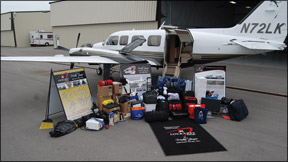
For anyone who needs to haul a lot of stuff and fly fast while doing it, the choices are limited. Unless you have a million-dollar -plus turbine budget, legacy piston twins are the top contenders. And in that group, Pipers Navajo will survive to the short list and thats why it remains a brisk seller on the used market, despite the cratered economy. Aircraft dealer and modifier Mike Jones, a Navajo specialist, gets that and thus: the Lock and Key Navajo. This mod treads ground thats been broken before, which is essentially to pick a reliable, robust airframe and remanufacture it to new standards, tossing in some state-of-the-art technology where appropriate.

Read More »
Used Aircraft Guide

Used Aircraft Guide: Bellanca Viking – Quirky But Cool

In an era when the state-of-the-art aircraft have to be baked in an oven after being laid up in plastic sheets squished together in vacuum bags, its hard to imagine that a wood and fabric wonder like the Bellanca Viking still exists. But it does. And although there arent great squadrons of them around, the Viking retains a loyal, almost cultish following. Why? Because there’s nothing quite like it, thats why. The Vikings performance isn’t stellar, but its credible with most of its contemporaries, the aircraft handles we’ll with few gotchas and its so strongly built that owners still delight in showing the famous factory picture of a dozen cheerleaders standing on the wings. “Try that with an aluminum airplane,” goes the advertising tag line.

Read More »
Cockpit Accessories

Gear of the Year: Aspen is Our Top Pick

You cant imagine how difficult it is for us to keep a straight face when we ask a company for an estimated delivery date of some new airplane or widget. We dutifully report what these companies tell us and when theyre out of earshot, we allow the sniggering and eye rolling to begin unabated. But there are exceptions. Some companies do what they say theyre going to more or less when they said they would. One of these is Aspen Avionics, which we are selecting as our company of the year.

Read More »
Avionics

Portable VHF radios: Sportys SP-400 Shines

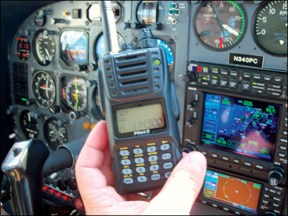
Despite the ridiculous backup common to modern cockpits, the portable radio is the last resort when all other options fail. But not all are created equal, and add-ons, such as an external antenna connection, can play seriously into performance and cost. Heres our hard-nosed report. Our criteria: Portables must have a high-end transmitter with a modulator that can reach reasonable distances at altitude. They must offer a headset interface. They must be small enough to stow in a map pocket but large enough for easy use in high-workload emergencies.

Read More »
Used Aircraft Guide

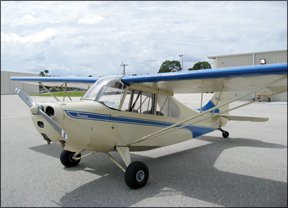
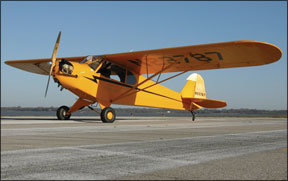
Used Aircraft Guide: Aeronca Champ

Flying low and slow with the occasional whiff of honeysuckle through the open cabin window is what flying an Aeronca Champ is all about. There’s a certain romance tagging along with a rag-and-tube two-seater thats left over from the post-World War II heyday.Moreover, the Aeronca Champ is perhaps one of the few remaining inexpensive-to-buy, inexpensive-to-own, tandem-seaters on the market. You can even buy a new one-more on that later. Its also an LSA so sport pilots can fly it.

Read More »
Used Aircraft Guide

Used Aircraft Guide: Cessna 182 – Still a Load Hulling Standard

By all measure of logic, the Cessna 182 should have passed out of production years ago. Given its horsepower, its slow and in an age of $5 avgas, its hardly economical. It handles like a truck. But its that truck part that explains why, in 2008, Cessna sold 223 new Skylanes, making it essentially tied with the Cessna 172 in sales popularity. Sales tanked in 2009, but that was true for the entire market. Still, in the teeth of a vicious recession, the airplane retains relatively good values on the used market, although not many are selling. The reason for this, we surmise, is that the 182 will haul about anything you can throw at it, it has good dispatch reliability and hardly any handling, except for nose-first landings. All that adds up to one thing: Buyers are comfortable with Skylanes and for many, its as far up the pecking order as theyll go in their flying careers. These days, you can buy a 182 with a full G1000 glass panel and a luxe interior for a price in the low $400s. A big investment, to be sure, but less money than a new SR22 from Cirrus.

Read More »
Commentary

Letters: June 2010

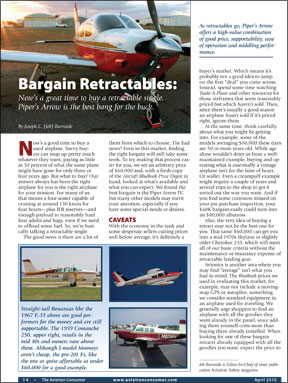
As always, I enjoyed reading Aviation Consumers airplane review of bargain retractables in your April 2010 issue. But having owned both an Arrow and Cardinal RG, you represent the especially efficient Cessna 177RG unfairly. In range, for example, you chart the RG range at 500 miles, which must be the original 1972 50-gallon model. The 1973 RG manuals call for 682 miles, while 1974-1975 models with standard 60-gallon tanks show 821 miles range at 75 percent cruise power. This places the 177RG just behind the Bonanza and Debonair in range capability. Your chart should have at least shown this model variation, if not the maximum, since it purported to include optional fuel.

Read More »
Uncategorized

Used Aircraft Guide: Cessna 310

New general aviation aircraft are as iconic as Cessnas 310. Whether because of its aggressive ramp presence, its supporting role in a television adventure series or its suitability for a wide range of missions, the 310 is what many non-pilots recall when piston twins come up in conversation. Its arguably the first “modern” light twin and certainly a classic. While the 310 is all of those things, its also a complicated machine, production of which ended almost 30 years ago. The tall landing gear might be thought of as delicate and its systems demanding, both to maintain and operate. But it still offers substantial transportation value, and the many different variants that were built as the model evolved means it shouldnt be hard to find the right one for your mission.

Read More »
Uncategorized

IFR Desktop Simulators: Buy On Top or X-Plane

There’s no question that logging some time flying pixels on your desktop computer can help keep you sharp flying real instruments through real clouds. How much it helps depends on how sophisticated the simulation is and how you go about using it. So lets be crystal-clear that were talking about the bottom rung here: Whats the best choice for a simulator you can install at home to practice your procedures and scan in the half hour between cleaning up after dinner and the next episode of House? We should also set a few ground rules. You wont be able to log time for approaches flown without an instructor by your side, so we see no point in forking over big bucks for an FAA-approved system. You will want at least the basic flight controls, so expect to spend about $110 for something like CH Products Flight Sim Yoke. Helicopter controls might cost a bit more. We wouldnt bother with rudder pedals for airplanes. Plan on using your keyboard and mouse to control on-screen switches, knobs and buttons.

Read More »
Editorial

First Word: May 2010

I just got a call from a reader in New Jersey who sold his Baron-lucky guy-and wants to step down into an LSA to finish out his flying career. “When you get these things all tricked out with glass,” he said, “they cost $170,000.” That happens to be a significantly larger piece of change than he got for his Baron. Is this right? Or more to the point, do these kinds of prices make for a sustainable LSA industry with dozens of players? The short answer, I think, is no. Let me rephrase that: Prices like that wont sustain the large number of LSA manufacturers now in the market, but my view is that nothing will.

Read More »