










Register

Accessories

Computer Logbooks

[IMGCAP(1)]

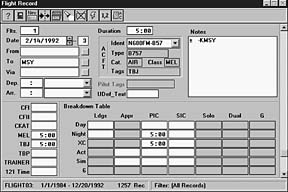
During those first few hours of flight training, when it was still iffy whether youd be better off to forget flying and buy golf clubs, you probably got some gruff advice on logbooks. From an FBO counter selection of exactly one, your CFI probably grunted, Here, buy this.

Each page completed and carefully totaled thereafter was its own little milestone and its great fun to flip back through those pages, no matter how far down the airway youve traveled since.

Paper logbooks arent treasured, however, when youre filling out the application for the private or instrument checkride and you just cant get the subcategories to add up to the totals. The odd misplaced dec…

Read More »

Ryan Goes Graphic

[IMGCAP(1)]

As pilots, we all want to decrease risks. In some cases, that can be done by buying sophisticated equipment, such as a sferics device, radar or improved seatbelts.

Until very recently, gadgets to reduce the risk of a midair collision have been out of reach for most aircraft owners, primarily due to cost. The typical airline TCAS (Traffic Collision Avoidance System) costs from $50,000 up to more than three times that, making it a top-heavy investment for light aircraft owners.

The low-cost alternative-the Ryan TCAD-helps. But until recently, it lacked one very critical bit of information: azimuth. With a TCAD, you can tell when traffic is out there and how high it is r…

Read More »

Build Your Own ANR

[IMGCAP(1)]Although GPS systems are the glamour boxes of the avionics world, in some ways, the most impressive advances have been made in the mundane field of audio panels.

As we reported in the July 1999 issue, new audio panels from Garmin and PS Engineering have advanced the state of cockpit sound far beyond the simple switching networks common a decade ago. But all the money in the world spent on an audio panel isn’t worth squat without a good pair of headsets.

Many pilots continue to shortchange themselves by plugging an ancient David Clark or an el-cheapo passive headset into a multi-thousand dollar audio network. It makes no sense.

Thats one reason active noise canceling…

Read More »

Navigation by PDA

[IMGCAP(1)]Pilots may be pre-disposed towards gadgets but we have to believe that when the cabin door is secured, many of us wish to shut out at least some of lifes annoyances, a crabby boss, perhaps or those pesky swings in the NASDAQ. Or maybe the fact that three hours on the phone with technical support didnt fix the ^%$#@#!* bug that keeps locking up that great software from Redmond. (Yeah, we know, the best is yet to come.)

Against that backdrop, do we really want to let Windows-based navigators into the cockpit or stick with the tried-and-true (and expensive) genuine airplane-approved hardware from Olathe and other avionics garden spots? A small company called Control Vision is…

Read More »

Boom Beam Landing Light

[IMGCAP(1)]

For the typical presbyopic middle-aged pilot, night flying can sometimes be as much fun as a root canal. Its not so much the flying or squinting at the eye-test type on an approach plate but avoiding disaster on the taxi to and from the runway.

Even landing at night is hardly an ordeal for most of us, at least on a well-lighted runway. Once off the runway, however, good luck finding and following the faded yellow lines, especially if you have a nose-mounted landing light burning dimly behind an age-yellowed plastic lens smeared with dirt.

Youd think, then, that the world cries out for a better class of landing light and youre probably right. But does it have to cost $…

Read More »

Precise Flights Pulselite

[IMGCAP(1)]

Most pilots generally assume that switching on the landing light during daylight operations radically improves the chances of avoiding a midair collision, especially in a busy pattern.

While this may not always be true, logically, a bright landing light will improve your chances to be seen, especially when youre head-on to any traffic that you might or might not see. If a bright light is good, is a flashing bright light better? Again, probably so, or at least so claims Precise Flight, manufacturer of the Pulselite landing light flasher system.

The Pulselite has been on the market for a number of years and has a reputation for being a well-made, easy-to-install device….

Read More »

A Better Kind of Seat

[IMGCAP(1)]Forget crashworthiness, durability, looks and adjustability, the average aircraft seat circa 1975 fails miserably on one count alone: Comfort.

Most were built with nylon webbing that sags with time or cheap foam thats long since lost its resilience. Upholstery shops sometimes deal with this merely by stitching fresh fabric over the old stuff or by replacing the underpinnings with more of the same, although some shops make an honest attempt at improving the seats underlying foundation.

One company thats kicked things up a notch is Oregon Aero, which has made a handy little business out of marketing the heck of an open-cell foam product know as conformal foam.

This stu…

Read More »

LED Lights

[IMGCAP(1)]

A failed flashlight bulb in the cockpit can be serious. Even if there’s a spare handy, changing it can be a challenge in the dark or in turbulence.

How about a flashlight with a bulb that never burns out, or at least not for tens of thousands of hours? How about a light with batteries that last days, not hours?

Were talking about flashlights that use LEDs (light emitting diodes) instead of conventional incandescent bulbs. Yes, these are the same LEDs weve seen in electronic equipment-cheap key ring lights and the like-for years. The problem has been that while LEDs came in an array of colors, they werent available in white, until recently, when a white LED was fin…

Read More »

Aviation Life Rafts

[IMGCAP(1)]Since we last examined aviation life rafts four years ago, new designs have been introduced and weve seen significant improvements made to existing products. Light aircraft owners have benefited from the Part 135 and big-iron GA market, which drives raft development, for better or worse.

We were sent evaluation rafts from Air Cruisers, BFGoodrich, Hoover and Winslow. Once again, Eastern Aero Marine (EAM) and Survival Products declined to participate and RFD didnt return our calls or e-mails. Survival Products later had an apparent change of heart and did provide rafts for testing.

Our testing protocol was simple but demanding. We enlisted a team of volunteers-ranging fro…

Read More »

Garmins 295

[IMGCAP(1)]

Is there anybody alive who doesnt have a portable GPS moving map yet? Okay, so maybe youre a Ralph Kramden fan and youre waiting for the 3D model with accompanying decoder ring.

Garmin hasnt announced that model yet but we sometimes get the impression theyre about to. In the meantime, the company is finally shipping something that comes close: A portable moving map GPS with color that rivals Garmins GNS 430 panel mount.

At a glance, the GPSMAP 295 looks like an inflated version of the GPS III Pilot, another popular Garmin product. Like the Pilot, the 295s screen orientation is horizontal or landscape, the buttons are on the right and the antenna pokes up from…

Read More »

AirCell Flight Trial

[IMGCAP(1)]Now that the wireless world stands poised to equip every man, woman and child on the planet with a PDA-personal downtime annihilator- the era of the affordable airborne telephone has finally emerged.

After literally years of false starts and technical plot twists, AirCell, Inc. has gone from the are-you-guys-still-out-there phase to genuine hardware and service thats ready for purchase.

Although AirCells network is still only about half complete, the system provides good coverage at high altitudes east of the Mississippi and by years end, most of the service gaps will be filled. We recently flew the system with AirCells test pilot Keith Griffith in a Mooney, tried som…

Read More »

Denalt on the Fly

[IMGCAP(1)]Worrying about how density altitude saps aircraft performance is a little like your mother reminding you to take your galoshes to school. Most of the time, it didnt matter but when you needed the boots, you really needed them.

Our guess is that most flat lander pilots don’t have to worry much about density altitude computations, either. Even in the heat and humidity of high summer, most of us operate off long enough runways or at light enough weights for denalt not to be a serious issue.

At higher weights or at mountain airports, the sanguine attitude wont wash. Every year, there are a handful of wrecks in which pilots ignore the effect of density altitude and assume the…

Read More »