










Register

Search Results for: piper

Industry News

Thielert Diesel Reliability: Mixed at Best…

When Diamond pulled the wraps off its proposed DA42 Twin Star at the Berlin Airshow in May 2002, we thought theyd lost touch with reality. A new twin in the current market? And powered by automotive-influenced diesel engines just then at the prototype stage? Surely they were joking.No, they werent. And 350 Twin Stars later, the jokes on us. The Twin Star has been a smash hit, especially in Europe and Australasia, where avgas is $8 a gallon, if you can find it at all. But there’s some tarnish on this bright success story. The Thielert Centurion 1.7 engines that power the Twin Star have accumulated what many owners consider to be a poor service history, with numerous premature replacements, cylinder head cracking and at least 22 inflight stoppages that Thielert confirms.


Read More »
Avionics

WSIs New Datalink: Lots of Display Choices

While its a stretch to say everyone flies with datalink weather gear, were certainly seeing more of it by the month. Garmin, with its XM-based WxWorx systems, dominates the market with others-Bendix/King and WSI-running far behind. It shouldnt really be this way, however. Despite the current XM hoopla, WSI (Weather Services International) was first out of the gate with reliable satellite-based weather, but was quickly outpaced by XM-based systems for two reasons: WSI ran into unresolvable technical snags with their satellite technology and they fooled with Mother Nature: They reverse-engineered a GNS400/500 interface without Garmins cooperation, effectively stunting vibrant growth.

Read More »
Used Aircraft Guide

Used Aircraft Guide: Cessna 152

If any airplane can be considered economical, the Cessna 152 probably makes the cut. A “modernized” version of the Cessna 150, the 152 was first delivered in 1977 as a 1978 model and quickly found its way into training and rental fleets around the world. But its production run ended a short eight years later when the bottom fell out of Cessnas piston-aircraft market in 1985 and all production ceased. Although Cessna restarted piston-aircraft production in 1996, the 152 wasnt part of that revival. Over its eight years of production, 7584 examples of the 152, including A152 Aerobat and French-made Reims Aviation variants, were built. Today, the FAA shows more than 3800 copies presently wearing an N-number; many others are overseas, soldiering on alongside competing contemporaries from Piper (the PA-38-112 Tomahawk) and Beech (the Model 77 Skipper).

Read More »
Industry News

LSA Insurance: Planes Yes, Pilots Maybe

For aviation insurers, its the best of times and the worst of times. In many traditional parts of the aircraft insurance market, an overabundance of capital and new insurers is forcing premiums-especially those for corporate airplanes-down to new lows. At the same time, buyers are snapping up new airplanes of all sizes faster than manufacturers can build them. And the two new market areas of the decade, Very Light Jets and Light Sport Aircraft, are beginning to take off.In some ways, Light Sport Airplanes are an insurers dream. If the glass-half-full guys are even remotely right, there will be shoals of them. And from an underwriters viewpoint, theyre attractive because they have what insurers call “low severity.” Severity is essentially the average cost of an accident.

Read More »
Maintenance

Tails from the Crypt: Making Sense of Salvage

Lets say you need a part for your airplane-not a maintenance item like a Brackett foam filter or a spin-on oil filter, but something more exotic, say an elevator trim tab or a new wingtip. The immediate impulse is to order it new through your shop or FBO or get it from one of the discount vendors like Preferred Airparts. The second impulse will be to sit down and steel yourself for the price. As we reported in the September 2007 issue of Aviation Consumer, finding replacement parts is getting to be an expensive chore. Often overlooked, particularly by owners, is the option of buying a used part from an aircraft salvage yard. Around the country, there are dozens of small and not-so-small businesses that deal in recycled airplane parts

Read More »
Commentary

Letters: 10/07

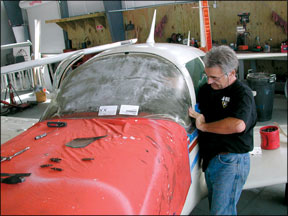
With reference to your article on thicker windshields being quieter in the August 2007 Aviation Consumer, there is a very good reason you could not perceive a reduction in sound after installing a thicker windshield in your Mooney. The human ear cannot perceive a sound level change of less than about 3 dB and [IMGCAP(1)]you were only getting that much reduction in one location. The inability to remember the previous sound level accurately is also a reason, so your measurements are the only way to really tell. By the way, the cockpit noise in a 747 at the ear next to the side window is about 85 dB at cruise.

Read More »
Industry News

No Longer Available: Parts are Getting Scarce

For those of us to whom a half-million bucks for a new airplane is a non-starter, older airframes-maybe 40-year-old airframes-are the only option. And even those can cost the better part of $100,000. For that kind of money, a would-be buyer assumes these expensive purchases will be supportable with parts, accessories and upgrades for the foreseeable future. And for the most part, a telephone call and a credit card payment are all thats needed to get a specific part to your mechanic in a matter of days, if not hours. But that isn’t always true and it may become less true as our airplanes get older. And even when a part is available, in some cases you may find that the hit to the credit card is breathtaking, if not prohibitive.

Read More »
Used Aircraft Guide

Citabria and Decathlon

A significant fraction of the aviation community is made up of pilots who are less interested in getting rapidly from Point A to Point B than they are in just going aloft to enjoy a fine day and perhaps being able to top off the flight with a loop and a roll or three. Rather than fantasize about bigger engines, retractable gear, turbocharging and glass panels, they dream of an airplane that will let them enjoy the sky by doing more than flying straight and level while still being able to go somewhere at a reasonable pace. The explosion of the homebuilt, ultralight and the budding Light Sport industry in recent decades is testament to the demand for simple, inexpensive airplanes suited to the pure joy of flight. Unfortunately, for those who prefer factory-built airplanes, the choices are limited, especially if one has the desire to enhance that joy with the sensuous pleasure of aerobatics.

Read More »
Industry News

Oshkosh Diary: A Watershed Year

If Oshkosh is to airplane companies what Wall Street is to investors, the mood in the world of general aviation is upbeat bordering on ebullient. At EAA AirVenture 2007 we saw a bumper crop of new product introductions-major and minor-at a well-attended show that may signal a turning point of sorts. Thats especially true for the emerging Light Sport Aircraft category, thanks to both Cessna and Cirrus announcing full-blown LSA programs which send the unmistakable message that they finally take this idea seriously. There were lots of hey-did-ya-see-that moments at AirVenture, but the biggest came from Eclipse, which flew in an intriguing single-engine “concept” personal jet that it claimed to have built in about 200 days in an off-site skunk works in Virginia. We werent entirely surprised by this, given persistent rumors of Eclipses plans before the show. But the fact that Eclipse CEO Vern Raburn actually taxied the thing up to the Eclipse exhibition was a stunner that were sure got the attention of Diamond, Cirrus and Piper, all of whom are toiling away on single-engine jets of their own.

Read More »
Uncategorized

Wet Vacuum Pumps: Reliable, Durable

In free markets-or so the theory goes-good products rise to the top like cream and bad products are weeded out and tossed aside to wither and die. In the real world, its messier than that, thus we have VHS instead of BetaMax, PCs dominate Macs and the overwhelming majority of airplanes have failure-prone dry vacuum pumps instead of bulletproof wet pumps. What happened here? The precise details seem to be lost to the sands of time but the short version is this: Dry pumps appeared in the mid-1960s, they were substantially cheaper than wet pumps and by the time owners realized how unreliable dry pumps were, the aircraft manufacturers had established them as the defacto standard. And because the OEMs could get away with that, the two wet pump manufacturers-Pesco and Garwin-got out of the wet pump business and eventually disappeared entirely.

Read More »
Commentary

Letters: 07/07

Thanks for the interesting article on the TBM 850. I am a happy Mooney TLS Bravo owner but must admit that my mouth starts to water when I think of VLJs and these high-performance single-engine turboprops. Like you, I was mystified by what Socata has decided to leave off this airplane, such as a glass cockpit. There are two other items that surprise me when I evaluate these aircraft. One is a toilet. My wife wont let me look at another airplane unless that has been addressed. Seems the companies are spending a lot of time and ink talking about range. What about passenger range?

Read More »
Aircraft

TBM 850: Who Needs a VLJ?

All but obscured by the lava flow of VLJ hype is this simple reality: For more than a year, one of the most conservative and oldest airplane manufacturers in the world has been delivering a single-engine turboprop with the performance, legs and load-carrying ability to make any would-be VLJ buyer think twice. The EADS Socata TBM 850 whistles along at a max cruise of 320 knots at FL260, only 20 knots slower than most of the VLJs advertise. It goes further with a load of passengers and burns a lot less fuel. For the owner-pilot, the speed, operating costs and the allure of limiting insurance-mandated training to three days a year rather than nearly two weeks for the VLJ means that the 850 is a contender. We were surprised by the numbers, frankly.

Read More »