Industry News

Austro Diesel: Certified and Building

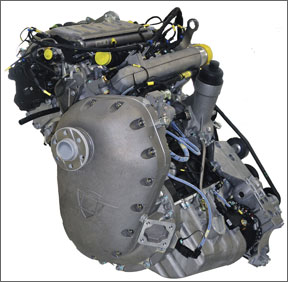
Back in the day when aeronautical engineers actually wore ties-skinny black ones-and ran calcs on wooden slide rules, it was accepted wisdom that to develop a new airframe and fit it with a new, untried engine was to court disaster. Diamond Aircraft proved the point in the digital age with its DA42 Twin Star. The Twin Star proved a terrific airframe and a strong seller. But the four-cylinder Thielert diesel engine Diamond selected as the powerplant turned out to be just the disaster the guys in the skinny ties worried about. Owners complained of high maintenance incidence, long downtimes and last spring, Thielert went bankrupt, beaching hundreds of owners who needed parts and engines. Moreover, during its initial recovery, Thielert quoted parts and replacement engine prices that raised hourly engine reserves to $100 or more-per engine, without fuel. Although Thielert seems to be getting back on its feet, Diamond went its own way and established the Austro Engine Company in Wiener Neustadt, Austria, next door to Diamonds factory. After what must be one of the fastest engine development cycles in recent history, Austro announced in late January that it has EASA certification for its 168-HP AE 300 diesel engine and production is already underway. (AE 300 is the marketing nomenclature; the type certificate calls the engine the E4.) The good news for Twin Star owners stranded by Thielerts cratering is that in the Austro, they now have a choice in replacement engines. The new engine delivers more power and is more fuel efficient, according to Diamond. The bad news is that it will be a number of months before retrofits are available for Twin Stars and the single-engine DA40 TDI. Diamonds Peter Maurer told us in February that the factory has the capacity to produce replacement engines for existing DA42s or soon will. But the initial production will go to new DA42 NG models (next generation) not to retrofits because Diamond wont have approvals for retrofits until later in the year. Meanwhile, certification work on the Lycoming-powered version of the DA42 is nearly complete, so owners may soon have the option of three engine choices.

Read More »

Using LSAs for Travel: Practical But Not Perfect

Fuel prices may be in a momentary decline, but the handwriting is clear: The cost of owning even a fixed-gear, four-place single is slipping away from more and more pilots. Light sport aircraft (LSAs) are heralded as a possible solution, but what happens when you need to go several hundred miles? Are these “hobby planes” up to the task? The question isn’t whether you can travel in an LSA-people have taken ultralights around the world, so, of course, you can. The question is whether they have reached a level of utility close enough to a four-seat single that the tradeoffs are minimal and the gains are worth it. In our view, this analysis comes down to four things: comfort, efficiency (for both fuel and time), payload and adverse-weather capacity. We asked owners and operators for their thoughts and then put our findings to the test. One January afternoon, we borrowed a new Remos GX from Tommy Lee of Adventure Flight in Springdale, Arkansas, and took off for a meeting in Houston, Texas, just shy of 400 miles away.

Read More »

Late-Model Cruisers: Cessna, Cirrus Are Tops

It was the best of times, it was the worst of times. Were not talking about Dickens 19th century London, but last week in the used aircraft market. Its the best of times if youre looking for a late-model used aircraft of any kind, the worst if youre trying to sell anything for top dollar. Stated another way, if you made a note to yourself to start shopping for a used model with glass after theyd been on the market for five year, now would be a good time. The market is awash with good deals on recent model aircraft and many of them have full glass for under $200,000-the downward pressure on prices is obvious. High inventories and brokers willing to wiggle improve buying prospects.For this article, were focusing on entry level four-place cruisers, specifically the Cirrus SR20, the Cessna 172, the Piper Archer and the Diamond DA40 Star. There are even better deals in the step-up Cirrus SR22, but we’ll focus on that later. About five years ago, brokers we occasionally talk to surmised that as Cirrus, Cessna, Columbia (now Cessna), Diamond and others pumped new aircraft into the market, this flood of new airplanes would inevitably put downward price pressure on the used fleet. We seem to have crossed this dividing line, thus the used models that had been appreciating or holding their value, now no longer do. Values of older used aircraft havent yet paralleled the sort of depreciation thats standard for cars, but with fewer buyers, they simply don’t retain value as they once did. The trend seems to represent an unusually good buying opportunity for owners looking to upgrade to something newer. Some surprisingly recent model aircraft are selling for prices we wouldnt have dreamed of two years ago. For our purposes, “recent” means 1997 forward-thats the year Cessna came back into the market. Two years later Cirrus introduced the SR20, then Diamond rolled out the DA40 Star.

Read More »

Letters: 03/09

Nice article on the Garmin 330ES. I strongly agree on not jumping to ADS-B technology right now. The FAA is working with an Aviation Rulemaking Committee (ARC) to figure out what to do with the universally opposed ADS-B NPRM from last year. Things could change. If you have a WAAS navigator, the Garmin 330ES is probably the cheapest way to comply with the ADS-B mandate. Add the 330ES and you have “ADS-B out” (which is what is required in the NPRM), plus the 330ES suffices for the transponder that you still have to keep after complying with the NPRM. One thing that keeps getting forgotten with ADS-B is the VFR aircraft or the low-end IFR aircraft. If you don’t have a WAAS navigator-and there is zero reason to spend the money to put one in a VFR aircraft-then you are talking some big bucks to comply with the NPRM with the 330ES. Youll have to get a WAAS navigator and the 330ES, plus installation of a GPS antenna. The 330ES can give you TIS traffic, but it wont give you TIS-B traffic from ADS-B aircraft transmitting their position to you. With the UAT, you can purchase Garmins GDL-90, which includes a WAAS chip and the equipment for sending and receiving ADS-B signals. You still need to keep your transponder unless you buy some kind of display. Nonetheless, complying with the ADS-B-out NPRM would be cheaper with the UAT for the VFR or low-end IFR aircraft, since you don’t have to buy the WAAS navigator.

Read More »

Power Flow Exhaust: Owners Say Thumbs UP

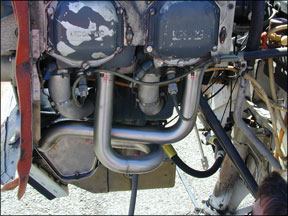
Airplane manufacturers rarely spend time optimizing the engine compartment. Instead, they just make sure everything fits, which can result in some Byzantine exhaust pipe routing. That means exhaust gases from each cylinder travel unequal distances before being dumped overboard. Power Flow likens the resulting increased back pressure in the system to a kinked garden hose. Improve the engines ability to breathe, according to theory, and you’ll improve performance without altering anything else. This something-for-nothing phenomenon only works if the engine and its exhaust are not working at top efficiency: Some combinations of carburetors/engines/airframes may not see any benefits, according to the company. Power Flow says its header pipes from each cylinder are of equal length, so when the negative pressure following one cylinders power stroke occurs, the lower pressure helps extract the exhaust from the next cylinder. Since the length of time each exhaust pulse needs to travel from the cylinder to the collector varies with engine speed, the company has optimized its systems for 2450 RPM. At that speed, Power Flow says more of the exhaust is scavenged from the cylinder and the incoming fuel/air charges volume is greater. Early Power Flow designs were fitted with a rather ungainly pipe assembly, extending below the cowling and supported by a rod. This rod usually extends through a hole cut in the cowling during installation. Later designs use a so-called short stack, which is about the length of a stock system, eliminating the support rod. Both the original design and the optional short stack are available in either stainless steel or ceramic-coated stainless. For some applications, only the short stack is available. For a Grumman Traveler, Cheetah or Tiger, Power Flow says you’ll immediately notice a 30 to 130 RPM increase at full throttle, plus significant climb rate improvement. Similar claims exist for other engine/airframe combinations for which Power Flow offers an exhaust. (See the table at left.) Since there’s no free lunch, especially with airplanes and 100LL, more power means higher fuel burn than in an unmodified airplane. Power Flows fuel-savings claim comes from being able to cruise at the same speed as before the conversion, using less throttle and therefore less power. Many owners report their fixed-pitch propellers tended to turn too fast on takeoff or in cruise after the conversion and have re-pitched the prop, returning RPM to POH values while still seeing increased climb and cruise performance.

Read More »

Aviation Insurance Myths: Idiocy Isnt Covered

Test your knowledge of aviation insurance practices. Which of the following statements is true? If you take off 250 pounds over gross, youre in violation of the FARs and your insurer wont pay any claim resulting from an accident related to the overgross condition. On a long cross country, you blithely forget a weather briefing and fly straight into the icing layer from hell. You end the flight (alive and scared) in a farmers muddy cornfield. Your insurer wont pay. Last, you forgot that your annual was due last week, but only after you landed gear up. Your insurer wont pay. The answers? Probably false, even though the fine print in your insurance contract clearly allows the insurer to deny a claim, in many circumstances-perhaps the majority-they pay the claim anyway. Why? Several reasons. One is that laws governing contracts like insurance policies from state to state and some regulators take a more customer friendly stance than do others. Second, the aviation insurance business is a small (and shrinking) segment. A company with a habit of denying claims will soon find its business going elsewhere.

Read More »

Cataract Options: LASIK Plus Intraocular

As the pilot population ages, one medical condition afflicts everyone and a second afflicts many. Presbyopia-the inability of the eye to accommodate for close-in focus-is a curse of middle age, setting in for most people between the ages of 40 and 50. The second condition-cataracts-afflicts most of the population, but not everyone requires treatment for it. In our October 2008 issue, we covered the leading choices for pilots facing cataract surgery. Generally, the FAA has no problem with cataract surgery, although the procedure must be reported. Longtime reader, eye surgeon and AME Dr. Steven Siepser wrote us recently to note that our October article overlooked some options for pilots facing cataract procedures. “The fourth option for cataract surgery,” he writes, “is the use of an accommodating intraocular lens combined with laser vision correction for unencumbered maximum visual performance.” Laser vision correction isn’t a treatment for cataracts, but it does reshape and change the focusing power of the cornea, usually resulting in improved vision without glasses. As with cataract surgery, the procedure passes FAA muster, requiring a report to the FAA to explain the outcome. Barring any complications, it has no impact on medical issuance. The most common form of laser correction is laser in-situ keratomileusis or LASIK. The surgeon uses a microkeratome to lift a thin flap of corneal tissue, then an excimer laser is used to reshape the underlying corneal tissue. Cataract patients can also be candidates for laser correction, according to Siepser.

Read More »

First Word: 02/09

The effective demise of Superior Air Parts in early January will fundamentally shift the market for engine parts that overhaul shops depend on for their survival. I say “effective” demise because Superior still exists as a company, albeit an insolvent one without much to sell. When Lycoming came along and bought all of Superiors assets, the crown jewels were the PMAs and STCs used to manufacture Lycoming and Continental replacement parts. Those mere slips of paper represent years of investment and without them, Superior doesnt have much left. Lycoming wont say what its plans are until the sale is approved, but its hard to imagine theyll license Superior to make parts. At press time, Superior told us it would continue its XP engine program and may resume its experimental builder program, but how many buyers will have confidence in Superiors future?

Read More »

Letters: 02/09

I would like to provide some corrections and clarification to the “Deicing Dissent” letter in the January 2009 issue of the The Aviation Consumer. It is true that the TKS system is not intended to be used as a deice system. However, the correct classification is anti-ice, not ice prevention. The correct usage of any anti-ice system is to activate the protection in anticipation of icing conditions. Surface anti-icing keeps the airframe clear of ice accretion, eliminating the performance loss from pre-activation and inter-cycle ice accretion associated with deice protection systems. This is not to say a TKS system cannot deice the airframe. FAA regulations for known-icing-certificated anti-ice components state that “tests should be conducted that simulate inadvertent icing encounters in which the pilot may not recognize that the airplane is about to enter an icing condition and the anti-ice component may not be activated until actual ice build-up is noticed”. TKS leading-edge panels are required to demonstrate the ability to deice after a two-minute delayed ice accumulation resulting from the most severe icing conditions found in the FAA certification envelope. The modern known-ice certificated TKS ice protection systems now have three fluid flow settings: normal, high and maximum. The maximum setting provides the best deice performance and has a pre-selected two-minute activation mode to eliminate forgetting to turn it off.

Read More »

LOP Lab Report : Lean Run is a Home Run

Start with a heaped serving of ignorance, add equal measures of industrial inertia and mediocre engineering, add a dash of petulant, not-invented-here intransigence and you’ll have a lucid understanding of how the airplane industry looked at the mundane world of engine management 10 years ago. Or, more accurately, how it looked at engine leaning. Five years before that, General Aviation Modifications, Inc. had begun marketing its calibrated fuel injectors to wide market acceptance. Along with that, came the old-new idea of running engines lean of peak EGTs to save fuel and tame high CHTs. Reaction from the entrenched interests was harsh. you’ll fry the cylinders, said Lycoming. you’ll fry the valves, said mechanics. you’ll fry everything, said some engine shops. What was needed was a controlled experiment whereby a fleet of airplanes running lean of peak could be carefully monitored. Yes, we know the orginal Piper Malibu specified lean of peak, too. But its engine service history was spotty, probably for reasons not related to leaning. When it introduced the SR22 TN in late 2006, Cirrus provided a better lab rat because every SR22 has sophisticated engine data monitoring. Here was an airplane whose POH required lean-of-peak operation. It was nothing if not a bold stroke.

Read More »

SR20 vs. DA40 Cirrus Prevails

Cirrus Design and Diamond Aircraft Industries are success stories in this business because they took chances. Diamonds DA20 opened the door for composite aircraft in certified, light GA, and then Cirruss SR20 and Diamonds DA40 blew it wide open. But the first generation of both the SR20 and DA40 were just starting points. Cirrus is now on its third generation SR20 (G3) and Diamond has been selling its refined DA40 as the DA40 XLS and CS. Both aircraft make good choices if youre looking for a new, budget, four-seat single. If you think “new” and “budget” shouldnt rest in the same sentence, we hear you. But there are good arguments for buying new if you can, and not everyone in that category wants to drop half a million on a high-performance speed demon. We looked at the concept of budget from three angles: mission flexibility, aircraft efficiency and options to buy just what you need, but no more. In this hard light, the latest SR20 is tough to beat.

Read More »

Letters: 01/09

I just received the November 2008 issue of The Aviation Consumer and read the article on deicing. I have a TKS system on a Mooney 262 (a 231 modified firewall forward to 252 specs). From my experience, don’t trust estimates. The original installation cost was estimated at just over $25,000. By the time we were done, it was over $35,000. This kind of price escalation is nothing new to people with experience in aircraft maintenance and upgrades. More important, I was disappointed in what the article failed to disclose about TKS. Your article clearly pointed out the critical deficiencies of Thermawing and pneumatic boots, but failed to state the TKS is ice prevention and is not deice. While most people and even the manufacturer talk about it as a deice system, it will not deice light rime ice nor will it deice clear ice once it has frozen into the pores.

Read More »