










Maintenance

Letters: May 2011

Your thorough reports provide a very valuable service to your readers. Unfortunately for your readers, the March 2011 report on private pilot test prep was not up to your usual high standards, in my view. For example, regarding King Schools, your reporter had two major complaints. First was the price. But thats because you compared the King Schools price for six courses with everyone elses price for a single course.

Read More »

Lakeland Tiedown Test: What Worked?

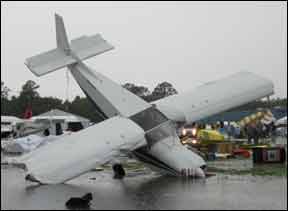
Sun n Fun 2011 may very we’ll go down as the year of The Claw, the ubiquitous yellow three-leg tiedown system that dominates the portable tiedown market. When an F1 tornado roared through the airport, The Claw got its supreme test. Did [IMGCAP(1)]it pass? It generally appeared to perform we’ll and the company wasted no time getting testimonials up on its Web site. But there were dramatic failures of all the tiedown systems, including The…

Read More »

100-Octane Cost Data: Sharpening the Pencil

The two leading contenders to replace 100LL with an unleaded equivalent, Swift Enterprises Swift Fuel and General Aviation Modification Inc.s G100UL, both say their fuel will cost more than 100LL. But how much more? We took our own run at it based on what weve been able to glean about these fuels from patent filings and information from the two companies. According to its patent filings and published FAA test data, Swift is a binary blend of mesitylene (also known as trimethylbenzene) and isopentane. Mesitylene is a bit of an exotic, used for specialized solvents and industrial processes. Its a terrific octane enhancer, but so rare in industy that no commodity prices are available. One supplier we contacted sells it for $53 a gallon, a price thats obviously unsustainable for fuel use.

Read More »

Oil Supplements: Worth it for Many

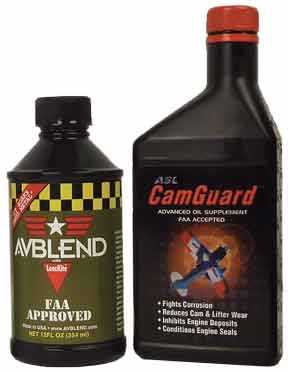
Oil leads a tough life. Its supposed to lubricate, seal, clean and cool the running engine. After shutdown, its supposed to protect metal surfaces so the next start doesnt scrape off corroded material thats ultimately replaced from your wallet via a premature overhaul. Oil companies will improve the oil as best they can, but their choices to market a case of oil at the right price might not match your preference for long-term investment in your engine. The bottom line is this: Is it worth up to an extra dollar an hour-maybe $2000 over the life of an engine-to beef up your oil?

Read More »

External Power: Starting Amps a Plus

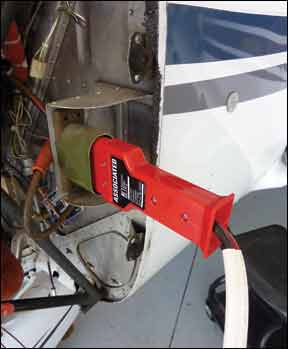
When gas was cheap(er), no one thought about doing avionics training on the ground. After all, how long does it take to learn to tune a radio and center a needle? Glass panels changed that. Now, even if you have a sim program, you still have to seal the deal with some seat time in the airplane. Thats best done on the ground, preferably with the engine off and thats where a ground power unit comes in. Not many owner hangars have these valuable gadgets, but a new offering from Audio Authority, the 2860A GPU, might provide a reason to buy one.

Read More »

Biofuels Take Flight: But Its No Slam Dunk

While the world of piston general aviation wrings its collective hands over an unleaded replacement for 100LL, the turbine market is caught up in a vast, breaking wave of biofuel activity. Even though heavily subsidized biodiesel is already finding a niche market, it looks like demand from the airlines, but especially from the military, is driving an explosion of so-called advanced biofuels development. As we reported in the December 2010 issue of Aviation Consumer, the ASTM approvals for bio-derived turbine fuels are already in place or soon will be.

Read More »

Letters: February 2011

Sunglasses (see December 2010 Aviation Consumer) are always a great subject. I purchased Veldalo Titanium sunglasses a few years ago after reading about them in Aviation Consumer. This was my first encounter with copper-rose (Blue Blockers) sunglasses and I loved them. They worked best at twilight, amplifying contrast. A problem I had was my glass cockpit displays, which had a washed-out look. I got a pair of free glasses at the last Consumer Electronics show in Las Vegas. While the glasses look funky to my friends, they work great, are comfortable and let me view my glass panel with no problems.

Read More »

Aircraft Cover Shootout: Bruces and Kennon Rule

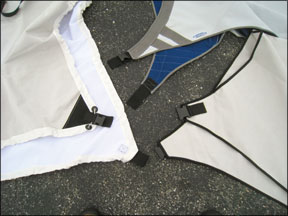
We get glimpses into the thinning aviation market whenever we do a round-up article like this. Out of the eight companies we contacted, we ended up with only four still in business and interested in participating: Aero Covers, Bruces Custom Covers, Kennon Aircraft Covers and Macs Airplane Covers. We found Bruces and Kennon to be the walk-away winners, albeit with different strengths. Its our opinion that you cant go wrong with a cover from Bruces. The company has patterns at the ready for common and uncommon airplanes and plenty of experience making them work. Need a cover for your F4U Corsair? They can do that.

Read More »

Letters: December 2010

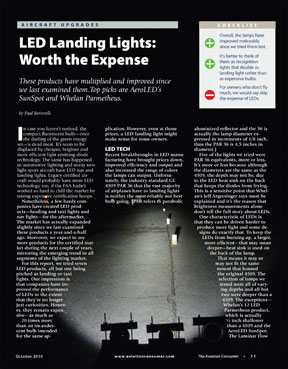
Your recent article titled, “LED Landing Lights: Worth the Expense,” was a disturbing article to me. In it, the author suggests to consumers that they can simply replace their current landing lights with LED lights without any additional approval. This could not be further from the truth. In order to install any component, light bulb or otherwise, on a U.S. registered certificated aircraft, it must be shown that the part, when installed on the given aircraft, still meets the requirements of FAR 23.

Read More »

How the Jet Guys Did It (A New Fuel, That Is)

Money talks, goes the standard street wisdom, and [expletive of choice] walks. That more than anything describes the state of play when comparing the alternative jet fuel industry to the rather more stalled effort to find an unleaded replacement for 100LL. This should be no surprise. Thanks to serious industry support from the military, turbine engine manufacturers, the airlines and even the FAA, the alternative jet fuel industry is on a virtual gallop to have in place the regulatory approval standards to allow use of bio-derived or synthetic jet fuels by next year or at least 2012. The economics remain untested so far, but the regulatory hurdles havent proven as difficult or at least as time-consuming as they have for finding a 100LL replacement. Is there a lesson here?

Read More »

Letters: November 2010

I have read your article on aircraft diesels, but am a bit puzzled since I cannot relate to our reality in Europe. For example, here in northern Sweden, the price of avgas 100LL is roughly about double that of Jet A. This means that in our club, we fly our very fine and powerful Cessna 182 SMA for about the same price per hour as our old PA-28-161.

Read More »

Letters: September 2010

Ive been following the EFB debate for years-often considering but never committing to buy a device to take with me on IFR trips, yet reading everything available on the subject. I was amused by your “Gear of the Year” awards (July 2010 Aviation Consumer) in which you awarded fully three different devices to do the job of plate reading, flight planning and enroute EFB. It seemed as if my own reservations were validated by your conclusions: There just isn’t any one device that does the whole job well.

Read More »